I’ve talked to hundreds of RV owners over the years, and almost everyone has one regret: not getting an awning sooner. There you are, sun blazing, no escape. Then one day you invest in an RV awning, and suddenly, your RV transforms from a cramped box into a second living room with actual shade. But here’s what surprised me the most: the choice between electric and manual isn’t as straightforward as it sounds. Both have legitimate tradeoffs that could make or break your camping experience, depending on how you actually travel.
This guide breaks down everything about RV awnings—from manual vs. electric to fabric choices to brand comparisons—so you can stop overthinking and pick the one that actually fits your life.
What Makes an RV Awning Worth the Investment?
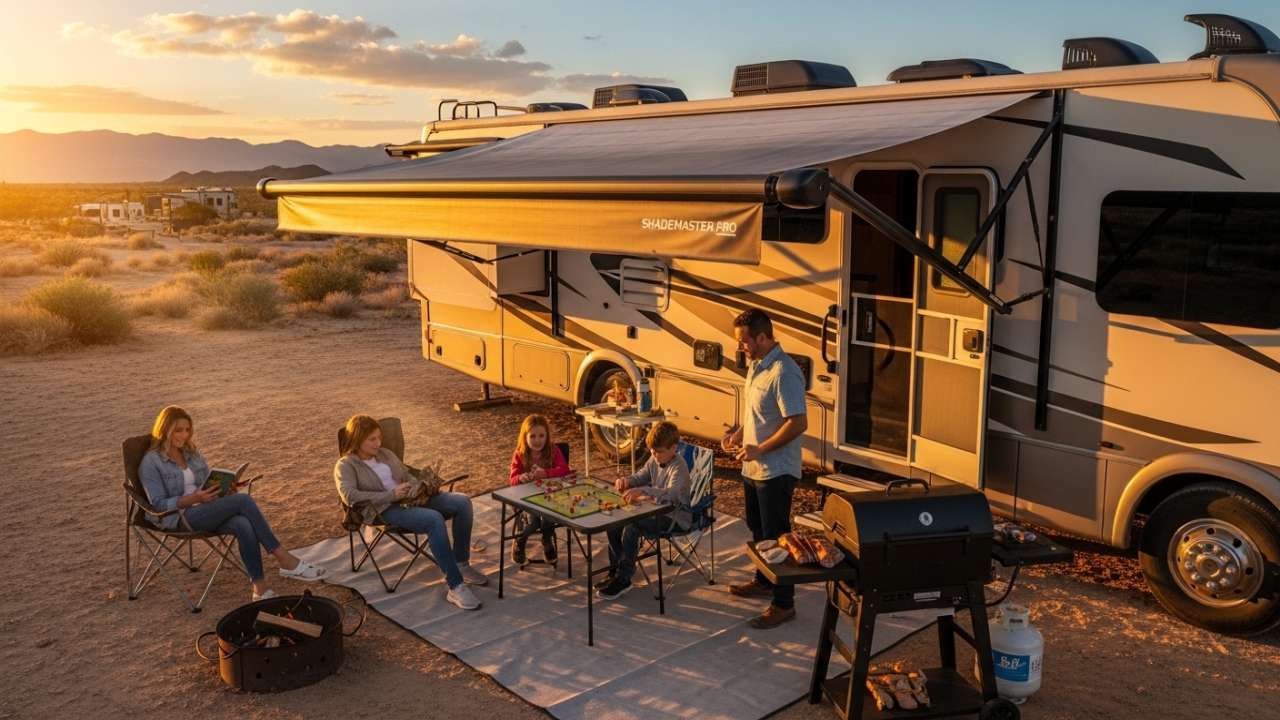
An awning isn’t just shade. Think of it as doubling your usable living space. It protects you from sun, rain, and harsh UV rays that fade your upholstery and spike your cooling costs. Real numbers? A good RV awning can reduce your RV’s interior temperature by 10–15°F on a hot day, which means less AC running, quieter operation, and lighter stress on your batteries.
But the real magic happens psychologically. RV awnings transform camping from “enduring outdoors” to “enjoying outdoors.” You can cook under cover without sweating through your shirt, watch sunsets with protection, relax without burning up, or ride out drizzles without frantically stowing gear and scrambling inside.
For full-time RVers and boondockers, an awning isn’t a luxury—it’s essential infrastructure. For weekend warriors, it’s the difference between “nice trip” and “wish we did that more often.”
Also Read:- They Stole My RV Battery in 30 Seconds — Here’s What I Do Now (2026 Guide)
Manual vs. Electric RV Awnings: The Real Tradeoffs Explained
This is where most people get confused. It’s not about one being objectively better. It’s about which fits your actual camping style. Let me be honest about both.
Manual RV Awnings: Simplicity Wins
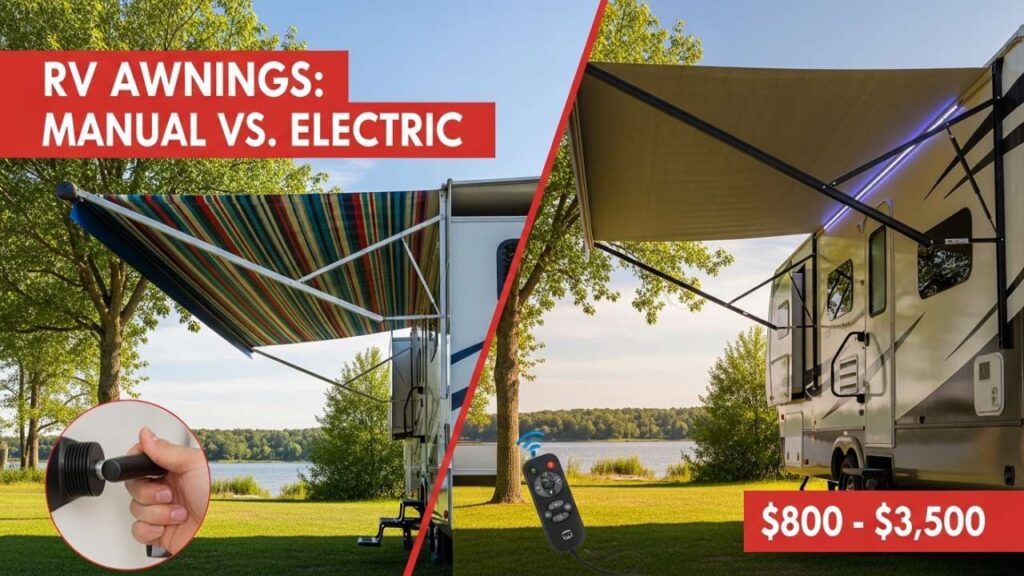
Manual awnings require physical effort to extend and retract using a hand crank. You’re operating a mechanical system that’s been refined for decades—basically foolproof engineering.
Real Advantages:
- Cheap, seriously cheap. Expect $800–$2,000 vs. $2,000+ for electric awnings. That’s a real difference.
- Reliability that’s hard to beat. Fewer electrical components means fewer things break. Manual RV awnings run 10–15 years with minimal maintenance.
- Adjustable angles. You can tilt the arms to control shade, water runoff, and ventilation—something most electric awnings don’t allow. This matters in the rain.
- Zero battery drain. Perfect for boondockers. Doesn’t care if your power system is at 20%.
- Cheaper repairs. A broken crank costs $50–$200. A dead motor? $400–$1,500.
Real Disadvantages:
- You have to crank it. Setting up a manual awning takes 5–10 minutes of physical labor. If you’re moving every 2–3 days, this adds up. If you have mobility issues, it’s a problem.
- Weather responsiveness is on you. You can’t quickly retract if the wind picks up or a storm rolls in. You have to be paying attention.
- No smart features. No automatic wind sensors, no LED lighting, no remote controls.
Who should buy manual awnings: Budget-conscious owners, boondockers, people who stay in one spot 7+ days, anyone with DIY repair skills, folks who camp 10–20 days per year.
Also Read:- RV Solar System Cost 2026: Real Prices Nobody Tells You
Electric RV Awnings: Convenience Costs
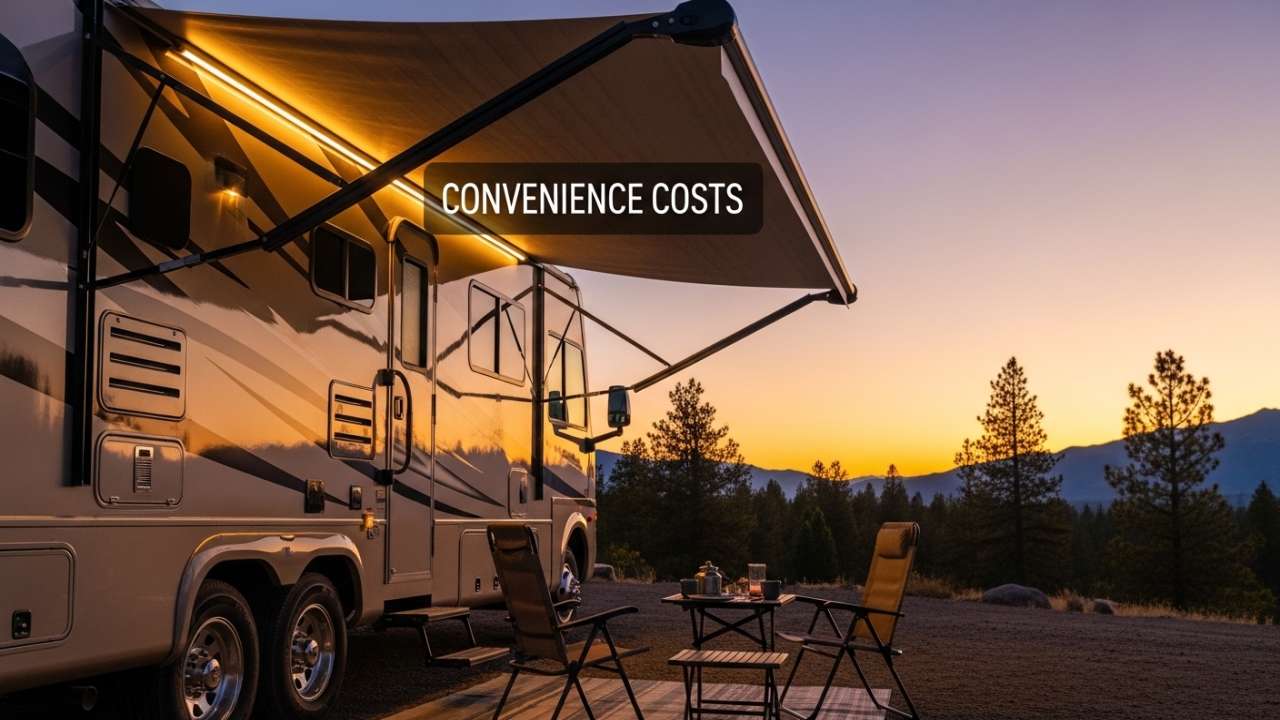
Electric awnings operate with a button push or remote. Modern electric RV awning models include wind sensors, LED lighting, and sometimes smartphone controls. They’re the gadget option.
Real Advantages:
- Push-button convenience. Deploy or retract an electric awning in 10–20 seconds. Game-changer if you change camps every 2–3 days.
- Smart features included. Wind sensors auto-retract in gusts. LED lighting. Remote controls so you don’t have to leave your rig.
- Modern aesthetics. Electric awnings mount flush and look sleeker than manual systems with visible arms.
- Accessibility. For people with mobility concerns or anyone who prefers minimal effort, this matters.
- Better for frequent movers. If you’re packing up every 2–3 days, time savings actually add up.
Real Disadvantages:
- Higher upfront cost. Budget $2,000–$3,500+ depending on brand and features. That’s 2–3x more than manual awnings.
- Motors fail. Repairs aren’t cheap. You might need professional service. Battery costs add up.
- Battery drain. Each deployment of an electric awning draws 2–5 amps. In off-grid situations, this stresses your system. In full-hookup campgrounds, irrelevant.
- Over-sensitive sensors. Some wind sensors retract in light breezes when you’d rather keep it out. Frustrating.
- Limited angle control. Most electric awnings have fixed pitch. You can’t easily tilt for water runoff like manual systems.
- Maintenance complexity. More moving parts, more potential issues, more dealer visits.
Who should buy electric awnings: Frequent travelers (move every 2–3 days), people with mobility limitations, those in full-hookup campgrounds, folks who value convenience over cost, owners who dislike mechanical work.
Manual vs. Electric: Comparison Table
| Feature | Manual Awnings | Electric Awnings |
|---|---|---|
| Initial Cost | $800–$2,000 | $2,000–$3,500+ |
| Setup Time | 5–10 minutes (crank) | 10–20 seconds (button) |
| Angle Adjustment | Highly adjustable (tilting) | Fixed pitch (limited) |
| Battery Impact | Zero drain | 2–5 amps per use |
| Maintenance | Minimal (occasional lubrication) | Regular servicing recommended |
| Lifespan | 10–15 years typical | 7–12 years (motor dependent) |
| Weather Response | Manual (requires attention) | Automatic sensors |
| Motor Failure Risk | N/A | Common after 7+ years |
| Repair Costs | $50–$300 | $300–$1,500 |
| Best For | Boondockers, budget buyers, occasional use | Frequent travelers, full-hookup parks, convenience seekers |
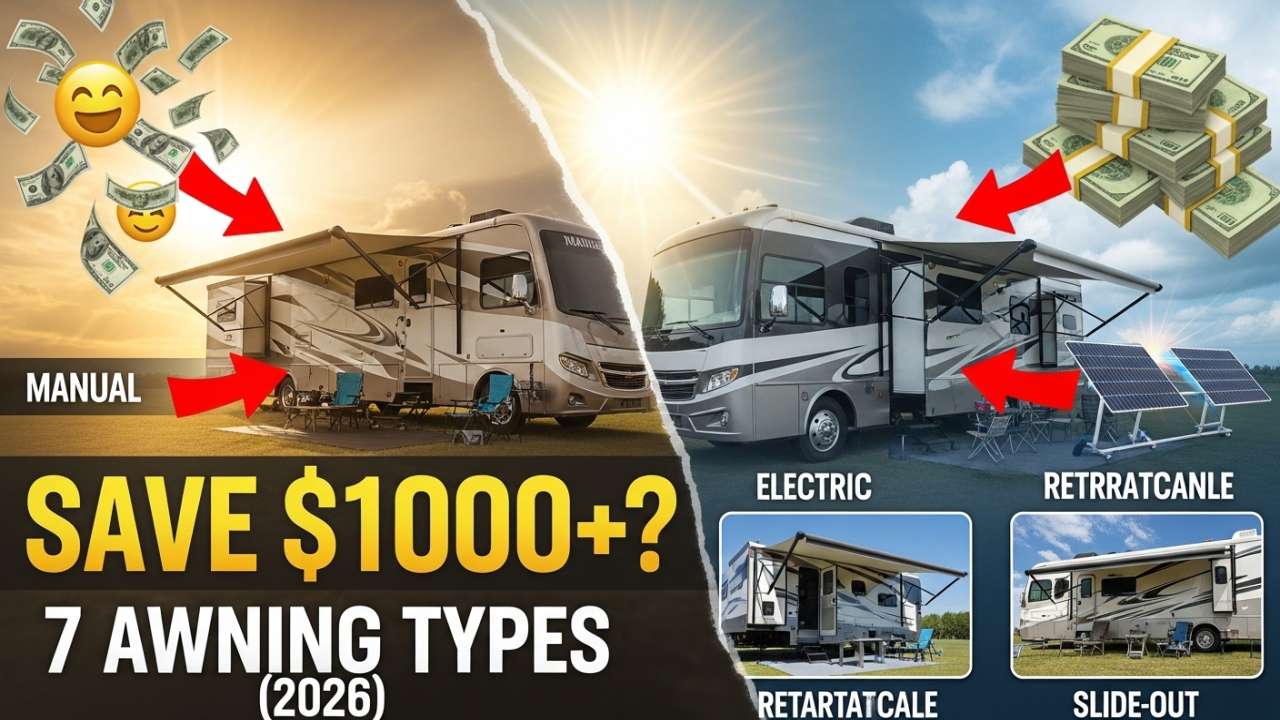
RV Awning Types: Understanding Your Options
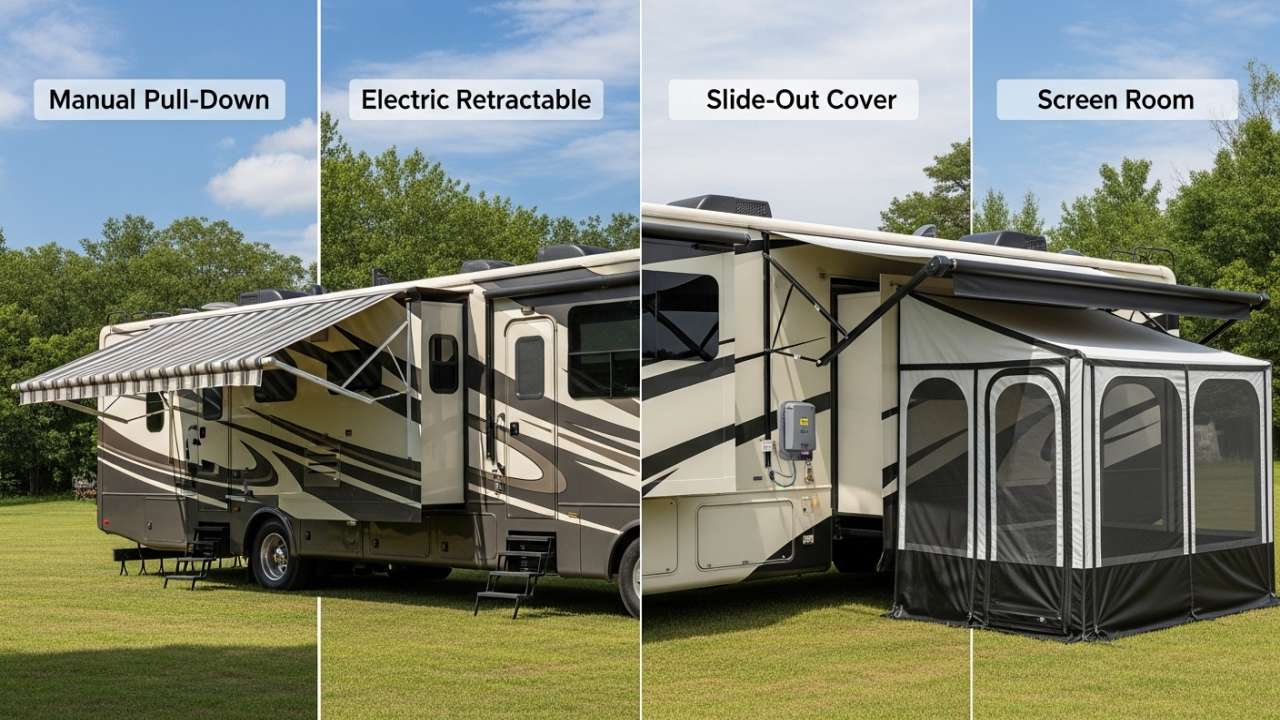
Not all awnings are the same. The type you choose affects how much shade you get and how it performs in different situations.
Full Patio Awnings (Standard Main Awning)
These run the full length of your RV’s side, providing maximum shade and coverage. They extend 8–25 feet, depending on your rig’s size. This is the workhorse awning.
Use case: Primary shade and weather protection. Standard on nearly all modern RVs. This is what most people think of as “the awning.”
Slide Topper Awnings (Mini Awnings)
These sit above your RV’s slide-outs, protecting them from rain and UV damage while extended. Essential if you frequently camp in wet climates or have expensive slides.
Use case: Protecting slides from weather damage, reducing interior moisture, extending slide lifespan.
Cassette Awnings (Premium Option)
The fabric retracts fully into an aluminum box mounted to the RV. No external fabric exposure means maximum protection when stored. These are expensive but gorgeous.
Use case: Owners concerned about fabric longevity, aesthetics, and protection. High-end RVs and luxury builds. Premium pricing ($3,000+).
Pop-Up/Bag Awnings (Lightweight)
Canvas systems on popup campers with poles and bags. Lightweight and easy to store, but provide less coverage than main awnings.
Use case: Popup campers, lightweight RVs, temporary shade solutions, budget-conscious buyers.
Awning Fabric Materials: What Actually Matters
The fabric you choose affects durability, appearance, maintenance, and how bright/dark it is underneath. Here’s what you’re actually buying.
Acrylic Fabrics
Woven acrylic blended with vinyl. Lightweight, breathable, comes in 100+ colors. The aesthetic choice for RV awning fabric.
Pros: Beautiful color options, fades slower than vinyl, better airflow underneath, softer feel.
Cons: Requires more maintenance, absorbs water if not sealed properly, slightly shorter lifespan in extreme sun.
Vinyl Fabrics
Heavy-duty vinyl coating, usually 13–15 oz. Maximum waterproofing and durability. The utilitarian choice for awning materials.
Pros: Superior water resistance, low maintenance, works in heavy rain without fail, and darker color holds up.
Cons: Heavier (harder to crank on manual), reduces brightness underneath, limited color options, can feel cheaper.
Polyweave/Hybrid Fabrics
Combines acrylic and vinyl properties. The compromise option—good at everything, excellent at nothing.
Pros: Good water resistance, decent color selection, balanced weight, moderate price.
Cons: Slightly higher cost than pure acrylic or vinyl, middle-of-the-road performance across the board.
Bottom line: For wet climates or full-time camping, vinyl fabric is practical. For occasional use and aesthetics, acrylic works. Polyweave splits the difference if you can’t decide.
Also Read:- RV Water Heater Not Working? Fix It in 30 Minutes (2026)
Top RV Awning Brands: What You’re Actually Buying
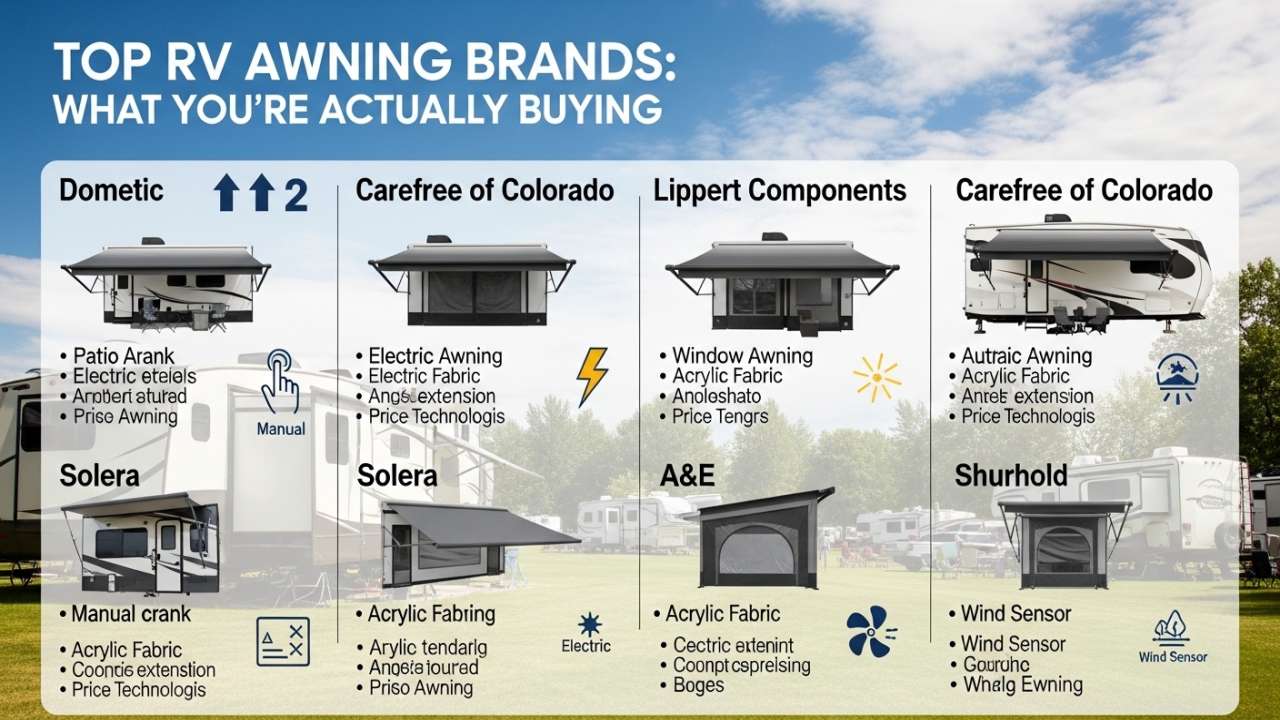
Your choice of brand affects warranty, reliability, parts availability, and long-term peace of mind. Here’s what the leaders actually offer.
Carefree of Colorado
Making RV awnings since 1971. Known for design innovation and thoughtful engineering. Widely available through dealers.
- Popular models: Fiesta (manual), Spirit (manual), Eclipse (electric), Travel’R (electric).
- Strengths: 100+ color options, wind sensor technology that actually works, good scissor-arm design, strong dealer network.
- Price range: $1,200–$3,200 for complete units.
- Warranty: 5 years on materials, 2 years on motors.
- Real-world feedback: Owners like the aesthetics. Scissor arms are strong but some report they flatten pitch when extended (less shade).
Dometic (Including A&E Brand)
Massive RV supplier. Owns the A&E brand, which was the original RV awning company. Known for backward compatibility and parts availability.
- Popular models: Solera (premium), A&E WeatherPro (manual), A&E Power (electric).
- Strengths: Parts availability unmatched, compatibility with older RVs, reliable engineering, good dealer support.
- Price range: $1,000–$3,000.
- Warranty: 5–7 years, depending on model.
- Real-world feedback: Owners praise reliability and parts availability. Some say Dometic prioritizes durability over aesthetics (more industrial look).
Lippert/Solera
Growing market share through acquisitions and innovation. Competitive pricing with improving quality.
- Popular models: Wide range from budget to premium.
- Strengths: Competitive pricing, modern designs, improving quality control, emerging brand.
- Price range: $900–$2,800.
- Warranty: 5 years standard.
- Real-world feedback: Newer brand, mixed reviews. Some owners report good value, others had motor issues.
Thule
Modern brand focused on sleek, lightweight designs for newer RV trends. Premium positioning.
- Strengths: Contemporary aesthetics, modern engineering, integrated smart features, sleek design.
- Price range: $1,500–$3,500+ (premium tier).
- Real-world feedback: Owners love the look. Premium price reflects. Not as widely available as Carefree/Dometic.
Girard (Ultra-Premium)
Top-tier option with integrated tilt mechanisms and legless arm design. Beautiful but expensive.
- Strengths: Legless arms (clean look), adjustable pitch on electric awning models, elegant design, high durability.
- Price range: $2,500–$4,500+ (luxury tier).
- Note: Strictly a sun awning. Girard recommends supplemental poles in rain. Not ideal for weather protection.
- Real-world feedback: Owners who can afford it love the design. Not practical for everyone.
Brand Comparison Table
| Brand | Type Range | Price Range | Best For | Downside |
|---|---|---|---|---|
| Carefree | Manual & Electric | $1,200–$3,200 | Design, color options, reliability | Mid-market pricing, scissor arms flatten pitch |
| Dometic | Manual & Electric | $1,000–$3,000 | Parts availability, durability, compatibility | Less aesthetic variety, industrial look |
| Lippert/Solera | Manual & Electric | $900–$2,800 | Value, innovation, budget buyers | Smaller dealer network, newer brand |
| Thule | Electric focus | $1,500–$3,500 | Modern aesthetics, smart features | Premium pricing, less available |
| Girard | Electric | $2,500–$4,500+ | Elegant design, sun protection | Rain-unsuitable, luxury pricing |
RV Awning Installation: DIY vs. Professional
Installation matters more than people think. A botched job causes water damage and voids warranties.
Professional installation: $300–$800 labor (plus unit cost). Guarantees warranty validity, handles electrical integration properly, ensures correct mounting with minimal water leak risk.
DIY installation: Possible if you have mechanical skills and time. Saves labor but risks warranty issues if something goes wrong. Most RV awning installation jobs take 2–4 hours with basic tools.
Honest assessment: Unless you’re experienced with RV systems, professional RV awning installation is worth the money. One mounting mistake causes permanent water damage inside your walls—far more expensive than $500 in labor.
Recommendation: Go professional unless you’ve installed awnings before or have serious mechanical experience.
RV Awning Maintenance & Care: Making Your Awning Last
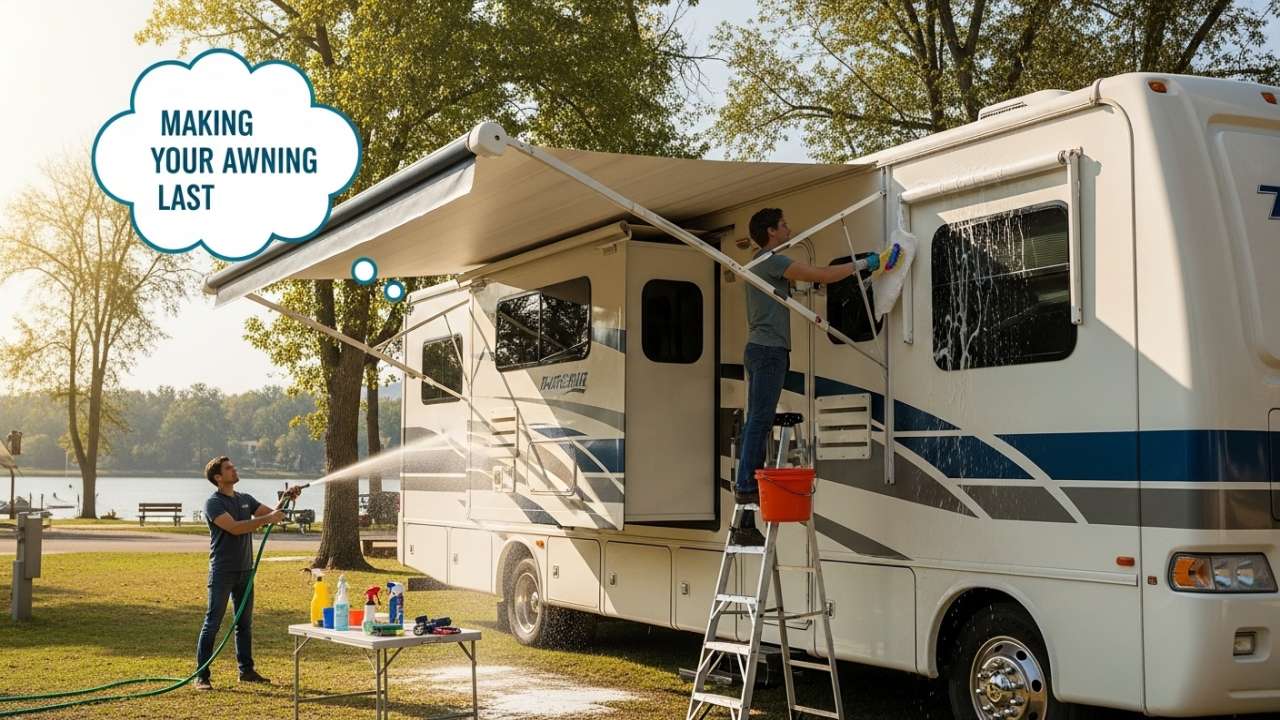
Your awning will last longer if you actually care for it. These aren’t “set and forget” investments.
Regular Awning Maintenance Checklist
- Clean quarterly: Mild soap and water. Mold loves damp fabric—don’t let it sit dirty.
- Inspect annually: Check arm bolts, pivot points, and roller tube condition.
- UV protection: Apply UV protectant to acrylic awnings seasonally. Vinyl doesn’t need this.
- Lubricate moving parts: Keep the roller tube and arm pivots lubricated per manufacturer specs (usually silicone spray).
- Inspect fabric: Look for tears, mold, or seam separation before they become big problems.
Storage Tips
- Always retract before traveling. Wind damage while moving is surprisingly common and expensive.
- Store dry. Moisture promotes mold and motor corrosion. Store in a garage or covered area if possible.
- Winter protection: Consider a weatherguard (metal or fabric shield) if you store in a damp location.
Common Issues & Costs
- Sagging fabric: Usually fixable with dealer re-tensioning. Cost: $100–$300.
- Motor failure: Budget $400–$1,000 for replacement (plus installation).
- Torn fabric: Replacement runs $600–$1,200 installed. Patches work for small tears under 6 inches.
- Arm creaking: Often just needs lubrication. Free if you do it yourself.
- Roller tube issues: $200–$500 to replace, depending on accessibility.
Real Cost Breakdown: 10-Year RV Awning Ownership
Here’s what you actually spend over a decade of ownership, assuming typical camping (20–30 days/year).
Manual Awning Total Cost
- Initial purchase: $800–$2,000
- Professional installation: $200–$400
- Fabric replacement (year 8–10): $600–$1,000
- Minor repairs (crank, arm bolts): $200–$500
- Total 10-year cost: $1,800–$3,900
Electric Awning Total Cost
- Initial purchase: $2,000–$3,500
- Professional installation: $300–$600
- Motor replacement (year 7–8): $400–$1,200
- Fabric replacement (year 8–10): $700–$1,200
- Electrical repairs/parts: $200–$500
- Total 10-year cost: $3,600–$7,000
Bottom line: If you camp 20+ days per year for a decade, electric awning convenience might justify the cost. If you camp 5–10 days per year, manual awning savings compound significantly.
RV Awning Market Trends 2025–2026
The industry is shifting. Here’s what’s actually happening:
- Electric dominance accelerating: Industry projections suggest electric awnings will capture 75%+ of new RV sales by 2030, driven by aging demographics (50%+ of RV owners are 55+) and labor-saving appeal.
- Smart features expanding: Wi-Fi/app control, solar-powered motors, better wind sensors becoming standard on mid-range models.
- Price compression: Chinese manufacturers entering the US market are pushing prices down, especially for manual awnings and budget electric awnings.
- Manual awning market persistence: Manual awnings won’t disappear. Growing in “retro RV” and lightweight camper segments. Dominant in used RV market.
- Cassette awning design growth: Premium RV builders increasingly spec cassette awnings for durability and aesthetics.
- Used market stabilization: Pre-2015 RVs with manual awnings are becoming harder to find as they age out. The secondhand market is growing.
Frequently Asked Questions
Can I use my electric awning in rain?
Yes, but carefully. Most modern electric awnings have drainage systems or angle mechanisms that dump water. However, heavy rain with strong winds stresses the system. Manual awnings traditionally handle rain better due to their adjustable angles. Many owners use support poles under electric awnings during heavy rain for added stability. Never leave an electric awning extended in a thunderstorm.
How much battery power does an electric awning use?
Each extend/retract cycle of an electric awning typically draws 2–5 amps. On a 200 Ah battery bank, one cycle is negligible. But if you’re boondocking and using it frequently without recharging, it adds up. In full-hookup campgrounds where you’re plugged in, power draw is completely irrelevant.
What’s the best fabric color for an RV awning?
Light colors (white, tan, cream) reflect heat better and let more light through underneath. Dark colors hide stains but absorb more heat and reduce brightness. Gray and neutral tones are the compromise. Consider what matches your RV’s trim and choose accordingly. Fashion matters less than functionality—pick what you’ll actually enjoy looking at for years.
Can I repair torn awning fabric myself?
Minor tears (under 6 inches) can be patched with vinyl repair kits ($20–$40). Larger tears or multiple punctures warrant replacement fabric, which is a job best left to professionals. DIY repairs on major tears usually fail within a season.
Are manual awnings adjustable in the wind?
Yes, and this is a major advantage. You can lower the angle to reduce wind load or tilt one arm higher for ventilation. Electric awnings have fixed pitch, making wind resistance a bigger issue. In consistently windy locations, manual awnings offer better control.
How do I prevent awning flutter and noise?
Wind-resistant poles, proper tensioning, and flutter-damper clips help. Many owners swear by tying the fabric down with straps in breezy areas. Proper installation and regular maintenance significantly reduce noise.
What’s the average lifespan of an RV awning?
Manual awnings typically last 10–15 years with proper care. Electric awnings, 7–12 years depending on motor quality and usage frequency. Fabric life varies by material and UV exposure, but plan on replacement every 8–10 years in sunny climates, 12–15 years in moderate sun.
The Bottom Line: Which Awning Should You Actually Buy?
Here’s how to decide honestly:
Choose manual awnings if:
- You camp occasionally (under 30 days/year).
- You boondock or dry camp frequently.
- Budget is a primary constraint ($800–$2,000 vs. $2,000+).
- You’re mechanically inclined and enjoy DIY repairs.
- You value adjustability and simplicity over convenience.
- You stay in one spot 7+ days per trip.
Choose electric awnings if:
- You move camps every 2–3 days.
- You have mobility limitations or prefer minimal effort.
- You’re parked in full-hookup campgrounds most of the time.
- You value smart features and automated operation.
- You can justify the higher upfront and long-term costs.
- You dislike mechanical work and prefer dealer service.
The honest truth: The “best” RV awning is the one you’ll actually use. A manual awning you never deploy because setup is annoying is worse than an electric awning you use daily—factor in your actual camping style, not your aspirational camping style.
Most full-time travelers and frequent campers lean toward electric. Most budget-conscious boondockers choose manual. Neither is wrong—they’re just different tools for different jobs.
Pick the one that matches how you actually camp, install it properly, maintain it regularly, and you’ll get 10+ good years of shade.