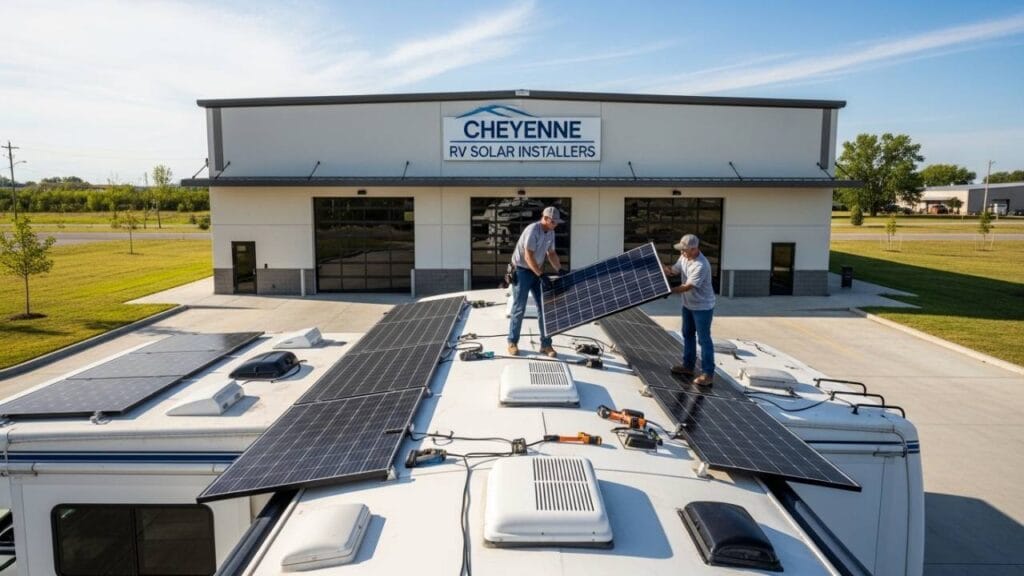
If you’re rolling through the I-80 corridor or parking your rig in Wyoming’s capital for any length of time, you’ve probably wondered about RV solar in Cheyenne. This city punches above its weight as a service stop — with a population of around 65,000, Cheyenne supports a surprisingly robust network of RV service providers, and solar installation has grown right alongside the boom in full-time RV living.
Sitting at roughly 6,000 feet above sea level on the high plains, Cheyenne is Wyoming’s largest city and its capital. For RV travelers, it’s a strategic crossroads: I-80 and I-25 intersect here, making it one of the most-passed cities in the Mountain West. Tens of thousands of RVs pass through or stage here annually, heading toward the Black Hills, Yellowstone, Colorado’s Front Range, or south into New Mexico.
What makes RV solar in Cheyenne particularly compelling is the combination of high-altitude sun intensity, long summer days, and comparatively low shop rates compared to resort towns like Jackson Hole. You’ll pay roughly 20–35% less for the same install in Cheyenne than you would in Jackson, where tourist-area pricing inflates every service category. Add in Medicine Bow National Forest to the west and Curt Gowdy State Park just 25 miles away, and you have a strong case for getting solar sorted before heading deeper into Wyoming’s backcountry.
This guide reviews the top 5 RV solar installers in and around Cheyenne, covers pricing, what to watch for at high-altitude, and answers the questions we hear most from RV owners passing through.
Also Read:- Billings RV Solar Installation: Top 5 Local Shops + Complete DIY Guide (2026)
Why Go Solar in Cheyenne? Climate, Location & Value
Cheyenne averages about 300 sunny days per year — not far behind Tucson in raw sunny-day count, and more reliable than you might expect from a Wyoming location. The high plains elevation means thinner atmosphere and higher UV intensity, which translates to meaningful gains in panel output compared to sea-level installations. A 400W panel on a rooftop in Cheyenne can realistically outperform the same panel in coastal cities where humidity and lower elevation reduce effective irradiance.
There’s one major Cheyenne-specific factor that every RV solar buyer needs to understand before booking an install: wind. The I-80 corridor through southeastern Wyoming is one of the windiest stretches of highway in the United States. Wind advisories are routine, gusts regularly exceed 50 mph, and sustained 30–40 mph winds are commonplace from October through March. This means panel mounting and wire management matter far more here than in calmer
climates. A shop that installs panels with basic Z-brackets and skips adhesive sealant is cutting corners that will show up somewhere between Laramie and Rawlins on a bad November day.
On pricing: expect to pay $800–$2,400 for a professional entry-level 200–400W install in Cheyenne, versus $1,200–$3,500 for equivalent work in Jackson. For full 600W–1,200W lithium setups targeting full-timers or boondockers, Cheyenne shops typically run $3,500–$7,500 all-in. That’s meaningful savings, especially if you’re doing a large system.
Top 5 RV Solar Installers in Cheyenne (2026 Reviews)
1. High Plains Solar & RV — Best Overall
High Plains Solar & RV on Pershing Boulevard has built the strongest overall reputation for RV solar in Cheyenne over the past several years. The shop is run by a husband-and-wife team with backgrounds in both electrical contracting and full-time RV living — a combination that shows in the quality of their recommendations. They don’t just sell you panels; they walk through your power audit first, asking about typical daily usage, battery discharge depth, and how often you’re in high-wind territory on the I-80 run.
Their signature Wind-Rated Installation Package is worth highlighting. All panel mounts are installed with a secondary adhesive sealant and tested for uplift resistance before the rig leaves the lot. Wire routing is always interior-chased where possible, and they use marine-grade Ancor wiring throughout rather than standard automotive wire. Pricing runs $950 for a 200W starter setup to $6,200 for a 600W lithium system with a 100A Victron MPPT and 200Ah Battle Born battery bank.
Pros: Highly knowledgeable staff; wind-rated mount systems; honest power audits; strong warranty support. Cons: Appointment wait times can run 2–3 weeks during summer; no walk-in service for large installs.
Also Read:- RV Solar Panel System Cost Breakdown 2026
2. Frontier RV Outfitters — Best for Budget Installs

Frontier RV Outfitters, located near the Dell Range Boulevard commercial strip, targets the budget-conscious buyer without completely sacrificing quality. They’ve developed an affordable entry-level RV solar package specifically designed for weekend warriors and snowbirds making a single long trip rather than full-timers who need maximum system durability. Their 100W starter kit installs for a flat $595 including labor, panel, wiring, and a PWM controller — about 20% less than most competitors.
For buyers stepping up, the 200W package at $950 and the 400W package at $1,750 both use Renogy panels and are popular with Cheyenne locals heading to Curt Gowdy or Vedauwoo on weekends. The shop also sells DIY components and will spend 20–30 minutes walking you through a self-install if you buy your gear from them. The staff is friendly and approachable, which makes this an excellent first stop for RV owners new to solar.
Pros: Most affordable professional installs in Cheyenne; great DIY support; quick turnaround (often same-week). Cons: Budget hardware choices; PWM controllers at lower tiers rather than MPPT; less wind-specific mounting rigor than premium shops.
3. Wyoming RV & Electrical Solutions — Best for Complex Builds
For the serious boondocker building out a full electrical system — lithium batteries, inverter/charger, solar, and shore power integration — Wyoming RV & Electrical Solutions on Yellowstone Road is the Cheyenne specialist. The shop is run by a licensed master electrician who transitioned into RV work after seeing too many fire-risk installs on the road. Their work is thorough, code-compliant, and priced accordingly: expect to pay a premium of 15–20% above mid-market.
What sets them apart is their full-system design service. For $150 (credited toward install), they’ll produce a wiring diagram and component spec sheet for your entire electrical system before a single panel goes on the roof. Their 800W lithium builds — which include a Victron MultiPlus inverter/charger, 400Ah lithium bank, and dual MPPT controllers — run $8,500–$11,000 depending on battery capacity. These are systems designed to run indefinitely without generator backup.
Pros: Master electrician on staff; full system design service; best safety record in town; handles complex hybrid (solar + alternator + shore) setups. Cons: Expensive; longer lead times for full builds (3–5 weeks); overkill for simple panel-only installs.
4. Cowboy Solar & RV Service — Best Mobile Installer
Not every RV owner can easily move their rig to a shop. Cowboy Solar & RV Service solves this with a fully equipped mobile installation van that serves Cheyenne and surrounding communities including Laramie, Wheatland, and as far north as Casper for larger jobs. The owner, a former wind-energy technician from the Cheyenne area, brings high-altitude and high-wind experience to every installation — a background that directly informs how he handles panel placement and mounting on larger Class A and fifth-wheel units.
Mobile pricing adds roughly $75–$150 to standard install costs to cover travel and van setup time, but for RV owners parked at Terry Bison Ranch or one of the area’s full-hookup parks, the convenience math works out. Standard 200W mobile installs run $1,100; 400W systems run $2,100. Cowboy Solar also offers mobile battery upgrades for owners who just want to swap flooded lead-acid for AGM or lithium without a full system overhaul.
Pros: Mobile service throughout southeastern Wyoming; wind-tech background; lithium upgrade specials. Cons: Mobile premium adds cost; limited to mid-size systems on mobile jobs; not ideal for full electrical rebuilds requiring shop-level access.
5. Sun & Plains RV Accessories — Best for DIY Support
Sun & Plains RV Accessories on East Lincolnway occupies a niche that the other shops on this list don’t fully fill: a well-stocked retail store with knowledgeable staff who genuinely support DIY installs. The shop carries Renogy, Rich Solar, Victron, Xantrex, and Battle Born product lines, along with an excellent selection of cables, fuses, connectors, and mounting hardware. Importantly for Cheyenne buyers, they stock heavier-gauge mounting brackets and wind-rated hardware specifically because of the local wind environment.
Sun & Plains offers a paid DIY consultation service at $75 per hour, during which a staff member will review your system plan, flag any safety or sizing errors, and help you create a component list. They also host monthly Saturday morning RV solar workshops (typically $30 per person) that cover basic system design, safety, and installation technique. If you buy your gear from them and run into trouble during your install, they’ll provide free phone support.
Pros: Best retail component selection in Cheyenne; genuine DIY support culture; affordable workshops; stocks wind-rated hardware. Cons: No full professional install service; limited to component sales and consulting; workshop schedule can fill up.
Also Read:- How Many Solar Panels Does an RV Need?
Cheyenne RV Solar Pricing Comparison Table (2026)
| Shop | Entry Install | 400W System | Full Lithium Build | Mobile? | Best For |
| High Plains Solar & RV | $950 | $2,800 | $6,200 | No | Best Overall |
| Frontier RV Outfitters | $595 | $1,750 | $4,200 | No | Budget Buyers |
| Wyoming RV & Electrical | $1,100 | $3,200 | $8,500–$11,000 | No | Complex Builds |
| Cowboy Solar & RV Service | $1,100 | $2,100 | $5,800 | YES | Mobile Service |
| Sun & Plains RV Accessories | DIY only | DIY only | DIY only | No | DIY Builders |
DIY RV Solar in Cheyenne: Where to Buy & Get Help
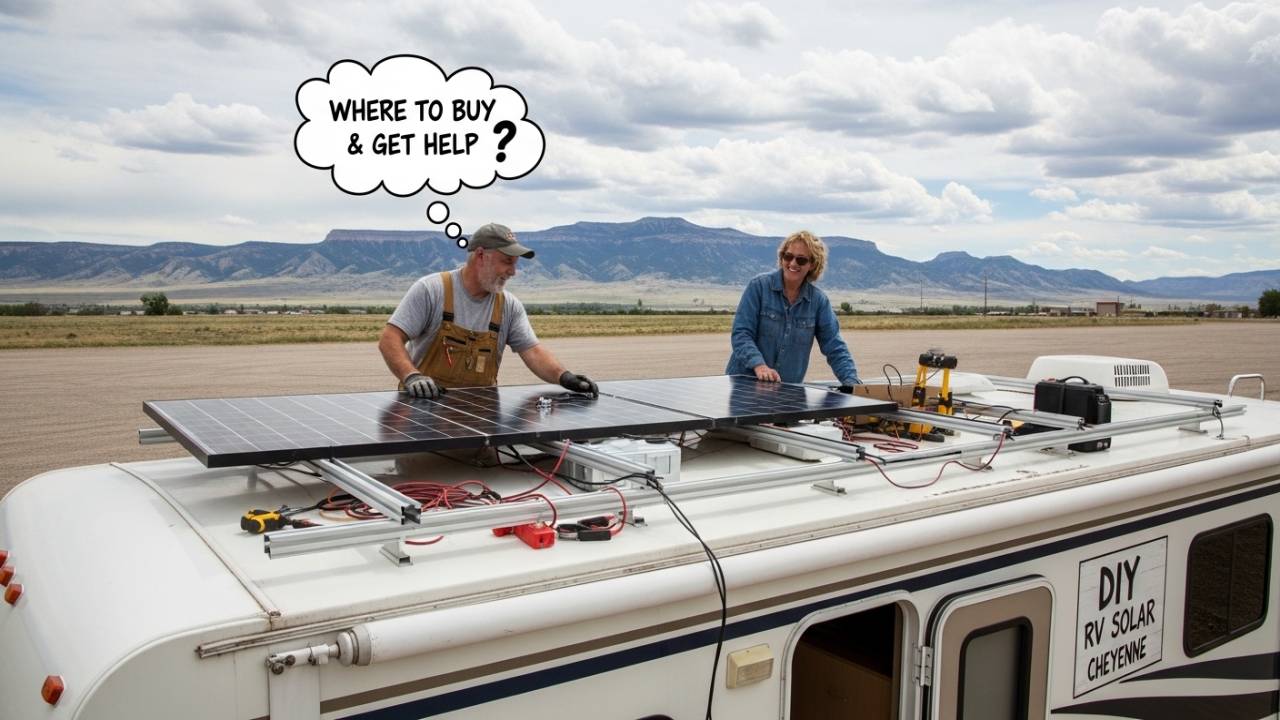
For RV owners comfortable with electrical work, Cheyenne has solid local options for sourcing components without ordering online and waiting for shipping.
Sun & Plains RV Accessories (East Lincolnway) is the best single-stop local source for panels, MPPT controllers, and mounting hardware. Their stock of wind-rated racking hardware is particularly useful for Cheyenne and the wider I-80 corridor. Frontier RV Outfitters also sells components to DIYers and will spend time helping you plan your system if you purchase from them.
For electrical components — wire, lugs, fuse blocks, bus bars — Northern Tool & Equipment on Bluegrass Circle carries a solid range, and Ace Hardware locations around Cheyenne stock basic wiring supplies. If you need specialty items fast, AutoZone and O’Reilly have marine-grade Ancor wire in several gauges.
Online, the most active DIY community for Cheyenne-area RV solar is the Wyoming RV Owners Facebook group and the r/vandwellers and r/boondocking subreddits, where High Plains-specific questions about wind mounting and altitude performance get regular real-world answers from people who’ve been doing this in the region for years.
One firm DIY warning for Cheyenne specifically: do not use standard light-duty Z-bracket mounts. The sustained wind loads on the I-80 corridor are well documented, and undersized mounts will fail. At minimum, use heavy-duty 3M VHB tape in addition to mechanical fasteners, seal every roof penetration with Dicor self-leveling lap sealant, and route cables through the interior whenever possible rather than along the exterior roof edge.
Also Read:- RV Solar Setup for Yellowstone: Complete Wyoming Camping Guide
Cheyenne-Specific Considerations for RV Solar
Wind: The #1 Factor on the I-80 Corridor
The stretch of I-80 between Cheyenne and Rawlins is among the windiest road corridors in the country. Panel tilt angle matters here: flat-mounted panels have lower aerodynamic drag than tilted panels, which can act as sails at highway speeds or during stationary high-wind events. Ask your installer about flush-mount versus tilt options and what the structural load ratings are for your specific panel and mount combination.
Altitude & UV Intensity
At approximately 6,000 feet, UV irradiance is meaningfully higher than at sea level. This benefits solar output but also accelerates degradation of lower-quality panel encapsulants and EVA laminate. Stick with Tier 1 panels (Renogy, Rich Solar, Canadian Solar, LG) and avoid no-name budget panels that may not be rated for prolonged high-altitude UV exposure.
Temperature Swings
Cheyenne’s high plains climate produces significant temperature variation — hot summer afternoons above 90°F and winter nights well below zero. Lithium batteries (LiFePO4) require a battery heater for winter use if you’re charging in sub-freezing temperatures, as charging a cold lithium battery below 32°F can cause permanent damage. Both High Plains Solar and Wyoming RV & Electrical offer integrated low-temperature protection as a standard option on lithium builds.
Nearby Camping: Test Your System Before the Deep Backcountry
Curt Gowdy State Park (25 miles west) and the Vedauwoo area in Medicine Bow National Forest (35 miles west) offer excellent dry-camping opportunities to test your new solar system before committing to a remote backcountry trip. Cell coverage is limited in parts of Medicine Bow, making a reliable solar power system even more critical — you’ll want to know your system works before you’re three days down a forest road.
FAQ: RV Solar in Cheyenne
Q: How much does a basic RV solar install cost in Cheyenne in 2026?
A: Entry-level 100–200W installs run $595–$1,100 at Cheyenne shops. A mid-range 400W system with MPPT controller and upgraded wiring typically costs $1,750–$2,800. Full lithium builds (600W+ with Battle Born or Renogy lithium batteries) run $4,200–$11,000 depending on battery capacity and system complexity.
Q: Is RV solar in Cheyenne cheaper than in Jackson Hole?
A: Yes, typically 20–35% cheaper. Jackson’s resort-town labor rates push up every service category. Cheyenne has a more competitive local market with multiple shops competing on
price. If you’re doing a significant install, it’s genuinely worth routing through Cheyenne rather than booking an appointment in Jackson.
Q: How does Wyoming’s wind affect RV solar panels?
A: Wind is the primary installation concern on the I-80 corridor. Panels must be mounted with wind-rated hardware, secondary adhesive bonding, and proper roof sealing. Flat-flush mounting is preferred over tilted mounting for wind resistance. Always ask your installer specifically about their wind-load mounting standards before approving any work.
Q: What’s the best battery type for RV solar in Cheyenne’s climate?
A: LiFePO4 (lithium iron phosphate) is the best choice for Wyoming’s temperature extremes, with one caveat: you need a battery with built-in low-temperature protection (or an external heater) for winter charging. AGM batteries are a reliable, lower-cost alternative but have less usable capacity and shorter cycle life. Avoid flooded lead-acid if you’re doing any serious boondocking or if your rig is stored outdoors in winter.
Q: How long does a professional install take at a Cheyenne shop?
A: Simple 200–400W installs typically take 4–8 hours of shop time and can often be completed in a single day for shops with appointment availability. Full lithium system builds (wiring, inverter, battery, solar, shore power integration) take 2–4 days. During peak summer season (June–August), appointment wait times at the better shops run 2–4 weeks, so plan accordingly.
Conclusion: Our Cheyenne RV Solar Shop Recommendations
For most RV owners passing through or based in Cheyenne, High Plains Solar & RV is the easiest recommendation — their wind-rated installs, honest power audits, and solid warranty support make them the go-to for anyone who needs the job done right and isn’t primarily driven by cost. If you’re on a tighter budget, Frontier RV Outfitters will give you a clean, functional install at the lowest professional price in town.
If you’re building out a serious full-time or extended boondocking rig — the kind of system where you genuinely don’t want a generator — Wyoming RV & Electrical Solutions is worth the premium. Their master electrician background shows in every aspect of the design and execution. For RV owners who can’t move their rig, Cowboy Solar’s mobile service is a well-priced, wind-savvy option.
And if you’re a capable DIYer who just wants quality local components and some expert guidance before getting your hands dirty, Sun & Plains RV Accessories will serve you better than any other stop on this list.
Cheyenne’s position at the crossroads of the Mountain West, its long sunny days, and its competitive pricing make it one of the most practical places in the region to invest in RV solar. Just respect the wind — and you’ll be running on sunshine long after you’ve left the I-80 corridor behind.