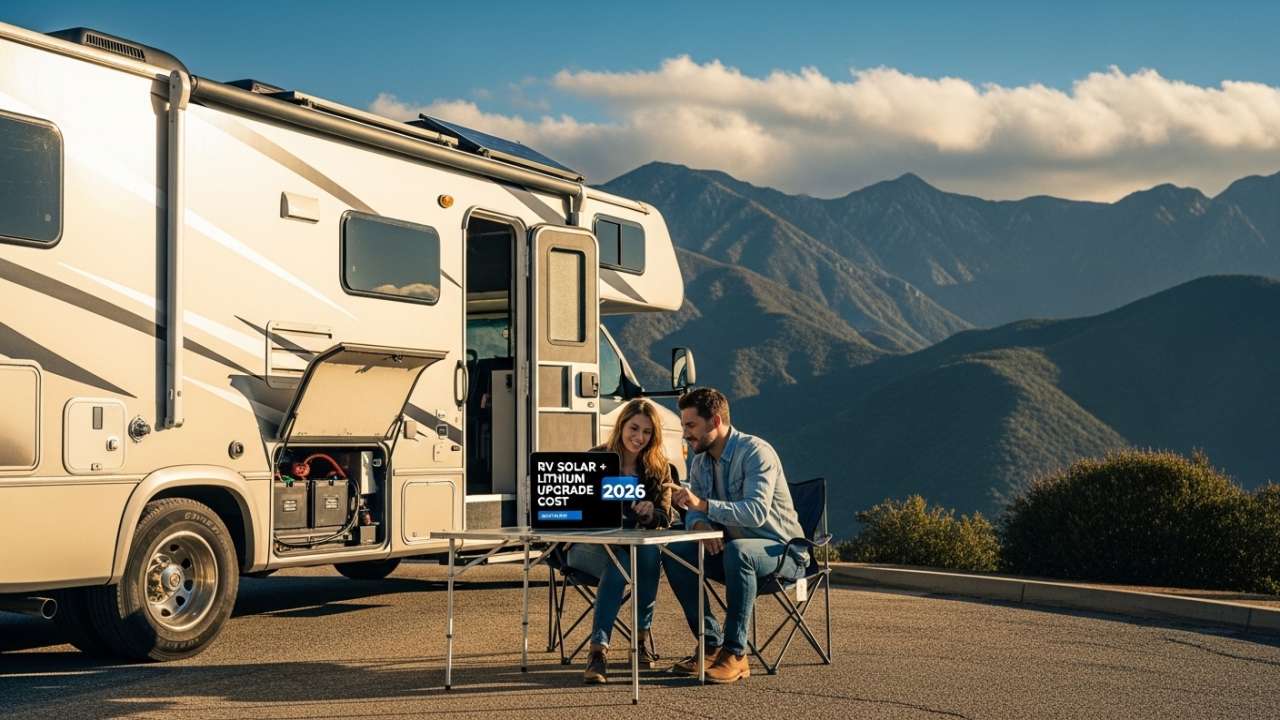
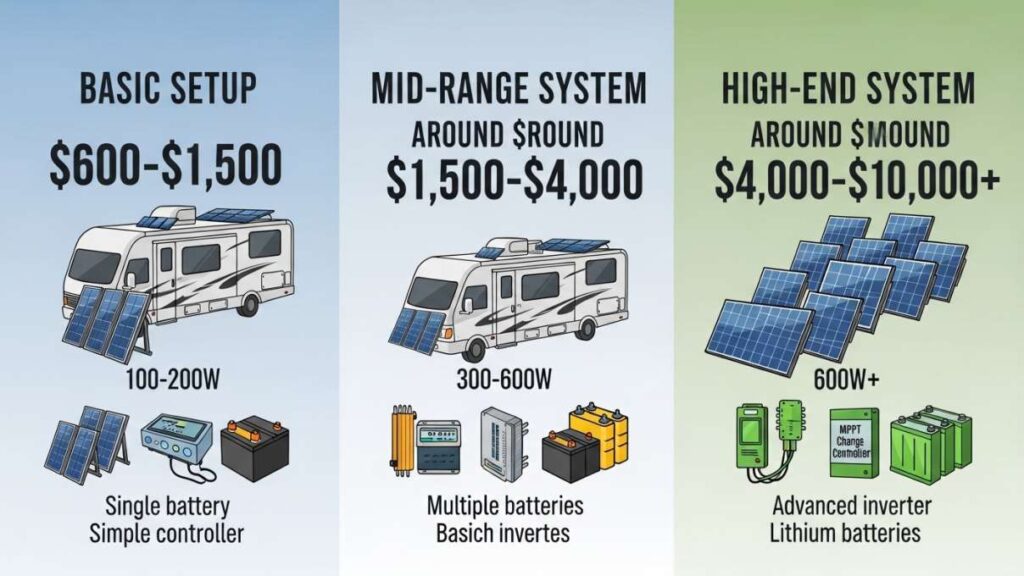
Quick Answer: Adding solar panels to an RV costs $600 to $18,000, depending on your system size, battery type, and whether you DIY or hire a pro. Most RV owners in the US spend between $1,500 and $5,000 for a solid, capable setup.
You’re Tired of paying for shore power. We Get It.
You’ve been at it all season — $30 hookups here, $50 there. You’ve watched people boondock for weeks in the Arizona desert without plugging into a single outlet, and you think the following:
“Why am I still paying for electricity at a campsite?”
So you Google it. And suddenly you’re staring at price ranges like “$500 to $10,000” – which tells you almost nothing.
Here’s what this article does differently:
- Real component prices from the 2024–2025 US market
- Three real-world cost scenarios with itemised breakdowns
- An honest talk about DIY vs. pro installation
- Actionable advice so you can build YOUR system, not a hypothetical one
The Full RV Solar Cost Breakdown by System Size
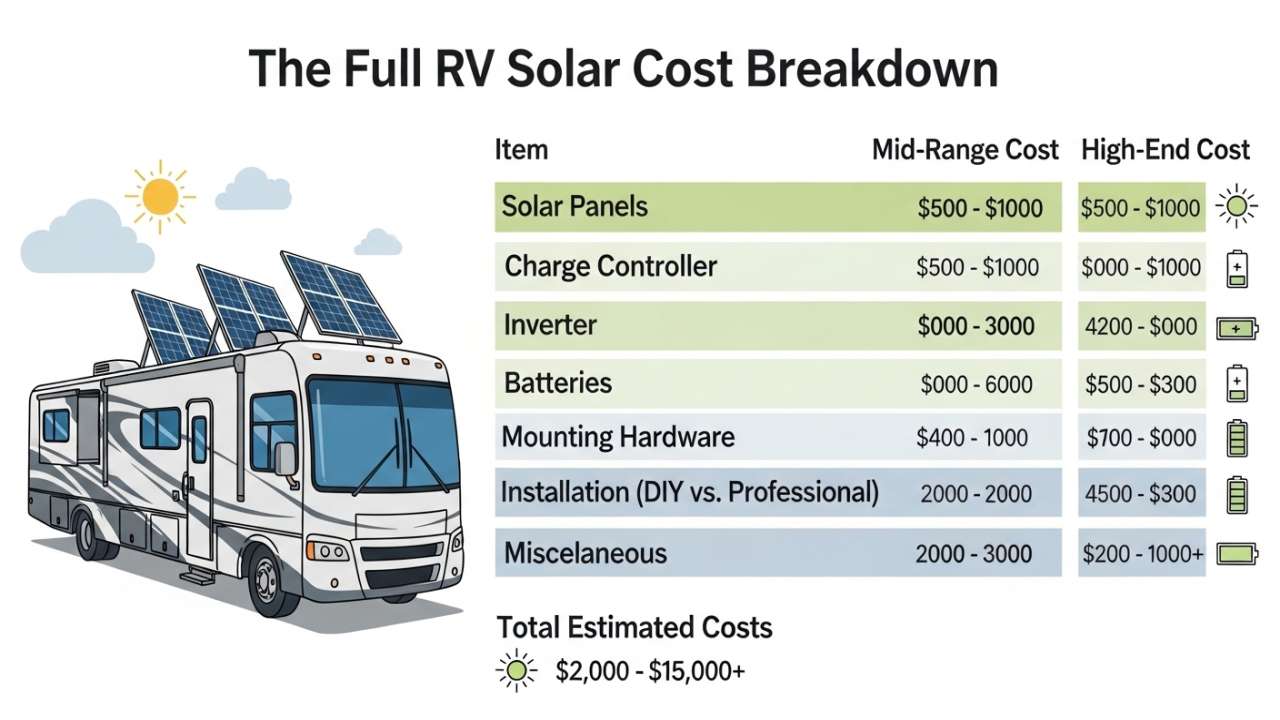
Think of your RV solar system like a restaurant order. You can grab a quick sandwich (weekend setup) or sit down for a full five-course dinner (full-timer’s dream rig). Both work – it just depends on how hungry you are for power.
| System Size | DIY Cost | Pro Install | Best For | What It Powers |
|---|---|---|---|---|
| 100–200W Starter | $300–$600 | $800–$1,200 | Weekend warriors | Phone, laptop, LED lights, fan |
| 400W Mid-Range | $800–$1,500 | $1,800–$2,800 | Part-timers (2–5 days) | TV, water pump, 12V fridge |
| 800W Capable | $1,800–$3,000 | $3,500–$5,000 | Frequent boondockers | Most appliances (no A/C) |
| 1,200W+ Full-Timer | $3,000–$6,000 | $6,000–$12,000 | Full-time RV living | Residential fridge, limited A/C |
| 2,000W+ Off-Grid | $6,000–$10,000 | $12,000–$18,000 | Power users / solar nerds | Whole-home comfort off-grid |
Pro tip: If you’re unsure where to start, a 400W system with lithium batteries is the sweet spot for most American RV campers in 2025.
Every Component You Need (And Exactly What Each One Costs)
Here’s where most RV owners get blindsided. Solar panels are just one piece of the puzzle. A complete system has four core components — skip or cheap out on one, and the whole setup suffers.
1. Solar Panels — Your Power Source
For most RV rooftops, monocrystalline panels are the gold standard. Highest efficiency per square foot, which matters when your roof space is limited.
| Panel Type | Wattage | Price Range | Best For |
|---|---|---|---|
| Monocrystalline | 100W | $80–$130 | Most RV rooftops |
| Monocrystalline | 200W | $150–$220 | Bigger systems, fewer panels |
| Flexible Panels | 100W | $100–$180 | Curved roofs, low-profile rigs |
| Portable Folding | 200W | $200–$350 | No-drill setup, campsite flexibility |
2. Charge Controller — The Brain of the System
This sits between your panels and batteries. It controls how much power flows in and prevents overcharging.
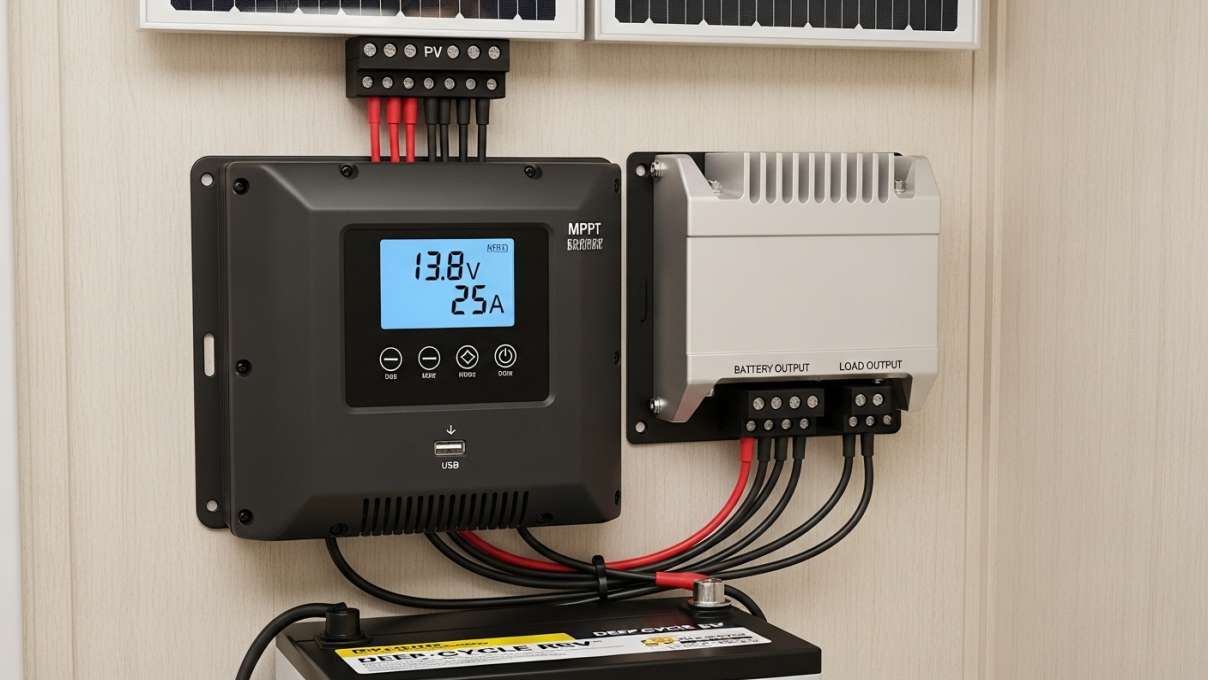
Two types exist: PWM (older, budget) and MPPT (modern, 20–30% more efficient). Always go MPPT when you can.
| Controller Type | Amperage | Cost | When to Use |
|---|---|---|---|
| PWM | 20A | $20–$60 | Small 100–200W systems only |
| MPPT | 20A | $50–$120 | Up to ~400W systems |
| MPPT | 40A | $100–$200 | 400–800W systems |
| MPPT | 60A+ | $200–$400+ | Large 1,000W+ builds |
Brands like Victron and Renogy are widely trusted in the US RV community and carry solid warranties.
3. Battery Bank — Where Your Power Lives
This is the single biggest cost factor — and the most important decision you’ll make.
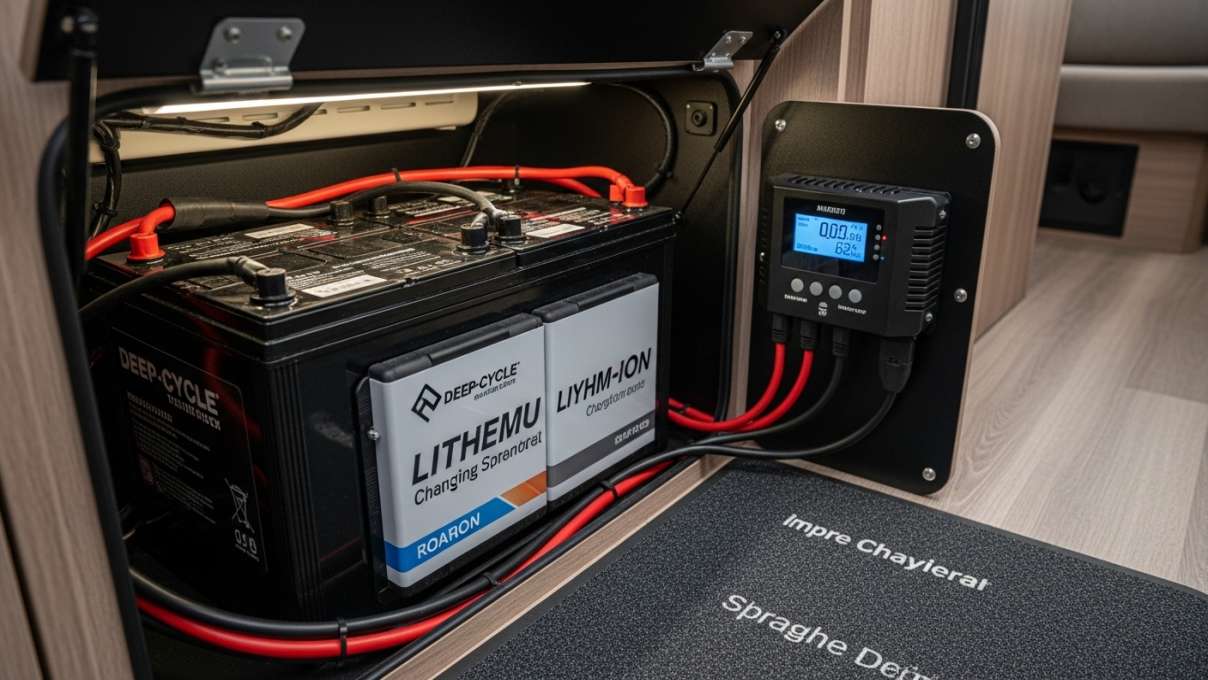
Your battery bank stores all the energy your panels generate, so you can use it at night or on cloudy days.
| Battery Type | Cost (100Ah) | Lifespan | Usable Capacity | Best For |
|---|---|---|---|---|
| Flooded Lead-Acid | $100–$200 | 3–5 years | ~50% | Budget builds, short trips |
| AGM | $150–$350 | 4–7 years | ~50–60% | Low-maintenance, moderate use |
| Gel | $200–$400 | 5–8 years | ~60% | Hot climates, slow discharges |
| Lithium (LiFePO₄) | $600–$1,500 | 10–15 years | ~95–100% | Full-timers, power users |
The real talk on lithium vs. lead-acid:
A 200Ah lithium battery often outperforms a 400Ah lead-acid setup because lead-acid batteries are only safely usable at 50% capacity, while lithium gives you nearly every amp-hour it holds.
Yes, lithium costs more upfront. But over 10+ years? It’s almost always cheaper in the long run.
Also Read:- Top Solar RV Battery Setup for Off-Grid Weekends (2026 Guide): Panel Size, Battery Type & Cost Breakdown
4. Inverter — Turning Solar Into Usable Power
Your panels generate DC power. Your coffee maker, laptop, and TV want AC power. The inverter bridges that gap.
| Inverter Type | Wattage | Cost | Best For |
|---|---|---|---|
| Modified Sine Wave | 700W | $80–$150 | Basic loads only |
| Pure Sine Wave | 1,000W | $150–$300 | Most electronics |
| Pure Sine Wave | 2,000–3,000W | $300–$800 | Full kitchens, workstations |
| Inverter/Charger Combo | 2,000W+ | $500–$2,000+ | Full-timer all-in-one solution |
Always buy a pure-sine-wave inverter if your budget allows. Modified sine wave models can damage sensitive electronics — CPAPs, certain laptops, and audio equipment.
5. The Extras That Add Up Fast
Don’t let these small items blindside you. Individually small, collectively significant — budget $200–$600 for the following:
- Mounting hardware and brackets: $50–$150
- Wiring, connectors, and fuses: $80–$200
- Bus bars and battery terminals: $30–$80
- Battery monitor/shunt: $30–$150 (highly recommended — you’ll want to see your power usage in real time)
- Cable entry glands (roof penetrations): $20–$60
DIY vs. Professional Installation: The Honest Comparison
This is the question every RV solar shopper wrestles with. The answer depends on your comfort level with electrical work — not just your budget.
Going the DIY Route
If you’re comfortable with basic wiring and can follow a diagram, DIY is absolutely doable. Thousands of American RV owners do it every year.
Typical DIY savings: 30–50% off your total cost.
What you’ll need:
- A multimeter
- Wire stripper and crimping tool
- A drill with RV-safe bits
- One weekend of patience
A basic 400W system on a travel trailer takes most people 1–2 weekends. Larger Class A or C builds can take 3+ days.
For learning RV electrical basics, the U.S. Department of Energy’s Alternative Fuels Data Center is a free, trusted resource covering solar and battery fundamentals.
Also Read:- How to Size an RV Solar System the Right Way
Hiring a Professional Installer
Pro installation makes sense when your system is 800W or larger, your RV has complex existing wiring, or you don’t want the stress and liability.
Most RVIA-certified RV service centres charge $75–$150/hour for installation labour.
| System Size | Estimated Labor Hours | Estimated Labor Cost |
|---|---|---|
| 200W starter | 4–6 hours | $300–$900 |
| 400W mid-range | 6–10 hours | $600–$1,500 |
| 800W capable | 10–16 hours | $1,000–$2,400 |
| 1,200W+ full-timer | 20–30 hours | $2,000–$4,500 |
Three Real-World Scenarios With Actual Price Tags
Enough theory. Here’s what three real types of RV campers actually spend when they go solar.
Scenario 1: The Weekend Warrior
Rig: 22-foot travel trailer. Needs: Phones, LED lights, a Bluetooth speaker, and a 12V cooler
| Component | Cost |
|---|---|
| 2 x 100W monocrystalline panels | $220 |
| 30A MPPT charge controller | $90 |
| 2 x 100Ah AGM batteries | $360 |
| 700W pure sine wave inverter | $120 |
| Wiring, mounts, and hardware | $180 |
| Total (DIY) | ~$970 |
Result: They now dry camp for free at national forest dispersed sites and haven’t paid a single hookup fee in two camping seasons.
Also Read:- Wyoming Wind & RV Solar Panels: Protection & Mounting Tips
Scenario 2: The Part-Time Boondocker
Rig: 30-foot fifth wheel. Needs: Residential fridge, TV, devices, occasional blender — 2 weeks/month at BLM sites
| Component | Cost |
|---|---|
| 4 x 200W panels (800W total) | $640 |
| 60A MPPT charge controller | $220 |
| 200Ah lithium battery | $900 |
| 2,000W pure sine wave inverter | $450 |
| Wiring, hardware, battery monitor | $320 |
| Professional installation (14 hrs at $110/hr) | $1,540 |
| Total (Pro Installed) | ~$4,070 |
Result: The system paid for itself in about 18 months by eliminating $50/night hookup fees on extended trips.
Scenario 3: The Full-Timer
Rig: 40-foot Class A motorhome. Needs: a residential fridge, multiple workstations, occasional A/C via hybrid generator and solar
| Component | Cost |
|---|---|
| 10 x 200W panels (2,000W total) | $1,600 |
| Two 60A MPPT charge controllers | $500 |
| 400Ah lithium battery bank | $3,200 |
| 3,000W inverter/charger combo | $1,800 |
| Wiring, hardware, monitoring, and roof work | $700 |
| Professional installation | $4,200 |
| Total (Pro Installed) | ~$12,000 |
Result: Eliminated $200+/month in generator fuel costs plus nearly all hookup fees — paying itself off faster than expected.
How to Save Real Money on Your RV Solar Build
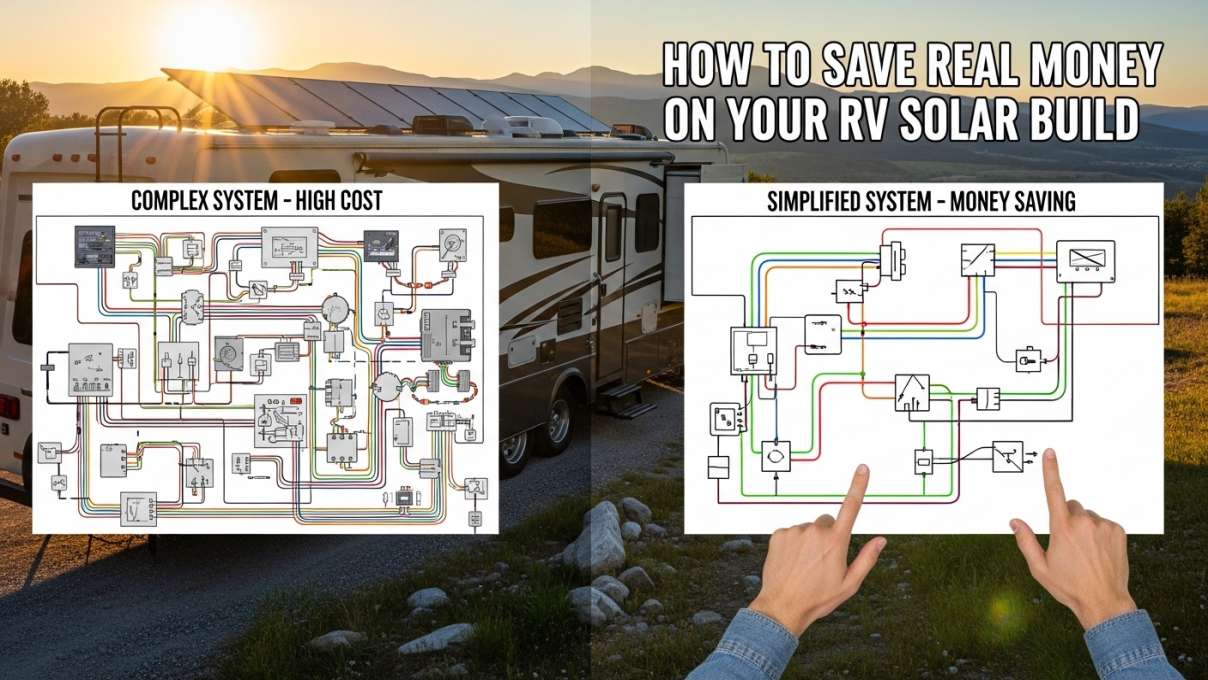
You don’t have to spend top dollar to get a system that works beautifully. Here are real ways to stretch your budget:
- Start smaller than you think you need. You can always add panels later. One season of real camping teaches you more about your power use than any calculator.
- Buy a solar kit from reputable brands like Renogy, Victron, or Battle Born. Kits bundle compatible components and often cost less than buying parts separately.
- Don’t cheap out on wiring. Undersized wire is a genuine fire hazard. Spend the extra $40–$60 on correctly rated cables — it’s a small cost that prevents a catastrophic one.
- Consider refurbished lithium batteries. Brands like Battle Born and Ampere Time offer warrantied refurbished units at meaningful discounts.
- Add a portable panel as a supplement. A 200W folding panel can boost your system on cloudy days without any roof penetration – great for renters or vandwellers who want flexibility.
- Check federal tax incentives. The Residential Clean Energy Credit (currently 30%) primarily applies to home solar, but some full-time RV dwellers who use their RV as a primary residence may qualify. Check IRS.gov or consult a tax professional.
Also Read:- Jackson Hole RV Solar Mountain Weather Performance Guide
Frequently Asked Questions About RV Solar Costs
How long does RV solar take to pay for itself?
For most American RV owners, a properly sized solar system pays for itself in 12 to 36 months. The more you currently spend on hookups or generator fuel, the faster your payback. Someone spending $100/month on shore power will break even on a $1,500 system in roughly 15 months.
Can I add solar panels to any RV?
Yes — virtually any RV can accommodate solar. Class A and C motorhomes have the most roof space (often 200+ square feet). Vans and pop-ups have less. If your roof is limited, portable ground-mounted panels fill the gap beautifully.
Do I need solar to run my RV air conditioner?
Running a standard RV A/C on solar alone requires a very large system — typically 2,000W+ in panels and a big battery bank. Most RVers either use a generator for A/C, or invest in a newer mini-split system designed for solar compatibility. A soft-start kit can also reduce the startup power spike of existing A/C units.
What is the difference between portable and rooftop solar for an RV?
Rooftop panels are permanently mounted and generate power even while you’re driving — maximising your daily harvest. Portable panels give you flexibility — angle them toward the sun, deploy them away from shade, move them as needed. Many experienced RVers use both — rooftop for baseline power, portable to boost on overcast days or when parked under trees.
How many solar panels does a 30-foot travel trailer need?
A 30-foot trailer typically needs 400–800 watts for comfortable part-time off-grid camping. If you’re running a residential fridge and want reliable power for a full week, aim for 800W+ paired with 200Ah+ of lithium storage.
Is professional RV solar installation worth the cost?
If your system is 800W or larger, or if you’re not comfortable with electrical work, professional installation is worth every penny. A poorly wired system can cause fires, drain batteries incorrectly, or void your RV warranty. For smaller starter systems on travel trailers, DIY is manageable for most handy owners.
Will solar panels damage my RV roof?
Not if installed correctly. Most professional installers and experienced DIYers use self-leveling lap sealant around all roof penetrations. EPDM rubber roofs — the most common RV roof material — work well with standard panel mounting hardware. Inspect your sealant once a year to stay ahead of any potential leaks.
The Bottom Line: What Should You Actually Do?
Here’s the most honest thing we can say:
Your first solar system doesn’t have to be perfect. It just has to work.
Start with a 200–400W system, a solid battery bank, and a quality charge controller. Live with it for one season. You’ll learn more about your actual power needs from a month of real camping than from six months of reading forums.
Then expand. RV solar systems are modular by design. You can always add panels, upgrade your battery bank, or swap in a bigger inverter as your needs grow.
The RV lifestyle is about freedom. Solar gives you the freedom to camp where hookups don’t exist — National Forest dispersed sites, BLM land, state parks without electric — without ever worrying about your batteries dying by 8pm.
That freedom is absolutely worth the investment.
The sun’s not going anywhere. Go chase it.