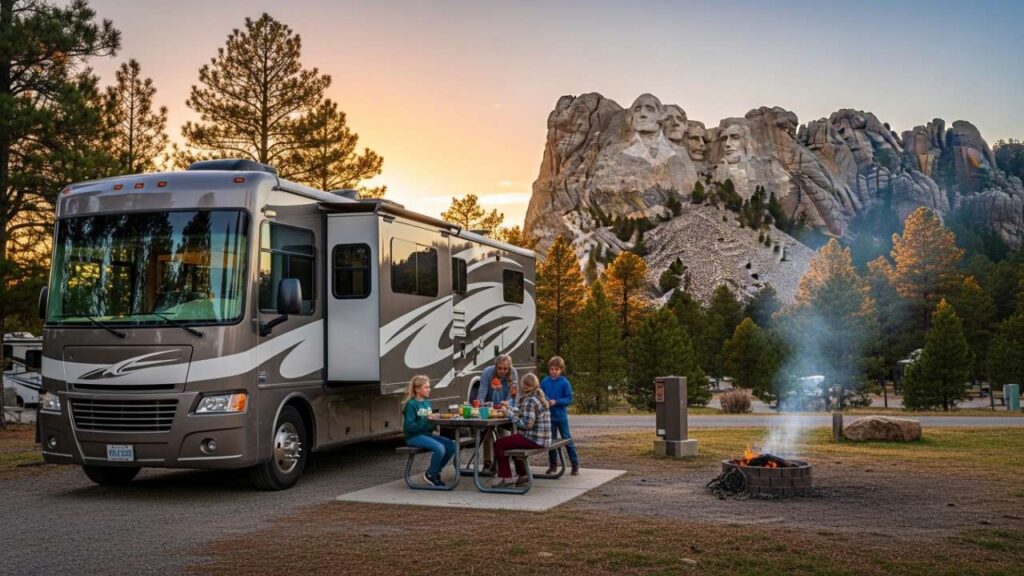
Picture this: You’re parked just minutes from Mount Rushmore, morning sunlight hitting your RV windows. Outside, the Black Hills stretch endlessly in every direction. Your phone shows a full battery. Your refrigerator is humming quietly. Your coffee maker just finished brewing. And the best part? Every bit of that power came from the sun—not a generator, not a campground hookup, just clean, silent energy you captured while you slept.
That’s the Mount Rushmore solar camping dream. And for thousands of RV adventurers heading to South Dakota each year, it’s becoming increasingly achievable.
But here’s the reality: Solar power for RVs camping near Mount Rushmore isn’t a one-size-fits-all solution. The Black Hills region presents unique challenges—intense summer sun, variable spring and fall conditions, and genuine winter camping obstacles for those adventurous enough to chase the snow. Your solar setup needs to account for all of these scenarios if you want reliable power when you need it most.
In this guide, I’ll walk you through exactly what you need to know to design a solar system that works specifically for Mount Rushmore camping, from calculating your actual power needs to choosing the right components for South Dakota’s particular climate and landscape.
Why Solar Power Makes Sense for Mount Rushmore Camping
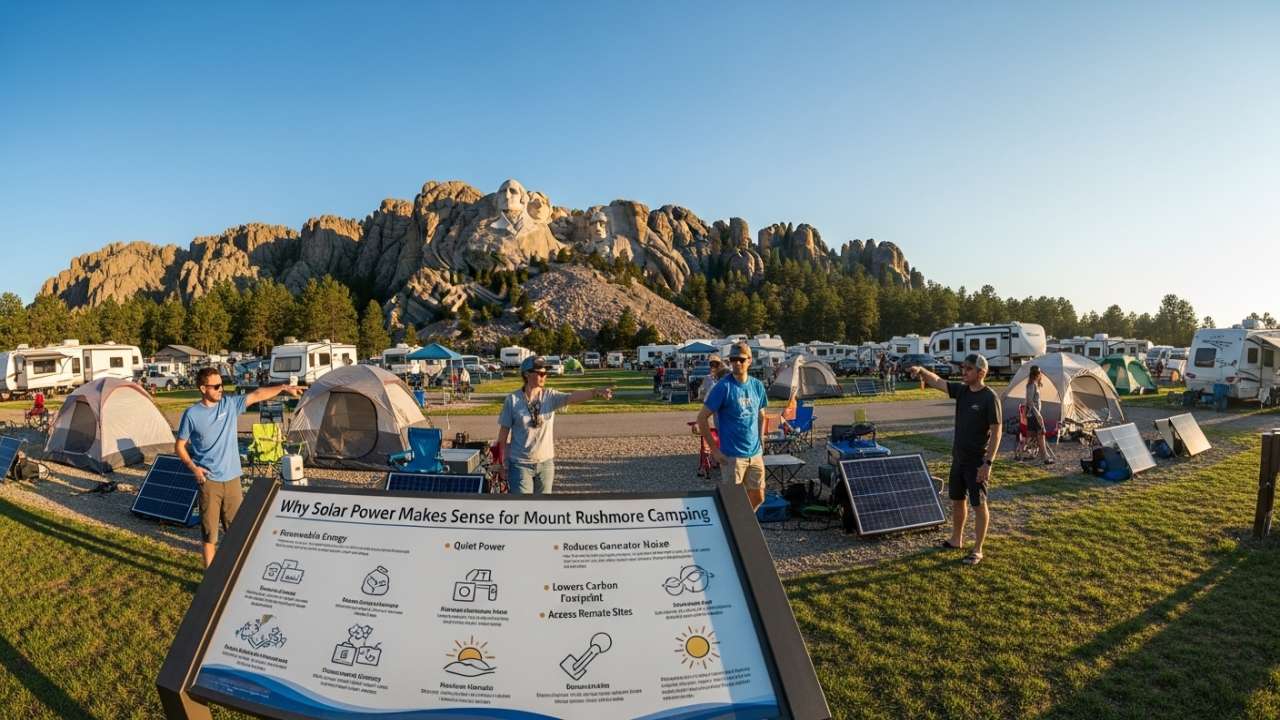
Here’s something most RV guides won’t tell you: Mount Rushmore’s surrounding area is absolutely ideal for solar camping. The Black Hills National Forest and surrounding BLM land offer hundreds of free or low-cost dispersed camping spots with minimal shade—perfect for maximizing solar production. Many of these sites have zero hookups, which means solar isn’t just nice to have; it’s genuinely essential if you want the freedom to stay off the beaten path.
Beyond the practical advantages, solar power offers something intangible. It’s the silence of a morning with no generator running. It’s the ability to wake up whenever you want instead of respecting quiet hours. It’s the freedom to stay at remote trailheads near Badlands National Park or Custer State Park without worrying about your power supply.
And let’s be honest: there’s something deeply satisfying about powering your entire camping lifestyle with nothing but sunlight and engineering. You become genuinely self-sufficient in a way that full hookup camping never allows.
Also Read:- Best RV Solar Battery Charger 2026 – 12V/24V Portable MPPT Charger for Camping & Off-Grid Motorhome
Understanding Mount Rushmore’s Solar Advantage
South Dakota gets about 220 sunny days per year, which ranks it in the top 15 states for solar potential. But “average” doesn’t tell you much about what you’ll actually experience as an RV camper.
Summer (June–August): This is peak solar season in the Black Hills. Long days, minimal cloud cover in western South Dakota, and strong sun angles mean a properly sized system will fully charge your batteries before noon and still have surplus power by 2 PM. Summer campers near Mount Rushmore have it relatively easy.
Spring and Fall (April–May, September–October): More variable. Afternoon thunderstorms are common, cloud cover increases, and sun angles become less favorable. Your system needs to handle 3–5 cloudy days in a row without panic. This is where oversizing your system pays dividends.
Winter (December–February): This is the true test. Snow cover on panels becomes a real issue. Sun angles drop dramatically. Days get short. Most RVers who brave winter near Mount Rushmore recommend treating solar as a supplemental power source, with a backup generator for extended cloudy periods. If you’re planning winter camping, your solar setup needs to be significantly larger or supplemented differently.
Step 1: Calculate Your Actual Power Consumption
This is where most RV solar systems fail before they even start. Too many people buy solar panels based on what a salesman suggests or what they saw on someone’s Instagram rig. Instead, you need to track your actual power usage.
For one full week, write down every electrical device you use and estimate how many hours daily you use it:
High-draw appliances (plan carefully):
- Refrigerator: 150–300 watt-hours daily (runs continuously)
- Air conditioning: 1,200–3,000 watt-hours per hour of use
- Microwave: 600–1,500 watt-hours per use (short bursts, big impact)
- Hair dryer: 1,500+ watt-hours per use (brief, intense)
- Induction cooktop: 1,200–3,000 watt-hours per cooking session
Moderate-draw appliances:
- Laptop/work computer: 50–150 watt-hours daily
- Phones and tablets: 20–50 watt-hours daily
- LED lighting: 10–30 watt-hours daily (highly efficient)
- Water pump: 30–100 watt-hours for showers and washing
- Furnace/heating: 50–200 watt-hours per hour
Low-draw appliances:
- Television: 50–150 watt-hours for 4 hours of viewing
- Fans: 10–30 watt-hours per hour
Once you add all this up, you’ll have a daily watt-hour requirement. Most RVers camping near Mount Rushmore report daily usage between 1,500 and 4,000 watt-hours, depending on how much they use air conditioning, heating, and cooking appliances.
Here’s the critical step: Don’t just size your solar system to meet your average day. Size it to handle 30% more than your calculated usage. This buffer accounts for cloudy days, panel degradation over time, and the inefficiency of real-world solar systems.
Understanding the Three Types of RV Solar Panels
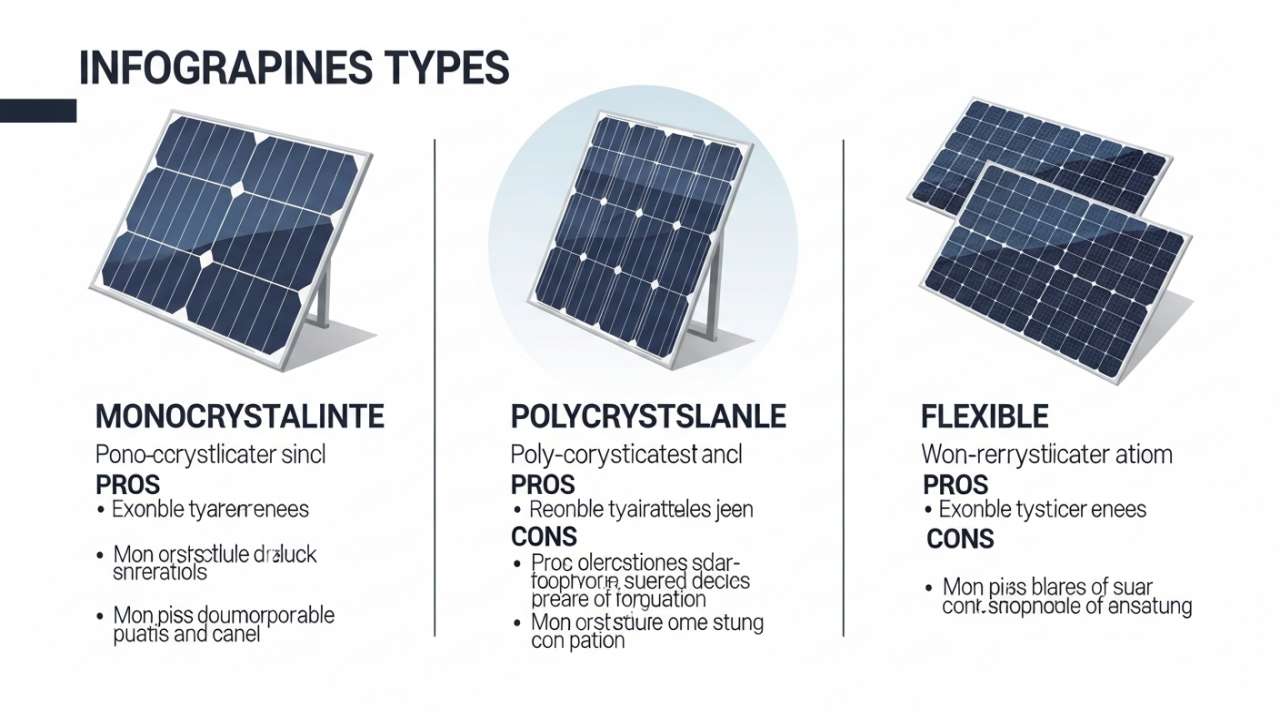
Not all solar panels are created equal. South Dakota camping presents different opportunities depending on which panel type you choose.
Monocrystalline Panels: The Performance Standard
Monocrystalline panels are the workhorses of RV solar. Made from a single silicon crystal structure, they deliver 21–23% efficiency in real-world conditions—the highest of any readily available panel type.
Why they’re ideal for Mount Rushmore camping: South Dakota’s intense summer sun and high altitude (the Black Hills peak at about 7,200 feet) make these panels extremely effective. They handle partial shade better than polycrystalline options and degrade slowly over their 25-year lifespan.
The trade-off: They’re heavier and require mechanical roof penetration for mounting. They’re also more expensive upfront, though the efficiency gain usually justifies the cost.
Also Read:- Your RV Slide Out Stuck or Not Working? The Complete Repair & Prevention Guide
Flexible Panels: The No-Drill Option
Flexible panels bond directly to your RV roof without mechanical mounting. They’re lighter, easier to install, and don’t require roof penetration.
Why some RVers prefer them: If your RV doesn’t have roof space or you want to avoid drilling, flexible panels work. They’re ideal for canvas roof systems or RVs with weight limitations.
The limitation: You can’t tilt them for seasonal angle optimization. They’re also slightly less efficient than monocrystalline (around 19–20%), and they degrade faster over time.
Portable Panels: The Flexibility Champion
Portable 100–200-watt foldable panels let you position your power source anywhere. Park under a shady ponderosa pine, unfold your panels in the sunny clearing nearby, and you solve the shade problem that plagued Mount Rushmore’s forest camping.
Why Mount Rushmore campers love them: Many of the best dispersed camping spots near Mount Rushmore are nestled under tall pines for afternoon shade, which kills solar production. Portable panels let you have your shade and your power, too.
The reality: Portable panels work best as supplemental power. Relying solely on them means constantly managing cable runs and panel positioning. But paired with a roof system, they’re genuinely clever.
The Solar Panel Wattage Calculator for Mount Rushmore
Here’s where your earlier calculation meets real-world South Dakota conditions.
For Summer-Only Camping (May–September)
If you’re one of those RVers who only hits the road during peak season near Mount Rushmore, your requirements are more forgiving.
Daily usage: 2,000 watt-hours
- Recommended system: 400–600 watts of monocrystalline panels
- Realistic daily production: 2,000–3,200 watt-hours (depending on cloud cover)
Daily usage: 3,000 watt-hours
- Recommended system: 600–900 watts of monocrystalline panels
- Realistic daily production: 3,000–4,800 watt-hours
Also Read:- Why Is My RV Engine Overheating? Solutions & Prevention Tips
For Year-Round or Extended Shoulder Season Camping
This is more complex because winter production in South Dakota drops dramatically.
| Daily Watt-Hour Need | Summer Setup | Winter Setup | Total Annual Cost |
|---|---|---|---|
| 1,500 wh/day | 400W panels | 600W panels + battery upgrade | $3,500–$5,000 |
| 2,500 wh/day | 600W panels | 900W panels + generator backup | $5,500–$8,000 |
| 3,500 wh/day | 900W panels | 1,200W panels + generator backup | $7,500–$11,000 |
| 5,000+ wh/day | 1,200W panels | Professional install recommended | $10,000–$15,000+ |
These figures assume monocrystalline panels, an MPPT charge controller, and lithium battery backup. Costs vary significantly based on DIY installation versus professional installation.
Battery Capacity: The Often-Overlooked Piece
Solar panels collect energy. But what happens when the sun sets? That’s where battery banks come in.
For Mount Rushmore camping, most experts recommend:
Seasonal camping: 100–200 amp-hours of lithium battery capacity (about 3–6 kWh usable)
Year-round camping: 200–400 amp-hours of lithium capacity (6–12 kWh usable)
Why lithium instead of lead-acid? Modern lithium batteries (LiFePO4) have dropped dramatically in price and now compete directly with AGM batteries. They weigh less, charge faster, tolerate deeper discharge cycles, and last 2–3 times longer. For serious Mount Rushmore RV camping, lithium is becoming the standard.
The Charge Controller: MPPT vs. PWM
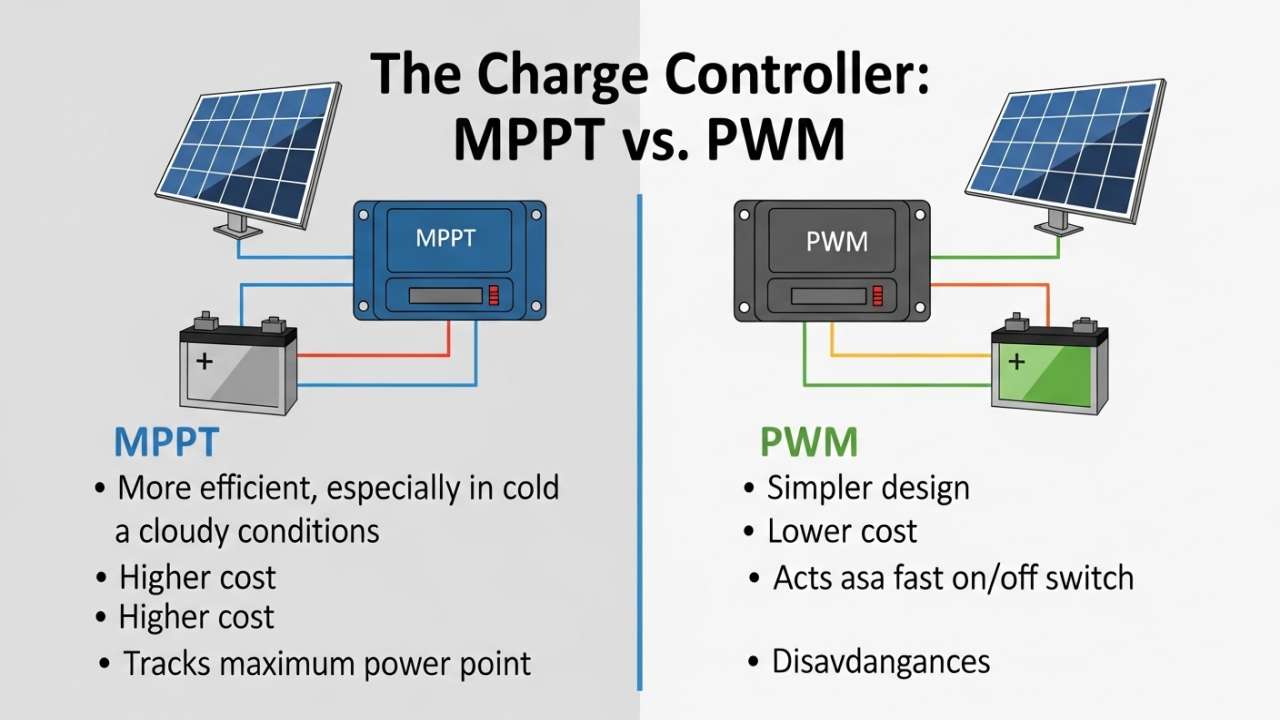
Your charge controller is the traffic cop between your panels and batteries. It prevents overcharging while optimizing the voltage and current flowing into your battery bank.
MPPT (Maximum Power Point Tracking) controllers:
- 25–40% more efficient than PWM
- Essential for systems over 600 watts
- Cost: $400–$1,200
PWM (Pulse Width Modulation) controllers:
- Simpler, lower cost ($150–$400)
- Fine for small systems under 400 watts
- Adequate for supplemental portable panels
For Mount Rushmore RV camping: If you’re installing a permanent roof system, MPPT is worth the investment. The efficiency gains pay for itself within a few years through improved charging and reduced battery strain.
Putting It All Together: A Real-World Mount Rushmore Setup
Let’s say you’re a typical RV couple planning to camp near Mount Rushmore for 4–5 months annually (May–September), with occasional trips into spring and fall.
Your power profile:
- Refrigerator: 250 wh/day (runs continuously)
- Lighting: 40 wh/day (LED, used 4 hours)
- Laptop/phones: 80 wh/day
- Coffee maker: 200 wh/day
- Evening fan: 60 wh/day
- Water pump/toiletries: 70 wh/day
- Total: ~700 wh/day (conservative; add 30% buffer = 910 wh/day)
Your Mount Rushmore-specific system:
- 600 watts of monocrystalline panels
- 150 amp-hours of lithium battery
- MPPT charge controller
- Wiring, breakers, and monitoring system
- Estimated total cost: $4,000–$6,500 (DIY) or $6,500–$9,000 (professional install)
On a typical June day near Mount Rushmore with clear skies, this system would:
- Produce 2,400–3,200 watt-hours
- Use 910 watt-hours
- Build a 1,500+ watt-hour surplus into your battery bank
You’d wake up the next morning with full batteries, ready for another day of complete independence.
Also Read:- Rapid City RV Solar: The Complete Black Hills Installation Blueprint for Off-Grid Freedom
FAQ: Your Mount Rushmore Solar Camping Questions Answered
Q: Will snow cover ruin my solar production during winter camping near Mount Rushmore?
A: Winter near Mount Rushmore is challenging for solar. South Dakota’s Black Hills do get snow, which covers panels completely until sun heat melts it (sometimes days). Most winter RV campers either use portable panels they can clear manually or supplement with a small generator. December through February, expect 30–50% of peak summer production on average.
Q: Can I install solar panels myself, or should I hire a professional?
A: Simple installations (roof-mounted monocrystalline panels on a fiberglass RV roof) are absolutely DIY-able if you’re mechanically inclined. Hardest part is running wires through the RV. More complex installations—curved roofs, metal roofs, or integrating with multiple existing systems—benefit from professional installation. Cost savings from DIY: $1,500–$3,000.
Q: What happens if I park under trees at Black Hills dispersed camping sites?
A: Tree shade cuts solar production 40–70%. This is why portable panels shine for Black Hills camping. Or, you can size your system 50% larger and accept reduced production on shady days. Many Mount Rushmore campers do both: a permanent 600W roof system plus 200W of portable panels for flexibility.
Q: How long do RV solar panels last?
A: Monocrystalline panels typically have 25-year warranties and maintain 80–85% output after 20 years. Real-world degradation: about 0.5% per year. A panel installed today will still produce meaningful power in 25 years. Battery banks (lithium) last 10–15 years with proper care.
Q: Can I expand my system later if I want more power?
A: Yes, absolutely. Start with a foundation (400–600W panels, charge controller rated for 50% more), then add panels and battery capacity as needed. Many Mount Rushmore RVers start with summer-only systems then upgrade to year-round capacity after a season.
Q: What’s the true payback period for a $6,000 solar system?
A: If you camp 150+ days per year and would otherwise pay $30–50/night for hookup campgrounds, you’re saving $4,500–$7,500 annually. Your system pays for itself in 1–2 years. Plus, you can stay at free BLM sites year-round. By year 3–4, you’re purely in profit territory.
Q: Do I need permits to install solar on my RV in South Dakota?
A: No. RV solar installations don’t require permits in South Dakota—they’re considered temporary personal vehicle modifications. This is different from residential solar on property, which does require permitting.
Q: What’s the best battery type: lithium, AGM, or lead-acid?
A: For Mount Rushmore camping in 2026, lithium (LiFePO4) is the smart choice if budget allows. Lithium costs $800–$1,500 per 100 amp-hours. AGM costs $300–$600 per 100 amp-hours but lasts 5–8 years. Lead-acid is cheapest ($2–$3 per watt-hour) but only lasts 3–5 years. Over a decade, lithium wins on total cost of ownership.
Conclusion: Your Mount Rushmore Solar Adventure Awaits
Standing in front of Mount Rushmore at sunrise is an American moment worth protecting. And when you’re doing it powered entirely by South Dakota sunshine—independent, sustainable, and genuinely free—the experience becomes something else entirely.
The technical side of RV solar can feel overwhelming at first. Watts, watt-hours, charge controllers, battery chemistry, seasonal production curves—it’s a lot to absorb. But the beautiful part is that thousands of RV campers have walked this path before you near Mount Rushmore. The technology is proven. The economics work. And communities like those on Reddit’s r/RVLiving and specialized solar RV forums share real-world experience freely.
Start with honest calculations of your power needs. Size your system for real-world Mount Rushmore conditions, not marketing claims. Build in a 30% efficiency buffer. Choose quality components from manufacturers with strong track records. And if you’re not completely confident in the wiring and installation, hire a professional—that’s what they’re there for.
Your Mount Rushmore solar camping story is waiting. The Black Hills are calling. And every morning you wake up powered by the sun makes the initial investment feel like the smartest decision you ever made about your RV.