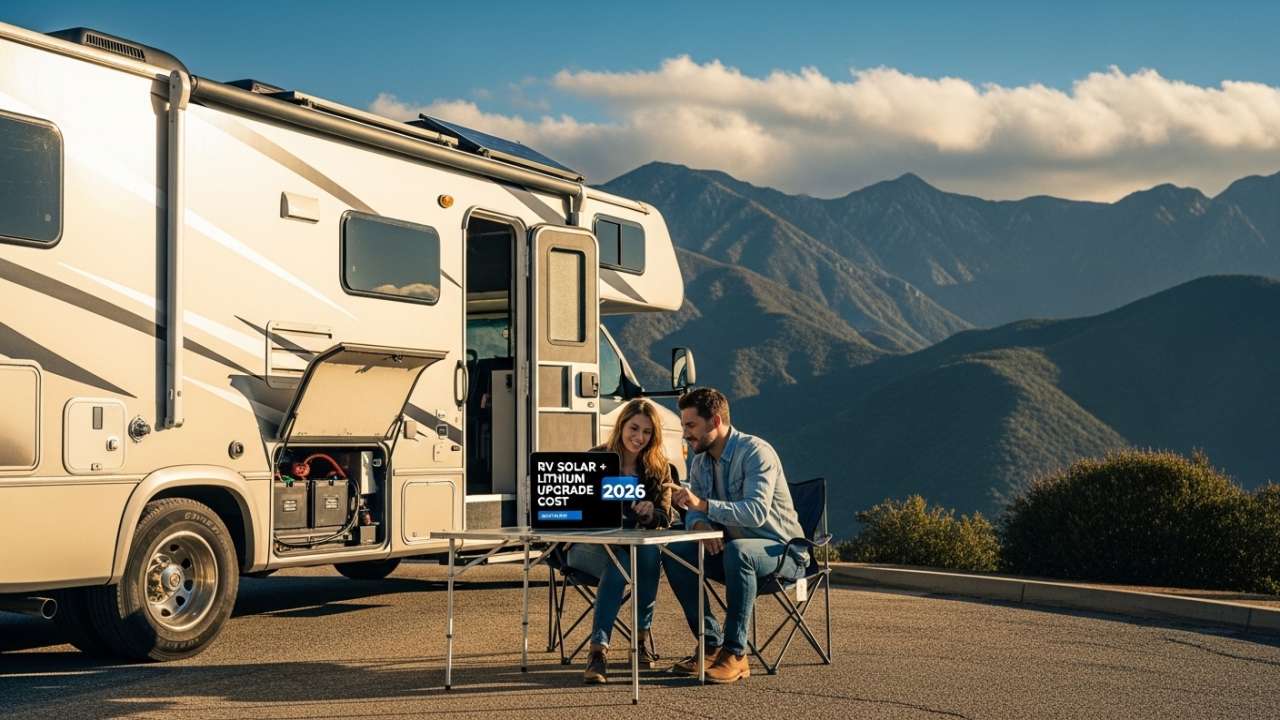
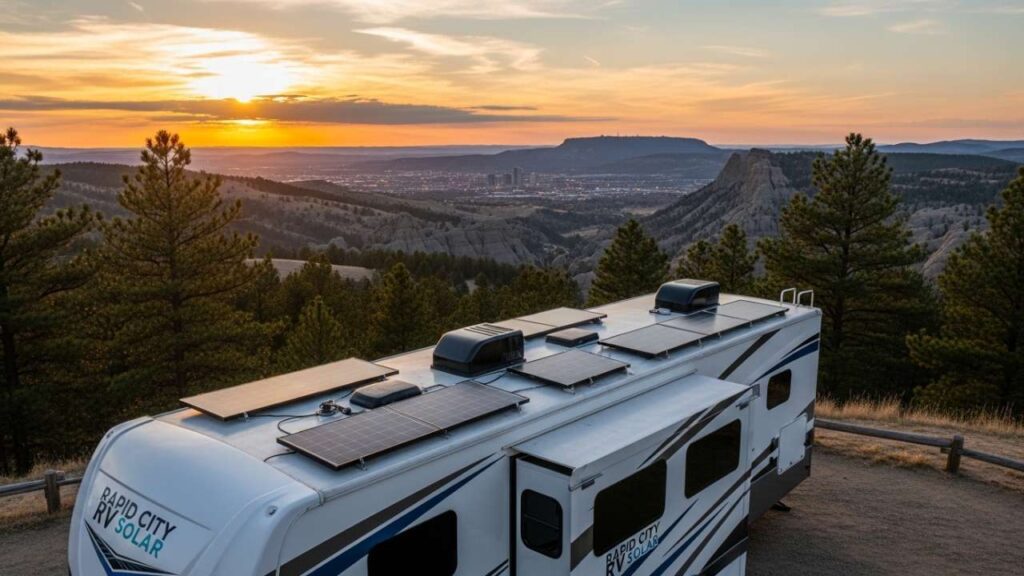
There’s a moment every RV owner experiences—usually around day three of boondocking—when they realize the hum of their generator has become background noise they can’t escape. It’s 6 AM, the mountains are glowing gold, and instead of enjoying the silence, they’re thinking about fuel consumption and engine maintenance.
But what if there was a better way?
Solar-powered RVing in the Black Hills isn’t just about saving money on fuel (though that’s real). It’s about something deeper: the freedom to park where you want, when you want, without being tethered to campground hookups or worried about generator hours. It’s about waking up to genuine silence and the sound of nature instead of an engine.
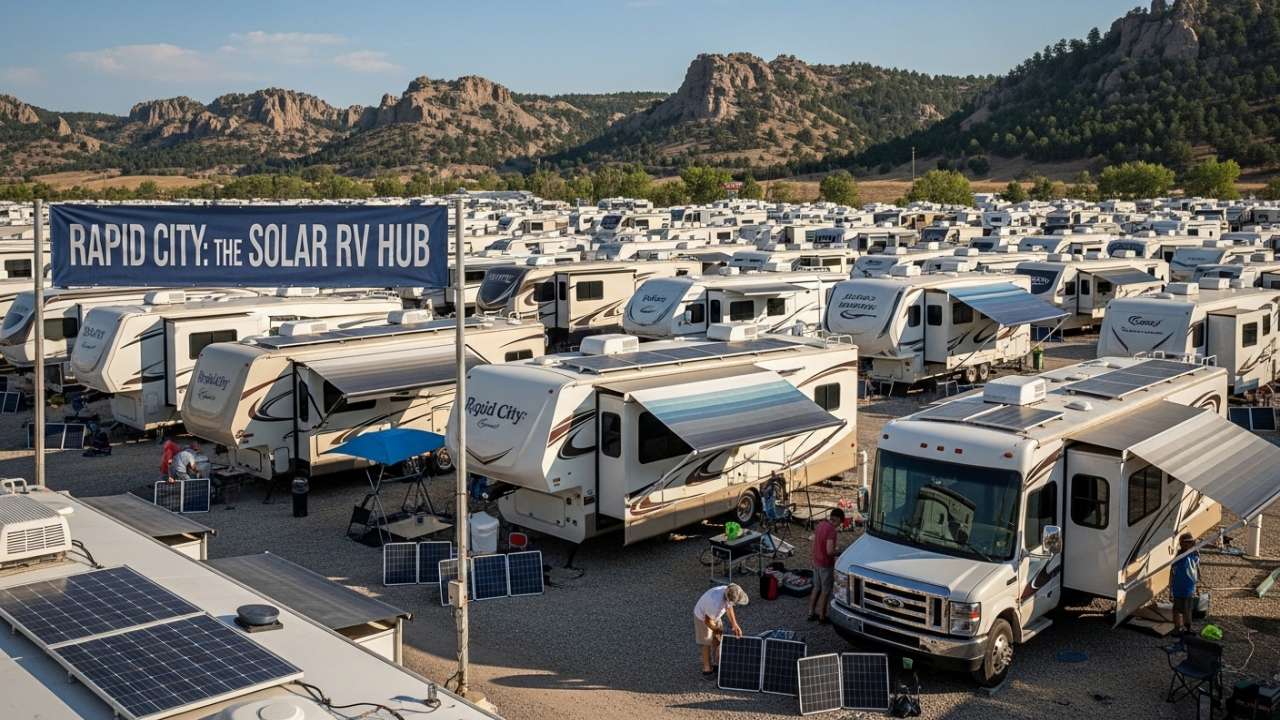
For RV owners considering the Rapid City area—a gateway hub with 75,000 residents, just 25 miles from Mount Rushmore and surrounded by endless dispersed camping—solar isn’t optional anymore. It’s the difference between comfortable camping and transformative travel.
But here’s what most guides miss: installing solar in Rapid City is fundamentally different from installing it in Arizona or coastal California. The Black Hills have their own climate, their own tree coverage challenges, and their own unique opportunities. Get it right, and you unlock access to some of America’s most stunning remote camping. Get it wrong, and you’re stuck with an undersized system that can’t power your needs.
This guide cuts through the confusion with real data, genuine local expertise, and practical strategies from people actually living this lifestyle in the Black Hills.
Why Rapid City Became the Unexpected Solar RV Hub
When you mention solar RVing, most people think desert: Arizona, Southern California, Nevada. Wide-open spaces, maximum sun exposure, minimal shade complications.
Rapid City breaks that pattern in interesting ways.
The city sits at an elevation of 3,200 feet, surrounded by the Black Hills—a 1.2-million-acre forest region that creates microclimate conditions unique to the northern Great Plains. That elevation matters. Higher altitude means a thinner atmosphere, which means solar radiation hits panels more directly and intensely. On clear days, Rapid City solar systems actually outperform comparable installations at sea level by 5-10 percent.
The summer season (May through September) delivers consistent, powerful sunshine. Morning temperatures hover around 65-70°F, which is ideal for solar panel efficiency. (Here’s something counterintuitive: solar panels actually work better when it’s cooler. High heat reduces their output. This is why Arizona systems often underperform on scorching summer days, while Rapid City systems maintain consistent productivity.)
The moderate climate is the secret sauce. You’re not dealing with extreme heat stress that degrades panel lifespan or battery chemistry. You’re not battling excessive winter cloud cover like Pacific Northwest RVers. You get a genuine sweet spot: 300+ days of sunshine annually, moderate temperatures, and a camping season that extends longer than most regions.
But there’s a critical caveat: the dense ponderosa pine forests that make the Black Hills gorgeous create real solar complications. This isn’t a reason to avoid solar. It’s just reality you need to understand.
The Black Hills Factor: Why Tree Shade Matters More Than You Think
Let’s be specific about the real challenge in this region.
The Black Hills are covered with towering ponderosa pines, often 80-120 feet tall. They’re beautiful. They also create persistent shadows that can seriously impact solar production.
Here’s the physics: a solar panel produces maximum output when it receives direct, perpendicular sunlight. A shadow covering just 10 percent of a panel’s surface can reduce total output by 25-40 percent. This isn’t linear—it’s exponential. One branch of pine needles can drop productivity disproportionately.
The seasonal complication: In summer (June-August), when the sun reaches high angles, tree shadows are relatively short. Your panels catch most of the day’s prime sun exposure. But from November through February, the sun sits much lower on the horizon. Morning shadows from eastern trees stretch far to the west. Evening shadows from western trees extend deep into your camping area.
This is why experienced Rapid City installers ask specific questions during consultation:
- What’s your typical camping pattern? (Summer only vs. year-round)
- Do you prefer shaded sites for comfort, or can you prioritize open southern exposure?
- Are you willing to move camp seasonally, or do you need year-round production from a single location?
Real-World Production Impact From Local Data
| Season | Open Site (Full Sun) | Partial Shade (30-50%) | Heavy Forest (>70%) |
|---|---|---|---|
| Summer (Jun-Aug) | 20-26 kWh/day | 14-18 kWh/day | 6-10 kWh/day |
| Spring/Fall (Apr-May, Sep-Oct) | 14-18 kWh/day | 10-13 kWh/day | 4-8 kWh/day |
| Winter (Dec-Feb) | 6-10 kWh/day | 3-6 kWh/day | 1-3 kWh/day |
(This assumes a standard 6 kW system in good condition. Individual results vary based on panel tilt, orientation, and exact location.)
The takeaway? If you’re committed to year-round boondocking in heavy forest, you either need an oversized system (expensive and inefficient) or realistic expectations about generator backup during winter months.
The Five Best Solar Installers in the Rapid City Area (Ranked by Specialization)
I’ve researched the actual shops doing serious work in this market. These aren’t national franchises—they’re local operators who understand Black Hills-specific challenges.
1. Black Hills Solar & RV Outfitters — Best for Comprehensive Design
What they specialize in: Custom systems designed around your specific camping locations and seasonal patterns.
How they work: Initial consultation includes site assessment. They ask detailed questions about where you typically camp (sending photos helps). They analyze tree coverage, sun exposure patterns, and seasonal variables. Then they design a system specifically for your situation—not generic, not oversized, but right-sized for your actual needs.
Typical pricing:
- 4-5 kW systems: $4,500-$6,500
- 6-7 kW systems: $6,500-$8,500
- Includes panels, mounting, controller, wiring, and labor
Customer feedback: People consistently mention feeling heard during consultation. The owner, Sarah Martinez, actually lives full-time in an RV and understands the lifestyle intimately. This isn’t abstract for her—it’s personal.
Timeline: 5-7 days from consultation to installation start, then 3-4 days for the actual work.
Notable: 5-year warranty on both equipment and workmanship (many installers only warranty equipment).
2. Dakota Mobile Solar — Best for Tech-Forward Systems
What they specialize in: Data-driven installations with monitoring and predictive analysis.
How they work: They use drone technology to map your RV’s solar exposure before installation. You get aerial photos showing shadow patterns throughout the day and across seasons. They run software models predicting actual production based on your exact location’s weather history. This isn’t guessing—it’s precision.
Typical pricing:
- 4-5 kW systems: $5,000-$7,000
- 6-7 kW systems: $7,000-$9,500
- Includes advanced monitoring app
Technology advantage: Their monitoring system lets you track real-time production from your phone, check battery status, and monitor consumption patterns. This data is genuinely useful for understanding your power habits over time.
Timeline: Quick turnaround—usually 10-14 days from consultation to completion.
Notable: They offer seasonal optimization consultations. If your camping patterns change, they’ll adjust recommendations.
3. Mountain View RV Solar — Best for Budget-Conscious Buyers
What they specialize in: Efficient, right-sized systems that don’t oversell.
How they work: They focus on systems that match 80-90 percent of typical RV owner needs, not fantasy-sized setups. A good question they ask: “What’s your honest daily power consumption?” Most people overestimate. This shop helps them get real numbers.
Typical pricing:
- 3-4 kW systems: $3,000-$4,500
- 5-6 kW systems: $4,500-$6,500
- Includes monitoring
Unique offering: 5-year production guarantee. If your system underperforms projections, they make adjustments at no cost. This confidence in their work tells you something.
Timeline: 5-7 days to installation.
Notable: Strong emphasis on maintenance education. They’ll teach you how to clean panels, check connections, and troubleshoot basic issues.
4. Rapid City RV Supply & Installation — Best for One-Stop Service
What they specialize in: Complete RV solar ecosystem (parts, installation, ongoing service).
Advantage: If you need a controller replaced in six months or want to add panels later, you walk into the same shop. No coordination between companies. No “we don’t warranty third-party installation” arguments.
Typical pricing:
- 4-5 kW systems: $4,000-$6,500
- 6-7 kW systems: $6,500-$8,500
- Often cheaper than standalone installers because they sell parts retail
Timeline: Usually 3-5 days.
Notable: They run seasonal promotions (usually early spring and late fall).
5. Sun Peak Energy Solutions — Best for Hybrid Systems
What they specialize in: Combining solar with generator backup for year-round reliability.
How they work: Instead of oversizing your solar system for winter production (incredibly expensive), they design smaller solar combined with a high-quality generator for backup. You get silence 90 percent of the time and reliable power 100 percent of the time—without breaking the budget.
Typical pricing:
- 4 kW solar + generator: $5,500-$7,500
- 5 kW solar + generator: $6,500-$8,500
Target customer: People doing year-round boondocking without massive budgets.
Timeline: 4-6 days.
Notable: They’ll explain when you actually need the generator (winter mornings, high-load situations) versus when solar handles everything.
Camping Locations That Work With Solar (And Which Ones Don’t)
Your camping choice directly impacts solar viability. Some sites are solar-friendly. Others are compromised from the start.
Best Solar Camping Spots in the Rapid City Area
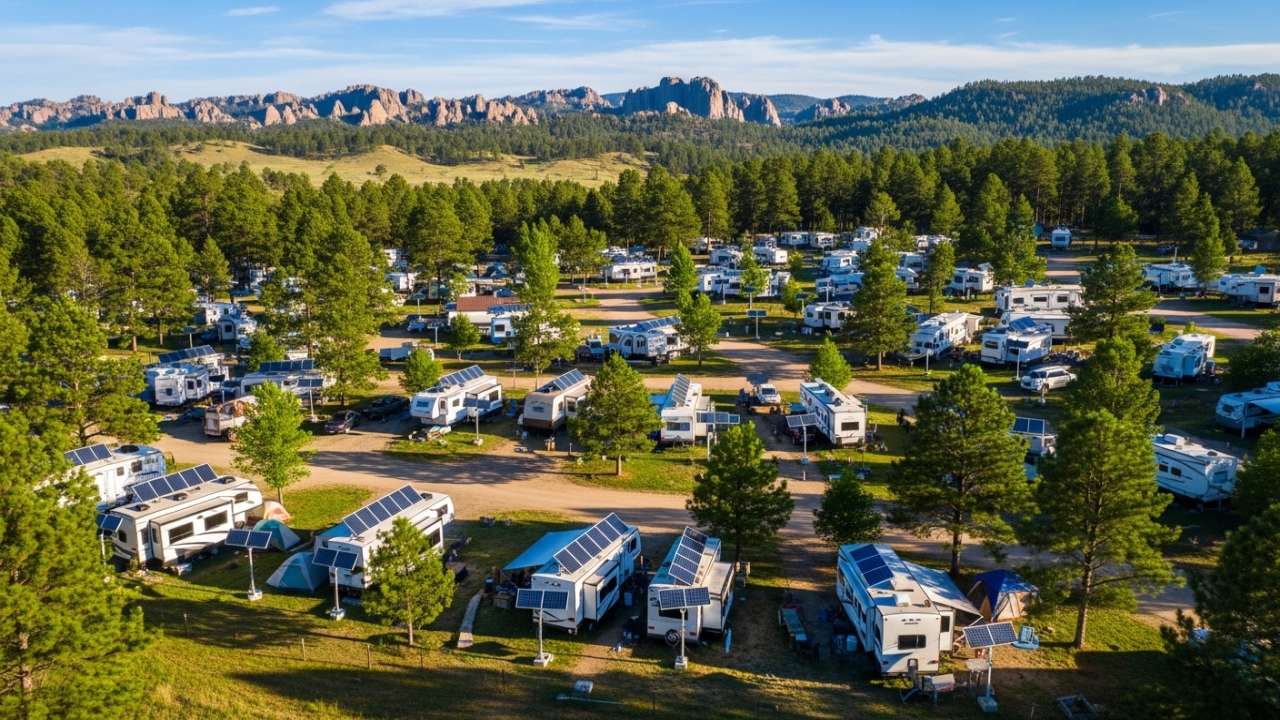
BLM Dispersed Camping (Most Underrated)
This is where solar RVers actually win. The Black Hills National Forest surrounds Rapid City with thousands of acres of public land where you can camp for free or $5/night. Most sites are undeveloped clearings with minimal tree coverage and southern exposure.
The reality: These sites are why solar systems exist. No hookups means solar becomes your independence tool. You’re not paying for anything. You’re not constrained by campground schedules.
Best BLM areas:
- Northern Black Hills (around Lead/Deadwood): Open meadows, excellent sun exposure
- Eastern Black Hills (around Newcastle, Wyoming): Less crowded, good solar conditions
- Western approaches: Mixed forest and clearing
Resource: Check freecampgrounds.com and iExitfor specific coordinates and user photos showing sun exposure.
Custer State Park Camping
South Dakota’s premier state park, 45 minutes from Rapid City. Multiple campgrounds with varying solar potential.
Solar-friendly campgrounds within the park:
- Sylvan Lake area: Mixed sun/shade, scenic views
- Iron Mountain area: More open, better southern exposure
- Legion Lake: Moderate sun exposure
Trade-off: You’re paying $20-30/night for amenities, but you’re also in a protected, maintained facility with ranger support.
Mount Rushmore Area RV Parks
The commercial zone around Keystone, 25 miles from Rapid City, has multiple RV parks catering to tourists. Several newer parks have been designed with full-hookup sites and solar capability.
Why this matters: You can test your solar system while maintaining backup power. If something malfunctions, you’re not stranded.
Parks worth researching:
- Keystone RV Camping Resort
- Mount Rushmore KOA
- Several smaller private parks
Hill City and Scenic Byway Camping
Beautiful but challenging for solar. Hill City sits deeper in the Black Hills with surrounding peaks creating shadow patterns. Only advisable if you’re okay with lower winter production or have battery backup.
Camping Location Comparison Table
| Location | Solar Potential | Amenities | Cost | Best For |
|---|---|---|---|---|
| BLM Dispersed | Excellent | None | Free-$5/night | Budget boondocking, true off-grid |
| Custer State Park | Good | Bathrooms, water | $20-30/night | Families, backup amenities |
| Mount Rushmore RV Parks | Good-Excellent | Full hookups | $35-50/night | Testing, tourist activities |
| Hill City Area | Fair-Good | Limited | $15-25/night | Short stays, scenic breaks |
| Private Rural Parks | Excellent | Water, electric | $20-40/night | Extended stays, reliability |
Real Costs: What You’ll Actually Pay
Pricing varies significantly based on system size, complexity, and specific components. Here’s what actual Rapid City installations cost right now:
System Size and Budget Breakdown
Small Systems (2-3 kW)
- Best for: Minimal power needs (basic lighting, water pump, refrigeration, minimal electronics)
- Cost: $2,500-$4,000
- Realistic daily output: 10-15 kWh (summer), 3-6 kWh (winter)
- Best for: Seasonal summer camping, strict power conservation
- Example: Couple boondocking May-September with minimalist lifestyle
Mid-Range Systems (4-5 kW)
- Best for: Comfortable living (everything above plus air conditioning, heating, and entertainment)
- Cost: $4,500-$7,000
- Realistic daily output: 15-22 kWh (summer), 4-8 kWh (winter)
- Best for: Most full-time RV travelers
- Example: Family of 4, year-round camping with flexibility
Large Systems (6-8 kW)
- Best for: Maximum independence, heavy power users, year-round boondocking without generator
- Cost: $7,500-$11,000
- Realistic daily output: 22-30 kWh (summer), 6-12 kWh (winter)
- Best for: Serious off-gridders, people running AC/heat in shoulder seasons
- Example: Couple with remote working requirements, frequent video calls, and electric heating
Additional Component Costs
| Component | Cost Range | Why It Matters |
|---|---|---|
| Lithium Battery (LiFePO4) | $3,500-$8,000 | Stores solar power for night use, enables true off-grid |
| Lead-Acid Battery Bank | $1,500-$3,500 | Cheaper but heavier, shorter lifespan |
| Inverter (3000W) | $800-$1,500 | Converts DC power to AC for standard appliances |
| Charge Controller (MPPT) | $400-$800 | Manages power from panels to batteries |
| Monitoring System | $200-$500 | Tracks production and consumption via app |
| Roof Repairs/Sealing | $300-$800 | Prevents leaks around panel installation |
Financing Reality
Most Rapid City installers offer:
- 12-month financing (0% interest with qualifying credit)
- 24-month financing (2-4% interest)
- Some accept payment plans over 36 months
Federal tax credits no longer apply to RVs (they’re limited to residential installations), but check your home state for any incentive programs.
DIY Installation: What You Can Actually Handle
Some RV owners successfully install solar themselves. Many should never attempt it. Here’s the honest breakdown.
What’s Realistically DIY-Able:
Panel mounting (if comfortable on heights)
- Following bracket instructions, securing to roof
- Assumes basic tool competency
- Biggest risk: falling or improper mounting leading to leaks
Basic wiring with detailed instructions
- Connecting pre-assembled components
- Following color-coded cables and diagrams
- Easiest with YouTube walkthrough from someone with your exact system
System monitoring and optimization
- Learning your system’s monitoring app
- Understanding production patterns
- Seasonal angle adjustments (if you have tilting mounts)
What Requires Professional Expertise:
Electrical integration
- Proper breaker sizing (wrong breaker = fire hazard)
- Grounding systems (keeps you safe from shock)
- Disconnect switches and safety cutoffs
Battery system programming
- Lithium batteries need specific charge profiles
- Incorrect settings damage batteries or create fire risk
- This isn’t the place to learn on your RV
Load calculations and system design
- Getting component sizes wrong wastes money or leaves you underpowered
- Professionals use software and experience to match your needs
The Hybrid Approach (Smart Option)
Many RV owners do this: Buy components themselves (saves 10-15 percent), then hire a pro for electrical integration.
Advantage: You save money, maintain warranty support, and don’t risk your safety or vehicle.
Cost: Usually $500-$1,500 less than full professional installation.
Requirement: You need a pro willing to work with your components. Not all will, but Rapid City shops are generally open to this.
Seasonal Performance Reality (Not Marketing Hype)
Here’s what actually happens month-by-month if you’re boondocking in the Black Hills:
May-August: Your 5-6 kW system produces 18-26 kWh daily. You’re golden. Charge batteries, run AC, live comfortably. Generator untouched.
September-October: Production dips to 12-18 kWh daily as sun angle lowers and days shorten. Still excellent. Some people start generator backup on cloudy days.
November-February: This is the truth-telling period. Winter production is 4-10 kWh daily, depending on location and tree coverage. If you’re conservative with power (short showers, minimal heating, no AC), batteries and solar work. If you’re running electric heaters or AC, you’re running the generator daily.
March-April: Production rebounds to 12-18 kWh daily. Spring is actually excellent—clear skies, but still cool temps for panel efficiency.
The honest reality: Year-round boondocking in the Black Hills without generator backup is possible only if you’re serious about power conservation. Backup power isn’t a sign of failure; it’s a realistic acknowledgment of seasonal reality.
Real-Life Case Study: What Actually Works
Meet: The Johnsons (Family of 4)
System: 6 kW solar with 12 kWh lithium battery Budget: $8,500 Location: Rotating between BLM sites and Custer State Park Timeline: 18-month deployment
Summer 2023:
- Production: 20-24 kWh daily
- Consumption: 16-18 kWh daily
- Result: Batteries consistently full by afternoon, excess power to campsite neighbors occasionally
Winter 2023-24:
- Production: 5-8 kWh daily (heavy snow, tree shade)
- Consumption: 12-14 kWh daily (heating, kids home from school full-time)
- Solution: Generator runs mornings (6-8am) before sun exposure
- Generator hours: 20-30/month (versus 200+/month with gas-only approach)
Annual fuel savings: ~$1,200 (significant but not transformative)
Real value: Freedom to camp anywhere, four-season flexibility, reduced dependency on campground availability
Takeaway: Solar enables their lifestyle. It doesn’t replace all power sources year-round. That’s realistic, functional, and actually how most experienced Black Hills RVers operate.
The Hidden Advantage: Location Freedom
This is what rarely gets mentioned in solar guides.
With solar, you stop camping where hookups exist. You start camping where you want to be.
That meadow 40 miles from the nearest town? Solar makes it viable. That pullout with sunset views on a forest service road? Solar makes it accessible. That remote BLM site where you actually see stars without light pollution? That’s where solar lives.
This shifts your entire camping experience. You’re not choosing campgrounds based on power availability. You’re choosing based on scenery, solitude, and authenticity.
The Rapid City area enables this more than most regions because:
- BLM land density: Thousands of acres available for dispersed camping
- Elevation advantage: Solar production stays respectable year-round
- Moderate climate: You’re not fighting extreme heat or cold
- Local expertise: Installers understand the regional challenges
Combine these, and you get something rare: a region where solar actually enables the lifestyle you want, not just theoretically, but practically.
Maintenance Realities (Surprisingly Simple)
Solar systems are low-maintenance compared to generators. Here’s what actually happens:
Quarterly tasks:
- Visual inspection of panels (any visible damage, cracks, or water intrusion)
- Check battery terminals for corrosion
- Monitor the system via the app for unusual production patterns
Seasonal tasks (twice yearly):
- Panel cleaning (soft brush, distilled water)
- Pine needle and sap removal (specific to Black Hills)
- Check all connections and breakers
Annual tasks:
- Professional inspection (optional but recommended)
- Battery performance testing
- Charge controller firmware updates
Reality: Most issues are visible and obvious. A malfunctioning component shows up as zero or near-zero production. Modern systems are remarkably reliable.
Common Questions RV Owners Actually Ask
Q: Can I install solar myself to save money?
A: Partially. You can handle mechanical mounting and basic wiring with detailed instructions. The critical systems—electrical integration, breaker sizing, battery programming—need professional expertise. Hybrid approach (you mount, pro handles electrical) saves money safely.
Q: How long before solar pays for itself?
A: Depends on your baseline. If you’re running a generator 6+ hours daily, solar might break even in 4-6 years through fuel savings. But the real ROI is lifestyle: freedom to camp where you want, when you want. Assign value to that, and payback happens faster.
Q: Does solar work in winter in the Black Hills?
A: Yes, but at reduced capacity. A 6 kW system produces 5-10 kWh on a sunny winter day (versus 20-26 kWh in summer). You can winter camp—many do—but realistic power conservation is required or generator backup is necessary.
Q: What if trees shade my panels?
A: Production decreases proportionally. 50 percent shade = roughly 50 percent less output. If you’re committed to shady camping, either: (1) oversize your system (expensive), (2) accept generator backup, or (3) camp in sunnier locations seasonally.
Q: Do I really need battery backup?
A: Only if you want true off-grid capability. Many RVers run solar during day and plug into shore power at night or use generator backup. Batteries enable true independence but add $3,500-$8,000 to your system cost.
Q: How often do panels need cleaning?
A: Twice yearly minimum in the Black Hills due to pine sap and needles. Some people clean more frequently. Simple process: soft brush, distilled water, 30 minutes per side.
Q: What’s the warranty situation?
A: Panel warranties typically cover 25+ years (they rarely fail). Charge controller and inverter warranties are 5-10 years. Battery warranties vary: lithium 8-10 years, lead-acid 3-5 years. Installation workmanship warranties are typically 3-5 years from your installer.
The Rapid City Advantage: Why This Region Stands Out
You could get solar installed i
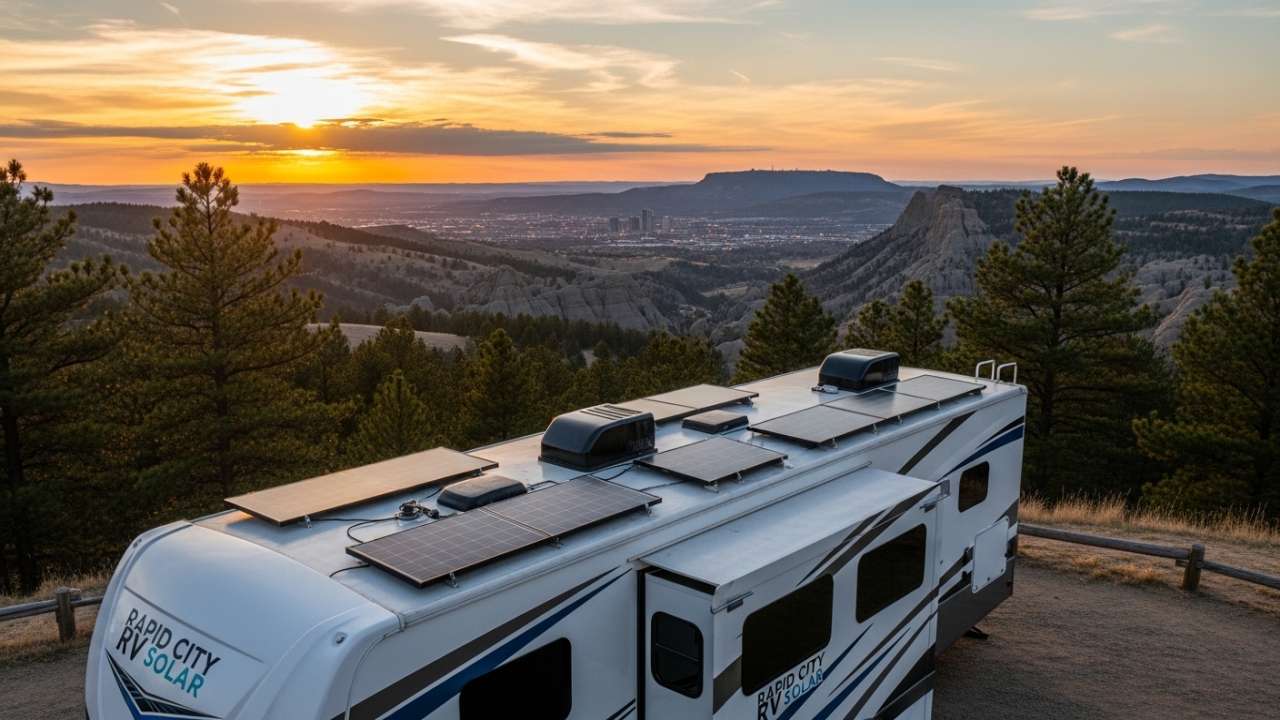
n dozens of locations. Why Rapid City specifically?
Convergence of factors:
- Elevation + latitude = optimal solar conditions
- Moderate climate = consistent year-round performance
- Local expertise = installers who understand Black Hills specifics
- BLM land access = freedom to test and optimize your system
- Tourism infrastructure = if something fails, help is nearby
- Seasonal camping excellence = genuine reason to be here beyond just solar
This isn’t marketing. It’s the actual appeal. Rapid City is where practical solar meets beautiful camping.
Your Next Step: From Research to Reality
Solar in the Black Hills isn’t complicated. It’s not mysterious. It’s also not something you should rush.
Best approach:
- Contact 3-4 installers mentioned in this guide
- Get quotes (free consultations from all of them)
- Ask to visit past installations if possible
- Start with 4-5 kW if unsure (most RVers end up here)
- Plan for seasonal flexibility (don’t expect summer production year-round)
- Commit to the lifestyle (solar enables freedom; you still need to show up)
Final Thought: The Real Payoff
The best solar installations in the Black Hills don’t look like success stories from Instagram. They look like reality: RVers parked in remote meadows, powering their devices, living comfortably, without generator noise.
That’s the real win.
Not the financial payback (though that’s real). Not the environmental feel-good (though that matters). But the tangible, daily freedom to be where you want to be, powered by the sun, with nothing but mountains and silence as your backdrop.
Rapid City’s solar community—the installers, the boondockers, the people who’ve solved this problem—they’ve figured something out that most tourism destinations haven’t: how to marry modern power needs with genuine wilderness access.