Your RV air conditioner just went silent on a 95°F day. Your wallet just winced. But here’s what surprised me after fixing hundreds of RV AC problems—most of them are a 5-minute fix. A tripped breaker. A frozen coil. Filters so clogged they block everything. Before you book a $300+ service call, let me walk you through exactly what to check and in what order.
I’ve been through every AC nightmare: compressors dying in the Nevada desert, refrigerant leaks that cost $1,200 to fix, units that just stopped cooling even though they ran fine last season. And I’ve learned the tricks the pros use first. This guide cuts straight to it—diagnose your problem in minutes, fix it yourself if you can, and know exactly when to surrender to a technician.
Why Your RV AC Actually Stops Working (And Why It Matters)
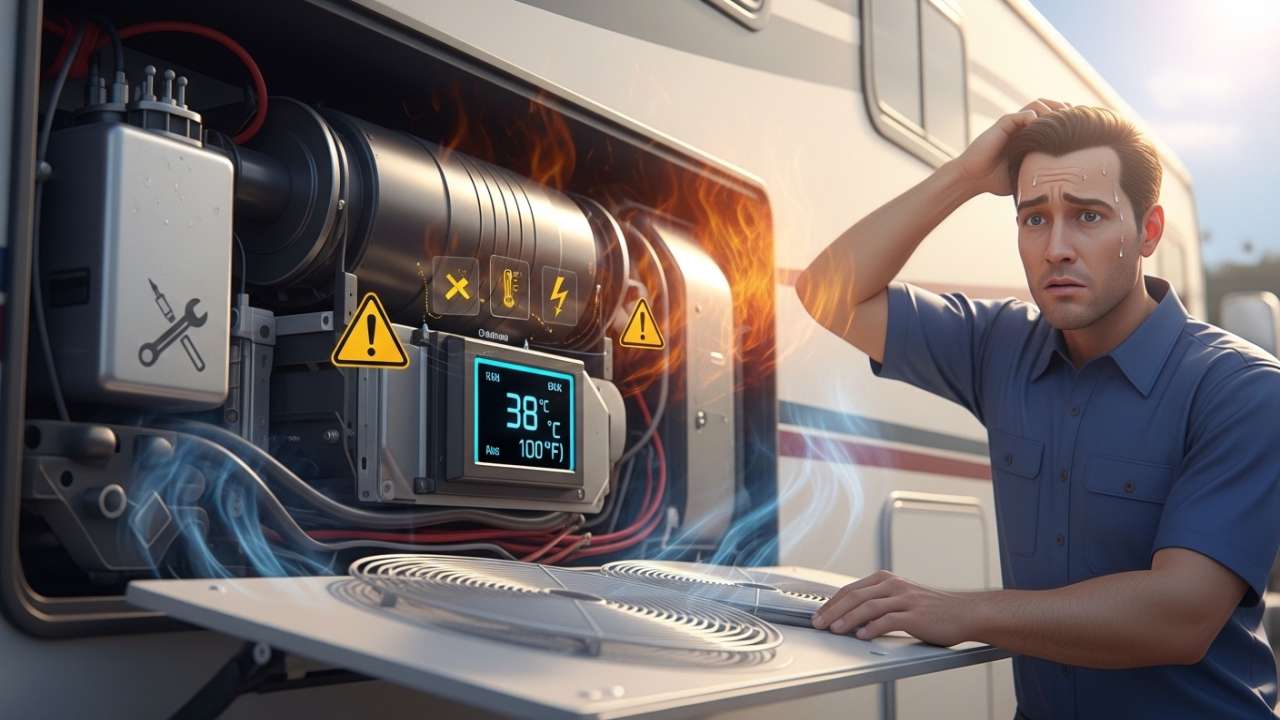
Your RV AC isn’t one unit—it’s a system. The outdoor condenser pulls air, the compressor pressurizes refrigerant, indoor coils exchange heat, and a capacitor kicks the whole thing to life. Break one link, and the whole chain fails. Most failures aren’t catastrophic. They’re warning signs your AC gave you that you missed.
Seasonal AC shutdowns? Temperature swings during storage? Humidity that won’t quit? These aren’t random. RV AC units are engineered for constant 24/7 travel, not months of sitting in a hot lot. They’re stressed from day one.
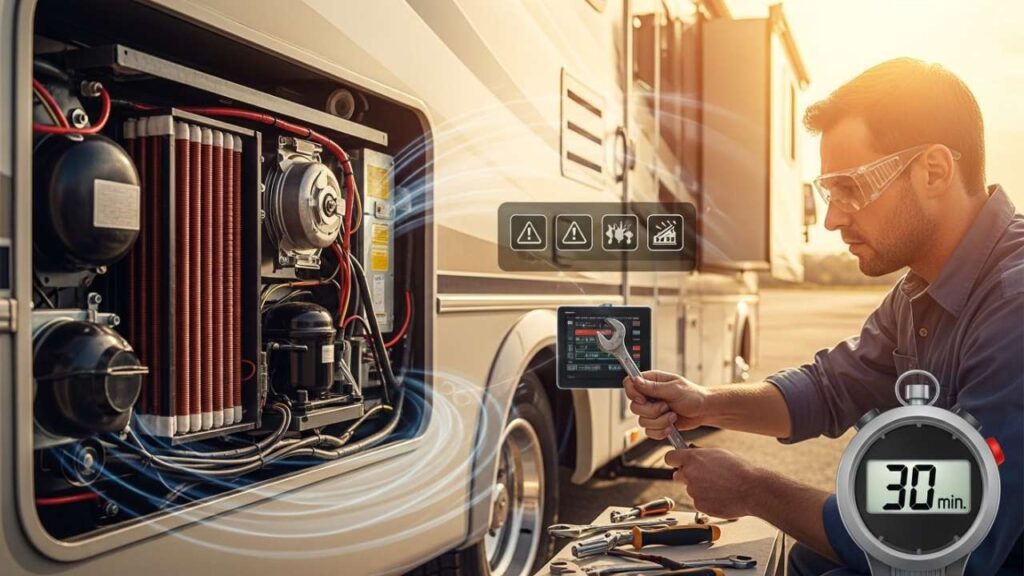
Also Read:- RV Air Conditioner Not Working? Troubleshoot & Fix in 30 Minutes (No Technician
Step 1: Check Power & Breakers (2 minutes)
This is where 30% of “broken” AC units actually are.
Walk to your breaker panel inside the RV. Look for a tripped breaker labeled “AC” or “A/C.” It’ll be switched down or in the middle. Flip it fully off, wait 5 seconds, then flip it back on. Listen for the condenser outside to kick on.
Still nothing? Check the outside disconnect switch on your RV (usually mounted near the AC unit itself). It’s a small box with a handle. Make sure it’s fully engaged—sometimes it pops out from vibration during travel.
Both are fine? Plug into shore power. Does the AC breaker trip immediately when you turn on the AC unit? That’s a short circuit inside the unit—stop here and call a technician. It’s not a 30-minute fix.
| Issue | Solution | Time |
|---|---|---|
| Breaker tripped | Flip to off, wait 5 sec, flip back on | 1 min |
| Outside disconnect off | Push handle fully in until it clicks | 1 min |
| Breaker trips again immediately | Stop. Electrical short inside unit. Call pro. | N/A |
Step 2: Verify Thermostat Settings (1 minute)
I can’t tell you how many RVers thought their AC was broken because the thermostat was set to heat mode.
Check these:
- Mode dial = COOL (not heat, not fan-only)
- Temperature set below current interior temp (at least 5°F lower)
- Fan switch = AUTO or ON (not off)
If it’s winterized mode or emergency shutdown mode is on, you’ll see that on the display. Reset it.
AC still silent? Move to Step 3.
Step 3: Look at the Condenser Unit (5 minutes)
Walk outside. Locate the AC condenser (looks like a square box, usually on the roof or rear of your RV).
Listen: Does it hum? You should hear a low hum when it powers on.
Look for:
- Leaves, dirt, bugs blocking the intake vents → clean it
- Ice buildup on the coils → freeze issue (Step 5)
- Bent fins on the condenser → bent fins reduce cooling (still works, just less efficient)
Use a soft brush or compressed air to gently clean the condenser. Don’t use a pressure washer—you’ll bend the aluminum fins and make things worse.
Hums but no cold air inside? Refrigerant leak or compressor issue. Skip to Step 5.
Step 4: Check & Clean the Filter (3 minutes)
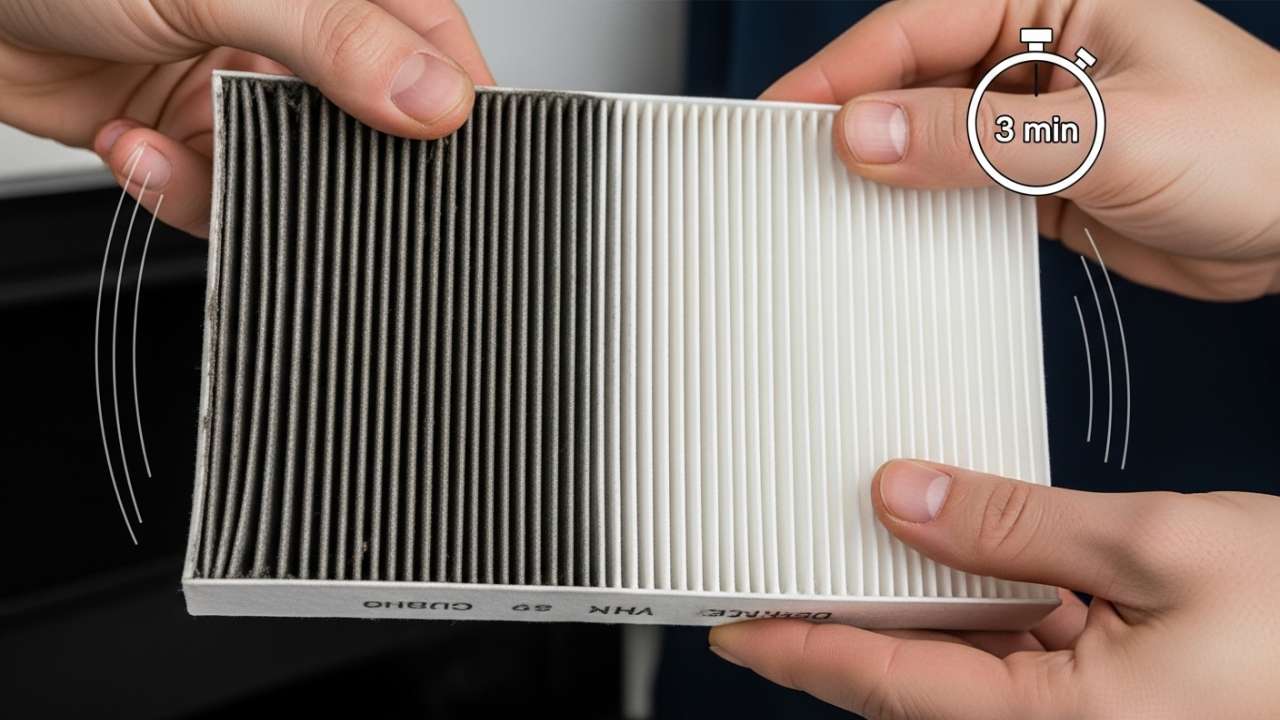
A clogged filter starves your AC of air and kills cooling power.
Locate the filter: Usually in a return air duct inside your RV (check ceiling vents or wall returns).
Replace or clean it:
- Disposable filter? Toss it and install a new one ($8–15).
- Reusable filter? Vacuum both sides gently, then rinse with a hose outside. Let it dry completely before reinstalling.
Pro tip: If you’re on the road, keep two extra filters. A clogged filter doesn’t just kill AC—it strains the whole system and shortens the compressor’s life.
Still no cooling after cleaning? Move to Step 5.
Also Read:- RV Fuel Efficiency: 10 Secrets That Cut Gas Costs 50% (2026 Guide)
Step 5: Diagnose the Refrigerant Problem (5 minutes)
This is where most RV AC failures actually live—low refrigerant or a frozen evaporator coil.
The Frozen Coil Test
Close all vents except one. Put your hand on the cold air outlet for 10 seconds.
- Ice cold (below 40°F)? Good—refrigerant is circulating.
- Cool but not cold? Refrigerant might be low.
- Warm or room temperature? Compressor isn’t running or refrigerant is critically low.
If you suspect a freeze:
- Turn off the AC.
- Run the fan only for 15 minutes to thaw the coil.
- Wait 30 minutes without running AC.
- Try again.
Why freezing happens: A leak drops refrigerant too low. Low refrigerant pressure causes the evaporator coil to ice over. Ice blocks airflow. The unit shuts down or struggles. This is your system’s self-defense mechanism.
Refrigerant Leak Signs
- Oil stains under the condenser or around the indoor unit
- AC gets colder for 5 minutes, then suddenly warm (it’s freezing and unfreezing)
- Running 24/7 but barely keeping up (fighting against low charge)
If you see these: You have a refrigerant leak. This requires EPA certification to fix legally. You need a pro.
Step 6: Check the Capacitor (If the Condenser Hums But Doesn’t Start)
The capacitor is a small cylinder (usually 2–4 inches tall) that gives the compressor the kick to start. If it fails, the compressor hums but never actually runs.
You can hear it failing: A faint buzz or hum, but the compressor doesn’t engage.
To check visually:
- Look for the capacitor near the compressor on your condenser unit.
- Swollen top? It’s dead.
- Burned or leaking fluid? Dead.
This is a $30–80 part, but replacing it requires:
- Safely discharging the capacitor (it holds a charge).
- Desoldering the old one.
- Soldering the new one in.
If you’re handy with a soldering iron, this is doable. If not, this is a technician’s job. Takes them 15 minutes, costs $150–250 with labor.
| Component | Cost | DIY? | Time |
|---|---|---|---|
| Filter replacement | $8–15 | Yes | 5 min |
| Capacitor replacement | $30–80 | Maybe | 15–30 min |
| Refrigerant top-up | $200–400 | No (EPA cert req) | 45 min |
| Compressor replacement | $800–1,500 | No | 2–3 hrs |
Step 7: When to Call a Professional (And What It Costs)
Stop troubleshooting and call a tech if:
- Compressor won’t run at all (no hum from outside unit) → Likely capacitor or electrical issue ($150–350)
- Compressor hums but no cooling after you’ve cleaned filters and verified settings → Possible refrigerant leak ($400–800 depending on location)
- You see oil stains under the unit → Refrigerant leak confirmed ($400–800+)
- AC cycles on for 5 minutes then off repeatedly → Low refrigerant or overheating compressor ($300–1,000+)
- Breaker trips immediately when AC turns on → Short circuit in the unit ($200–500+ diagnostics)
- Ice buildup won’t thaw even after running fan-only for 20 minutes → Systemic refrigerant problem ($400–1,200+)
RV AC repair costs vary wildly by location:
- Small town near major city: $150–250/hour + parts
- Remote area (ski resort, desert): $300+/hour + parts
- Mobile tech who comes to you: Often 20–30% markup
- Dealership: 40–60% markup over independent shop
Pro tip: Call 2–3 independent RV service shops in your area before booking. A reputable shop will do a $50–100 diagnostic fee that gets credited toward repairs.
Quick Comparison:
| Problem | DIY Cost | DIY Time | Pro Cost | Pro Time | Difficulty |
|---|---|---|---|---|---|
| Clogged filter | $8–15 | 5 min | $50–100 | 15 min | Easy |
| Tripped breaker | $0 | 2 min | $75–150 | 10 min | Trivial |
| Frozen coil thaw | $0 | 45 min | $100–200 | 30 min | Easy |
| Capacitor replacement | $30–80 | 15–30 min | $150–250 | 30 min | Moderate |
| Refrigerant top-up | Illegal DIY | N/A | $300–600 | 45 min | Professional only |
| Compressor replacement | $800+ (part only) | 2+ hrs | $1,500–3,000 | 2–4 hrs | Professional only |
Prevention: Keep Your RV AC Alive

One thing RV owners skip that costs them $500+ in repairs:
- Clean the condenser monthly during heavy use (spring/summer travel). Bugs + dust = airflow killer.
- Replace the filter every 2 months or when you notice airflow dropping.
- Run the AC for 15 minutes weekly in winter, even if you’re not traveling. Idle AC systems lose refrigerant charge over months.
- Service the unit annually before peak season. A technician will check refrigerant levels, clean coils, test capacitor health.
- Winterize properly. If storing in winter, don’t leave the unit running. Flush the lines and cap them properly.
What annual maintenance costs: $100–150 (diagnostic + condenser cleaning). What is ignoring maintenance costs: $400–2,000 in emergency repairs
Frequently Asked Questions
Q: Can I refill my RV AC refrigerant myself?
A: Legally, no. In the USA, you need EPA Section 609 certification to handle refrigerant. Violating this carries fines of $2,500–25,000. That said, independent techs are cheaper than dealerships—find one with the cert and negotiate a fair price.
Q: Why does my AC stop cooling after running all day?
A: Your compressor is overheating. This happens when the condenser intake is blocked (dust, bugs), the capacitor is weak (struggles to deliver full power), or refrigerant is low. Clean the condenser first. If it persists, you likely have a slow refrigerant leak.
Q: Is it normal for my RV AC to be loud?
A: Modern RV ACs are surprisingly quiet. If yours just got loud (clicking, grinding, squealing), stop running it. Compressor noise usually means mechanical failure or compressor cavitation (low refrigerant). Call a tech.
Q: How long should an RV AC unit last?
A: 10–15 years with proper maintenance. Most fail earlier due to neglect (clogged condenser, dirty filters, no winterization). A $100 annual service can add 5+ years to your AC’s life.
Q: Can I run my RV AC on generator power?
A: Yes, but most RV ACs draw 12–15 amps at startup. You need at least a 30-amp generator. If you’re running on battery, the AC will drain a full battery in 1–2 hours. Shore power or a large generator is your friend.
Q: My AC works but only blows cool air from one vent. Why?
A: Check the vent selector controls. Most RVs have manual or digital vent selectors that direct airflow to specific zones. If all vents are “open” in the selector and one is still blocked, you have a blocked ductwork line (leaves, rodent nest, collapsed duct). This needs a tech visit.
Q: Should I run my AC on autopilot mode?
A: Autopilot (thermostat controls temp automatically) is fine for short trips. On long journeys, especially in extreme heat, manually set it to cool mode. Autopilot can miss temperature swings if your RV is parked in shifting shade.