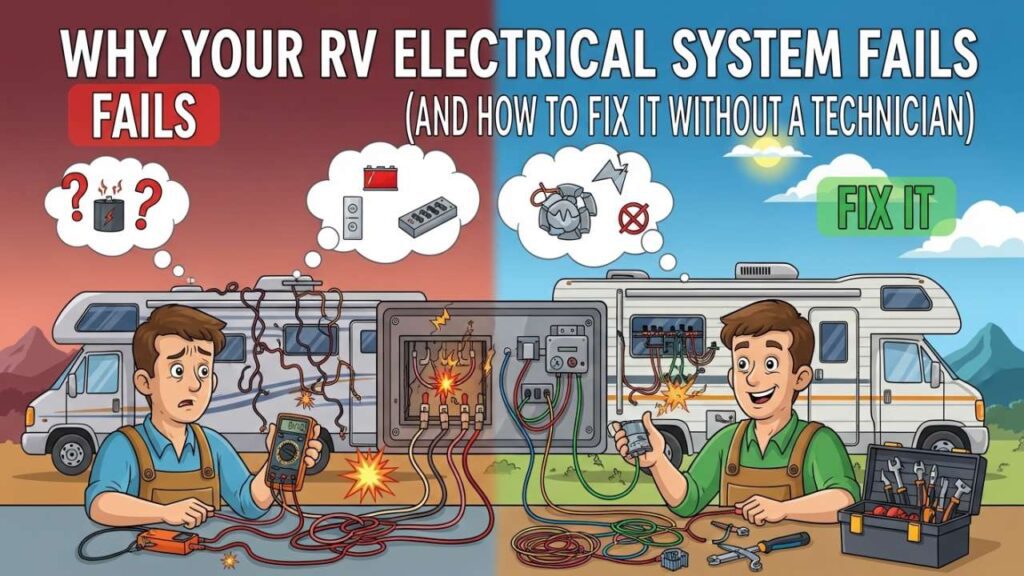
You’re parked at your favorite campground. The sun’s setting. You flip the light switch and… nothing. No lights. No fridge humming. No charging. Your whole RV goes dark.
That moment? It’s the panic every RV owner dreads.
But here’s what surprised me after talking to dozens of RVers: most electrical failures aren’t catastrophic. Most of the time, it’s something you can fix yourself in under an hour. A loose battery terminal. A tripped breaker. A corroded connection. Simple stuff that costs nothing but five minutes of your time.
The problem? RV electrical systems look intimidating. 12-volt batteries, converters, inverters, shore power hookups—it feels like you need an engineering degree just to understand the basics. So people panic. They call technicians. They pay $150+ just for a diagnosis.
This guide changes that. We’re breaking down exactly what causes RV electrical problems, how to diagnose them like a pro, and which fixes you can actually do yourself. No jargon. No guesswork. Just straightforward troubleshooting that works.
Understanding Your RV’s Electrical System (The Basics First)
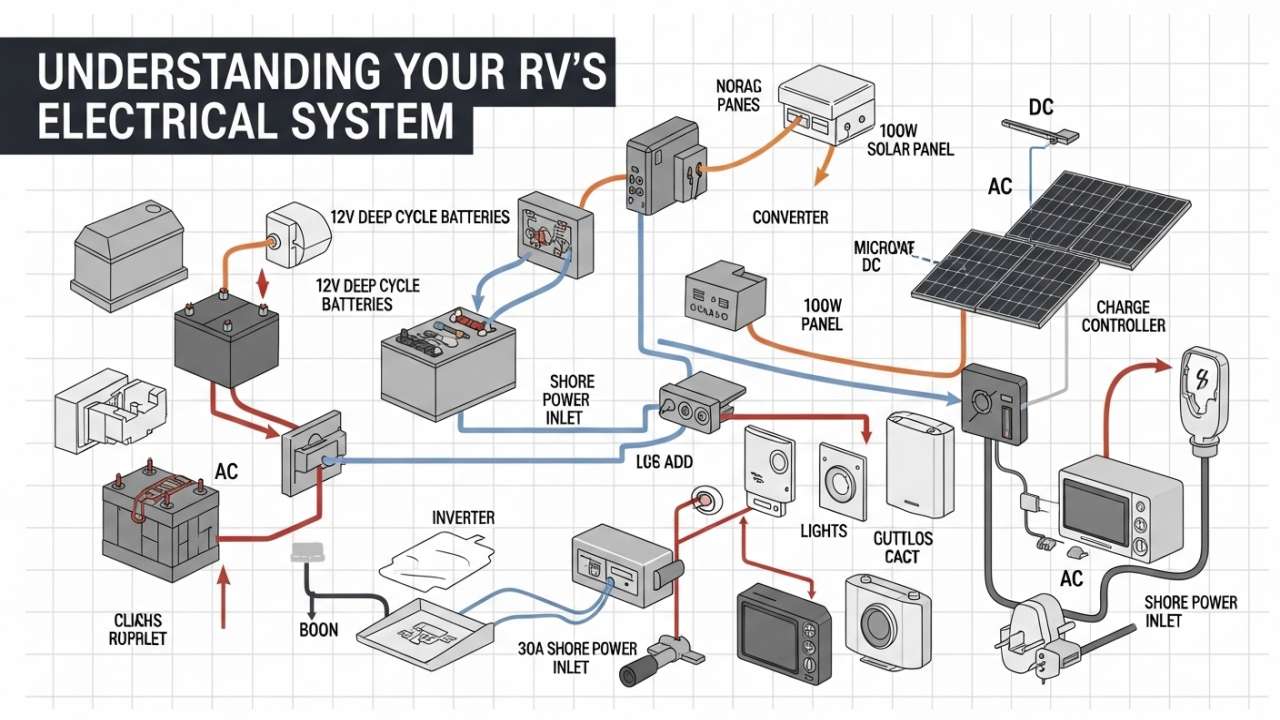
Before you troubleshoot, you need to understand what you’re working with. RV electrical systems aren’t complicated once you see how they connect.
Most RVs run on two separate electrical systems working together:
12-Volt DC System — powers lights, water pumps, slide-outs, and furnace ignition when you’re boondocking (off-grid). This runs off your house battery or chassis battery.
120-Volt AC System — powers your AC unit, microwave, washer, TV, and outlets when you’re plugged into shore power or running a generator.
Here’s what happens: when you’re at a campground plugged in, the converter transforms that 120V AC into 12V DC to charge your batteries and run 12V appliances. When you’re off-grid, you live purely on battery power. When you’re driving, the alternator charges everything.
This dual system is why RV electrical failures can feel random—you might have power at the outlets but no lights, or vice versa. The failure is almost always isolated to one system, not both.
Also Read:- Best RV Awnings: Manual vs. Electric—$800-$3,500 Explained
The good news? Understanding this separation is 80% of successful troubleshooting.
The Most Common RV Electrical Problems (Ranked by Frequency)
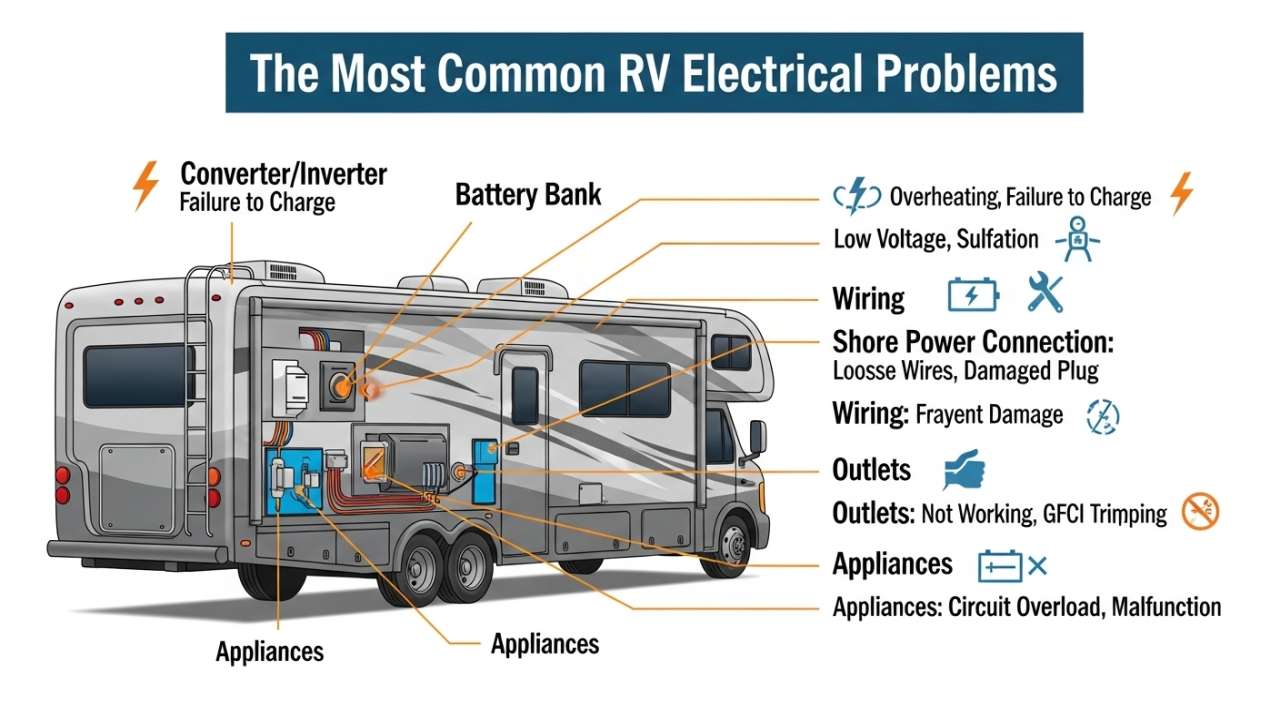
Not all electrical problems are equal. Some happen constantly. Others are rare but catastrophic.
Here are the issues we see most often:
Dead or Weak Battery
This is #1. Cold weather, age, parasitic drain, or simply not charging properly during your last trip kill your house battery. Symptoms: dim lights, slow slide-outs, weak water pump.
Loose or Corroded Battery Terminals
A simple connection issue that mimics a dead battery. Oxidation builds up on terminals, blocking current flow. You’ve got power but can’t access it.
Tripped 12-Volt Breaker
The converter has a breaker that protects the system. Something draws too much power—maybe a short circuit or an appliance malfunction—and click, you’re cut off.
Bad Converter
The converter is the bridge between shore power and 12V systems. When it fails, you lose battery charging and 12V power even when plugged in. This one usually needs professional replacement.
Inverter Issues
If you have an inverter, it converts 12V DC to 120V AC. A failing inverter won’t power your outlets or high-draw appliances.
Shore Power Not Working
You’re plugged in but nothing happens. Could be the pedestal (the campground’s fault), your shore power cable, or your RV’s power inlet.
Water Pump Running Without Water
The pump draws power but doesn’t produce water. Usually means a dead battery or bad pump relay, but can indicate a wiring issue.
Also Read:- They Stole My RV Battery in 30 Seconds — Here’s What I Do Now (2026 Guide)
Diagnosis Step 1: Isolate the Problem (Which System Failed?)
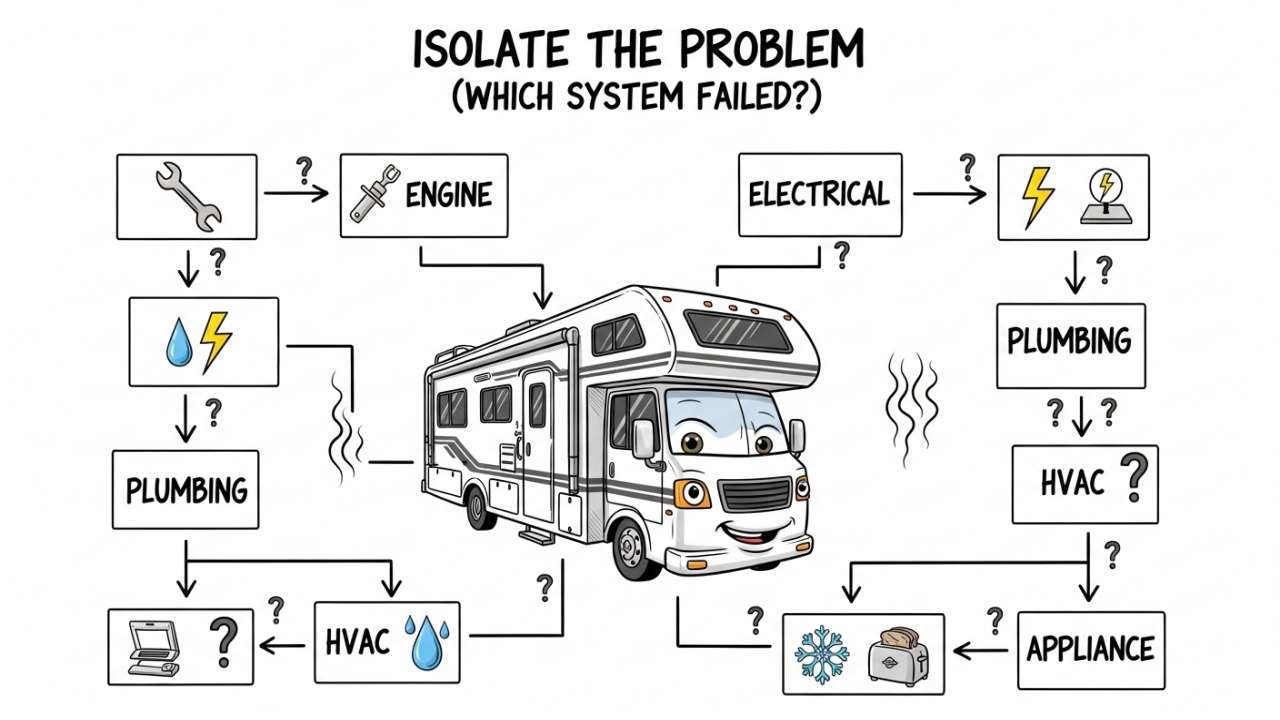
Here’s your first move: figure out if it’s 12V, 120V, or both.
Test 1: Is your RV plugged in?
- If yes, and 120V outlets aren’t working, → shore power or converter issue
- If yes, but 12V lights are dead → converter or battery issue
- If no, you’re on battery power alone
Test 2: Are your 12V lights working?
- Turn on an interior 12V light (ceiling light, reading light)
- If nothing → 12V system failure
- If lights work → 120V system failure (your problem is isolated)
Test 3: Check the battery monitor (if you have one)
- Does it show voltage? If under 11V, your battery is nearly dead
- If it shows normal voltage but lights are dim → likely a connection issue, not a dead battery
Test 4: Listen for the converter
- When plugged in, does the converter hum or buzz? If silent → it’s not charging
- If silent and you have no 12V power → likely converter failure
Why this matters: Isolating the problem saves hours. If it’s just 12V, you’re probably looking at a $0–$50 fix. If it’s the converter, you’re calling a technician. If it’s shore power, it might be the campground, not you.
Diagnosis Step 2: The Visual Inspection (Check These First)
Before you test anything with a multimeter, look at what you can see.
Battery terminal inspection:
- Open your battery compartment
- Look at the positive (red) and negative (black) terminals
- Are they green, white, or blue? That’s corrosion. Loose? That’s your problem.
- Is the cable visibly damaged, cracked, or burnt?
Breaker panel:
- Locate your 12V breaker panel (usually near the battery or converter)
- Are any breakers in the middle (tripped position)?
- Flip any that aren’t fully in the “ON” position
Shore power cable:
- Look at the cable where it plugs into your RV
- Any damage, bent pins, or burnt contacts?
- Is it plugged in fully?
Battery condition:
- How old is your battery? If it’s 5+ years old, failure is normal
- Does the battery have any visible damage or leaks?
Converter and inverter:
- Look for burn marks, loose wires, or obvious damage
- If it’s really hot to the touch → serious issue, turn it off
This visual inspection catches 40% of problems without needing any tools.
Diagnosis Step 3: Multimeter Testing (The Real Troubleshooting)
If visuals didn’t reveal anything, it’s time to measure voltage.
You’ll need:
- A multimeter (basic models are $10–20 from any hardware store)
- Five minutes and basic confidence
Test your battery directly:
- Set multimeter to DC voltage (usually marked “V” with a straight line)
- Touch the red probe to the positive terminal, black probe to negative
- A healthy battery shows 12.6V–13.2V when resting
- Below 11V = dead or severely discharged
- 12V–12.6V = partially discharged or old battery
Test at the converter input (when plugged in):
- Find the main power input wire to your converter
- Measure voltage there
- Should show 120V AC (you’ll need AC setting on multimeter)
- If 0V → shore power or shore power receptacle is bad
- If present but converter still isn’t charging → converter failed
Test your breaker:
- With everything plugged in, check voltage on the battery side of the main 12V breaker
- Should read 12V+ if breaker is working
- If 0V or very low → breaker is tripped or bad
This three-point test tells you exactly where the failure is.
Also Read:- RV Solar System Cost 2026: Real Prices Nobody Tells You
Common Fixes You Can Do Right Now

Once you know what’s wrong, most fixes are genuinely simple.
Fix 1: Clean Corroded Battery Terminals (5 minutes)
What you need:
- Baking soda
- Water
- An old toothbrush
- Wrench
Steps:
- Disconnect negative battery terminal first
- Mix baking soda and water into a paste
- Scrub terminals and cable ends with the toothbrush
- Wipe clean with a rag
- Reconnect negative terminal, then positive
- Turn on lights—they should brighten immediately
Cost: $0 (you probably have baking soda at home)
Fix 2: Tighten Loose Battery Terminals (2 minutes)
What you need:
- Wrench (usually 5/16″ or 3/8″)
Steps:
- Disconnect negative terminal
- Tighten the bolt on the positive terminal (turn clockwise until snug—don’t over-tighten)
- Tighten negative terminal
- Reconnect and test
Cost: $0
Fix 3: Reset a Tripped 12V Breaker (30 seconds)
What you need:
- Nothing—just your hands
Steps:
- Locate your 12V breaker panel (usually a small box near battery or converter)
- Look for any breakers in the middle position (not fully ON)
- Flip them fully to the ON position
- Check if power returns
Cost: $0
If the breaker trips again immediately, don’t keep resetting it. You have a short circuit and need professional help.
Also Read:- Best RV Solar Panels for New Mexico Extreme Heat (2026 Desert Solar Guide)
Fix 4: Test and Replace a Blown Fuse (10 minutes)
RVs have multiple fuse blocks. If a specific appliance dies (water pump, fridge, lights), a fuse likely blew.
What you need:
- Replacement fuses (get a kit, $5–10)
- Fuse puller (comes in kits) or needle-nose pliers
Steps:
- Find the fuse block (usually labeled)
- Locate which fuse corresponds to your dead appliance
- Pull the fuse straight out
- Look at the wire inside—is it broken? That’s your blown fuse
- Replace with same amperage (should be marked on fuse)
- Test appliance
Cost: $5–10
Fix 5: Charge a Deeply Discharged Battery (4–8 hours)
If your battery reads below 10V, it needs a proper charge, not just generator power.
What you need:
- Shore power connection or generator
- Patience
Steps:
- Plug your RV into shore power or start the generator
- Leave the converter running for several hours (don’t drain the battery by running appliances)
- Check voltage every hour—should rise slowly
- Once it reaches 12.6V+, you’re good
Cost: $0 (just time)
When to Call a Professional (Don’t DIY This)
Some problems need trained hands. Knowing when to stop saves money long-term.
Call a technician if:
Converter completely failed — If your battery shows good voltage but won’t charge when plugged in, and you’ve confirmed shore power is present, the converter is likely dead. Replacement runs $300–800 depending on model. This requires proper installation.
Multiple breakers tripping — This indicates a serious short circuit in the wiring. Electrical fires are a real risk. Don’t mess with this.
Battery won’t hold charge — You’ve charged it fully, but it drops from 13V to 8V in 24 hours with nothing running. The battery is failing internally and needs replacement ($150–400). Sometimes it’s a bad alternator, which is even more expensive.
Shore power receptacle damaged — If you can see burnt contacts or the plug won’t seat properly, the receptacle or incoming wiring is compromised. This is a fire hazard.
Inverter making noise or getting hot — Failing inverters can damage appliances or catch fire. Get it checked immediately.
Water in battery compartment — Flooding or condensation in the battery box indicates corrosion inside the battery or wiring. Professional inspection required.
The rule: If you’re not 100% confident, call someone. A $150 diagnosis fee beats a $5,000 electrical fire.
Preventive Maintenance (Stop Problems Before They Start)
Most RV electrical failures are preventable.
Monthly Checks:
- Visual inspection of battery terminals (look for corrosion, loose connections)
- Check battery voltage with a multimeter (should be 12.6V+ at rest)
- Test one 12V light and one 120V outlet to confirm both systems work
Quarterly Checks:
- Clean battery terminals even if they don’t look corroded (oxidation builds slow)
- Test your shore power by plugging in and checking 12V charging
- Run your generator for 30 minutes to keep it healthy
Seasonal Checks (Before Long Trips):
- Full battery load test (run your fridge, lights, water pump simultaneously for 30 minutes—voltage should stay above 11.5V)
- Inspect all visible wiring for damage
- Test every 12V appliance individually
- Confirm converter is humming when plugged in
Annual Tasks:
- Battery replacement if it’s 5+ years old (don’t wait for failure)
- Professional inspection if you’re uncomfortable DIYing
- Clean corrosion from alternator connection points
Why this works: Catching a corroded terminal takes five minutes. Fixing a dead alternator takes days and $600+.
Comparison Table: RV Electrical Problems vs. Solutions
| Problem | Symptom | Likely Cause | DIY Fix? | Cost |
|---|---|---|---|---|
| Dead battery | Dim lights, no power | Age, parasitic drain, no charging | Yes (charge it) | $0–$50 |
| Corroded terminals | Slow power, intermittent | Oxidation buildup | Yes (clean) | $0 |
| Loose connection | Flickering lights, weak 12V | Terminal not tight | Yes (tighten) | $0 |
| Blown fuse | One appliance dead, others work | Overcurrent or short | Yes (replace) | $5–$15 |
| Tripped breaker | All 12V dead or specific circuit | Overload or short | Yes (reset) | $0 |
| Converter failed | No 12V charging when plugged in | Internal failure | No | $300–$800 |
| Bad inverter | 120V outlets dead | Inverter malfunction | No | $400–$1,200 |
| Shore power broken | Everything dead when plugged in | Cable, receptacle, or pedestal | Maybe | $50–$300 |
| Water pump dead | Pump won’t run | Relay, fuse, or pump | Maybe | $50–$400 |
FAQ: Your RV Electrical Questions Answered
Q: My RV battery is draining overnight even though nothing is plugged in. What’s happening? A: Parasitic drain—something is drawing power when the RV is off. Usually a radio memory, monitor system, or converter in standby mode. It’s normal if it loses 1–2% per week, but faster means a failing battery or a real short. Use your multimeter to check if it’s fully charged before bed, then again in the morning.
Q: Can I charge my RV battery with a car charger? A: Not recommended. Car chargers are designed for car batteries, which have different amp requirements. Use an RV-specific battery charger or shore power with your converter. Using the wrong charger can overcharge and damage your battery.
Q: Is it safe to run my RV while my battery is dead? A: Yes, you can drive and the alternator will charge the battery. But don’t run 12V appliances heavily until it reaches 12.6V. Your water pump, fridge, and lights will work but slowly. Once you’re driving regularly, the alternator recharges everything.
Q: Why does my RV electrical system work sometimes but not other times? A: Intermittent failures are almost always loose or corroded connections. They work when vibration jiggle things into place, fail when they don’t. This is a clean and tighten everything situation. Check battery terminals, breaker connections, and alternator wiring.
Q: Can I add solar panels to my RV electrical system myself? A: Yes, if you’re comfortable with basic wiring. You’ll need a charge controller, panels, breaker, and proper wire gauge. Many RVers DIY solar successfully. But if you’re unsure about voltage drops or breaker sizing, hire an installer—$500 beats a $2,000 fire.
Q: How do I know if my RV alternator is failing? A: Battery stays low even while driving. If your battery drops to 11V while the engine is running and cruising, the alternator isn’t charging. Also check: does the charging light on your dash stay lit while driving? That’s a sign. Alternator replacement is $300–$600 and needs a mechanic.
Q: Is it normal for my converter to make noise? A: A gentle hum is normal. A loud buzzing, clicking, or high-pitched whine means something’s wrong—could be a failing transformer or cooling fan. If it’s really loud or gets hot, turn it off and have it inspected.
Conclusion: You’ve Got This
RV electrical failures feel catastrophic until you understand what you’re looking at. Then? They’re usually quick fixes.
Next time your RV goes dark, you know exactly what to do:
- Isolate — Is it 12V, 120V, or both?
- Inspect — Check terminals, breakers, and connections visually
- Test — Use a multimeter to measure voltage at key points
- Fix — Clean, tighten, or reset what you find
- Know your limits — Call a professional for converter failures, short circuits, and serious issues