You’ve found the perfect RV. The price is right. The layout screams “this is it.” Then comes the scary part: will you actually get approved for the loan?
I’ve watched plenty of RV dreamers get denied after falling in love with a specific vehicle. And the frustrating part? Most of them didn’t realize what lenders actually look for. They thought a decent credit score was enough. Or they didn’t understand why the lender asked for seemingly endless paperwork. Or they found out too late that their debt-to-income ratio was over the limit.
The good news? RV loan requirements are totally transparent once you know what lenders care about. There’s no mystery here. No tricks. Just clear rules and a predictable process. And honestly, understanding this upfront saves you heartbreak—and months of time.
This guide walks you through every RV loan approval requirement, what lenders actually check, the exact documents you’ll need, and the step-by-step RV approval process. By the end, you’ll know exactly where you stand and what to fix before applying.
The Three Pillars of RV Loan Approval
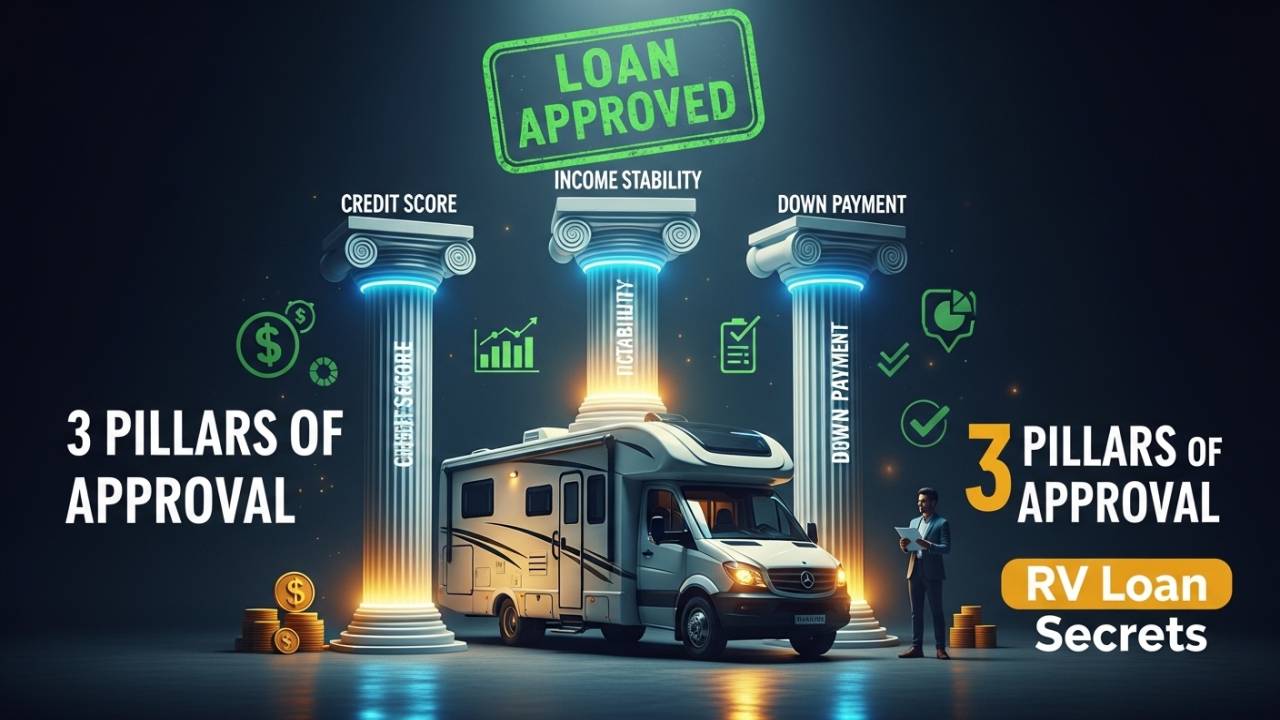
Before we dive into specifics, understand the big picture. Lenders evaluate three main things when deciding whether to approve your RV loan application:
- Your creditworthiness (credit score + payment history)
- Your ability to pay (income + debt-to-income ratio)
- The RV’s value (age, condition, market value)
Get any one of these wrong, and approval gets harder. Get all three right, and you’ll sail through.
Also Read:- RV Financing & Loan Options: What You Need to Know (2026)
Credit Score: The Single Most Important Factor
Your credit score requirement is the first gatekeeper. It determines whether you even get considered for a loan.
Minimum Credit Scores by Lender Type
Most lenders generally require a credit score of 670 or higher, but there’s variation across lender types:
| Lender Type | Minimum Credit Score | Best Rate Tier | Notes |
|---|---|---|---|
| Traditional Banks | 700+ | 750+ | Stricter requirements, lowest rates if you qualify |
| Credit Unions | 650–680 | 700+ | More flexible, often better rates than banks |
| Specialized RV Lenders | 600–620 | 680+ | Will work with lower scores, higher rates |
| Online Personal Loan Lenders | 580–600 | 660+ | Highest rates, max loan $100,000 |
| Dealer Financing | 620–650 | 700+ | Varies by dealership network |
Real talk: If your score is below 600, you’re going to struggle with mainstream lenders. You might need a cosigner or a much larger down payment (30%+).
Why Your Credit Score Matters This Much
Your credit score tells lenders one thing: How likely are you to pay back this loan? It’s based on:
- Payment history (35%) — Did you pay your bills on time?
- Credit utilization (30%) — How much of your available credit are you using?
- Length of credit history (15%) — How long have you had credit accounts?
- Credit mix (10%) — Do you have variety (credit cards, auto loans, etc.)?
- New inquiries (10%) — Have you recently applied for lots of credit?
The higher your score, the lower your risk. The lower your risk, the lower your interest rate. That translates to real dollars.
Example: A $100,000 loan at 7% APR (good credit) costs about $41,000 in interest over 10 years. The same loan at 12% APR (fair credit) costs about $66,000 in interest. That’s a $25,000 difference.
How to Check and Improve Your Credit Before Applying

Step 1: Check your credit reports
Go to AnnualCreditReport.com (it’s free, it’s legit). Get your reports from all three bureaus: Equifax, Experian, and TransUnion. Errors are more common than you’d think—wrong account information, fraudulent accounts, duplicate payments marked as missed.
Step 2: Dispute errors
Found an error? The process is free. Write to the bureau with documentation. They have 30 days to investigate. Fixing errors can boost your score by 20–50 points.
Step 3: Pay down existing debt
Pay down credit card balances below 30% of limits (improves credit utilization ratio). If you have $5,000 credit limits and $4,000 in balances, you’re at 80% utilization—that hurts your score. Get it to 30% and watch your score climb.
Step 4: Make on-time payments
For at least 6 months before applying, make every payment on time. No exceptions. This matters more than anything else.
Step 5: Avoid new credit inquiries
Don’t apply for credit cards, car loans, or other financing while you’re preparing for your RV loan. Each hard inquiry (when a lender checks your credit) can drop your score by 5–10 points.
Also Read:- How to Buy a Used RV: Complete Inspection Checklist for First-Time Buyers
Debt-to-Income Ratio (DTI): The Second Major Requirement
Your credit score gets you in the door. Your debt-to-income ratio determines how much you can borrow.
What Is DTI and How Do Lenders Calculate It?
Lenders calculate your DTI by dividing your total monthly debt payments by your gross monthly income.
Here’s the formula:
DTI = (Total Monthly Debt Payments) ÷ (Gross Monthly Income)
Example:
Total monthly debt payments: $1,500 (car payment $400 + credit cards $600 + student loans $500)
Gross monthly income: $5,000
DTI = $1,500 ÷ $5,000 = 30%
What DTI Do Lenders Want?
Most require a DTI below 40-45%, including your proposed RV payment. Ideally, aim for under 36% after adding your RV loan.
| DTI Range | Approval Likelihood | Interest Rate Impact |
|---|---|---|
| Under 36% | Very likely | Best rates available |
| 36–40% | Likely | Standard rates, may need better credit |
| 40–45% | Possible | Higher rates, may need larger down payment |
| Over 45% | Unlikely | Expect denial or need cosigner |
How to Improve Your DTI Before Applying
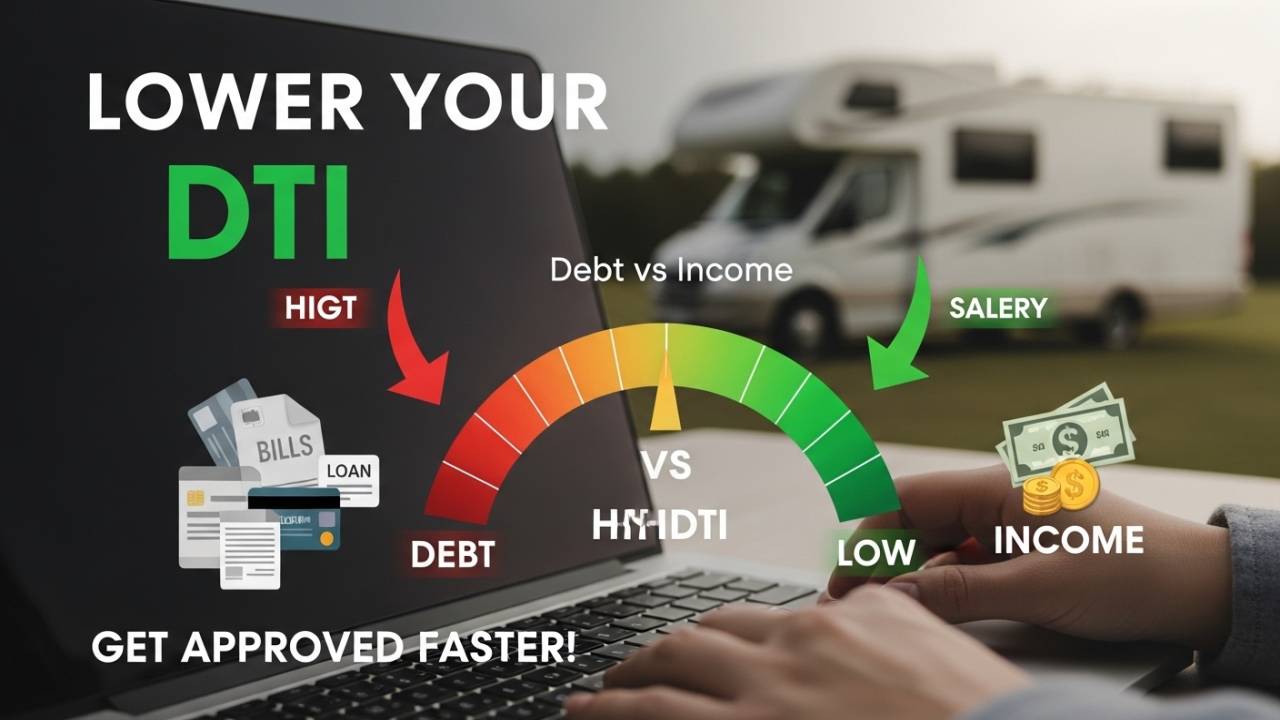
Option 1: Pay down existing debt
Every dollar you pay toward credit cards, car loans, or student loans directly improves your DTI. Pay off your smallest debts first—it shows the biggest impact. A $300/month reduction in existing debt lowers your DTI by 6% (if your income is $5,000).
Option 2: Increase your income
Got a second job? A raise coming? Document it. Lenders can use projected income if you can prove it’s stable. Freelance income needs to be averaged over 2 years, but it counts.
Option 3: Wait before applying
Sometimes time is the answer. If you’re close to a DTI threshold, waiting 6 months while you pay down debt can get you below 40% and unlock better rates.
Income Verification: Proving You Can Actually Pay
Lenders don’t just take your word that you make $5,000 a month. They want proof.
What Income Counts?
Not all income is created equal. Here’s what lenders typically accept:
| Income Type | Documentation Needed | How Long Back |
|---|---|---|
| W-2 Employment | Recent pay stubs + tax returns | Current year + prior year |
| Self-Employed | Tax returns + profit/loss statements | 2–3 years |
| Freelance/Contract | Tax returns + recent invoices | 2 years minimum |
| Social Security | Award letter | Current |
| Retirement Income | Account statements | Current |
| Rental Income | Tax returns + lease agreement | 2 years |
| Alimony/Child Support | Court documents + proof of payment | 2 years |
| Disability Income | Award letter | Current |
What Documents You’ll Need
Have these ready before you apply:
- 2 recent pay stubs (within 30 days)
- 2 years of tax returns (federal forms 1040, Schedule C if self-employed)
- 2 months of bank statements (to verify deposits match reported income)
- W-2s (for last 2 years)
- Proof of Social Security or retirement income (award letters, account statements)
Also Read:- 10 Best Budget RVs Under $50K for Beginners (2026 Guide + Buying Tips)
Employment History Matters
Most lenders prefer at least two years with the same employer or in the same industry. If you just changed jobs, be prepared to explain. A job change within your industry is fine. A major career switch? That might trigger additional scrutiny.
Down Payment: How Much You Need to Put Down

Your down payment directly affects approval odds and your interest rate.
Typical Down Payment Requirements
Most lenders require 10–20% down, though some go higher or lower depending on your credit:
| Credit Score | Typical Down Payment | Reasoning |
|---|---|---|
| 750+ | 10% | Excellent credit = lower risk |
| 700–749 | 15% | Good credit = standard requirement |
| 650–699 | 20%+ | Fair credit = need more skin in game |
| 600–649 | 25–30% | Poor credit = higher risk buffer |
| Below 600 | 30%+ | Very high risk = substantial down payment |
Why Down Payment Matters for Approval
A larger down payment does three things:
- Lowers your loan amount — If you put down $20,000 instead of $10,000, you’re borrowing $10,000 less. That’s immediate risk reduction.
- Improves your loan-to-value (LTV) ratio — Lenders compare your loan amount to the RV’s value. Putting down at least 10 percent shows good faith and improves your loan-to-value ratio, making approval more likely.
- Shows you’re serious — It demonstrates you have skin in the game. You’re not just asking the lender to take all the risk.
Real Math on Down Payments
Buying a $100,000 RV:
| Down Payment | Loan Amount | Monthly Payment (7%, 15 years) | Total Interest |
|---|---|---|---|
| $10,000 (10%) | $90,000 | $666 | $29,880 |
| $20,000 (20%) | $80,000 | $592 | $26,560 |
| $30,000 (30%) | $70,000 | $518 | $23,240 |
That extra $20,000 down saves you over $6,600 in interest and lowers your monthly payment by $148. That’s why lenders love big down payments.
RV-Specific Requirements: Age, Type, and Condition
Lenders don’t just care about you. They care about the RV you’re buying too.
RV Age Limits
How old can the RV be? It depends on the lender and loan amount:
- New RVs (0–2 years): All lenders finance these easily. Terms up to 20 years available.
- Recent RVs (3–10 years): Most lenders finance these. Terms up to 15 years typical.
- Older RVs (10–15 years): Specialized lenders only. Terms max at 10 years, may need larger down payment.
- Very old RVs (15+ years): Personal loans only (unsecured). Max loan $100,000. Terms max at 10 years.
RV Type Considerations
Class A motorhomes and travel trailers? Finance easily. Vintage Airstreams? Good luck. Lenders prefer RVs that hold value and have ready resale markets.
Types lenders prefer (in order):
- Travel trailers
- Class C motorhomes
- Class B motorhomes
- Class A motorhomes
- Fifth wheels
Types lenders avoid:
- Truck campers
- Converted vans
- Non-traditional RVs
- Homemade campers
RV Condition and Appraisal
Before approving your loan, lenders order an RV appraisal. This is like a home inspection. The appraiser checks:
- Structural condition (roof, frame, seals)
- Appliances and mechanical systems
- Interior condition (upholstery, cabinets, flooring)
- Mileage (for motorhomes)
- Market comparables (recent sales of similar RVs)
If the appraisal comes in lower than the purchase price, you have two options:
- Increase your down payment to make up the difference
- Renegotiate the RV price with the seller
Many deals fall apart here. An RV marked at $50,000 appraises at $43,000. Ouch.
Complete RV Loan Requirements Checklist
Before you apply, make sure you have all this squared away:
| Requirement | What Lenders Check | Your Status |
|---|---|---|
| Credit Score | Minimum 670 (some lenders 600) | ☐ Check your score at AnnualCreditReport.com |
| Payment History | On-time payments for past 24 months | ☐ No missed/late payments in 24 months |
| Debt-to-Income Ratio | Calculate total debt ÷ gross income | ☐ Should be 40% or less |
| Income Verification | Pay stubs, tax returns, W-2s | ☐ Have 2 recent pay stubs ready |
| Employment Stability | Same job/industry for 2+ years | ☐ Explain job changes if recent |
| Down Payment Savings | 10–20% of RV purchase price | ☐ Have funds in bank account |
| Proof of Identity | Government-issued ID | ☐ Have valid driver’s license/passport |
| Proof of Residence | Utility bill, lease, mortgage statement | ☐ Have 1–2 recent documents |
| Bank Statements | Last 2 months of account history | ☐ Download from online banking |
| RV Details | VIN, year, make, model, price | ☐ Know the exact RV you’re buying |
| Insurance Quote | RV insurance estimate | ☐ Get a quote before final approval |
| Credit Report Review | No major delinquencies/fraud | ☐ Review for errors, dispute if needed |
Step-by-Step: The Actual RV Loan Approval Process
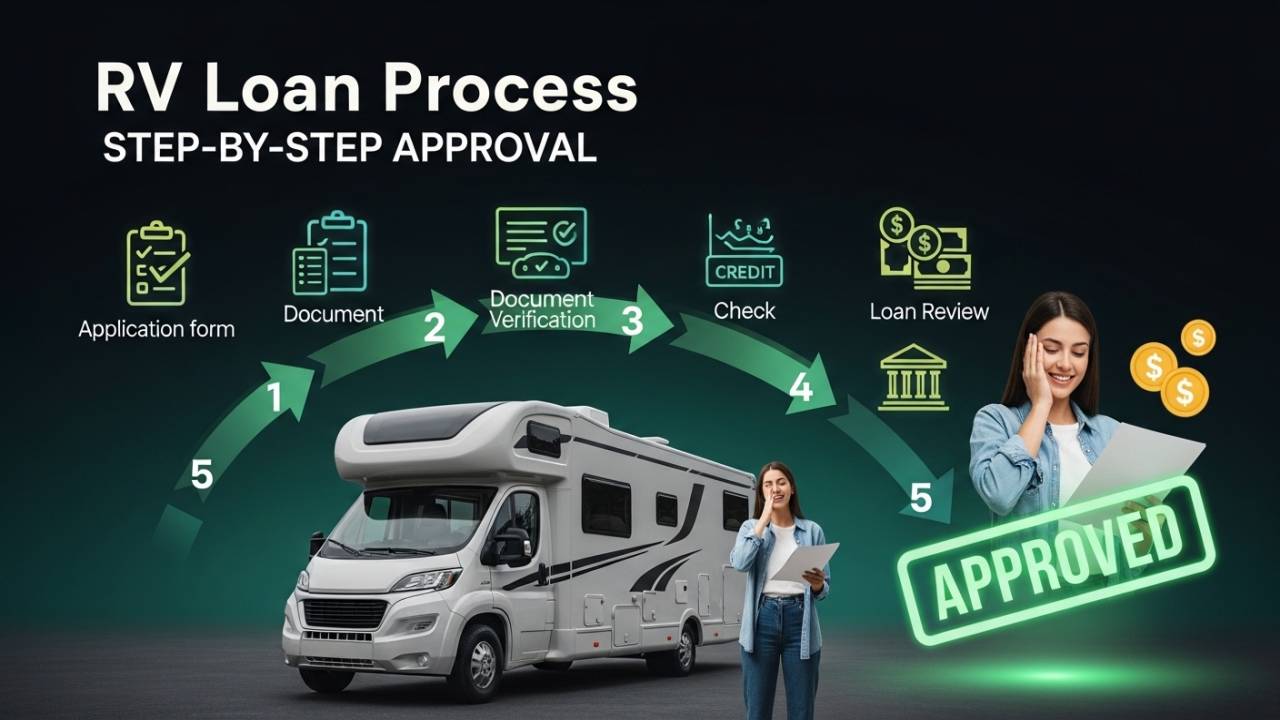
Now you understand the requirements. Here’s exactly what happens when you apply.
Also Read:- Norcold RV Refrigerator Not Cooling on Electric or Gas: Fix It in 30 Minutes
Step 1: Pre-Qualification (Optional but Recommended)
What happens: You contact a lender and provide basic information (credit score, income, amount needed). They give you a ballpark approval range.
Time required: 5–15 minutes
Credit impact: Soft inquiry (no credit score hit)
Documents needed: None yet
Why do this: It shows you’re serious to sellers. You’ll know your budget. You can compare multiple lenders.
Pro tip: Pre-qualify with 3+ lenders. This takes an hour and could save you thousands in interest.
Step 2: Find Your RV
You now know your budget. Go shop.
Time required: Days or weeks (depends on you)
Do: Find an RV within your pre-qualified range. Don’t stretch.
Don’t: Fall in love with an RV above your budget.
Step 3: Full Application Submission
What happens: You submit your formal loan application. The lender asks detailed questions about your finances, employment, existing debts, and the specific RV.
Documents you’ll submit:
- Completed application (can be online or paper)
- Government-issued ID
- 2 recent pay stubs
- 2 months of bank statements
- 2 years of tax returns
- W-2s for last 2 years
- Proof of residence (utility bill, lease)
- Proof of income (if self-employed, business license)
- Details about the RV (VIN, price, seller info)
Time required: Application takes 30 minutes. Gathering documents takes 1–2 days.
Credit impact: Hard inquiry (small, temporary credit score hit of 5–10 points)
Step 4: Credit Report and Verification
What happens: The lender pulls your full credit report. They verify your income with your employer. They confirm your bank account exists and has the stated funds.
What lenders check:
- All existing loans and credit cards
- Payment history for past 7 years
- Delinquencies, collections, bankruptcies
- Verification of employment (call your HR department)
- Verification of income (call your bank)
Red flags that slow things down:
- Recent job changes (may need additional explanation)
- Large unexplained cash deposits in bank account (lenders want to know source)
- Inconsistencies between stated and verified income
- Recent credit inquiries (appear worried you’re taking on more debt)
Time required: 2–5 business days
Step 5: RV Appraisal
What happens: The lender orders an independent appraisal of the RV. An appraiser inspects the vehicle and determines its market value using industry guides (NADA, Black Book).
What appraisers check:
- Structural integrity (roof leaks, frame damage, water damage)
- Appliances and systems (fridge, AC, heating, plumbing, electrical)
- Mileage and hours (for motorhomes)
- Interior condition (upholstery, cabinets, carpet)
- Recent comps (sales of similar RVs)
Cost: Usually $200–400 (lender may charge you)
Time required: 5–10 business days (can be faster)
Potential issue: Appraisal comes in lower than purchase price. You must either increase down payment or renegotiate RV price.
Step 6: Underwriting Review
What happens: An underwriter reviews all your documentation. They verify employment. They check the appraisal. They calculate your DTI with the new RV payment included. They assess risk.
What underwriters might ask for:
- Letter of explanation for late payments
- Proof of 2-year employment history (paystubs going back further)
- Explanation of large bank deposits
- Updated bank statements (if application took longer than expected)
- Co-signer agreement (if applicable)
Time required: 3–7 business days
Step 7: Conditional Approval or Denial
What happens: You get one of three decisions.
Option A: Clear to Close — You’re approved with no additional conditions. Rare and amazing.
Option B: Conditional Approval — You’re approved IF you do something. Examples:
- “Approved once we receive final pay stub”
- “Approved upon verification of employment”
- “Approved if down payment increases to $25,000”
Most loans fall in this category. It’s still approval.
Option C: Denied — The lender declines your application. Reasons include:
- Credit score below minimum
- DTI too high
- Income can’t be verified
- RV appraised too low
- Employment instability
- Recent delinquencies
If denied: You can reapply in 6 months, try a different lender, or improve your profile and try again.
Time required: 1–2 business days
Step 8: Final Approval and Loan Documents
What happens: You’ve met all conditions (or there were none). The lender prepares your loan documents for signing.
Documents you’ll sign:
- Promissory note (your promise to pay)
- Security agreement (RV is collateral)
- Disclosure statements (truth in lending, privacy, etc.)
- Insurance requirement letter
What to do:
- Read everything. Don’t just sign. Know your APR, monthly payment, loan term, and any fees.
- Ask questions. Anything unclear? Ask. This is your $100,000+ commitment.
- Verify the numbers. Monthly payment matches your quote? Term is what you agreed? APR is what was discussed?
Time required: 1 hour to read and sign (usually done electronically)
Red flags:
- APR is higher than quoted (ask why)
- Monthly payment is higher than expected (ask for recalculation)
- Surprise fees appear (ask where they came from)
- Loan term changed from what you discussed
Step 9: Funding and Purchase
What happens: Lender transfers funds to the RV dealer or seller. You sign the RV title and purchase documents. You take possession.
For dealer purchases: Lender sends money directly to dealer. Dealer handles paperwork and title transfer.
For private-party purchases: Lender sends money to you or directly to seller (depends on lender). You and seller handle title transfer at DMV.
Time required: 1–2 business days
What happens next: You register the RV in your name. You get RV insurance. You hit the road.
Approval Timeline: How Long Does It Take?
From application to funding:
| Stage | Time Required | Notes |
|---|---|---|
| Pre-qualification | 15 minutes | Soft inquiry, optional |
| Full application submission | 1–2 days | Your part (gathering docs) |
| Credit verification | 2–5 days | Lender’s part |
| RV appraisal | 5–10 days | Can vary widely |
| Underwriting | 3–7 days | Depends on complexity |
| Final approval | 1–2 days | Lender decision |
| Document signing | 1 hour | Your part |
| Funding | 1–2 days | Money transfers |
| TOTAL | 15–30 days | 3–4 weeks is typical |
Fastest timeline: 10–15 days (if pre-approved, RV appraises quickly, no issues)
Slowest timeline: 60+ days (if issues arise, appraisal delays, underwriting questions)
Red Flags That Slow Down or Deny Approval
Credit-Related Red Flags
- Recent bankruptcy (under 2 years) — Most lenders won’t approve
- Collections or charge-offs — Need explanation or higher down payment
- Missed payments (within 24 months) — Significantly hurt approval
- Too many recent inquiries — Looks like you’re desperate for credit
Income-Related Red Flags
- Recently unemployed — Can’t verify income
- Self-employment income (under 2 years) — Can’t document stability
- Income doesn’t match expenses — Doesn’t add up mathematically
- Can’t verify employment — Employer won’t confirm you work there
RV-Related Red Flags
- Appraisal comes in low — RV worth less than you’re paying
- RV too old — Lender doesn’t finance vehicles 15+ years old
- RV type uncommon — Lender unfamiliar with resale value
- RV used for commercial purposes — Lender has different requirements
Application Red Flags
- Inconsistencies — Stated income doesn’t match tax returns
- Incomplete documentation — Missing paystubs or bank statements
- Suspicious activity — Large cash deposits with no explanation
- Too many applications — Applied with 5+ lenders in 30 days
Also Read:- RV Refrigerator Not Cooling? Troubleshooting & Solar Power Fix
FAQs:
Can I get approved with a co-signer?
Yes. A co-signer with better credit can help you get approved or get better rates. But the lender will pull their credit and verify their income too. They’re on the hook if you don’t pay. Choose wisely—this strains relationships.
What if I was denied? Can I reapply?
Yes, but not immediately. Wait 3–6 months. In that time, improve your credit (pay down debt, fix errors, make on-time payments), increase your down payment, or target a lower-priced RV. Then reapply with different lender. Each lender has different criteria.
Does the RV inspection happen before or after I’m approved?
The appraisal happens during underwriting, after conditional approval. If appraisal fails, it can kill the deal. That’s why choosing the right RV matters—something that might appraise at 90% of purchase price instead of 95% kills some deals.
What if my employer won’t verify my employment?
Bring recent paystubs and W-2s instead. Most lenders will accept those. But if paystubs don’t match your claimed income or W-2s, that’s a problem.
Can I use a recent raise in my income calculation?
Not immediately. Most lenders need to see at least 6 months of your new income level (paystubs covering 6 months). If you just got a raise, document it in writing from your employer.
What if I have excellent credit but low income?
You’ll struggle with approval because of your debt-to-income ratio. A $600/month RV payment on a $2,000 monthly income is 30% of your gross income just for one payment. Lenders will want this at 15% or less. Either increase income or reduce the RV price you’re targeting.
Is it worth paying extra to get a higher credit score before applying?
If your score is 650–680, yes. Spend 3–6 months paying down debt. A 30-point improvement drops your interest rate 0.5–1%, saving you thousands on a $100,000 loan.
If your score is already above 700, probably not. The difference between 750 and 780 is marginal.
What if the RV appraisal is lower than the purchase price?
Renegotiate. Tell the seller “The appraisal came in at $43,000, not $50,000. We need to adjust the price.” If seller won’t budge, you have two options:
- Increase down payment to make up the difference (put extra $7,000 down instead of budgeted amount)
- Walk away and find another RV
Most smart buyers walk. You don’t want to be underwater on a loan (owing more than the asset is worth).
How long is pre-approval valid?
Usually 30–60 days. Your rate is locked for that period, but conditions can change. If your credit drops or you take on new debt, rate can increase. Read your pre-approval letter carefully.
Can I refinance later if rates drop?
Absolutely. Check rates annually. If they drop 1%+, refinancing could save thousands. Refinancing works the same as a new loan—appraisal, underwriting, the whole process. Only refinance if you plan to keep the RV for at least 2 more years (to recoup fees).