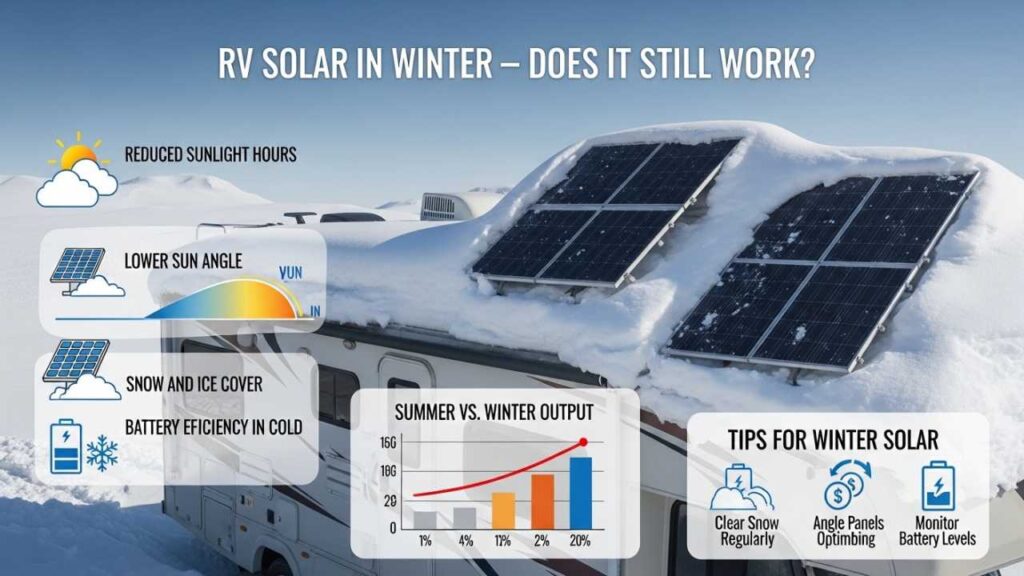
Winter is one of the biggest concerns for RV owners who depend on solar power. When the days get shorter, and the sky stays gray, you might wonder if those panels on your roof are worth anything at all. The honest answer: yes, solar still works in winter, but you need to understand how much less it produces and what you can do about it.
How Much Less Solar Works in Winter
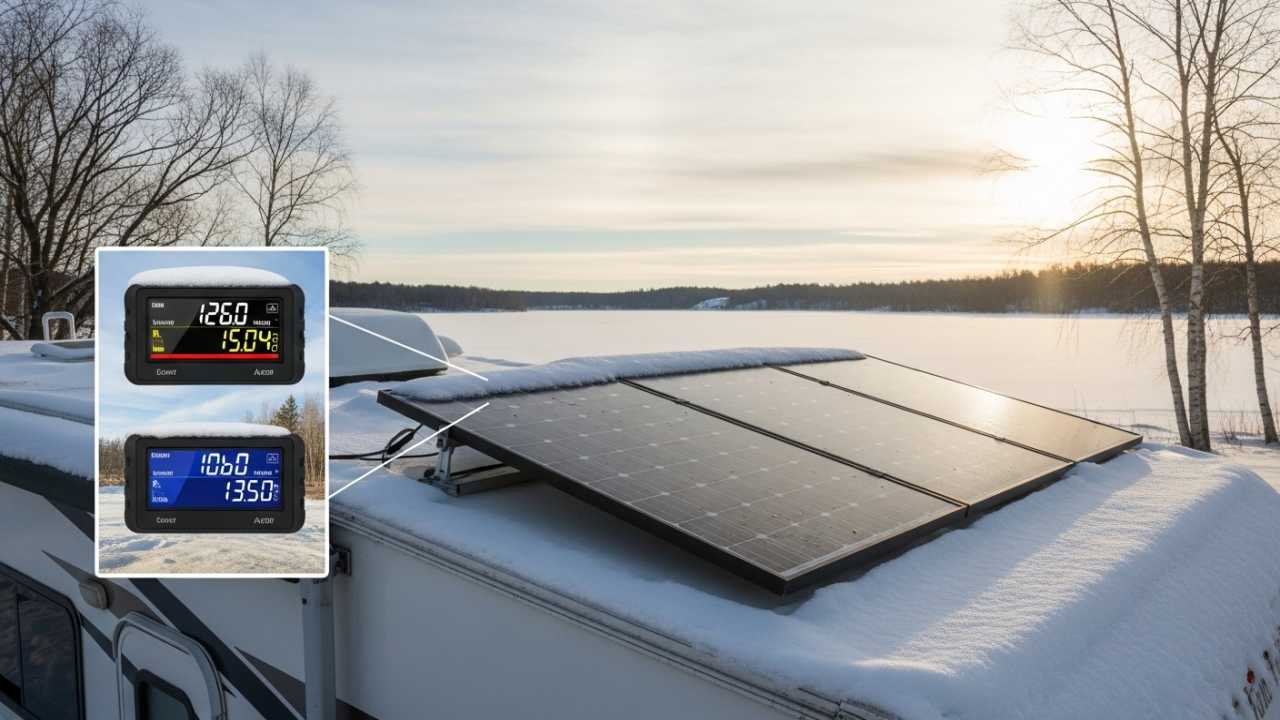
Your RV solar system doesn’t shut down when temperatures drop. The panels still generate electricity whenever there’s daylight—even on cloudy days. But the amount you get is significantly less than summer.
In most parts of the US, winter solar output drops to 40 to 60 percent of what you’d generate in summer. Some southern states see only a 30 percent drop, while northern regions can lose up to 70 percent of their summertime capacity. This happens because of shorter days and lower sun angles. In December, the sun peaks much lower in the sky, so your panels catch fewer rays directly.
Cold weather itself isn’t the enemy of your panels. In fact, solar panels work more efficiently in cold temperatures than in hot ones. A panel at 32°F actually produces slightly more electricity than the same panel at 77°F. The real issue is the limited daylight hours and cloud cover that come with winter weather.
Also Read:- How to Charge RV Batteries Faster with Solar: 7 Expert Tips to Maximize Charging Speed
Snow and Ice: The Real Problem
If winter solar had one villain, it would be snow. When snow blankets your RV’s roof, your panels produce almost nothing. That thick white layer blocks light from reaching the cells underneath.
The good news: snow slides off most RV solar panels faster than you’d expect. Panels are smooth and slightly angled, so a thin layer of snow usually blows off or melts within hours. If you’re parked where the sun hits your roof, afternoon warmth from the dark panel surface helps melt the snow from underneath.
The bad news: heavy, wet snow can stick around. Ice buildup is even worse. Once ice forms under the snow, it’s not going anywhere until temperatures rise significantly.
Your best defense is prevention. If you can park your RV where your panels face south and catch maximum sunlight, you’ll get faster melt-off. In a campground where you can position the RV, that simple move makes a difference. If you’re stuck with panels covered by snow, a soft brush can gently clear them without damaging the surface. Never use a squeegee, pressure washer, or anything metal.
Battery Performance Takes a Hit Too
Your batteries don’t work as hard in winter, and that’s actually helpful—your power needs tend to be lower (no AC running, for example). But batteries themselves perform worse in the cold.
A lithium battery rated at 100 amp-hours at 77°F might give you only 70 to 80 percent of that capacity when it’s 32°F outside. Lead-acid batteries are even more affected. They can lose 40 to 50 percent of their capacity in freezing weather.
This creates a double squeeze: your solar system generates less power while your batteries store less of it. If you’re relying entirely on solar to charge your batteries through a cold, cloudy winter, you could find yourself running low more often.
The solution isn’t complicated. Keep your battery bank warm if you can. Some RV owners insulate their battery boxes or add battery heaters (they draw small amounts of power but pay for themselves by improving efficiency). Running a small heater inside the RV also keeps the battery compartment warmer indirectly.
State-by-State Winter Solar Viability in the US
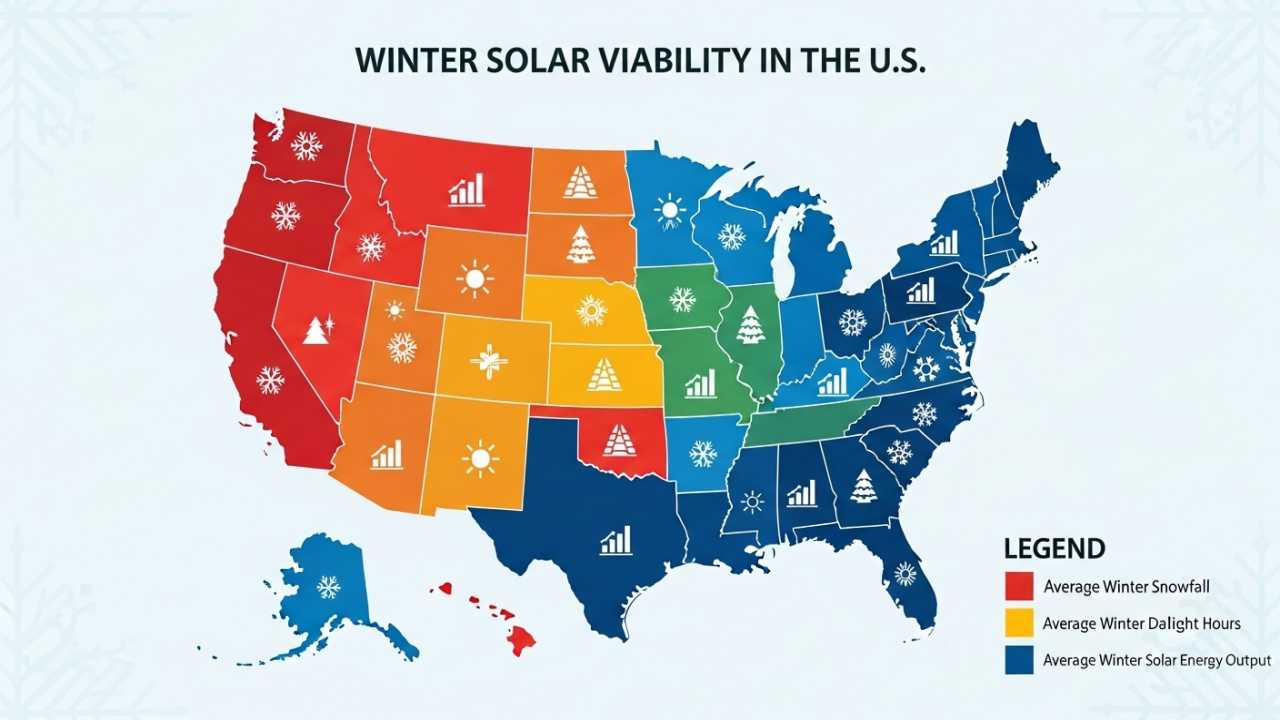
Winter solar viability depends heavily on where your RV is parked. Here’s how winter stacks up across the country:
| State | Winter Production Rate | Best For Winter Solar | Notes |
|---|---|---|---|
| Arizona | 55-65% | Yes | Low winter cloud cover; Phoenix area excellent |
| California | 50-60% | Yes | Desert regions strong; coastal areas less reliable |
| Florida | 60-70% | Yes | Relatively long winter days; minimal snow |
| Georgia | 40-50% | Moderate | Increasing cloud cover in winter months |
| Nevada | 60-65% | Yes | Desert climate; bright clear skies common |
| New Mexico | 55-65% | Yes | High elevation; low humidity aids panel performance |
| South Carolina | 40-50% | Moderate | Winter cloud cover common |
| Texas | 45-55% | Moderate | Southern regions better than north |
| Colorado | 45-55% | Moderate | High elevation helps; but frequent clouds |
| Idaho | 35-45% | Challenging | Short winter days; frequent cloud cover |
| Montana | 30-40% | Challenging | Extended winter; significant snow cover risk |
| Oregon | 30-40% | Challenging | Winter gloom; frequent rain and clouds |
| Utah | 50-60% | Yes | High elevation; mountain regions less ideal |
| Washington | 25-35% | Not Recommended | Gray, overcast winters are the norm |
| Wyoming | 40-50% | Moderate | High elevation; clear skies can offset short days |
| Maine | 25-35% | Not Recommended | Very short winter days; frequent clouds |
| Minnesota | 30-40% | Challenging | Extended winter; snow cover common |
| New York | 30-40% | Challenging | Limited winter daylight; cloud cover |
| Pennsylvania | 35-45% | Challenging | Winter cloud cover reduces output |
Key takeaway: If you want your RV solar to be truly productive in winter, head south and west. Arizona, New Mexico, southern Nevada, and coastal Florida are your best bets. Northern states and Pacific Northwest regions require backup power sources—a generator or shore power—to get through winter comfortably.
Also Read:- Can You Add More Solar Panels to an Existing RV System?
Tips to Maximize Winter RV Solar Output
1. Position Your Panels for Winter Sun
In winter, the sun sits much lower on the southern horizon. If your panels have adjustable mounts, tilt them to a steeper angle to catch more winter rays. Most fixed panels are angled at 15 to 20 degrees for year-round average; in winter, a 40 to 45 degree tilt in northern regions captures significantly more power.
2. Keep Panels Clean
Dust, dirt, and dried salt spray reduce panel efficiency by 5 to 15 percent. In winter, you’re already losing power. Don’t lose more to a dirty surface. Rinse your panels every two weeks with fresh water. Avoid cleaning in very cold conditions (the water can freeze immediately).
3. Trim Trees and Adjust Camp Position
The winter sun is low. Trees that don’t shade your panels in summer might block them in winter. If you’re boondocking or in a campground where you can move, position your RV so your panels face directly south with no shading between roughly 10 AM and 2 PM—when the sun is strongest.
4. Upgrade Your Battery Bank
A larger battery bank buffers short winter days. If one cloudy day costs you 60 percent of normal solar input, extra capacity means you’re not draining batteries to dangerous levels. Lithium batteries are expensive but perform far better in cold weather than lead-acid.
5. Reduce Power Consumption Strategically
You can’t generate more power, but you can use less. In winter, run high-draw appliances (microwaves, toasters, water heaters) during peak solar hours—roughly 10 AM to 3 PM. Save low-draw tasks (charging phones, running LED lights) for evening. This keeps your batteries from deep discharge.
6. Add a Backup Generator
This is the pragmatic answer. A small propane generator running 2 to 3 hours on cloudy winter days supplements solar and keeps your batteries healthy. Generators excel at this because they handle the hard work while solar handles the easy days.
7. Install a Second Solar Array
If your RV has mounting space, a second array on the ground (mounted on a portable frame) gives you flexibility. You can angle it perfectly for winter sun, move it as the sun’s path changes, and pack it away in summer.
8. Monitor Your System
Buy an inexpensive solar monitor if you don’t have one. Seeing real-time output data helps you understand exactly when and how much power you’re generating. This awareness drives smarter usage decisions.
9. Understand Your Inverter’s Efficiency
Inverters lose some power during the conversion from DC to AC. In winter, when total solar input is already reduced, inverter efficiency matters more. Higher-efficiency inverters (90-95%) lose less power than budget models. If your inverter is more than 8 to 10 years old, it’s worth checking its specs—newer models are noticeably more efficient. Make sure your inverter’s low-power mode (also called “search mode”) is properly calibrated so it wakes up quickly to small amounts of winter solar input.
10. Plan Your Water Heating Strategy
Water heating is one of the biggest winter power drains. Consider these options: run your water heater only during peak solar hours (10 AM to 3 PM), switch to a propane water heater for winter months, or install a smaller on-demand water heater that draws less total energy. Some RV owners heat water via their propane furnace (by running the furnace’s water jacket circuit) rather than relying on electrical heating—this is exceptionally efficient in winter.
FAQ: RV Solar in Winter
1. Will freezing temperatures damage my solar panels?
No. Modern RV solar panels are rated for temperatures well below zero. They’re designed to withstand extreme cold. What damages panels is physical impact and poor installation (expansion and contraction if not secured properly). The panels themselves can handle the cold with no problems. In fact, panels sitting at 0°F generate slightly more power per watt than panels at 77°F. The efficiency gain is small but real—typically 0.4 to 0.5 percent per degree Celsius below 25°C.
2. Can I use my RV solar full-time if I stay in Arizona or Florida all winter?
Probably yes, depending on your power needs. In southern Arizona and Florida, winter solar production stays between 60 and 70 percent of summer levels. If your RV uses less power in winter (no air conditioning, lower heating loads), solar alone might be enough. But if you run a water heater and other high-draw appliances, backup power is still smart. Real-world example: an RV with a 400-watt solar array in Phoenix generates roughly 2.0 to 2.5 kilowatt-hours per day in December versus 4.0+ kilowatt-hours in July. If your daily consumption is below 2 kWh, you’re in good shape. If it’s above 3 kWh, a generator becomes necessary on cloudy days.
3. Do I need to winterize my solar system?
Solar systems don’t require winterization. Your battery bank might—some RV owners add battery heaters or insulation in extremely cold climates, but the solar equipment itself needs no special preparation. Just clean the panels if they get covered in snow or dust. One exception: if your RV’s plumbing runs near solar panels or electrical conduits, make sure water won’t pool near electronics or freeze and expand the conduit. Otherwise, disconnect components and store them indoors only if you’re mothballing the RV for winter.
4. How long does it take a solar panel to defrost after snow?
On a sunny winter day with temperatures above 20°F, thin snow usually slides off or melts within a few hours. Heavy, wet snow can take longer. Ice underneath the snow takes much longer—potentially days if temperatures don’t rise significantly. Dark panel surfaces warm from solar radiation and help melt snow from underneath. This works best when your RV is angled to catch maximum sun (around 40 to 50 degrees south-facing). In shaded areas or north-facing positions, snow can persist for a week or more even during winter.
5. Is it worth keeping solar panels on my RV if I spend winters in the Pacific Northwest?
For most RV owners, no—not as a primary power source. The Pacific Northwest (Washington, Oregon) gets too little winter sun. You’d be dependent on a generator or shore power anyway, making solar less useful. However, if you plan to use your RV in spring, summer, and fall elsewhere, the panels are worth keeping for those seasons. Just accept that winter in that region requires a backup power plan. The economics shift if you boondock heavily during shoulder seasons (May-June and September-October) elsewhere—then those panels earn their keep. But pure winter use in that region is not solar-friendly.
The Bottom Line
RV solar works in winter, but your expectations need to match reality. In warm, sunny climates like Arizona and southern Florida, you can rely on winter solar to handle much of your power needs. In northern and coastal regions, solar becomes supplemental—useful on sunny days but not your primary power source.
The key is honest assessment: know how much power your RV uses, know how much your panels can generate in your chosen winter location, and plan backup power accordingly. Combined with a few smart adjustments—panel positioning, cleanliness, careful power management—winter solar can significantly extend your boondocking season and reduce generator dependence.
If you haven’t invested in solar yet and live in a northern climate, you can still benefit during warmer months. Just plan to use shore power or a generator in winter. If you’re heading to Arizona or New Mexico, your panels will work hard enough to be genuinely valuable year-round.