
You’re somewhere north of Albuquerque, cruising toward Santa Fe with your RV. The sun is absolutely relentless. Your dashboard thermometer reads 115°F, and you’re already sweating through your second shirt. But here’s the thing that makes you pause—your solar panels are barely pushing enough power to run the fridge and charge your phones. You spent good money on those panels, and they’re letting you down when you need them most.
This is the real story of solar in New Mexico.
Most articles about RV solar panels treat heat like a minor inconvenience. They don’t. Heat is the silent killer of solar efficiency, and if you’re planning extended trips through New Mexico’s scorching deserts, you need to understand exactly what’s happening on your roof—and more importantly, what you should have installed in the first place.
I’ve helped dozens of RV owners navigate this exact problem, and after years of watching people struggle with undersized systems in extreme heat, I realised something critical: standard solar panels lose anywhere from 12% to 20% of their power output when temperatures spike. And New Mexico? With 300+ days of sunshine annually, our state is basically one giant heat experiment. That means your system isn’t just underperforming occasionally—it’s underperforming consistently, every single day you’re here.
Let’s fix that.
Why Heat Actually Kills Solar Panels (And Why Nobody Talks About This Properly)
Here’s what they don’t tell you in most solar guides: solar panels work best when they’re cold. Yes, cold. Even though they need sunlight, they hate warmth.
Think of it like a computer. Sure, it needs power, but if your laptop overheats, it starts throttling down performance. The same thing happens with solar. When temperatures climb above 77°F (25°C—the standard test temperature), your panels start losing efficiency. Every single degree above that, you’re losing somewhere between 0.24% and 0.40% of your panel’s rated power output.
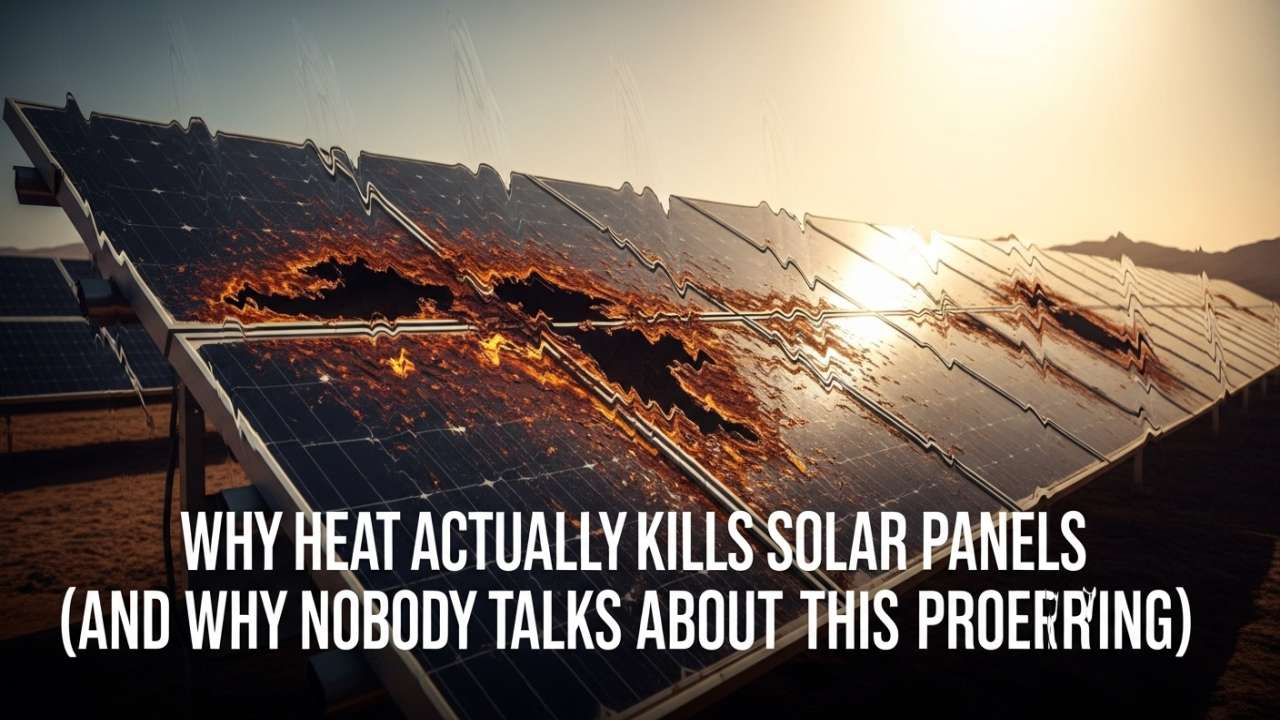
Let’s put that in real numbers. Say you have a 400W flexible solar panel on your RV roof. On a moderate 85°F day in town, that panel might deliver 400 watts of power. But drive into the New Mexico high desert on a 115°F day? That same panel is now pumping out somewhere around 320-340 watts. That’s not a small dip—that’s a legitimate loss of 60-80 watts of real power you thought you had.
Here’s where it gets worse: Your panel’s actual temperature isn’t the same as the air temperature. Because panels are dark—they absorb sunlight—they heat up much faster than the surrounding air. On a 115°F day, your RV roof panels can easily reach 160°F or higher. That’s where the real efficiency penalties kick in.
The technical term for this is the temperature coefficient. It’s listed on every panel’s spec sheet as a percentage, usually something like “-0.29%/°C” or “-0.40%/°C”. Lower numbers (closer to -0.24%) are better because they mean your panels lose less efficiency as they heat up.
What Makes New Mexico Different From Arizona (And Why That Matters)
People assume all hot desert climates are the same. They’re not.
New Mexico has a few unique characteristics that change the game for RV solar:
Elevation Changes: Most of New Mexico sits between 4,000 and 7,000 feet above sea level. Santa Fe is at 7,000 feet. Higher elevation means thinner air, which actually helps—less atmosphere means less heat absorption before sunlight hits your panels. But it also means UV radiation is more intense, which stresses panel materials over time.
Dry Heat vs. Humid Heat: Unlike Arizona where Phoenix hits 115°F but has 10-20% humidity, New Mexico’s heat is brutally dry. That’s actually good for solar panels (humidity and salt air are worse), but it’s bad for keeping your roof cool. There’s no moisture to help dissipate heat through evaporation.
Dust Storms and Dust in General: New Mexico gets more dust storms than you’d think. Dust covering your panels reduces output by 15-25%. That’s why the New Mexico Energy Conservation and Management Division recommends choosing panels specifically rated for dusty environments with self-cleaning or easy-to-clean surfaces.
The Sunshine Reality: Yes, New Mexico gets 300+ days of sunshine annually. That sounds great until you realize it means almost no cloudy days to give your panels a natural cool-down period. July and August? You’re looking at seven to eight hours of peak-intensity sunlight every single day.
Combine all these factors, and you’re looking at the harshest solar environment in the continental U.S. except for Death Valley.
Temperature Coefficient Explained (Without the Physics Degree)
Every solar panel manufacturer publishes a temperature coefficient. It’s usually buried in the tiny print on spec sheets, and it’s the single most important number you should care about if you’re buying solar for extreme heat.
Here’s how to read it:
If a panel has a temperature coefficient of -0.29%/°C, that means for every degree Celsius above 25°C (77°F), you lose 0.29% of the panel’s rated power.
Let’s do the math for a New Mexico summer afternoon:
- Ambient temperature: 105°F (40.5°C)
- Standard test temperature: 77°F (25°C)
- Temperature difference: 15.5°C
- A -0.29%/°C panel loses: 15.5 × 0.29% = 4.49% efficiency
That’s already substantial. But remember—your actual panel temperature is 30-40°F hotter than ambient. So add another 20-25°C to account for panel heating, and you’re looking at 35-40°C above standard conditions. Now you’re losing 10-12% of rated power right there.
The real takeaway? If you see two panels with the same wattage, but one has a -0.24%/°C coefficient and the other has -0.40%/°C, the cooler-coefficient panel will outperform the other by approximately 4-5% in New Mexico’s heat. Over a summer month, that’s the difference between “barely enough power” and “actually functional.”
NMOT: The Secret Spec Manufacturers Don’t Want You to Know
NMOT stands for “Nominal Module Operating Temperature.” It’s the temperature your panel will reach under specific real-world conditions: 20°C ambient air, 800 W/m² solar irradiance, and 1 m/s wind speed.
This matters because it tells you how hot your panel actually gets—not in theory, but in practice.
Premium panels are rated with NMOT between 42-45°C. Standard panels? Often 45-48°C. That gap looks small until you realize it means the premium panels stay 3-6°C cooler during operation, which translates to roughly 1-2% better efficiency. On a 400W panel over an entire summer, that’s real power.
When you’re shopping for RV solar panels, look for:
- Temperature coefficient of -0.30%/°C or lower (aim for -0.24% to -0.29%)
- NMOT rating of 45°C or lower
- High-grade materials (monocrystalline, not polycrystalline, and definitely not cheap thin-film)
Best Solar Panels for RV New Mexico Extreme Heat (Tested & Compared)
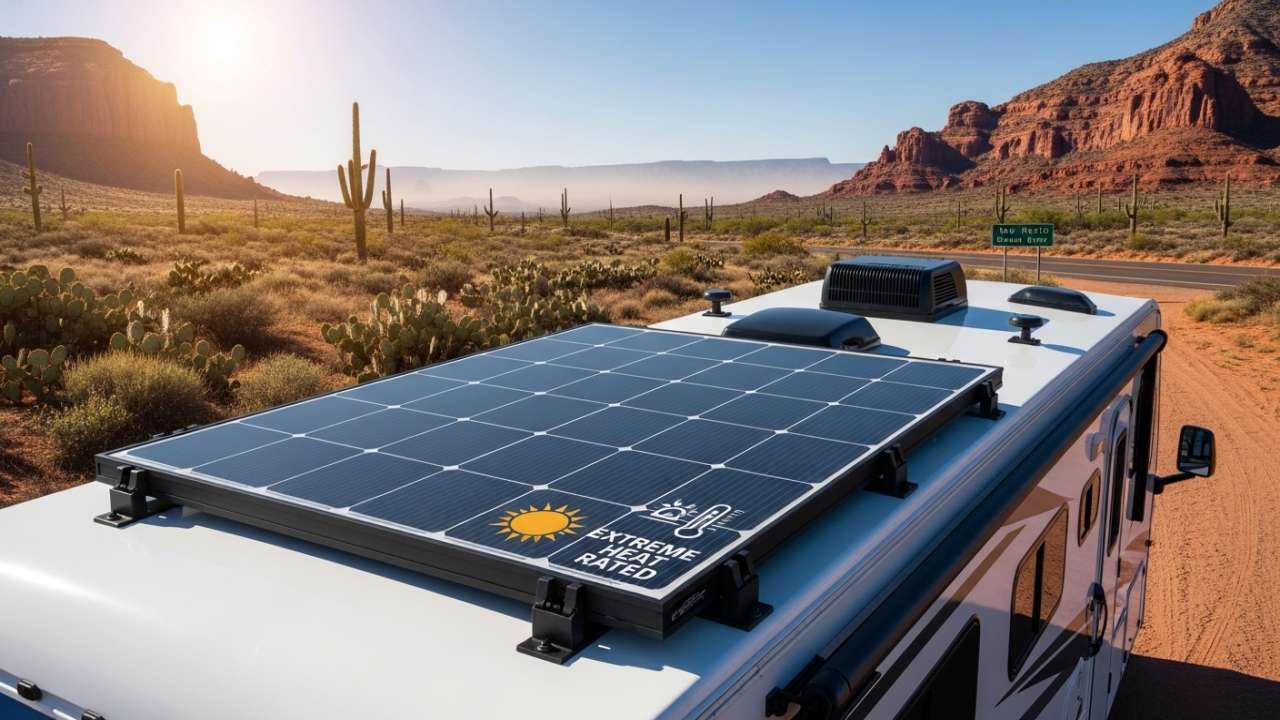
Not all solar panels are created equal. For RV use in New Mexico’s heat, you need panels that balance efficiency, heat tolerance, durability, and price. Here’s what actually works.
Comparison Table: Top RV Solar Panels for Extreme Heat
Basic Panel Specifications
| Panel Model | Type | Wattage | Efficiency |
|---|---|---|---|
| Renogy 100W N-Type Rigid | Monocrystalline | 100W | 23-24% |
| Sungold 400W Flexible ETFE | Flexible PERC | 400W | 22% |
| Maxeon 6 | Monocrystalline | 400W | 22.8% |
| Mission Solar 380W | Monocrystalline | 380W | 19.5% |
| Qcells Q.TRON 385W | Monocrystalline | 385W | 19.9% |
| REC Alpha Pure 410W | Monocrystalline | 410W | 22.3% |
Heat Performance Specifications
| Panel Model | Temp Coefficient | NMOT | Heat Performance |
|---|---|---|---|
| Renogy 100W N-Type | -0.26% / °C | 44°C | Very Good |
| Sungold 400W Flexible | -0.30% / °C | 45°C | Good |
| Maxeon 6 | -0.29% / °C | 45°C | Excellent |
| Mission Solar 380W | -0.35% / °C | 45°C | Moderate |
| Qcells Q.TRON 385W | -0.33% / °C | 45°C | Good |
| REC Alpha Pure 410W | -0.29% / °C | 44°C | Excellent |
Price & Best Use Case
| Panel Model | Price | Best For | Category |
|---|---|---|---|
| Renogy 100W N-Type | $150-180 | Budget heat-tolerant RVs | Budget |
| Sungold 400W Flexible | $450-550 | Lightweight rooftop installs | Flexible |
| Maxeon 6 | $1,100+ | Premium RV solar builds | Premium |
| Mission Solar 380W | $280-320 | USA-made reliability | Regional |
| Qcells Q.TRON 385W | $260-290 | Balanced performance | Mid-range |
| REC Alpha Pure 410W | $320-380 | Best heat resistance value | Best Value |
Renogy 100W N-Type: The Practical Workhorse
If you want the truth: Renogy has become the de facto standard for RV solar, and their newer N-Type panels deserve that reputation.
The Good: The 100W Renogy N-Type panel hits 23-24% efficiency with a solid -0.26%/°C temperature coefficient. That means it handles New Mexico heat significantly better than their older P-Type panels. The half-cut PERC cell technology boosts efficiency, and at around $150-180 per panel, the price-to-performance ratio is hard to beat.
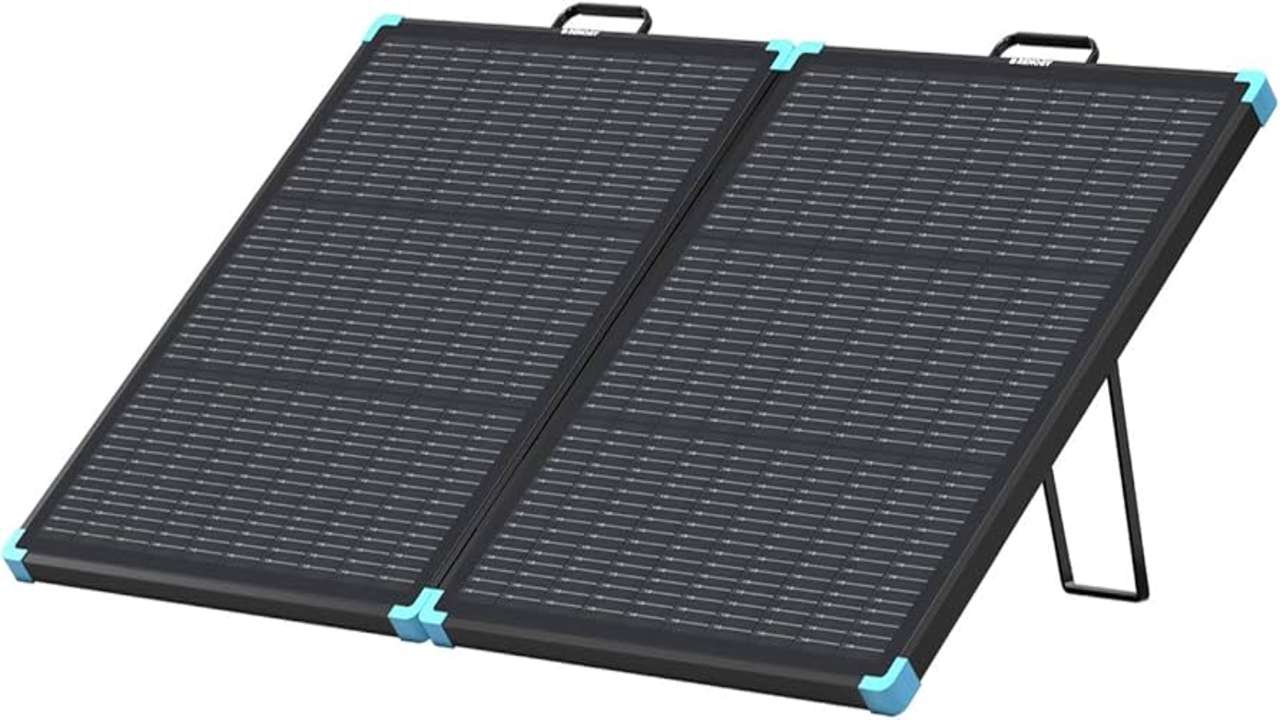
Installation Reality: These rigid panels weigh about 24 pounds each. Two of them on an RV roof equals 48 pounds. That matters if your roof isn’t built for weight. They also require 6-8 inches of clearance underneath for airflow (which I’ll explain in the cooling section).
The Honest Weakness: At -0.26%/°C, it’s not the absolute best for extreme heat. A panel with -0.24%/°C would give you another 0.5-1% efficiency gain. But that extra 0.02% costs you $100+ more per panel.
Why RV owners pick it: Proven durability, solid warranty, and enough performance that you feel like you made a smart decision—not a premium decision that costs thousands more.
Also Read:- Albuquerque RV Solar Installation (2026): Top Shops, Cost Breakdown & DIY Setup Guide
Sungold 400W Flexible ETFE: The Rooftop Specialist
Here’s where opinions get heated. Flexible panels are controversial in the solar community, and for good reason: they typically underperform rigid panels under extreme heat.
But Sungold’s 400W flexible panel with ETFE material is the exception.
Why it matters for RVs: A 400W flexible panel weighs half what two 200W rigid panels weigh (around 15 pounds vs. 30+). It glues directly to your roof without penetrating bolts (no new leaks). And with 22% efficiency and a -0.30%/°C coefficient, it’s competitive with mid-range rigid panels.
The trick they don’t tell you: Flexible panels get hotter because they’re in direct contact with your roof. A backing board (usually 6mm polycarbonate) creates an air gap that drops panel temperature by 10-15°C. That backing board costs $80-120 and adds weight back, but it’s worth every penny in New Mexico heat.
Real-world check: One RV owner I know mounted a Sungold 400W on her Sprinter van roof with a polycarbonate backing. In July, her panel temperature stayed around 130°F instead of 160°F. That 30-degree difference worked out to about 4% more power output. Over a summer trip, that’s the difference between having to rationed power and actually living comfortably.
REC Alpha Pure 410W: The Best Overall Value
If I had to recommend one panel for New Mexico RV use, it’s REC Alpha Pure.
The specs that matter: 22.3% efficiency, -0.29%/°C temperature coefficient, and a 44°C NMOT rating. Those numbers put it in the top tier for heat performance. But the real story is the price—$320-380 per panel—which undercuts premium options like Maxeon while matching performance.
Why installers recommend it: REC has a 25-year warranty, strong customer service, and proven durability in hot climates. Half-cut cell technology reduces shading loss, which matters if your RV has any roof obstructions (like vents or air conditioning units).
Installation ease: At 41 pounds per 410W panel, it’s heavier than Renogy but lighter than some alternatives. Two panels weigh around 82 pounds—manageable for most RV roofs rated for solar.
The honest conversation: REC panels aren’t flashy. They won’t win performance awards. But they’re the panels that solar professionals spec for hot-climate systems year after year because they work. They work consistently, and they last.
Passive Cooling: How to Drop Panel Temperature 10-15 Degrees (No Battery Required)
Here’s what solar manufacturers don’t emphasize: how you install your panels matters as much as which panels you buy.
The best cooling strategy for RV solar is laughably simple—airflow.
When you mount solar panels directly flush against your RV roof, you trap heat. The panel absorbs solar radiation, converts most of it to heat (panels are only 20-23% efficient at converting sunlight to electricity), and that heat has nowhere to go. It builds up underneath the panel, pushing your actual panel temperature 10-15°C higher than it should be.
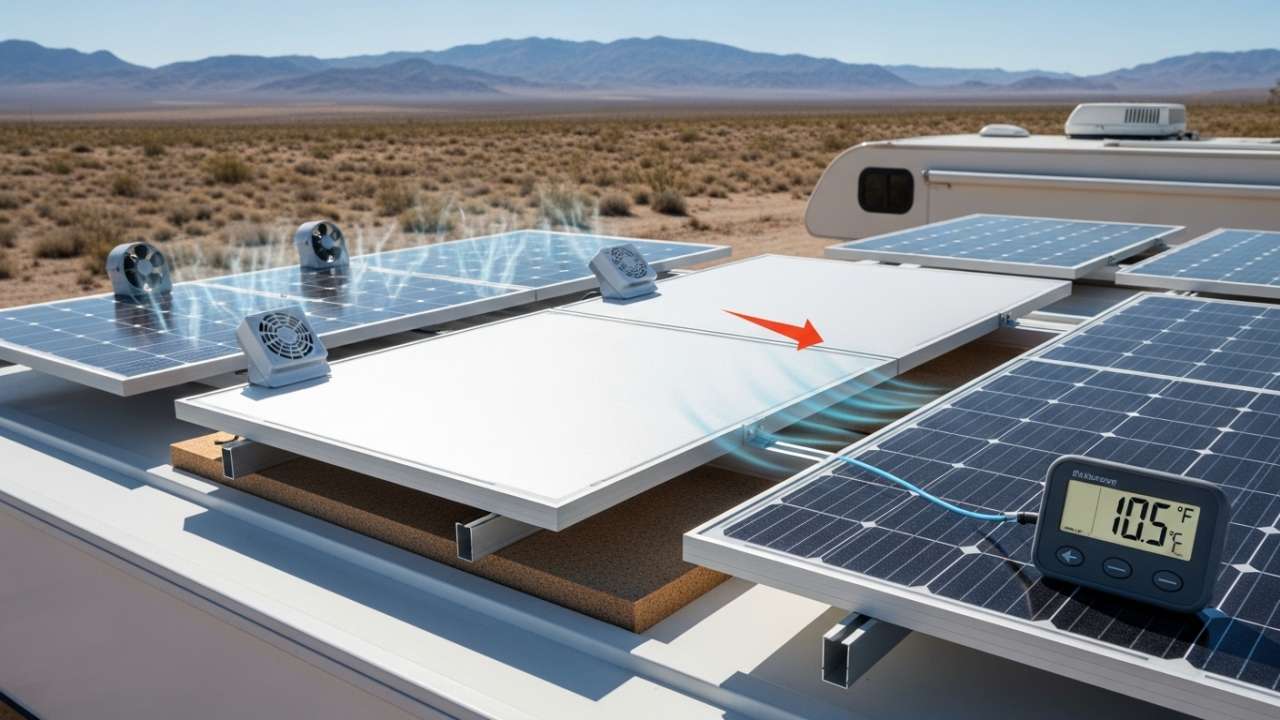
The fix: Create a gap between the panel and the roof.
Rigid panels mounted with 6-8 inch aluminum rails allow air to flow underneath. When you’re driving, that airflow cools the panel naturally. Even parked, a breeze helps. This simple spacing drops panel temperature by 5-10°C and improves efficiency by 2-3% without spending a dime on active cooling systems.
For flexible panels, a polycarbonate backing board creates the same effect. The hollow channels inside the backing act like mini air ducts. Real-world testing shows a 10-15°C temperature drop, which on a 400W panel translates to roughly 15-20 watts of additional power. Over a summer month, that’s meaningful.
Other passive strategies:
- Mount panels at a slight angle (15-20 degrees) instead of flat—allows better airflow underneath and slight self-cleaning when it rains
- Use light-colored backing boards instead of black—reflects some heat instead of absorbing it
- Space multiple panels apart by a few inches instead of butting them edge-to-edge—air flows between them, cooling both
None of these require extra equipment. They just require thinking about airflow when you design your system.
Also Read:- How Much Does It Cost to Convert an RV to Solar? The Real 2026 Pricing
New Mexico’s Real Solar Facts (What You Actually Need to Know)
Let me give you the ground truth about solar in New Mexico, because the marketing material doesn’t tell this story honestly.
New Mexico gets abundant sunshine—that part’s true. But the reality for RV travelers is more nuanced:
Summer (June-August): Peak sun, peak heat. You’ll get 7-8 hours of peak sunlight daily. Panels run hot, efficiency is reduced, but total energy output is still excellent. This is when undersized systems struggle most.
Spring & Fall (April-May, September-October): Actually the best performance periods. Moderate temperatures, high sun angles, moderate ambient temps. This is when your system runs at near-rated performance.
Winter (November-March): Short days, lower sun angle. New Mexico still gets sunshine (it’s dry and clear), but you’re only getting 4-5 hours of useful sunlight daily, even on clear days. This is when most RV owners head south to stay warm anyway.
Dust and Maintenance: After dust storms, your panels can lose 15-25% output. A quick wash with a soft brush and distilled water restores performance. Most RV owners in New Mexico wash their panels every 2-3 weeks during summer. It’s a 20-minute job but essential for maintaining output.
According to the U.S. Department of Energy, New Mexico ranks in the top three states for solar potential. But potential isn’t the same as performance when you don’t account for heat losses. That potential assumes standard panel installation and efficiency—not real RV roof conditions.
FAQ: Real RV Owners’ Real Questions About Solar in New Mexico Heat
Q: Will my panels actually fail if they get too hot?
A: No. Solar panels are engineered to handle up to 185°F surface temperature safely. Heat reduces efficiency, but it doesn’t cause permanent damage. If your panel gets damaged by heat, something else (like installation defect) is actually wrong.
Q: Can I just buy the cheapest panels and deal with heat loss?
A: Technically yes, but you’ll regret it. Cheap panels (below 18% efficiency) with poor temperature coefficients (-0.40%/°C or worse) can lose 20%+ of their output in extreme heat. You’ll get what you pay for, and what you pay for is inadequate power when you need it most.
Q: Should I mount my panels flat or angled?
A: For RVs, a slight tilt (15-20 degrees) is better. It improves cooling airflow, increases winter performance, and helps rain clean the panels. Flat mounting is cheaper to install but hotter and less effective in cooler months.
Q: How often do I need to wash my panels in New Mexico?
A: Every 2-3 weeks during heavy-use seasons (spring/summer). After dust storms, immediately. A quick rinse with distilled water and a soft brush takes 20 minutes and can restore 10-15% of lost output.
Q: Do flexible panels really perform worse than rigid panels?
A: In extreme heat, yes—unless you install a backing board. With proper backing and airflow, modern flexible panels (ETFE material, not PET) perform competitively while saving weight and reducing installation complexity.
Q: What’s the actual power difference between a -0.24%/°C panel and a -0.40%/°C panel?
A: On a 400W system in 110°F heat, roughly 15-20 watts. Over a full summer month, that’s several extra amp-hours per day. For a small RV, it might mean the difference between power rationing and comfortable living.
Q: Do I really need 6-8 inches of clearance under my panels?
A: Yes. Without it, your panel temperature jumps 10-15°C, cutting into that expensive efficiency you paid for. It’s the cheapest performance upgrade you can make.
Q: Will my New Mexico solar system work in other states?
A: Absolutely. A panel that handles New Mexico heat will perform beautifully in milder climates. You’re actually over-specifying for most of the country, which is a problem-to-have.
The Real Cost-Benefit: What You’re Actually Spending for Heat-Tolerant Solar
Let’s talk money, because this is where the real decision lives.
A budget RV solar setup (4 x 100W cheap panels, DIY installed) costs roughly $400-600 and delivers about 320-360W real output in New Mexico summer heat after temperature losses.
A mid-range RV solar setup (2 x 200W Renogy or 1 x 400W Sungold, professional-grade installer) costs $1,200-1,800 and delivers 360-400W real output in the same conditions.
A premium RV solar setup (2 x 410W REC or equivalent, professional mounting with proper cooling, battery integration) costs $2,500-3,500 and delivers 420-450W real output.
The premium option costs 5-7 times more but delivers only 30% more power. Is that worth it?
It depends on your usage pattern:
- Light usage (weekends, short trips): Mid-range setup is perfect. You’ll have enough power for lights, fridge, and device charging without breaking the bank.
- Extended travel (months at a time): Premium setup makes sense. You’re using more power daily, and every watt of system output saves you from running a generator.
- Winter travel: You want the premium setup because cooler temps help efficiency, but lower winter sun angles demand higher panel output to compensate.
For most RV owners doing 4-6 week trips in New Mexico, a solid mid-range system (Renogy 2x100W or equivalent) costs $1,200-1,500, lasts 25+ years, and handles the heat better than 95% of systems out there.
Making Your Final Decision: The System That Actually Works
Here’s the honest advice after seeing dozens of RV solar installs: Don’t guess about panel selection.
The panels that work best in New Mexico extreme heat are the ones with:
- Temperature coefficient of -0.30%/°C or better (non-negotiable)
- Proper installation clearance (6-8 inches for airflow, or backing board for flex panels)
- Mid-range or better efficiency (20%+ for rigid, 21%+ for flexible)
- Good warranty backing (25-year minimum)
Renogy 100W N-Type panels, Sungold 400W flexible panels with backing, REC Alpha Pure, or Qcells Q.TRON all meet these criteria. They’re not the cheapest, but they’re not premium-brand expensive either. They’re the panels that RV owners actually keep long-term and recommend to friends.
Skip the super-cheap panels you find on Amazon. Skip the premium brands if you’re budget-conscious. Land in the middle—spend $1,200-1,800 on a complete system—and you’ll have power that actually works when you need it, where you need it.
New Mexico’s heat is real. But with the right panels, proper installation, and basic maintenance, you can have a solar system that genuinely supports your RV lifestyle instead of limiting it.
The real power? That comes from understanding what you’re buying and why.