Why Santa Fe Is Different For RV Solar
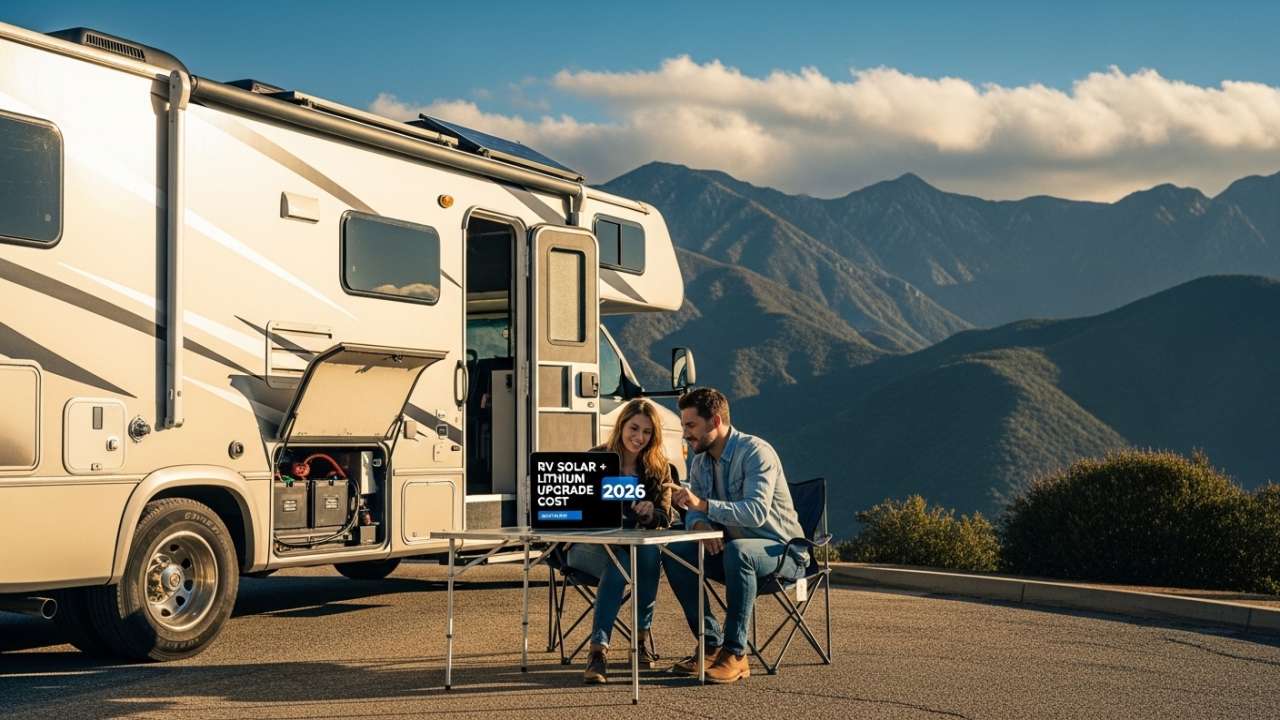
You drive into Santa Fe with your RV. It’s 7,000 feet high. The air is thin. The sun is intense. And solar panels work differently here than everywhere else.
Most RV solar guides? They’re written for Arizona or California. They don’t account for Santa Fe’s unique problems.
Here’s the truth: Santa Fe’s elevation, extreme weather, mineral-rich water, and desert dust create a completely different solar environment. Your panels face challenges that other locations don’t have.
But here’s the good news: When you understand Santa Fe’s specific conditions and maintain your system properly, you’ll get more reliable solar power than most RVers in the country.
Why Santa Fe’s Altitude Matters For Solar Panels
The Air Is Thinner At 7,000 Feet (This Is Good)
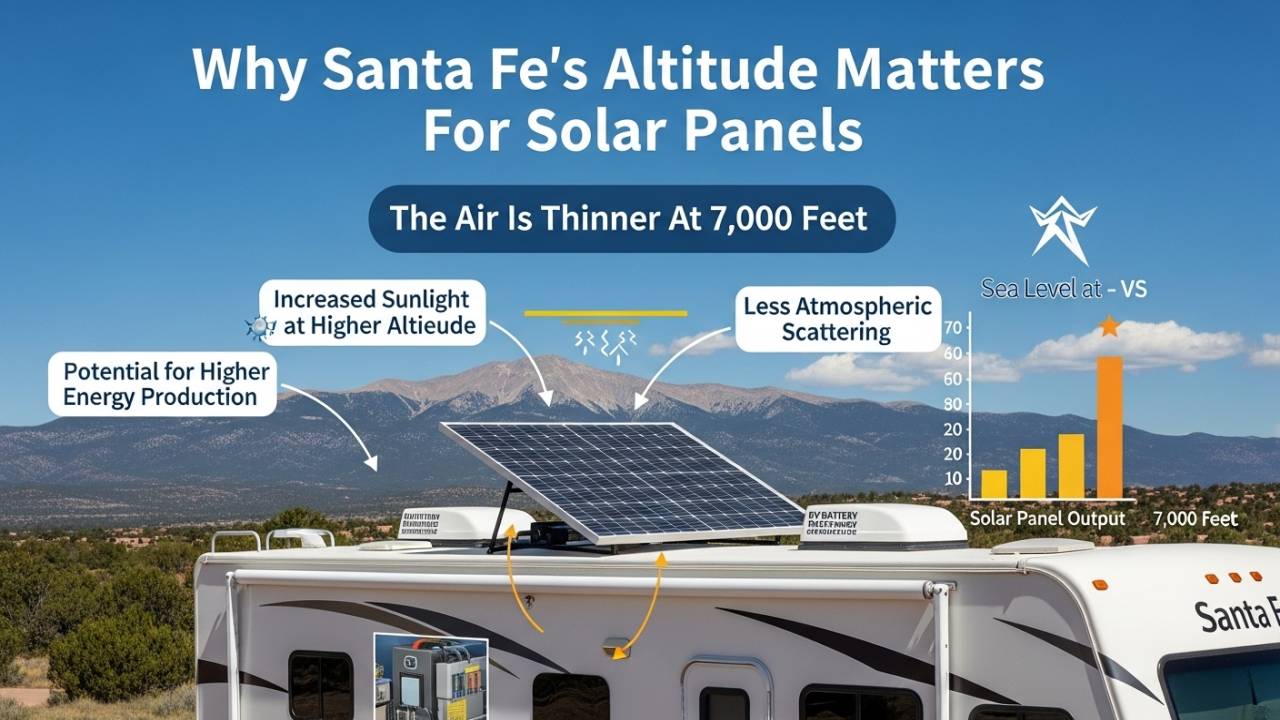
Santa Fe sits at 7,045 feet above sea level. At this height, the air is about 25% thinner than at sea level.
What does this mean for your solar panels?
More sunlight reaches your panels directly.
The thinner air blocks less sunlight. Less atmosphere means less interference. Your panels get stronger, more direct sunlight.
Real number: Santa Fe gets about 6.3 hours of good solar production per day. Lower elevations get 4.5 to 5.5 hours. That’s almost 40% more usable sun power.
More UV Light Also Reaches Your Panels (This Is Bad)
The same thin air that helps sunlight also lets more UV radiation through.
UV light damages solar panels over time. It makes them age faster.
Regular solar panels degrade at about 0.4% per year. In Santa Fe’s high-UV environment, they can degrade at 0.6 to 0.8% per year.
This means:
- You need stronger, UV-resistant panels
- Budget panels will fail faster here
- You’ll need more maintenance
- You need to choose the right brands
The good brands for Santa Fe: Panasonic, Maxeon, REC, and Q-Cells. These are built to handle harsh UV exposure.
The Temperature Swings Are Extreme
Santa Fe’s weather is wild.
Summer days: 85-90°F Winter nights: 25-35°F
That’s a 50-60 degree swing in one day.
This temperature change affects how well your panels work.
Here’s the surprising part: Cold makes panels MORE efficient. Heat makes them LESS efficient.
A 35°F morning? Your panels produce 15-20% more power than on a warm day.
An 85°F afternoon? Your panels produce 25-30% LESS power.
| Temperature | What Happens | Power Loss |
|---|---|---|
| 35°F cold morning | Panels work great | +15-20% bonus |
| 55°F spring | Normal production | 0% change |
| 75°F warm day | Panels slow down | -9% loss |
| 90°F hot day | Panels really slow | -25% loss |
How to fix the heat problem:
Don’t mount panels flat on your roof. Mount them 4-6 inches above your roof with space underneath. Air flows under the panels and keeps them cool. This simple fix gives you 3-5% more power during summer.
Why RV Solar Works Great In Santa Fe (Despite The Problems)
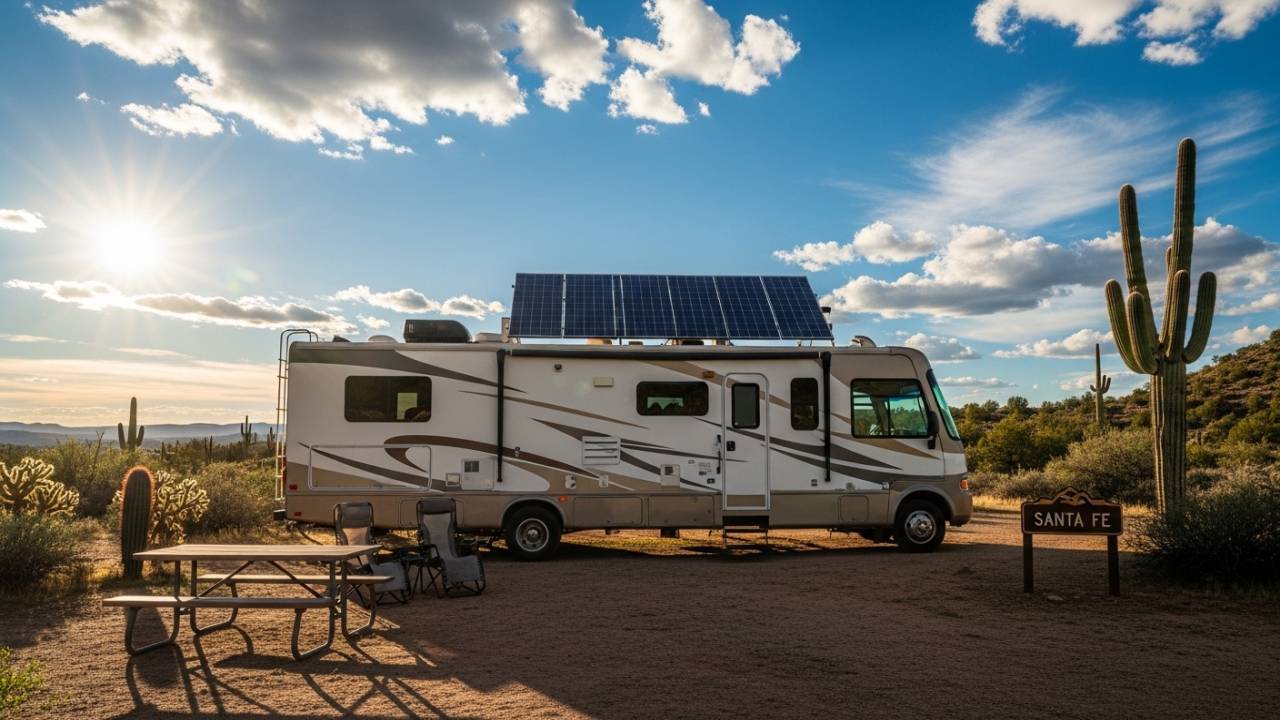
Yes, there are challenges. But Santa Fe is actually one of the best places in America for RV solar.
Why?
310 days of sunshine per year. That’s more clear days than most US locations. You can count on sun most days.
Dust is the main problem, not salt or pollen. Coastal areas have salt that damages panels. High-pollen areas have sticky buildup. Santa Fe has dust, which is actually easier to deal with if you know how.
Wind helps keep your equipment cool. The desert wind helps cool your inverter and charge controller naturally. Less overheating. Better performance.
Also:- Santa Fe RV Solar High Desert Performance & Maintenance Guide
How To Design Your RV Solar System For Santa Fe
Step 1: Figure Out How Much Power You Actually Need
This is where most RVers mess up.
They watch a YouTube video. Someone says “Get 400 watts of solar.” They buy exactly that. Then they park in Santa Fe and run out of power.
Here’s how to actually calculate what you need:
Make a list of everything you use and how long you use it:
- Lights: 100 watts × 5 hours = 500 watt-hours per day
- Refrigerator: 150 watts × 18 hours = 2,700 watt-hours per day
- Water pump: 50 watts × 2 hours = 100 watt-hours per day
- Phone charging: 100 watts × 3 hours = 300 watt-hours per day
- Coffee maker: 1,000 watts × 0.5 hours = 500 watt-hours per day
Your total: About 4,100 watt-hours per day
Now add 30-40% extra for bad days, cloudy weather, and system losses.
4,100 × 1.35 = 5,535 watt-hours needed per day
That means you need about 6,000 watts of solar capacity to reliably power your RV in Santa Fe.
In real panels, that’s about 6 panels at 400 watts each.
Pick The Right Solar Panels
Not all solar panels are the same. In Santa Fe, you need panels that handle extreme heat and UV.
Best choice: Monocrystalline panels
Why? They work best when space is limited and heat is extreme.
| Panel Type | Efficiency | Heat Rating | Best For |
|---|---|---|---|
| Monocrystalline | 18-22% | Good | Santa Fe RVs |
| Polycrystalline | 15-17% | Fair | Budget option |
| Thin-Film | 10-14% | Excellent | Extra hot areas |
Brands that work well in Santa Fe:
- Panasonic HIT (handles heat well)
- Maxeon by SunPower (lasts 25 years in desert)
- REC Alpha (great for high elevation)
- QCells (good balance of price and quality)
Don’t buy cheap panels. They fail faster in Santa Fe’s UV environment. The extra $500-1,000 now saves you $5,000+ in replacements later.
Also Read:- RV Solar Installation in Albuquerque: Your Complete Guide to Top Shops + DIY Setup
Choose Your Charge Controller
Your charge controller is the brain of your system. It decides when to charge your batteries and how fast.
There are two types:
PWM Controller:
- Costs: $200-400
- Works okay at sea level
- Problem in Santa Fe: Only 60-75% efficient in extreme temperatures
- You lose 25-40% of power in winter and summer
MPPT Controller:
- Costs: $500-1,200
- Works great everywhere, especially at altitude
- 85-98% efficient in all temperatures
- Recovers 20-30% more power in Santa Fe conditions
For Santa Fe: Get MPPT. Yes, it costs more. But it recovers so much lost power that it pays for itself in 2-3 years.
Pick A Battery Bank
Your batteries store power for when the sun isn’t shining.
Lead-Acid Batteries:
- Cost: $1,500-2,500
- Lifespan in Santa Fe: 3-4 years (heat kills them)
- You need to replace them often
- Can’t use more than 50% of capacity
Lithium Batteries (LiFePO4):
- Cost: $4,000-8,000
- Lifespan in Santa Fe: 10-15 years
- You can use 80-90% of capacity
- Better in cold weather
- Better in hot weather
- Better overall
Real cost over 10 years:
Lead-acid: $2,000 now + $2,000 replacement in year 4 = $4,000 total
Lithium: $6,000 now + $0 replacement (still working) = $6,000 total
But lithium gives you better power, works better in winter, and lasts 3x longer.
Get lithium if you can afford it. It’s worth the extra cost.
Cleaning Your Solar Panels (The Most Important Part)
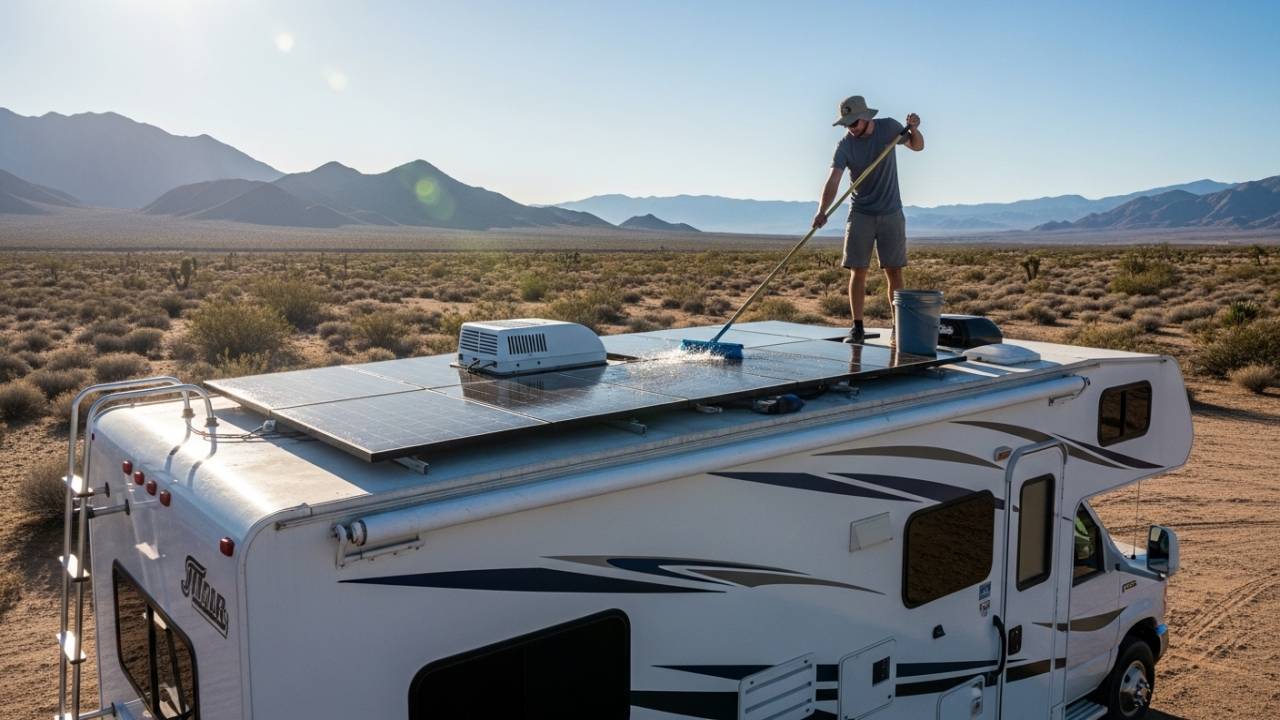
This is where Santa Fe RVers fail the most.
Most people clean panels once or twice a year. That works in Arizona. It doesn’t work in Santa Fe.
Santa Fe Has A Unique Dust And Mineral Problem
Santa Fe’s dust is different from other places.
When it rains (which is rare), the water evaporates super fast in the dry air. This leaves behind mineral deposits. These deposits stick to your panels and reduce how much sun gets through.
Plus, Santa Fe has juniper and chamisa plants that release sticky pollen.
Combined with desert dust, this creates a buildup that seriously hurts your power output.
Dirty panels can lose 15-30% of their power.
If your system makes 10 kilowatts per day, losing 30% means losing 3 kilowatts. That’s real money.
Also Read:- RV Water Heater Replacement Cost 2026 — How Much Should You Actually Budget?
When To Clean Your Panels
Spring (March-May): Every 3 weeks
- Reason: Pollen season, dust storms
Summer (June-September): Every 2-3 weeks
- Reason: Monsoon dust, mineral buildup from rain
Fall (September-November): Every 4 weeks
- Reason: Juniper and chamisa pollen
Winter (December-February): Every 6-8 weeks
- Reason: Less dust, less important anyway (lower sun angle)
How To Actually Clean Your Panels
What NOT to do:
- Don’t use a pressure washer (breaks the coating)
- Don’t use tap water (leaves mineral stains)
- Don’t clean in hot sun (you’ll burn yourself)
- Don’t scrub hard (damages the panels)
What TO do:
Step 1: Use deionized water. Buy it from an auto parts store for $5-10 per gallon. This water doesn’t leave mineral stains.
Step 2: Clean early morning or evening when panels are cool.
Step 3: Use a soft cloth or soft brush. Be gentle.
Step 4: Rinse with more deionized water. Let it dry naturally.
Step 5: Take photos before and after. Keep records. Manufacturers need proof you maintained your system.
Real Life Examples In Santa Fe
Example 1: Winter Weekend In Santa Fe
You park Friday night. It’s 32°F outside.
You make dinner, watch TV for 2 hours, charge your laptop, run lights.
Total power used: 1,000 watt-hours
Saturday morning, solar production starts. Winter sun is low but powerful at this altitude.
By 2 PM, you get maybe 2,500 watt-hours from your panels.
You have plenty of power. Your batteries stay charged.
Winter is actually pretty good for solar in Santa Fe because cold air makes panels efficient. Just keep panels clean.
Example 2: Summer Off-Grid In Santa Fe
You park for 5 days with no hookups.
It’s 85°F. Your panels get hot (up to 135°F).
You run:
- Air conditioner fan: 600 watt-hours
- Fridge: 2,400 watt-hours
- Lights: 600 watt-hours
- Devices: 400 watt-hours
Total needed: 4,000 watt-hours per day
Your solar panels, rated at 2,400 watts, only produce about 1,500-1,800 watts in peak heat. You get about 3,500 watt-hours per day.
You’re short 500 watt-hours.
Your battery goes down 5-10% per day. By day 5, you’re at 50% battery.
What real RVers do: Run a generator for 1-2 hours daily, OR use the AC fan less, OR plan shorter off-grid trips in summer.
This is normal. Even with good solar, Santa Fe summers need a backup plan.
How To Install Your Solar System
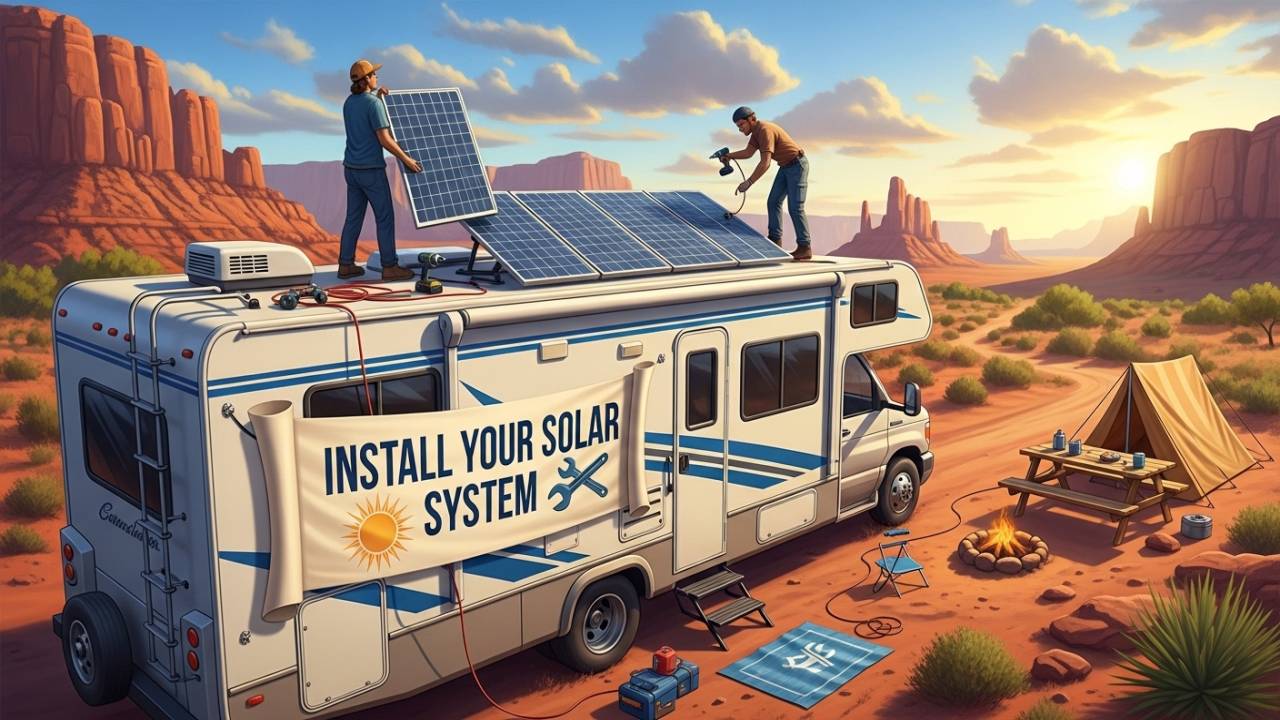
Step 1: Check Your Roof First
Before you install anything, make sure your RV roof is ready.
Santa Fe’s sun is intense. It ages RV roofs faster than other places.
Check for:
- Cracks or soft spots
- Old sealant that’s falling apart
- Water stains (old leaks)
- Rubber that’s dried out and cracking
If your RV is more than 10 years old, consider re-sealing the roof first.
Mount The Panels Correctly
Don’t bolt panels flat to your roof. Mount them with space underneath for air to flow.
Use 4-6 inch standoffs. This air gap keeps panels cool and keeps your roof from getting damaged.
What you need:
- Aluminum standoffs (not cheap aluminum, good aluminum)
- Stainless steel bolts (not galvanized, which rusts in dry air)
- Good rubber washers that handle UV
- Marine-grade sealant (Dicor or Eternabond)
Seal everything. Every hole is a potential leak.
Wire It Right
Use the right size wires. In Santa Fe cold, you need bigger wires than normal.
Standard recommendation: 10 gauge wire Santa Fe recommendation: 8 gauge wire
Cold makes electricity move differently. Bigger wires handle it better.
Use UV-rated conduit, not regular PVC. UV conduit costs more but lasts 3x longer.
Get A Monitoring System
This is not optional. You need to see what your system is actually doing.
A good monitor shows:
- Real-time power production
- Battery charge level
- Power you’re using
- Problems and warnings
Victron battery monitor is excellent. Costs $300-400.
Also Read:- How to Charge RV Battery with Solar: Best Solar Chargers, Panels & RV Solar Power Systems
Part 6: Maintenance Schedule For Santa Fe
Every Month:
- Check panels for dust and dirt
- Clean if needed (every 2-4 weeks depending on season)
- Look for cracks or damage on panels
- Check that bolts are tight
Every Season (4 times a year):
- Inspect wiring for damage
- Check sealants around roof penetrations
- Test your system under full load
- Check battery health
Every Year:
- Professional inspection of whole system
- Clean and check all connections
- Verify controller settings are correct
- Test inverter at full power
- Document everything for warranty
Santa Fe Specific Schedule:
| Season | Main Task | Why |
|---|---|---|
| Spring | Clean panels every 3 weeks | Pollen and dust |
| Summer | Clean every 2 weeks | Monsoon storms and mineral deposits |
| Fall | Clean every 4 weeks | More pollen from juniper |
| Winter | Clean every 6 weeks | Less dust, lower urgency |
Problems Santa Fe RVers Face And How To Fix Them
Problem 1: Winter Power Loss
You think winter is bad for solar because days are short. It is… but not the way you think.
Winter sun comes from a low angle. If your RV is parked pointing the wrong way, your panels are shaded.
Fix: Always park with your panels facing south when you can. Even 30 degrees wrong direction loses 20-40% of winter power.
Problem 2: Mineral Water Damage
Santa Fe water has lots of minerals. When it rains and dries fast, it leaves deposits that damage panels.
Fix: Use deionized water for final rinse. Costs $2-3 more per cleaning but prevents permanent damage.
Problem 3: Cheap Charge Controller Losses
PWM controllers lose 20-25% of power in Santa Fe. You think you’re saving $400, but you lose that in lost power within 3 years.
Fix: Get MPPT. It costs more but saves you money long-term.
Problem 4: Undersized Battery
You buy lots of panels but small batteries. In summer, panels fill batteries by 10 AM. Then power is wasted.
In winter, batteries empty by night. You need more capacity.
Fix: Match panel size to battery size. Every 500 watts of panels needs 50 amp-hours of battery capacity.
Problem 5: Heat Kills Inverters
Inverters overheat inside your RV in summer. They shut down. You lose power.
Fix: Mount inverter outside on the shady side of your RV. Make sure air can flow around it.
What It Actually Costs
Let’s be real about money.
Initial Cost
A complete solar system for Santa Fe RVs costs:
- Panels: $3,000
- Battery: $6,000
- Charge controller: $700
- Inverter: $2,000
- Hardware/wiring: $1,000
- Installation labor: $2,000
Total: $14,700
Yearly Costs
- Panel cleaning: $300
- Maintenance: $300
- Monitoring service: $100
Yearly: $700
10-Year Total Cost
$14,700 + ($700 × 10 years) = $21,700
What You Save
Campground hookup fees: $50-70 per night If you camp 200 nights per year: $10,000-14,000 per year
10-year savings: $100,000-140,000
Real cost to you: $21,700 – $100,000 = You make $78,300
After 5 years, your system pays for itself. Then it’s pure free power.
Questions People
Can I run my AC unit on solar only?
No. An AC unit uses 3,500-5,000 watts continuously. That’s 42-60 kilowatt-hours per day. Even big solar systems produce 12-15 kilowatt-hours in Santa Fe summer heat.
Use AC in early morning or evening. Use a generator during peak heat hours. Most RVers do this.
How often do I really clean panels?
Every 2-4 weeks in spring, summer, and early fall. Every 6-8 weeks in winter.
You’ll know they need cleaning when power production drops 15-20% without weather changes.
Will my battery freeze in winter?
Fully charged lead-acid batteries won’t freeze until -20°F. Keep your battery at least 50% charged through winter.
Lithium batteries are better in cold. They won’t freeze as fast.
Do I need MPPT or is PWM okay?
In Santa Fe? Get MPPT. PWM loses 20-30% of power. MPPT recovers that power.
The extra $400-600 cost pays back in 2-3 years from recovered power.
What size system do I need?
- Weekends only: 1,500-2,000 watts solar + 100 amp-hours battery
- 3 seasons camping: 2,500-3,000 watts solar + 200 amp-hours battery
- Year-round living: 4,000-5,000 watts solar + 300-400 amp-hours battery + generator backup
Winter production is 40-50% of summer, so bigger is better for year-round.
Can I install this myself?
Technically, yes, but think twice.
Pros of DIY:
- Save $2,000-3,000 in labor
Cons of DIY:
- Dangerous working on roof at height
- Easy to make expensive wiring mistakes
- May void warranties if not installed right
- Complex with all the equipment
Recommendation: Hire a professional. The extra cost is worth avoiding mistakes.
Where To Get Help In Santa Fe
When you need expert help for RV solar in Santa Fe:
Professional Solar Companies:
- Positive Energy Solar (Santa Fe specialists in altitude)
- Infinity Solar USA (New Mexico experience)
- Local RV shops (ask about solar installations)
Government Resources:
- NREL PVWatts calculator (input Santa Fe 87501 to see real production numbers)
- New Mexico Environment Department (tax incentives for solar)
- City of Santa Fe renewable energy programs
Online Communities:
- RV Solar Facebook groups
- iRV2 forums (RV-specific solar discussions)
- Van life communities (lots of DIY knowledge)
The Real Truth About RV Solar In Santa Fe
Here’s what you need to know:
Santa Fe is one of the best places in America for RV solar. 310 days of sun. High elevation. Desert air is clear.
But Santa Fe also demands respect. The altitude, heat, cold, dust, and mineral water create unique challenges.
When you understand these challenges and maintain your system properly, you’ll have more reliable power than most RVers. You’ll camp where you want. You’ll have energy independence.
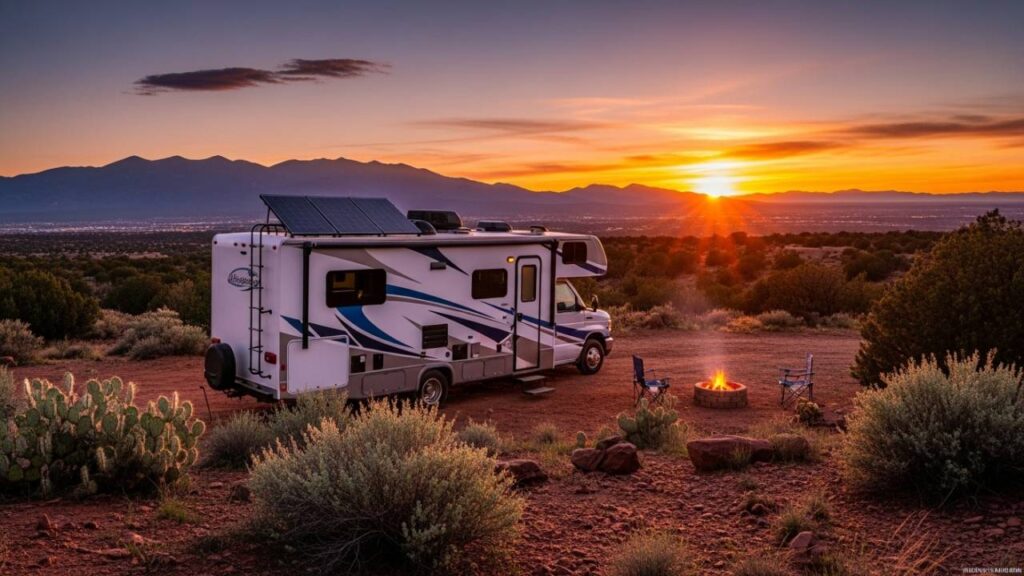
The RVers parked on Santa Fe mesas at sunrise, running their coffee makers without hookups, aren’t lucky. They understand their climate. They built systems designed for it. They clean panels regularly.
Now you can do the same.
Start here:
- Calculate your real power needs
- Buy the right equipment for altitude (MPPT, monocrystalline, lithium)
- Install with air gaps for cooling
- Clean panels every 2-4 weeks
- Monitor your system
- Enjoy free power