Why Yellowstone Demands a Solar-Ready RV
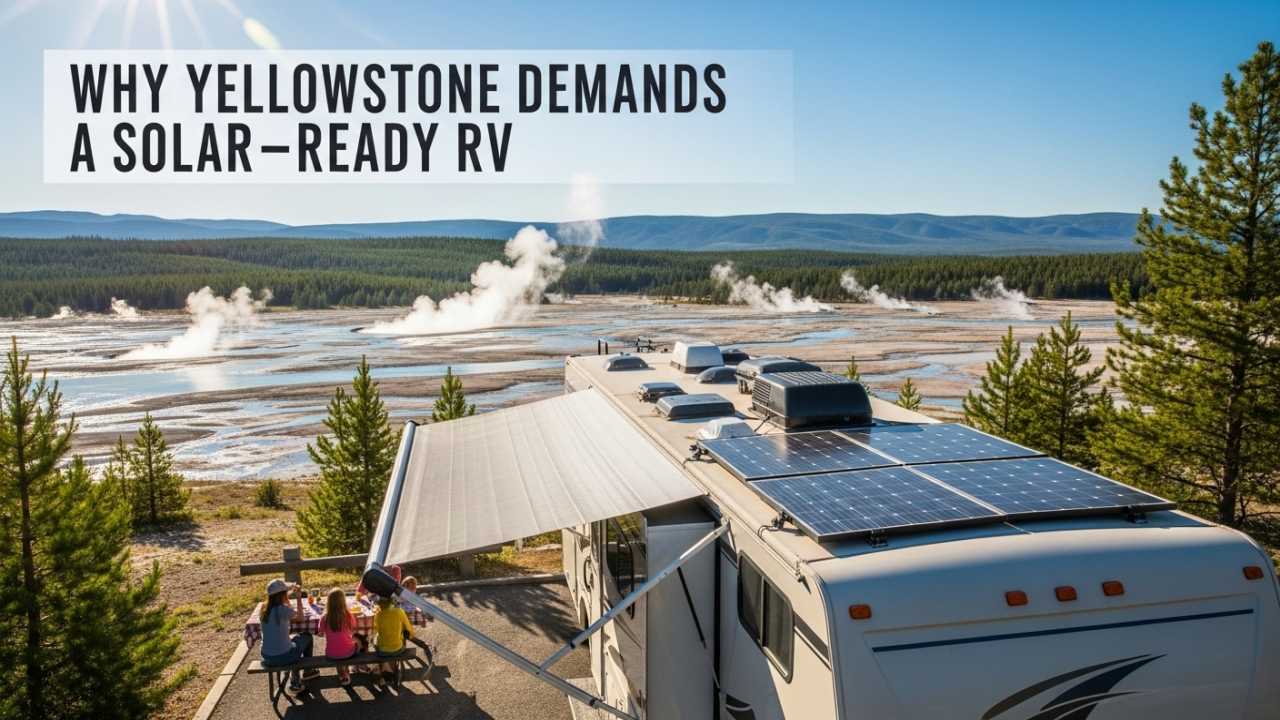
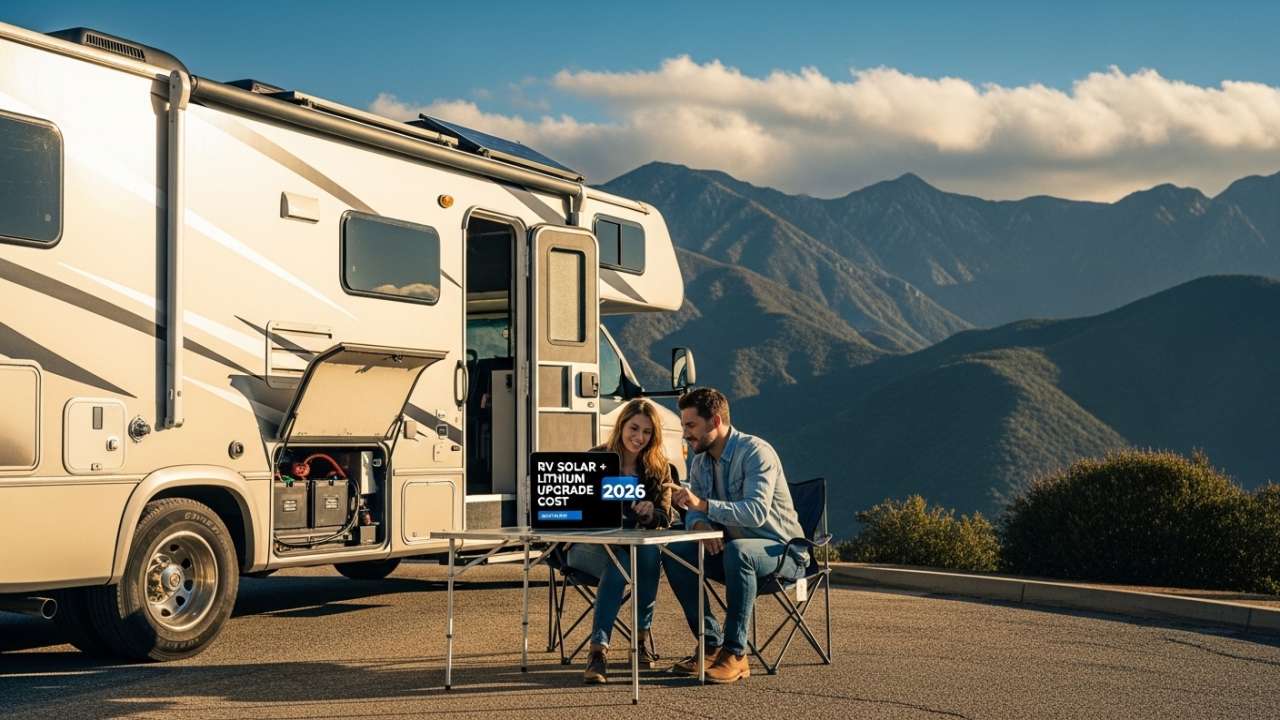
Yellowstone National Park is one of the most spectacular places on earth, and for RV travelers, it presents a unique challenge: the park is massive, incredibly popular, and almost completely lacking in electrical hookups for campers. If you roll in expecting shore power, you’re going to have a rough time.
Understanding RV solar for Yellowstone starts with understanding the park’s setup. Across more than 2.2 million acres of wilderness, only Fishing Bridge RV Park offers full electrical hookups. That single campground has 310 sites — and they fill up months in advance. Every other campground inside the park runs dry, meaning no electric, no water, no sewer at the site.
Key Reasons Solar Is Essential at Yellowstone
- Limited hookups — Only 1 out of 5 main campgrounds has electrical hookups (Fishing Bridge only)
- High altitude advantage — 7,000–8,000 ft elevation means 10–15% more solar output than sea level
- Daily driving drains batteries — Long days touring the Grand Loop Road won’t fully recharge your house battery bank
- Generator restrictions — Generators only allowed 8 a.m.–8 p.m. at RV sites; solar covers the gaps
- Limited cell service — No relying on campground apps or online resources once you’re in the interior
The bottom line: if you’re planning a Yellowstone RV trip, a functional RV solar Yellowstone setup isn’t a luxury — it’s the backbone of your whole experience.
Also Read:- How Many Solar Panels Does an RV Need?
Yellowstone RV Camping Overview: What You’re Actually Working With
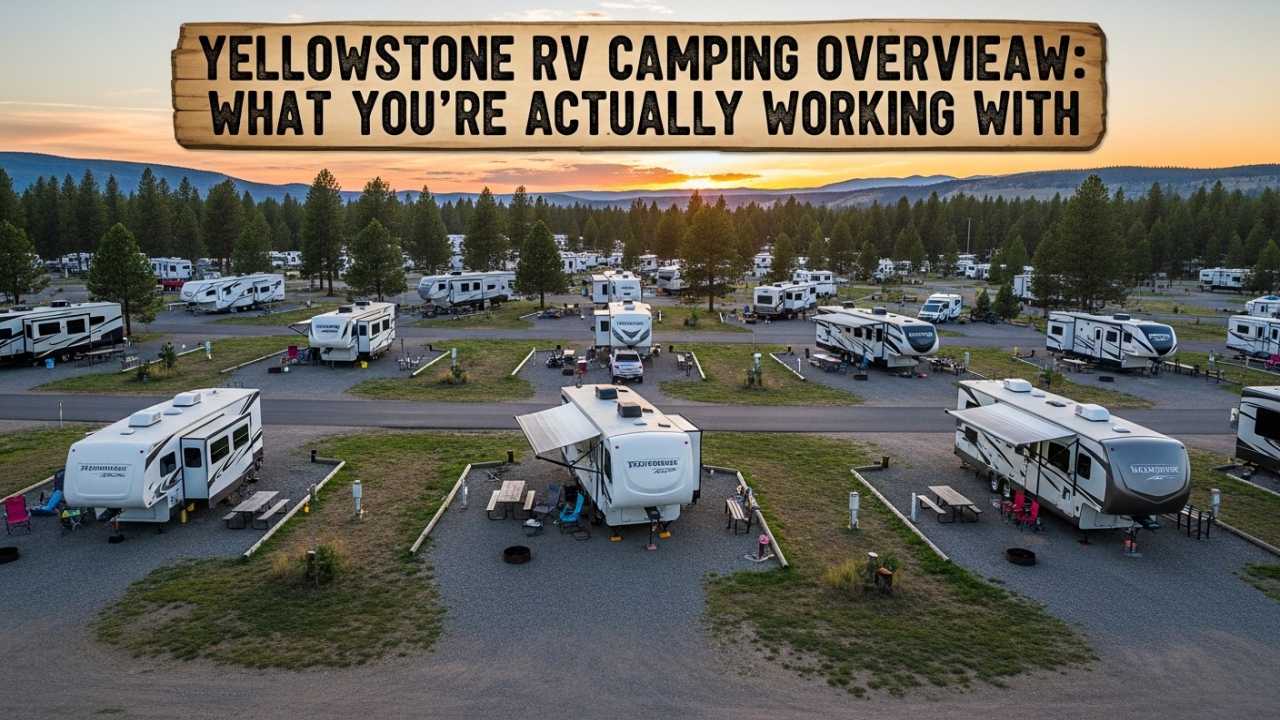
Before sizing your RV solar Yellowstone system, you need to know what the campground situation actually looks like inside the park. Here’s a full comparison of the 5 main campgrounds:
Yellowstone RV Campground Comparison Table
| Campground | Sites | Electrical Hookups | Max RV Length | Dump Station | Generator Hours | Approx. Price/Night |
|---|---|---|---|---|---|---|
| Fishing Bridge RV Park | 310 | Yes (Full hookup) | 45 ft (Hard-sided only) | Yes | Allowed | $89–$99 |
| Madison Campground | 278 | No | 40 ft (limited) | Yes | 8 a.m.–8 p.m. | $30–$35 |
| Canyon Village | 111 | No | 50 ft (2 sites) | Yes | 8 a.m.–8 p.m. | $30–$35 |
| Bridge Bay | 400+ | No | Standard | Yes | 8 a.m.–8 p.m. | $28–$32 |
| Grant Village | ~400 | No | Standard | Yes | 8 a.m.–8 p.m. | $28–$32 |
Bottom line: 4 out of 5 campgrounds have zero hookups. Your RV solar Yellowstone system is your primary power source for the entire trip unless you snag a Fishing Bridge site.
Campground Highlights at a Glance
Fishing Bridge RV Park
- Only full-hookup option in the entire park
- Hard-sided rigs only (prime grizzly bear habitat)
- Showers, laundry, dump station on-site
- Books out months in advance — reserve as early as possible
Madison Campground
- Best central location — close to Old Faithful and Norris Geyser Basin
- Open meadow setting = excellent solar panel exposure during the day
- 278 sites, flush toilets, dump station
Canyon Village Campground
- Near the Grand Canyon of the Yellowstone
- Limited cell reception — set up Bluetooth solar monitoring before you arrive
- Ranger programs at on-site amphitheater every evening
Bridge Bay Campground
- Largest campground — 400+ sites along Yellowstone Lake
- Open meadow layout = great daytime solar charging
- Fishing and boating access directly from camp
Grant Village Campground
- Closest campground to the south entrance (Jackson/Grand Teton route)
- Great first-night stop for south-entrance arrivals
- Mix of pull-through and back-in sites available
The Generator Rule You Need to Know
Generators are permitted only between 8:00 a.m. and 8:00 p.m. at RV sites, and must not exceed 60 decibels at 50 feet. Solar is your quiet, fully compliant alternative for overnight and early-morning power needs.
Also Read:- RV Solar Panel System Cost Breakdown 2026
Solar System Sizing for Yellowstone: Why 400W Is Your Starting Point
When thinking about RV solar for Yellowstone, 400 watts is the recommended minimum. Here’s the math behind that number.
Typical Yellowstone Evening Power Consumption
| Appliance | Estimated Draw | Hours Used | Daily Amp-Hours |
|---|---|---|---|
| LED Lighting (4 fixtures) | 3–5A | 4 hrs | 12–20 Ah |
| 12V Compressor Refrigerator | 4–6A | 24 hrs (cycling) | 30–50 Ah |
| Phone & Camera Charging | 2–3A | 3 hrs | 6–9 Ah |
| Laptop | 4–6A | 2 hrs | 8–12 Ah |
| Fan / Ventilation | 2–4A | 6 hrs | 12–24 Ah |
| CPAP Machine | 3–5A | 8 hrs | 24–40 Ah |
| Total Estimated Nightly Use | — | — | ~92–155 Ah |
Solar Output at Yellowstone’s Altitude (7,000–8,000 ft)
| Solar Setup | Clear Day Output | Partly Cloudy Day | Best For |
|---|---|---|---|
| 200W | 80–100 Ah/day | 40–60 Ah/day | Minimal use / short weekend trips |
| 400W | 160–200 Ah/day | 80–110 Ah/day | Most RVers — recommended minimum |
| 500W | 200–240 Ah/day | 100–140 Ah/day | Heavier users, 7+ day trips |
| 600W | 240–300 Ah/day | 120–170 Ah/day | Full comfort, AC use, cloudy-day buffer |
Note: Yellowstone’s high altitude gives a 10–15% solar output boost over sea level. Your panels will outperform their rated specs on clear summer days.
Recommended Complete System for a Week-Long Yellowstone Trip
- 400–600W monocrystalline solar panels
- 200Ah LiFePO4 lithium battery bank (or 300–400Ah AGM)
- 40-amp MPPT solar charge controller
- 2,000W pure sine wave inverter
Solar Installation: Before Your Trip vs. On the Road
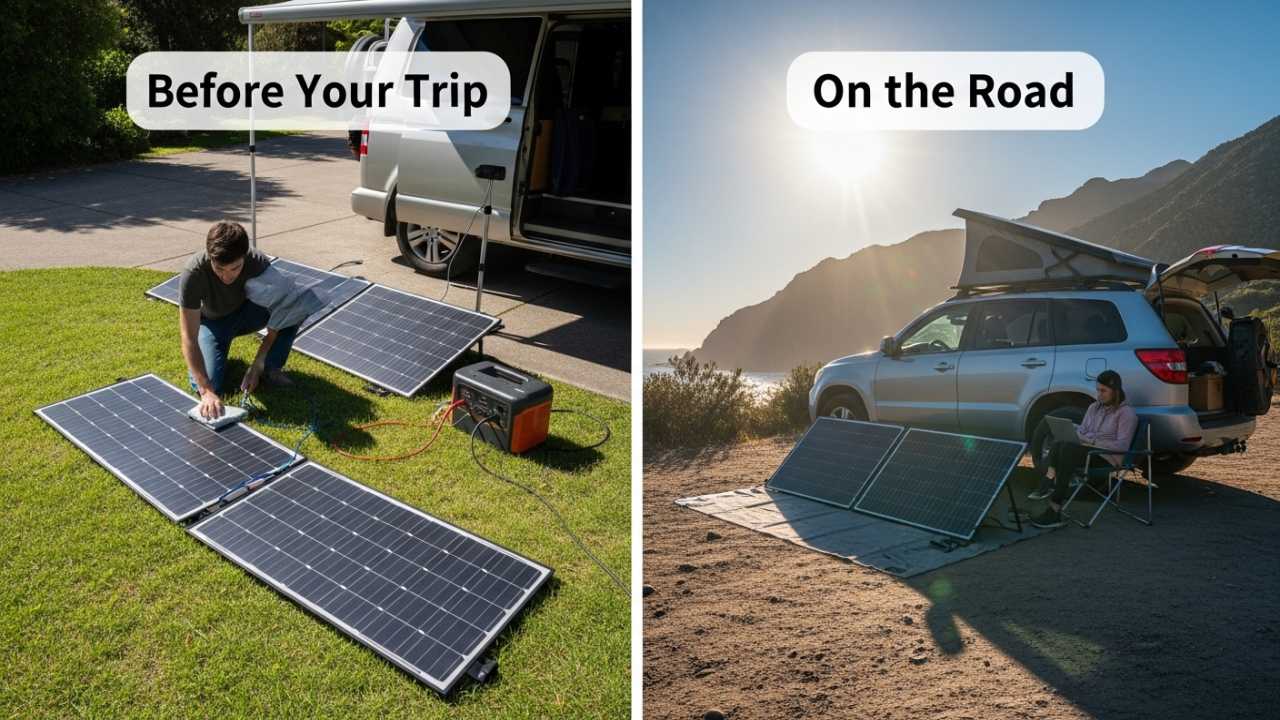
One of the most common questions around RV solar for Yellowstone is whether to get a permanent roof-mount system installed before the trip or rely on portable panels while you’re there.
Installation Options Compared
| Option | Setup Time at Camp | Power While Driving | Best For | Approx. Cost |
|---|---|---|---|---|
| Permanent Roof-Mount | Zero (always on) | Yes | Full-timers, frequent campers | $1,200–$3,500 installed |
| Portable Folding Panels | 5–10 min | No | Occasional campers | $300–$800 |
| Hybrid (roof + portable) | 2–5 min (portable add-on) | Partial | Best of both worlds | $800–$2,500 |
Pro tips for each approach:
- Permanent install: Get it done before you leave home. Troubleshooting wiring issues in a Yellowstone parking lot is not the vacation you want.
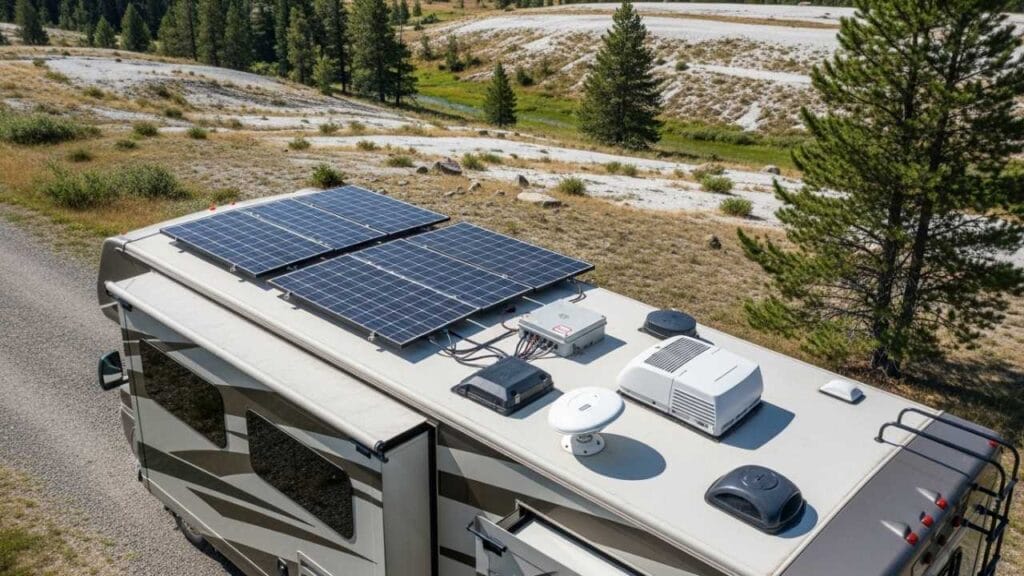
- Portable panels: Angle them toward the south and reposition mid-day for best output. Two 200W portable panels = a capable 400W RV solar Yellowstone setup.
- Hybrid: A modest 200W roof-mount plus one 200W portable panel gives you flexibility plus driving power, and you can leave the portable home on short trips.
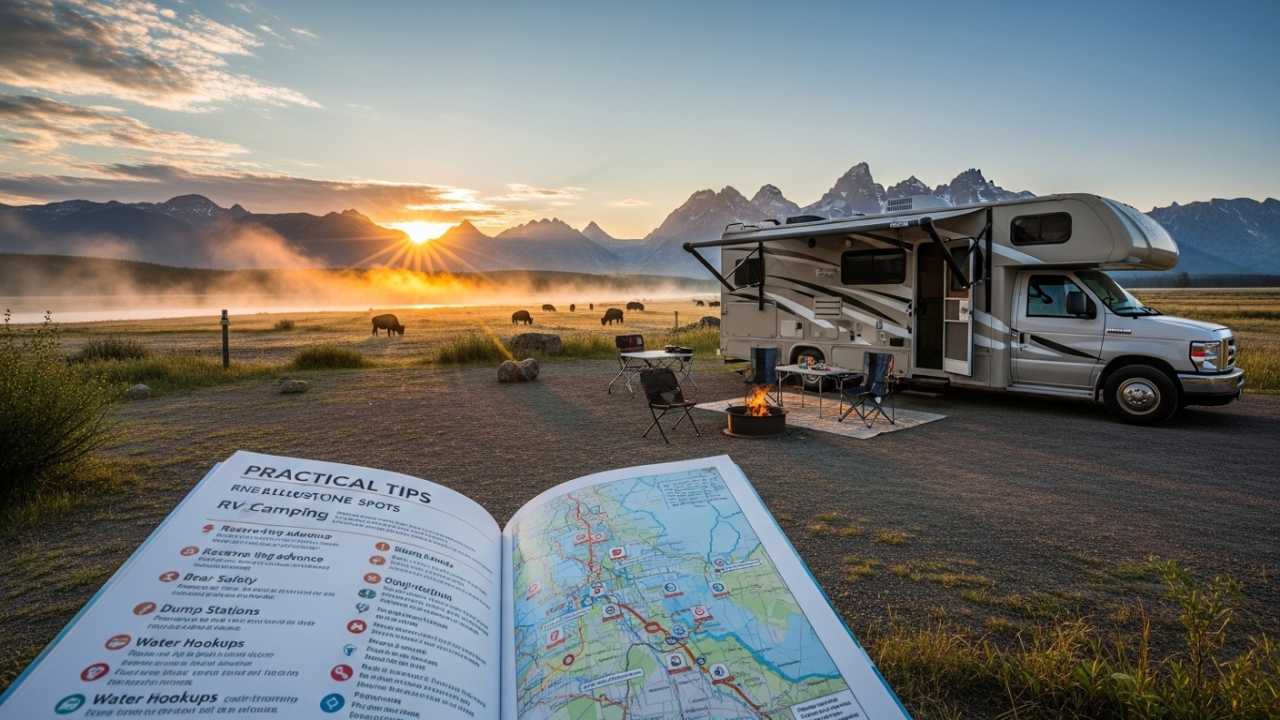
Best RV Camping Spots Inside Yellowstone — Practical Tips
For RV solar Yellowstone travelers, campsite selection inside the park matters more than most people think.
What to Look for in a Campsite
- Open sky to the south — Trees on the south side shade your roof panels during peak production hours (10 a.m.–3 p.m.)
- Pull-through sites — Often have better sky exposure than back-in spots tucked under pine canopy
- Ask the ranger at check-in — Request a “south-facing or open meadow site” — rangers often know exactly which spots get the most sun
- Avoid heavily wooded back-in spots — Pretty, but your panels will produce a fraction of their potential
Booking Strategy
- Reserve 13 months in advance — The window opens on the 5th of each month
- Madison, Canyon, Bridge Bay — peak July/August dates fill within hours of opening
- Fishing Bridge (hookup sites) — fills within minutes; set a calendar alarm and be ready at the exact opening time
- Same-day first-come spots — arrive at the campground between 8:00–9:00 a.m. for any cancellations
Bear Safety and Your Solar Setup
All of Yellowstone is active grizzly and black bear country. Here’s what RV solar campers specifically need to know:
- All food, trash, and scented items must be stored in a hard-sided vehicle or NPS bear box at all times
- Keep your RV doors locked at night, especially at Fishing Bridge and Bridge Bay where bears are highly habituated
- Solar panels, charge controllers, and wiring have zero bear attraction risk — no special precautions needed for your equipment
- Sunscreen, bug spray, and toiletries count as scented items — store them inside your locked rig, not in outside storage bays
Also Read:- Billings RV Solar Installation: Top 5 Local Shops (2026)
Boondocking Near Yellowstone: Free Camping at Every Entrance
The campgrounds inside Yellowstone are fantastic, but with high prices and limited availability, many RV solar Yellowstone travelers choose to base themselves just outside the park on public land. Here’s the full breakdown.
Boondocking Quick-Reference Table
| Entrance | Location | Site Name | RV Friendly | Cell Signal | Solar Exposure | Fee |
|---|---|---|---|---|---|---|
| West | West Yellowstone, MT | Henry’s Lake BLM Dispersed | All sizes | Moderate | Excellent | Free |
| West | West Yellowstone, MT | Denny Creek Road (Gallatin NF) | Most sizes | Low | Good | Free |
| North | Gardiner, MT | Carbella BLM Recreation Site | All sizes | Low | Good | Free |
| North | Gardiner, MT | FSR 3243 / Casey Lake (Custer-Gallatin NF) | Most sizes | None | Excellent | Free |
| East | Cody, WY | Spirit Mountain Road BLM | Smaller rigs | Moderate | Good | Free |
| East | Cody, WY | Sheep Mountain BLM | All sizes | Moderate | Good | Free |
| South | Jackson, WY | Spread Creek Dispersed (Bridger-Teton NF) | Large rigs | Low | Good | Free |
| South | Jackson, WY | Snake River Corridor Dispersed | Most sizes | Low | Moderate | Free |
West Entrance — West Yellowstone, MT
Henry’s Lake BLM Dispersed is just over 30 minutes from the west entrance — completely free with clean vault toilets and wide-open sky for excellent solar charging. Suitable for all rig sizes.
Denny Creek Road heads back into Gallatin National Forest just west of the West Yellowstone KOA, with pull-outs suitable for most RVs and solid views of the surrounding peaks.
North Entrance — Gardiner, MT
Carbella BLM Recreation Site sits alongside the Yellowstone River north of Gardiner. About a dozen designated dispersed sites with flat ground and space for large rigs. Fills quickly on summer weekends, so arrive early.
FSR 3243 off Jardine Road climbs into Custer-Gallatin National Forest. Sites past Casey Lake have open, south-facing sky — ideal for any RV solar Yellowstone setup. Note: zero cell signal up here, so download everything before you head up.
East Entrance — Cody, WY
Spirit Mountain Road and Cedar Mountain off Highway 14 offer BLM dispersed camping with rewarding views of Cody below. Best suited to smaller rigs on the rougher upper sections.
Sheep Mountain BLM has level ground suitable for large fifth wheels and decent cell reception with major carriers — a bonus if you’re working remotely during your Yellowstone trip.
South Entrance — Jackson, WY
Spread Creek Dispersed Campground off US-26/287 east of Moran Junction has fire rings and sites large enough for big rigs. One of the most popular south-entrance boondocking spots.
Colter Bay RV Park inside Grand Teton National Park (paid, with hookups) makes an excellent staging campground the night before you enter Yellowstone from the south.
Also Read:-Billings RV Solar Installation: Top 5 Local Shops + Complete DIY Guide (2026)
Equipment Recommendations for Yellowstone Conditions
Yellowstone’s altitude, cold nights, and dusty gravel roads all influence your gear choices for a reliable RV solar Yellowstone setup.
Recommended Equipment at a Glance
| Component | Recommended Spec | Top Brands | Approx. Price |
|---|---|---|---|
| Solar Panels | 400–600W monocrystalline | Renogy, Rich Solar, Newpowa | $300–$600 |
| Battery Bank | 200Ah LiFePO4 (or 300–400Ah AGM) | Battle Born, Renogy, Ampere Time | $600–$1,200 |
| Charge Controller | 40A MPPT | Victron SmartSolar, Renogy Rover, Epever | $120–$280 |
| Inverter / Charger | 2,000W pure sine wave | Victron MultiPlus, Renogy, AIMS | $300–$800 |
| Cell Signal Booster | WeBoost Drive 4G-X or equivalent | WeBoost, SureCall | $300–$500 |
Why Each Component Matters at Yellowstone
Solar Panels — Monocrystalline Only
- Outperform polycrystalline in high-altitude, high-UV conditions
- More efficient in cold morning temperatures common at 7,500 ft even in July
- For 400W: four 100W rigid panels or two 200W panels both work well
Batteries — LiFePO4 Over AGM
- Handle Yellowstone’s wide temperature swings better than AGM (freezing nights, warm afternoons)
- Charge 2–3x faster from solar — critical when peak sun hours are limited
- Can be safely discharged to 20% vs. 50% limit on AGM batteries
- 200Ah lithium = ~180–190Ah usable; equivalent AGM bank requires 300–400Ah
MPPT Charge Controller — Not PWM
- MPPT extracts 15–30% more power than PWM in variable mountain cloud conditions
- A 40A MPPT handles any 400–600W panel array without bottlenecking production
Cell Signal Booster — Non-Negotiable in the Interior
- Canyon Village, parts of Madison, and all forest service boondocking spots have weak or zero signal
- A WeBoost or SureCall booster can turn one bar into usable data for reservation lookups and weather
- Victron VictronConnect monitors your solar via Bluetooth — works with zero cell connection
Also Read:- RV Solar Panels in Montana Winter: Performance & Maintenance Tips (2026)
RV Solar Yellowstone: Frequently Asked Questions
Q: Is 400 watts of solar enough for a week in Yellowstone without hookups? For most RV travelers with moderate power use — lights, 12V fridge, device charging, fan — 400W paired with 200Ah of lithium is enough for a full week. Step up to 500–600W if you run air conditioning, a CPAP machine, or a large inverter regularly.
Q: Can I run my generator at Yellowstone campgrounds at night? No. Generators are permitted at RV sites only between 8:00 a.m. and 8:00 p.m. and must stay under 60 dB at 50 feet. Your RV solar Yellowstone setup handles overnight and early-morning power needs without breaking any park rules — and without annoying your neighbors.
Q: Does Yellowstone’s altitude actually improve solar performance? Yes — meaningfully. At 7,000–8,000 feet, thinner atmosphere and higher UV intensity can improve solar output by 10–15% versus sea level. Your panels will outperform their rated spec on clear summer days.
Q: How far in advance do I need to book Yellowstone campgrounds? Book as early as possible — ideally 13 months in advance on the 5th of the month when the window opens. Peak July/August spots at Madison, Canyon, and Bridge Bay fill within hours. Fishing Bridge (the only hookup site) fills within minutes.
Q: Are bears a concern with solar panels and equipment left outside? Bears are attracted to food, scents, and trash — not electronics or wiring. Solar panels, charge controllers, and cables pose zero bear-attraction risk. Keep all food, toiletries, and trash locked inside your hard-sided rig as required by the park.
Q: What’s cell service like at Yellowstone, and does that affect my solar monitoring? Cell reception is limited and unreliable throughout the park interior. Canyon Village, parts of Madison, and all FSR boondocking sites near Gardiner have weak or no signal. Download offline maps (Gaia GPS, maps.me), load reservation confirmations offline, and set up Bluetooth solar monitoring before you lose signal. Victron VictronConnect works entirely via Bluetooth — no cell connection needed.
Conclusion: Your RV Solar Yellowstone Setup in Plain English
Yellowstone rewards preparation. The campgrounds are stunning, the wildlife viewing is world-class, and the infrastructure is deliberately limited — that’s part of what makes the park feel genuinely wild. For RV travelers, your onboard power system needs to carry your entire stay.
Final Recommended System Specs
| Component | Minimum | Ideal |
|---|---|---|
| Solar Panels | 400W | 500–600W |
| Battery Bank | 100Ah LiFePO4 | 200Ah LiFePO4 |
| Charge Controller | 30A MPPT | 40A MPPT |
| Inverter | 1,500W pure sine | 2,000W pure sine |
| Cell Booster | Optional | Strongly recommended |
Pre-Trip Yellowstone Solar Checklist
- Size your system at 400W minimum (600W for full comfort)
- Install and fully test your system before leaving home
- Book campgrounds 13 months in advance on Recreation.gov
- Request south-facing or open meadow sites at check-in
- Download offline maps and load reservation confirmations before losing signal
- Set up Bluetooth solar monitoring (Victron VictronConnect recommended)
- Store all food, trash, and scented items in your locked hard-sided rig
- Pack a cell signal booster for forest service boondocking spots
Whether you’re parked at Madison with your panels soaking up high-altitude Wyoming sun, boondocking above Gardiner on FSR 3243, or stretched out at Henry’s Lake BLM outside West Yellowstone, your RV solar Yellowstone setup gives you the freedom to camp anywhere, stay as long as the park allows, and focus on what actually matters: the geysers, the bison herds, the morning wolf watches, and the kind of night sky you can only find far from city lights.
Invest in the system before you go, book early, and go get some of the best RVing in the country.