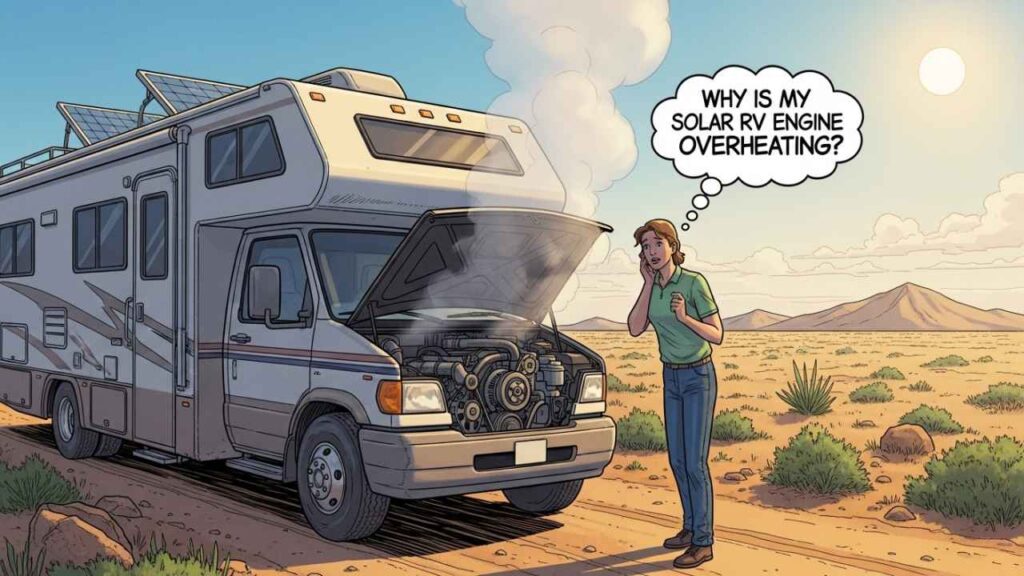
You’re cruising down I-40, mountains rising ahead, when you notice it—that needle climbing on the temperature gauge. Your stomach drops. An overheating RV engine isn’t just an inconvenience; it’s a financial time bomb that could cost you $3,000 to $10,000 in repairs if you ignore it.
I’ve been there. I’ve seen full-time RVers stranded on the side of the road, watching their engine’s coolant boil over while traffic whizzes by. The worst part? Most of them never saw it coming.
Here’s the thing: RV engine overheating doesn’t happen randomly. It’s your vehicle screaming for help, and if you know how to listen, you can prevent catastrophic damage before it happens.
This guide walks you through exactly what causes overheating, how to spot the warning signs, and most importantly—how to fix it before your next trip becomes a nightmare.
Why RV Engines Overheat (And Why It’s Worse Than Cars)
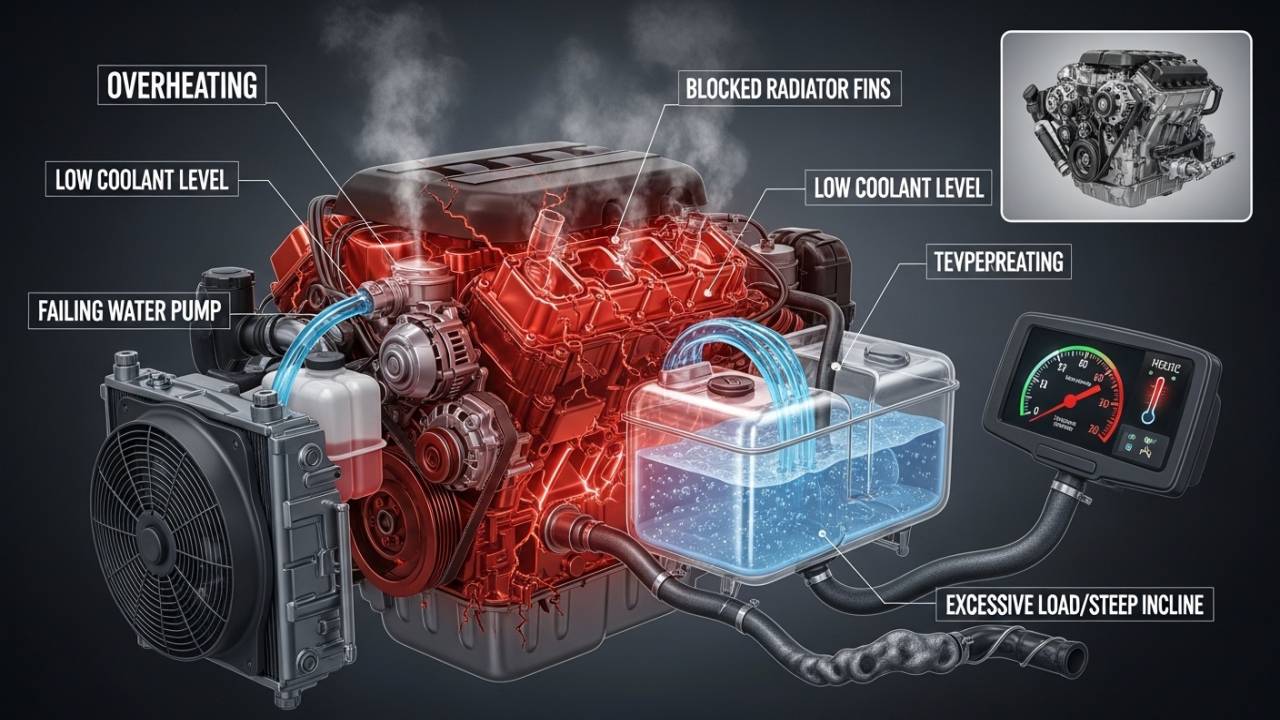
Your RV engine is fundamentally different from a standard car engine. You’re not just moving a few passengers and their luggage. You’re hauling thousands of pounds of living space, appliances, water tanks, and cargo up mountains, through desert heat, and in stop-and-go traffic.
That places exponentially more stress on your cooling system.
An RV engine typically operates between 195°F and 220°F under normal conditions. When it creeps above 220°F, you’re in the danger zone. Push it past 240°F, and you risk:
- Warped cylinder heads (usually $1,500-$3,000 to replace)
- Blown head gaskets (another $1,000-$2,000)
- Cracked engine blocks (essentially a new engine: $5,000-$15,000)
- Seized pistons (complete engine failure)
- Coolant leaks into the combustion chamber (hydro-locking)
The scary part? Once your engine hits 240°F, permanent damage is already happening. This is why prevention matters so much.
Also Read:- Rapid City RV Solar: The Complete Black Hills Installation Blueprint for Off-Grid Freedom
The 7 Real Reasons Your RV Engine is Overheating
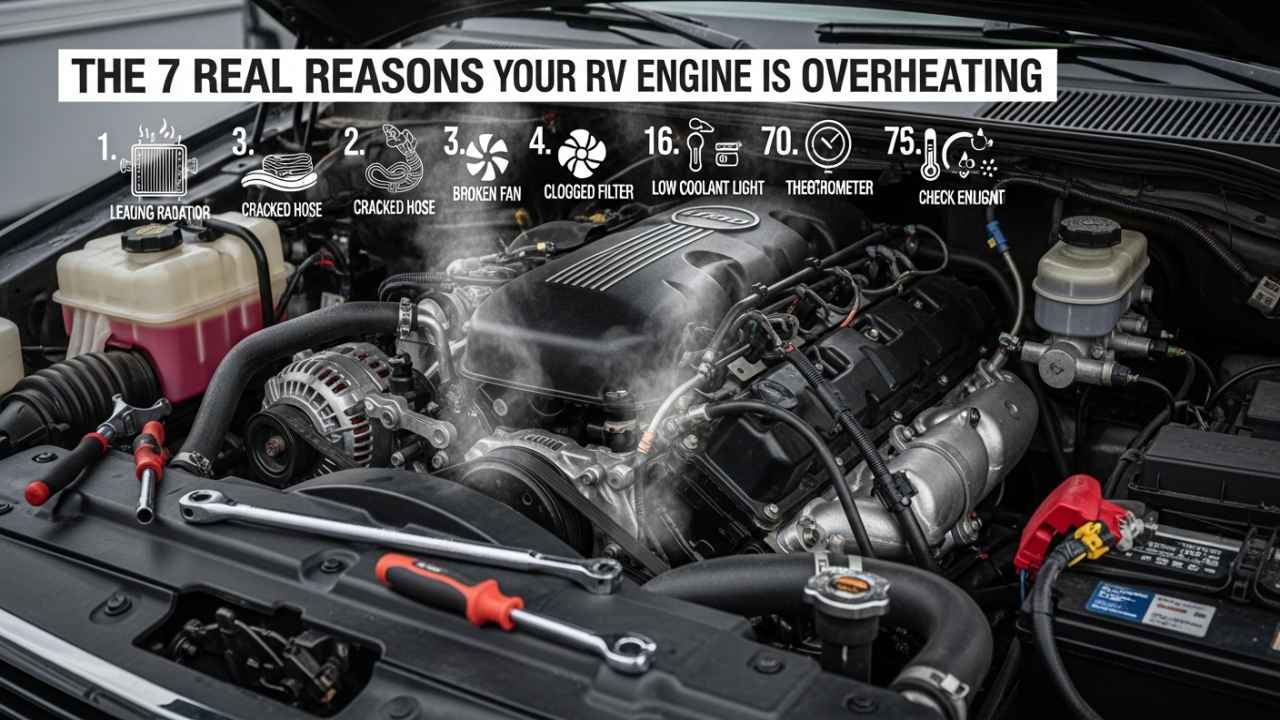
1. Low or Contaminated Coolant (The #1 Culprit)
This is responsible for roughly 40% of RV overheating cases. Your coolant does two critical jobs:
- It absorbs heat from the engine
- It raises the boiling point of water (pure water boils at 212°F, but proper coolant-water mix boils at 260°F+)
When your coolant level drops, your engine temperature rises. When your coolant becomes contaminated (oxidized, rusty, filled with debris), it loses its ability to transfer heat effectively.
Why it happens to RVers: Most RV owners check coolant once a year. That’s not enough. Coolant gradually leaks from hoses, pump seals, and radiators—often so slowly you don’t notice puddles. By the time you check, you’ve lost 20-30% of your coolant.
Real example: A couple we interviewed had their RV sitting in a driveway for three months before a summer trip. They didn’t check coolant. Halfway up the Grapevine (I-5 near Bakersfield, CA), their engine hit 250°F going uphill. Turns out a tiny pinhole leak in a radiator hose had drained half their coolant over those three months.
Also Read:- How to Build an RV Solar Battery Bank: Your Complete Guide to Off-Grid Freedom
2. Thermostat Malfunction (The Silent Killer)
Your thermostat is a valve that controls coolant flow. In cool conditions, it stays closed (so your engine warms up). When the engine gets hot, it opens, letting coolant circulate.
If your thermostat gets stuck closed, coolant can’t flow. The temperature skyrockets.
If it gets stuck open, your engine never reaches proper operating temperature (different problem, but still bad).
Why RVs are vulnerable: RV engines are older models on average. Many full-time travelers are running 10-20+ year old engines. Thermostats fail silently—there’s no warning light on most older RVs.
Cost to fix: $60-$150 in parts, $200-$400 if a mechanic does it.
3. Radiator Clogs and Blockages (More Common Than You’d Think)
Your radiator sits in front of your RV, pulling in air to cool the hot coolant flowing through its tubes. Over time, minerals, rust particles, and debris build up inside—like plaque in an artery.
Additionally, the outside of your radiator collects dead bugs, dust, and road grime, choking off airflow.
Why it matters to RVers: RVs spend months or years parked in RV parks, often without covers. Dust, pollen, and debris accumulate. Additionally, if your RV has sat unused for a season, internal corrosion can form rust particles that clog the cooling tubes.
How to spot it: Engine runs hot, but the radiator itself feels cold to the touch (meaning coolant isn’t circulating properly through it).
4. Failing Water Pump (The Expensive Surprise)
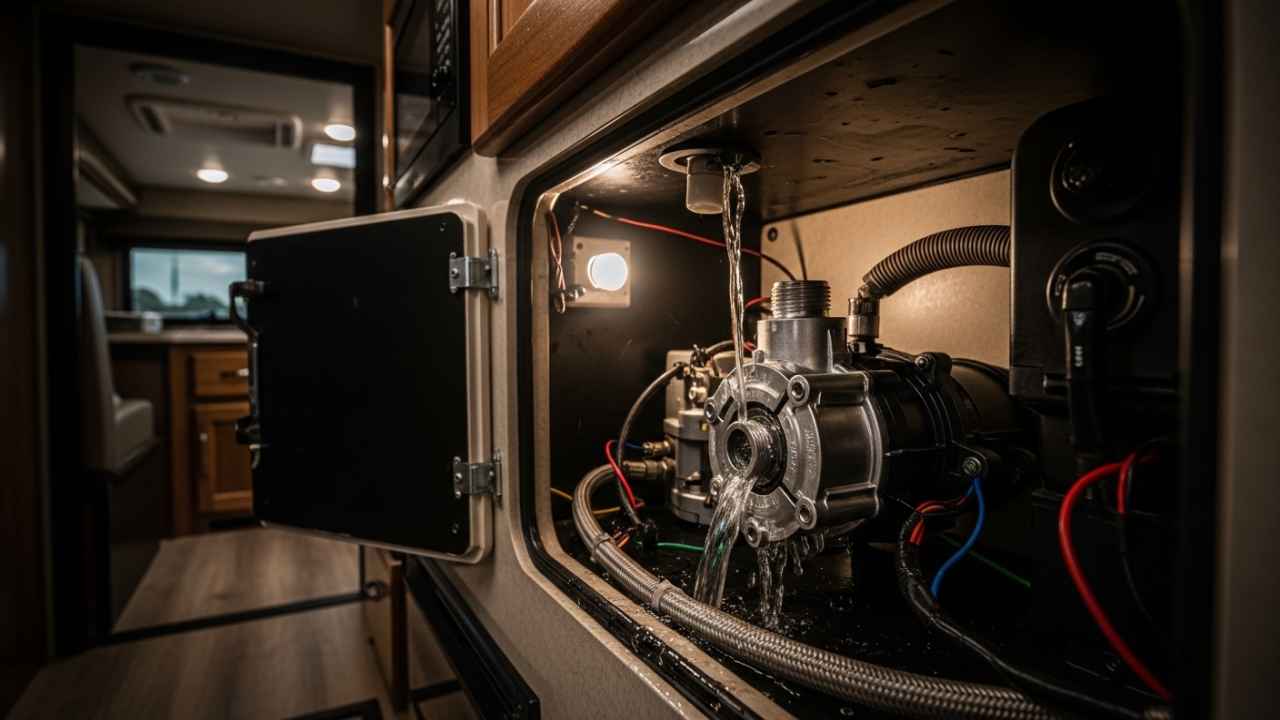
The water pump is the heart of your cooling system—it circulates coolant through the engine. If it fails, circulation stops, and your engine temperature soars within minutes.
Warning signs of water pump failure:
- Whining or grinding noise coming from the front of the engine
- Coolant leaking from the bottom of the engine block
- Sweet smell from under the hood (that’s coolant)
- Overheating without any obvious cause
Reality check: Water pumps typically last 80,000-150,000 miles. Many RVers who’ve owned their vehicles 15+ years haven’t replaced them. If you don’t know when yours was replaced, assume it might fail soon.
Cost: $400-$1,200 depending on engine type and whether you DIY or hire a mechanic.
Also Read:- Best Solar RV Panel Kit & Best Caravan Solar Panel Kit Guide 2026
5. Electric Fan Failure (Especially in Heavy Traffic)
Modern RVs often use electric cooling fans that kick on when the engine gets hot. Older RVs use mechanical fans.
Electric fans fail for several reasons:
- Bad fan motor
- Faulty temperature sensor
- Broken fan blade
- Electrical connection issues
When your fan doesn’t kick on, the radiator can’t pull air through efficiently.
Why it matters in summer: You’re sitting in traffic on a hot day, engine idling. Without a working fan, there’s minimal airflow through the radiator. Temperature climbs. Engine shuts down to protect itself.
6. Overloading (Underestimated and Overlooked)
Here’s what many RV owners don’t realize: exceeding your RV’s weight rating puts massive stress on your engine and transmission.
An overloaded engine works harder to move that weight, generating more heat. Your cooling system—designed for normal loads—can’t handle it.
The numbers are shocking:
- Gross Vehicle Weight Rating (GVWR) tells you the maximum safe weight
- Most RV owners exceed this by 10-20% (water tanks full, propane full, extra cargo, multiple passengers)
- Every 1,000 pounds over GVWR increases engine temperature by 5-10°F under highway driving
7. Steep Grades and Demanding Driving Conditions
This is physics: climbing a mountain requires your engine to work harder, generate more heat, and demand more from the cooling system.
Additionally:
- Extreme ambient heat (driving through Arizona in August)
- Continuous highway driving (no rest, no cool-down periods)
- Towing (massive additional load)
- Heavy traffic (engine idling in heat with minimal airflow)
All these situations stress your cooling system beyond its design limits.
How to Recognize Overheating Before It’s Too Late
Your dashboard warning light is just one indicator. Many RVs have aging electrical systems where warning lights fail. Don’t rely on it exclusively.
Early warning signs (Act now):
- The temperature gauge creeping toward the red zone
- Slight sweet smell from engine compartment (coolant burning)
- Radiator fan running constantly
- Engine seems sluggish or lacking power
Critical danger signs (Pull over immediately):
- Steam billowing from under the hood
- Dashboard overheating warning light
- Coolant overflowing from the cap/hoses
- Strong burning smell
- Engine knocking or pinging sounds
What to do if your engine overheats while driving:
- Turn off the A/C immediately (reduces engine load)
- Turn on the heat (sounds counterintuitive, but this pulls hot air away from the engine)
- Shift to a lower gear if you’re going uphill (increases RPM, boosts cooling fan speed)
- Pull over safely if the gauge stays in the red
- Turn off the engine and wait (at least 15-20 minutes—coolant pressure is dangerous)
- Never open the radiator cap when the engine is hot (pressurized steam can cause severe burns)
- Call for roadside assistance rather than continuing to drive
Prevention: Your Best Defense Against Overheating
Monthly Checklist
Check coolant level cold (before driving):
- Open the hood, find the translucent coolant reservoir
- Mark the “COLD” line with a piece of tape
- Check level when parked overnight
- It should be right at or slightly above the line
- If low, you have a leak that needs investigating
Inspect for leaks:
- Get under the RV and look for wet spots or crusty deposits on hoses, radiator, or water pump
- Check the ground where you parked overnight
Feel the radiator (after parking, once it’s cooled):
- It should be hot, but both the top and bottom should feel similarly warm
- If the bottom is significantly cooler, you may have a blockage
Listen for the radiator fan:
- After parking, the fan should kick on when the engine is still warm
- If you never hear it run, the fan might be broken
Seasonal Preparation (Before Summer Driving)
Coolant flush and replace:
- Every 2-3 years or 25,000-30,000 miles
- Use the type specified in your RV manual (mixing types can cause problems)
- Consider using a radiator flush product to remove deposits
Thermostat inspection/replacement:
- If your RV is older and hasn’t had the thermostat replaced, do it now
- Cost is low; failure rate is high
Radiator cleaning:
- Spray the front of the radiator with a gentle water stream to remove dust and debris
- Consider a professional chemical flush if your RV is over 10 years old
Fan and belt inspection:
- Check the serpentine belt for cracks, fraying, or glazing
- Belts typically last 3-5 years or 60,000 miles
- Spin the fan blade by hand—it should move freely
- Listen for squealing when the engine starts (sign of belt slippage)
Hose inspection:
- Squeeze each coolant hose—it should be firm, not hard or squishy
- Look for swelling, cracks, or visible leaks
- Check all clamps are tight
Real-World Prevention Strategies for Hot-Weather Travel
| Strategy | Cost | Effort | Effectiveness | Best For |
|---|---|---|---|---|
| Monthly coolant checks | Free | 5 minutes | 95% (prevents leaks) | All climates |
| Thermostat replacement | $60-400 | 1-4 hours | 85% (addresses failure) | Older RVs (10+ yrs) |
| Radiator flush | $100-300 | Professional | 80% (removes deposits) | Pre-summer |
| Auxiliary electric fan | $300-800 | Professional install | 70% (boosts cooling in traffic) | Hot climates/heavy traffic |
| Upgraded radiator | $800-2,000 | Professional install | 90% (high capacity) | Frequent mountain driving |
| Monitor weight/load | Free | Varies | 60% (reduces engine stress) | Heavy loaders |
| Adjust driving habits | Free | Behavioral | 65% (reduces engine strain) | Mountain driving |
When driving in hot climates or over mountains:
- Travel early morning or evening – Ambient heat dramatically affects your cooling system’s ability to cool. Traveling 5 AM-10 AM and 4 PM-8 PM reduces this stress.
- Take breaks on long climbs – Shift to a lower gear going uphill. Let the engine cool for 15 minutes every 1-2 hours of mountain driving. Many mountain passes have scenic pullouts perfectly designed for this.
- Monitor your weight – Use truck scales to verify you’re within GVWR. Many RV owners are shocked to discover they’re 2,000-3,000 pounds over. Remove unnecessary items.
- Use cruise control conservatively – On mountain grades, cruise control keeps trying to maintain speed even as the load increases, stressing the engine. Shift to lower gear and let the engine RPM rise naturally.
- Don’t rely on A/C alone in traffic – In stop-and-go traffic on a hot day, your radiator can’t effectively cool because there’s no airflow. Open windows, use the vent fan, or find an alternative route.
- Keep a coolant emergency kit on board:
- 2 gallons of pre-mixed coolant (50/50 antifreeze/water)
- Spare radiator hoses (or at least clamps and radiator stop-leak)
- Basic tools (wrench set, screwdrivers, pliers)
- Shop towels and work gloves
- Flashlight
Quick Fix: What to Do If Your Engine Overheats on the Road
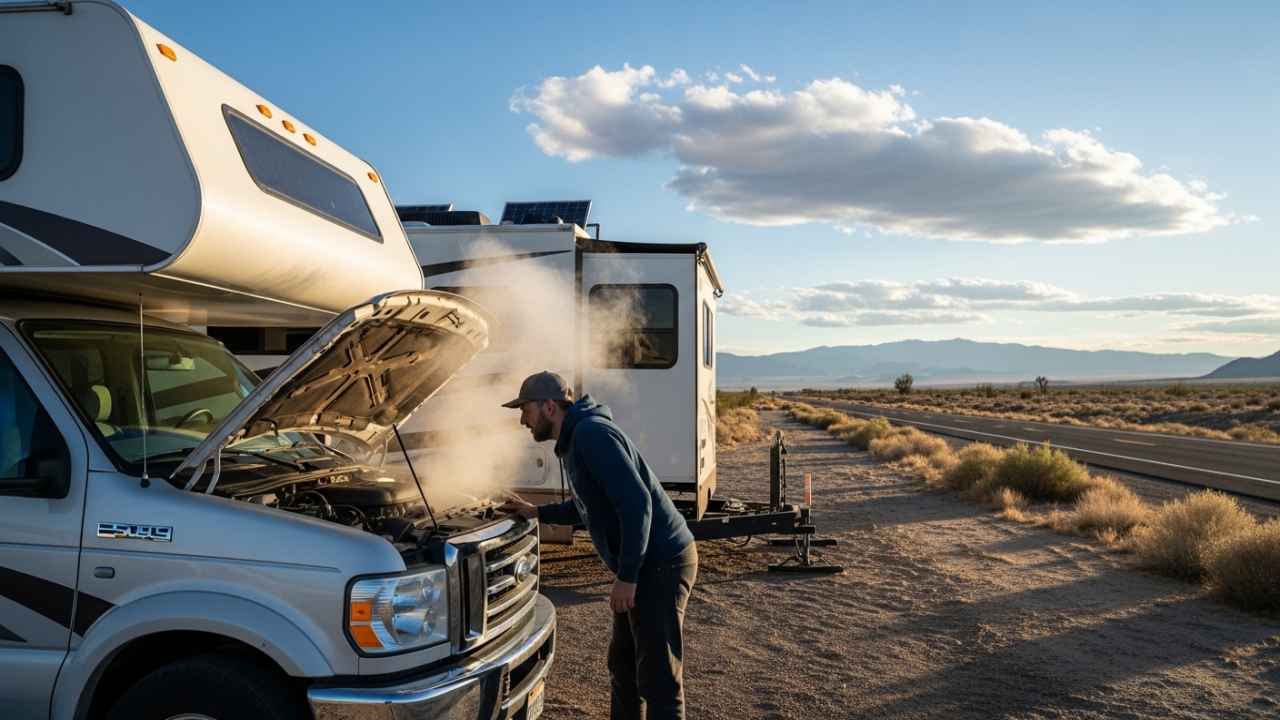
If you pull over and your engine is overheating, here’s the safe approach:
Immediate actions:
- Turn off the engine
- Stay inside the RV with doors closed (safer in traffic)
- Wait 15-20 minutes for temperature to drop
- Don’t open the hood if steam is still billowing
After cooling:
- Pop the hood carefully (be ready for residual steam)
- Look for obvious issues: disconnected hose, visible leak, radiator cap off
- If the coolant level is low, carefully top it up using pre-mixed coolant from your emergency kit
- Check for leaks before restarting
If you find a leak:
- Many radiator hose leaks can be temporarily fixed with radiator stop-leak (carries you 50-100 miles)
- A loose hose clamp can be tightened with an adjustable wrench
- If you can’t fix it safely, call for a tow
If no obvious cause:
- Call roadside assistance (that’s what you’re paying AAA for)
- Don’t risk further engine damage by driving to the nearest mechanic
- Let a professional diagnose the issue
Frequently Asked Questions About RV Engine Overheating
Q1: Is it safe to keep driving if my temperature gauge is in the yellow zone?
A: No. The yellow zone (anything above 220°F) means your engine is approaching dangerous temperatures. Permanent damage begins at 240°F. Pull over, let it cool, and diagnose the issue before continuing. Driving 10 more miles to find a mechanic might cost you a $5,000 engine repair.
Q2: What coolant type should I use in my RV?
A: Check your RV’s manual—this is critical. Most modern RVs use OAT (Organic Acid Technology) coolant in bright colors (orange, pink, or yellow). Older RVs often use IAT (Inorganic Acid Technology) in green. Never mix types, as they’re chemically incompatible. Using the wrong type can corrode your cooling system internally.
Q3: How often should I replace my coolant?
A: Flush and replace coolant every 2-3 years or 25,000-30,000 miles, whichever comes first. Some modern coolants last longer (5 years), but most RV owners don’t track this closely, so erring on the side of caution every 2-3 years is safer. Test strips can help you determine if coolant is still effective.
Q4: Why does my RV overheat only when going uphill?
A: This is classic thermostat or insufficient fan cooling. Uphill driving demands maximum cooling system performance. If something is marginal (thermostat starting to fail, fan not spinning fast enough, radiator slightly clogged), it shows up immediately under this heavy load. Have a mechanic check your thermostat first—it’s cheap and likely the culprit.
Q5: Can I use plain water instead of coolant in an emergency?
A: Technically, water works temporarily to cool an engine. However, it raises the boiling point to only 212°F and offers zero freeze protection (bad in winter). Plain water also corrodes metal engine components, creating rust and sludge. Use pre-mixed coolant or coolant concentrate diluted properly. If you have neither, water is better than letting your engine seize, but get proper coolant into the system as soon as possible.
Q6: Is it worth upgrading to a high-performance radiator?
A: If you frequently drive mountains, tow, or travel in extreme heat, yes. A larger radiator or one with better fin density can improve cooling by 15-25%. Cost is typically $800-$2,000 installed. For casual RV users in mild climates, it’s probably overkill. For serious travelers, it’s insurance against overheating.
Q7: What’s the difference between radiator stop-leak and a proper repair?
A: Stop-leak is a temporary band-aid. It contains particles that temporarily seal small leaks. It works for 50-200 miles, giving you time to reach a mechanic. But it also circulates through your entire cooling system, potentially clogging passages or your thermostat. Never use stop-leak as a permanent fix. Replace the faulty hose or component.
The Bottom Line
RV engine overheating is preventable. Most cases come down to simple maintenance: checking coolant monthly, replacing a thermostat, or flushing a radiator.
The cost of prevention (50-300 dollars, a few hours of your time) is insignificant compared to the cost of ignoring it ($3,000-$15,000 in engine repairs, days stuck on the roadside, a ruined vacation).
Your dashboard temperature gauge isn’t just a number. It’s a conversation between you and your RV. Listen to what it’s telling you.
Check your coolant this week. If you haven’t had your thermostat replaced in 5+ years, budget $200 for that. Clean your radiator before summer. And if you feel that temperature creeping up, pull over. Your future self—and your bank account—will thank you.
Safe travels out there.
Related Search Queries & FAQs
People Also Ask:
- How much does it cost to fix an overheating RV engine?
- Can you drive an RV with a bad thermostat?
- Why is my RV engine overheating in hot weather only?
- What does it mean when your RV radiator fan won’t turn off?
Long-tail keywords covered:
- RV engine overheating causes and solutions
- How to fix an overheating RV engine on the road
- Best RV coolant type and flush schedule
- RV thermostat replacement cost and difficulty
- Preventing RV engine overheating in summer heat
- RV radiator cleaning and maintenance
- Why RV engines overheat going uphill
- Emergency response to overheating RV engine