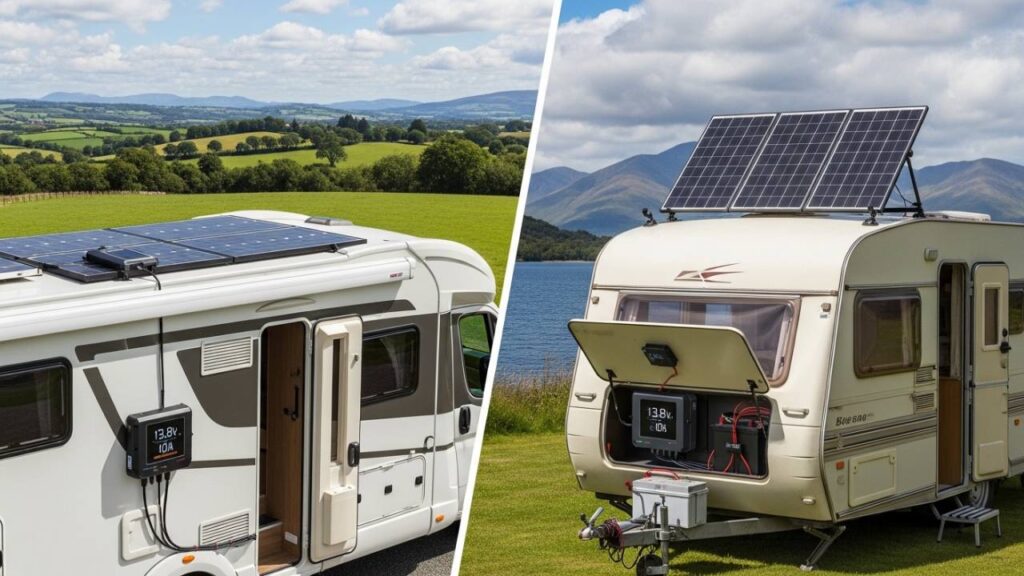
What’s the Best Motorhome Solar Panel Kit for Off-Grid Weekend Adventures?
You’re searching for this because: You want to know which motorhome solar panel kit will give you genuine off-grid independence without wasting money on unnecessary features.
When you ask “what’s the best motorhome solar panel kit,” you’re really asking three things: Will this system keep my motorhome powered for entire weekends? Is it worth the money? Will it actually work reliably when I’m far from civilization?
The answer depends entirely on your specific situation. But let’s cut through the marketing noise and get to what actually matters.
Dakota Lithium – The Best Pre-Built Motorhome Solar Panel Kit for Beginners
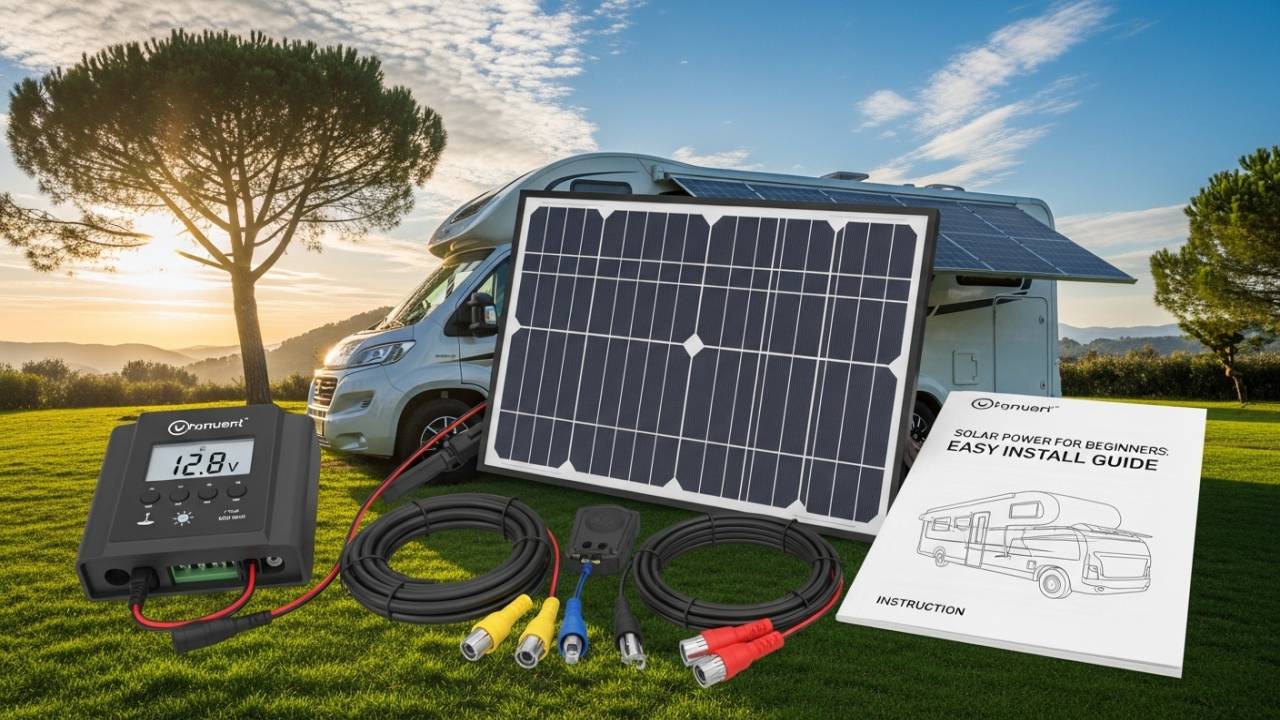
If you want everything handled for you—panels, battery, inverter, controller, all pre-engineered to work together—Dakota Lithium is your answer. Their complete motorhome package includes a 12V 100Ah lithium battery, 100-watt solar panel, 1500W pure sine wave inverter, DC-DC charger for engine alternator charging, and all necessary wiring.
Why it’s the best for most motorhome owners:
- Everything is pre-matched and tested together
- Zero compatibility worries
- Excellent customer support
- Includes battery management system built-in
- Can handle typical motorhome loads (lights, refrigerator, electronics)
The reality: You’ll spend $3,200-$3,800, but you get peace of mind. First-time installers love Dakota because they don’t have to become electrical engineers to set up their system.
Best for: Motorhome owners who want simplicity, don’t want to research component compatibility, and trust pre-engineered solutions.
Renogy 400-Watt System – The Best Motorhome Solar Panel Kit for DIY Customization
If you’re willing to spend 10-15 hours learning and installing, Renogy’s 400W modular kit offers exceptional value. Four 100-watt monocrystalline panels, 40-amp MPPT charge controller, mounting hardware, and Bluetooth monitoring system—you add your own battery and inverter.
Why DIY builders prefer this:
- Superior quality panels (20-22% efficiency)
- MPPT charge controller maximizes solar generation
- Flexibility to choose exactly the battery size you want
- Better value per watt than pre-assembled kits
- Easier to upgrade individual components later
The reality: $1,200-$1,500 for panels and controller, then $2,500-$4,500 for a quality battery and inverter. Total system cost: $4,000-$6,000 depending on your battery choice.
Best for: Motorhome owners comfortable with research, wanting maximum control over their system, or wanting to upgrade components individually.
Complete Motorhome Kit from Victron – The Best for Maximum Performance
If money isn’t the primary concern and you want the absolute best components available, Victron’s motorhome integration is professional-grade. Their MPPT charge controllers are industry-leading, their inverters are rock-solid, and their monitoring system is exceptional.
Why serious adventurers choose Victron:
- Components work flawlessly together
- Superior customer support for technical issues
- Built to handle extended off-grid use
- More efficient charging (saves money over time)
- Professional installation support available
The reality: Expect to spend $6,500-$9,000 for a complete system. But this is an investment in reliability and performance that lasts 15+ years.
Best for: Full-time RVers, extended off-grid adventurers, or anyone who can’t afford system failure.
What’s the Best Caravan Solar Panel Kit If I’m Towing, Not Driving a Motorhome?
You’re searching for this because: You’re towing a caravan behind your vehicle, not driving a motorhome. Weight matters. You want a system designed for trailers, not big vehicles.
The key difference? Motorhomes can handle heavier systems. Caravans have stricter weight limits. This completely changes which kit is “best” for you.
The Challenge with Caravan Solar Kits
Your caravan’s payload capacity is finite. If you’re already carrying water, propane, and camping gear, heavy solar equipment cuts into what else you can bring. This is why caravan-specific kits prioritize lightweight components.
Additionally, caravan roofs are often curved or have limited flat space. This affects panel placement options. Traditional large rigid panels might not fit your caravan’s specific roof design.
Best Caravan Solar Panel Kit Under $4,000: Renogy Lightweight System
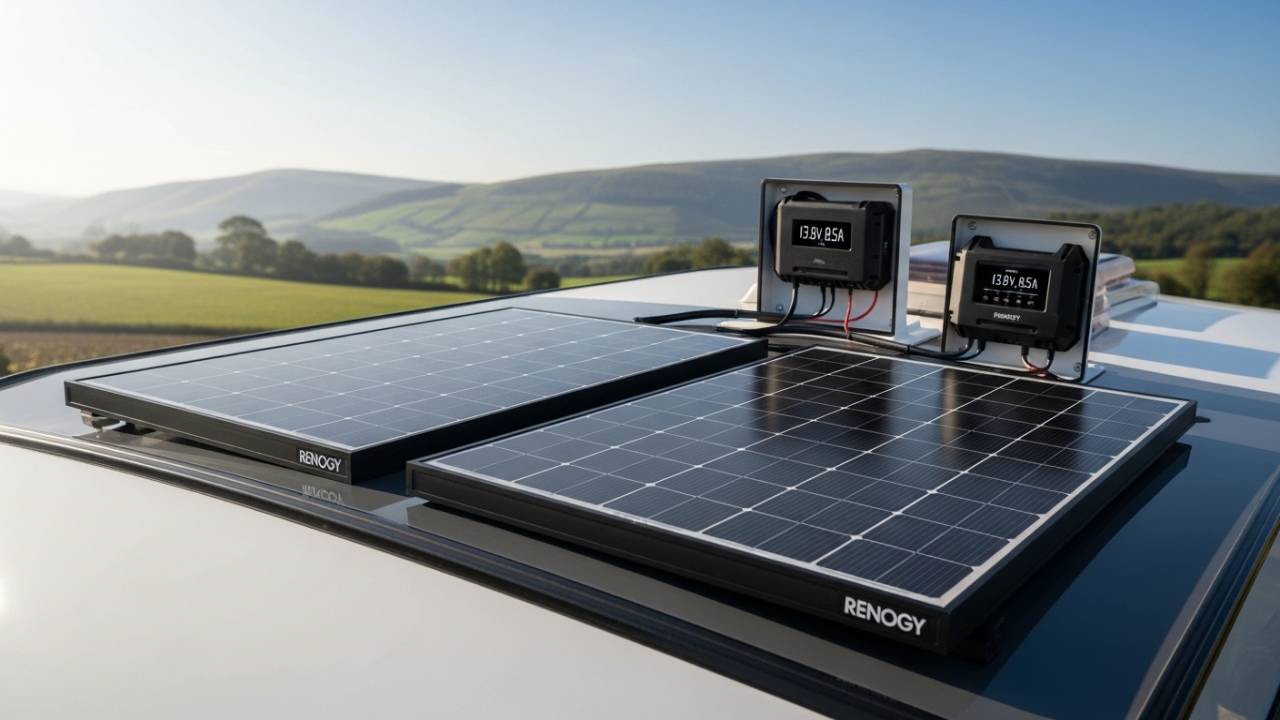
Renogy offers a caravan-specific 200W system designed with weight consciousness in mind. Two 100W panels mount on curved caravan roofs without modification. A 40-amp MPPT controller, combined with a portable 100Ah lithium battery (not roof-mounted, so your caravan’s roof structure doesn’t need reinforcement), creates a complete system.
Why it’s best for most caravan towers:
- Total weight: Only 85 pounds (compared to 180+ pounds for motorhome systems)
- Curved roof mounting without modifications
- Portable battery (can be removed for weight distribution)
- Easy to upgrade or replace components
- Total cost: $3,500-$4,200
What it powers:
- Lights for 8-10 hours
- Refrigerator for 3-4 days
- Phone and laptop charging
- Basic water pump operation
- Small entertainment system
Best for: Caravan owners with tight payload limits, weight-conscious adventurers, or those with existing battery systems they want to upgrade.
Also Read: Best RV Solar Panels for Montana: Cold Weather Guide 2026
Best Premium Solar RV Panel Kit: EcoFlow Expandable System
If you’re willing to spend $5,500-$7,000, EcoFlow’s modular system offers something unique: you start with one battery and solar array, then expand as your needs change.
Why serious caravanners choose EcoFlow:
- Start with 2kWh battery, expand to 5kWh
- App-based monitoring shows real-time power generation
- Lightweight yet powerful components
- All-in-one power management (no separate controller/inverter)
- Future-proof (easy to add capacity)
The advantage: Buy now for $5,500 for basic use, add a second battery in 2 years for $2,000 more when your budget allows.
Best for: Tech-forward caravan owners, those planning long-term adventure travel, or anyone wanting flexibility to upgrade over time.
What Is an Off-Grid Solar RV Caravan Solar System and Do I Really Need One?
You’re searching for this because: You’ve heard the term “off-grid caravan solar system” but aren’t sure what it means or if you actually need it.
Let’s be absolutely clear: An off-grid caravan solar system is different from adding a solar panel to your existing battery setup.
Understanding “Off-Grid”
“Off-grid” doesn’t mean disconnected from civilization. It means your caravan can operate independently from campground hookups. Your power comes from the sun, stored in batteries, not from campground electrical pedestals.
A true off-grid caravan solar system needs:
- Enough battery capacity for 1-2 cloudy days – This is the critical part most people get wrong. A 50Ah battery topped up by a solar panel isn’t “off-grid ready.” It’s supplemental power. You need 100-200Ah minimum.
- Adequate solar array for your location – A single 100W panel generates roughly 400-500 watt-hours on a cloudy day. If your caravan uses 1,000 watt-hours daily, you’re in deficit. You need 3-4 days of backup power in your battery.
- Proper charge controller and monitoring – You must be able to see what power you’re generating and consuming. Blind operation leads to dead batteries in the middle of nowhere.
- Realistic usage expectations – Off-grid means you can’t run air conditioning, cook with electric cooktops, or run power-hungry appliances simultaneously.
Is Off-Grid Right for You?
You DON’T need true off-grid if:
- You’re only camping 1-2 nights at a time
- You always camp near established campgrounds
- You’re comfortable moving camps every 2-3 days to recharge
- Budget is your primary concern
You DO need true off-grid if:
- You want 4-7 day trips without moving
- You’re exploring remote areas far from campgrounds
- Weather delays happen (stuck in one location for days)
- You value independence and flexibility above all else
The Real Cost of Off-Grid Solar Rv Living
Entry Level Off-Grid System: $4,500-$5,500
- 100Ah lithium battery: $1,800-$2,000
- 300W solar array: $800-$1,000
- Charge controller and wiring: $400-$500
- Monitor and installation: $500-$1,000
Powers: 1-2 days of moderate use (lights, refrigerator, basic devices)
Mid-Range Off-Grid System: $7,500-$9,000
- 200Ah lithium battery: $3,500-$4,000
- 400W solar array: $1,200-$1,500
- MPPT controller and components: $800-$1,000
- Monitoring and installation: $1,000-$1,500
Powers: 2-3 days of moderate use, even in cloudy weather
Premium Off-Grid System: $12,000-$15,000
- 300Ah lithium battery: $4,500-$5,500
- 600W solar array: $1,800-$2,400
- Dual MPPT controllers: $1,000-$1,200
- Professional installation: $2,000-$3,000
- Monitoring and backup systems: $1,000-$1,500
Powers: 4-5 days of moderate use, handles cloudy periods, supports additional appliances
Also Read: Billings RV Solar Installation: Top 5 Local Shops + Complete DIY Guide (2026)
The Truth About Off-Grid Solar RV Living
You’ll save money on campground fees. A typical caravan park costs $30-$50/night. After 2-3 months of boondocking, your system has paid for itself in savings. Over 10 years (the typical battery lifespan), you’ll save $10,000-$20,000 in campground fees.
But the real benefit isn’t financial. It’s freedom. You can park where you want, stay as long as you want, wake up to views nobody charges money for.
What Does a Complete Caravan Solar Panel Kit with Battery Really Include?
You’re searching for this because: You want a ready-to-go solution where everything works together—no component compatibility guessing, no missing pieces.
What “Complete” Actually Means
A complete caravan solar panel kit with battery includes:
- Solar panels (usually 100-400W)
- Lithium or AGM battery (100-200Ah typical)
- Charge controller (PWM or MPPT)
- Inverter (to convert DC to AC power)
- Wiring, breakers, and safety components
- Mounting hardware
- Monitoring system
- Sometimes: Installation support or instructions
Why All-in-One Kits Matter
Here’s the problem they solve: Component incompatibility anxiety.
If you buy a 400W solar array from one company, a 200Ah battery from another, a charge controller from a third, and an inverter from a fourth, you spend hours asking:
- Will the charge controller handle 400W of panels at my battery voltage?
- Is the inverter powerful enough for my expected loads?
- Are all the wiring gauges compatible?
- Why isn’t my system generating the power I expected?
Complete kits eliminate this. Everything is pre-matched. Installation instructions show exactly how pieces connect. If something doesn’t work, the manufacturer is responsible—not you.
Best Complete Caravan Solar Panel Kit with Battery Under $5,000
Renogy Essential Caravan Kit: $4,200-$4,800
Includes:
- Two 100W monocrystalline panels
- 12V 100Ah LiFePO4 battery (pre-wired for caravan roof mounting)
- 40-amp MPPT charge controller with Bluetooth
- 1500W pure sine wave inverter
- All wiring, breakers, fuses
- DC-DC charger for engine alternator charging
- Bluetooth monitoring app
- Complete installation guide with videos
Real-world performance:
- Generates 800-1,000 watt-hours on sunny days
- Powers lights for 8+ hours, refrigerator for 3-4 days
- Recharges from engine alternator while driving
- Smartphone app shows exactly what’s happening
Why caravan owners love this package:
- Arrives ready to install (or hire someone for $500-$800)
- Everything matches perfectly
- Expandable (can add second battery later for $2,000)
- Renogy customer service is excellent
- Transparent pricing, no hidden add-ons
Also Read:- How to Solve Solar RV Water Heater Not Working Problem Easy Troubleshooting Guide (2026)
Best Complete Caravan Solar Panel Kit with Battery $5,500-$8,000
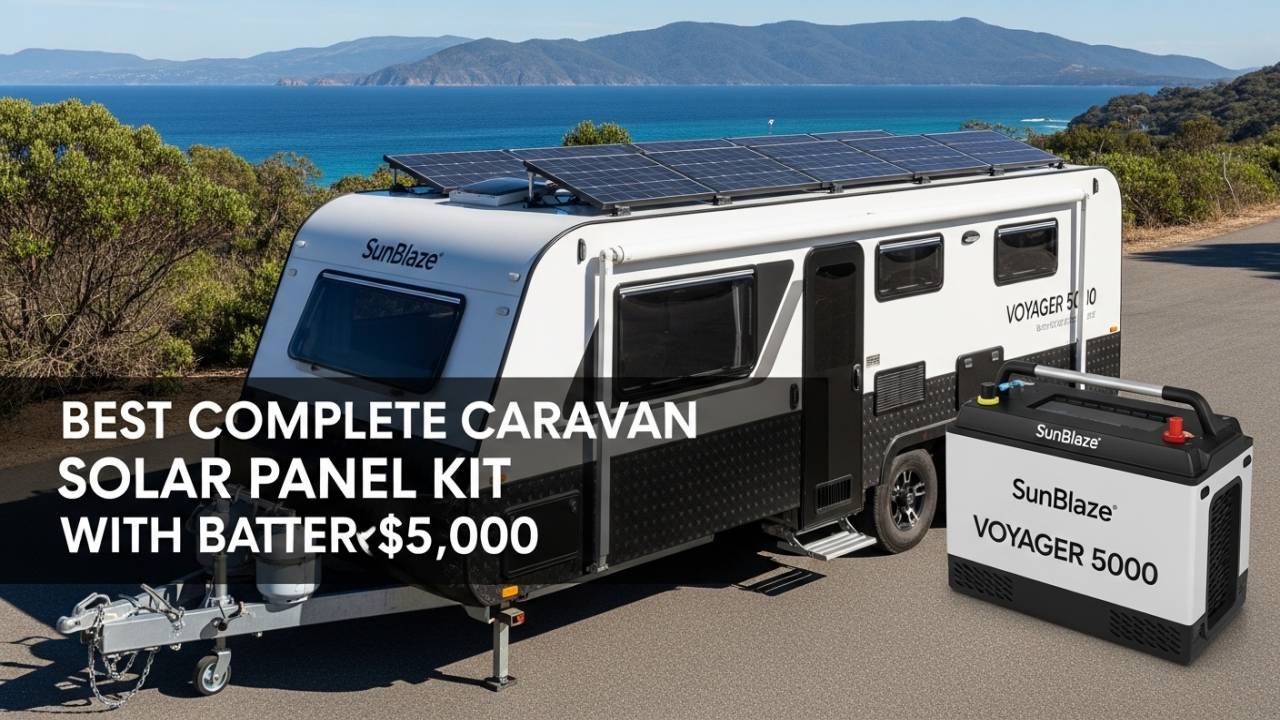
Dakota Lithium Caravan Deluxe: $6,500-$7,500
Includes:
- 150W rigid solar panel (or choice of 100W flexible panels)
- 12V 150Ah lithium battery with integrated BMS
- 60-amp MPPT charge controller with Bluetooth
- 3000W pure sine wave inverter
- All installation components and hardware
- Victron DC-DC charger
- Advanced monitoring system with multiple data points
- Professional installation support (unlimited phone/email)
- 10-year warranty on battery
Real-world performance:
- Generates 600-1,200 watt-hours depending on conditions
- Powers multiple appliances simultaneously
- Can run modest induction cooktop or microwave
- Handles extended cloudy periods better
- Charges significantly faster than smaller systems
Why serious caravanners choose this:
- Proven system used by full-time overlanders
- Professional support if anything goes wrong
- Larger battery means less dependence on sunshine
- Better inverter handles sensitive electronics
- Investment protection (long warranty)
Premium Complete Kit: EcoFlow Caravan Integration
EcoFlow Delta + Solar: $7,500-$9,000
Includes:
- 400W flexible solar panels (extremely lightweight)
- 5.1kWh modular battery (can expand to 10kWh)
- Integrated charge controller and inverter
- WiFi and Bluetooth app control
- Expandable (add battery packs or panels anytime)
- Compact design (space-efficient for caravans)
- AC and DC output options
Real-world performance:
- Massive power storage (can run AC unit for short periods)
- Fastest charging times (110V AC capable)
- App shows real-time generation and usage
- Expandable architecture (buy more capacity later)
- Ultra-lightweight flexible panels
Why tech-forward adventurers choose this:
- Feels like the future (app control, smart features)
- Expandable without replacing original investment
- Compact design saves roof space
- Can power more demanding appliances
- Future-proof technology
Also Read:- How to Wire Solar Panels on an RV – Step-by-Step Beginner Guide (2026)
What Does “Caravan Solar Panels 300W” Mean and Should I Choose It?
You’re searching for this because: You keep seeing “300W” in solar panel recommendations and want to know if that’s the right size for your caravan.
Understanding Solar Panel Wattage
A 300W solar panel generates approximately 300 watt-hours per hour of peak sunlight. In practical terms:
- Full summer sun (12 hours effective): 3,600 watt-hours daily
- Partly cloudy day (6 hours effective): 1,800 watt-hours daily
- Cloudy day (3 hours effective): 900 watt-hours daily
- Winter (2 hours effective): 600 watt-hours daily
Why 300W Has Become the Standard for Caravans
It’s not a coincidence you see “300W caravan solar panels” recommended everywhere. Here’s why:
Too small (100-150W):
- Only generates 600-900 watt-hours on sunny days
- Supplemental power only, not independence
- Leaves you dependent on campgrounds or generators
- Won’t fully recharge 100Ah battery in one day
Just right (300W):
- Generates 1,800-2,400 watt-hours on sunny days
- Fully recharges 100-150Ah battery with moderate use
- Provides genuine independence on 2-3 day trips
- Works in most UK, Australian, and Northern climates
- Doesn’t require excessively heavy roof reinforcement
- Fits on most caravan roofs without modifications
Too large (500W+):
- Generates 3,000-4,000+ watt-hours daily
- Requires 200-300Ah battery to absorb all power
- Significantly increases weight and cost
- Overkill for most weekend caravan users
- Requires substantial roof structural analysis
Typical 300W Caravan Solar Panel Configuration
Most 300W setups come in one of these combinations:
Option 1: Three 100W panels
- Weight: 45-50 pounds
- Mounting: Roof or ground-based
- Pros: Can mount on curved caravan roofs, replaceable individually
- Cons: More complicated mounting hardware
Option 2: One large 300W panel (common newer models)
- Weight: 35-40 pounds
- Mounting: Must be flat roof surface
- Pros: Single mount point, simpler installation
- Cons: Requires flat roof space
Option 3: Flexible thin-film 300W system
- Weight: 20-25 pounds (MAJOR advantage)
- Mounting: Adhesive or lightweight brackets
- Pros: Extremely lightweight, conforms to curved roofs
- Cons: Slightly lower efficiency (17-19% vs 20-22%)
Is 300W Enough for Your Caravan?
YES, 300W is sufficient if:
- You have 100-150Ah battery capacity
- You limit electricity use to lights, refrigerator, and electronics
- Your trips are 2-3 days
- You’ll move locations every 2-3 days
- You’re in climates with reasonable sunlight (UK, Australia, Southern USA)
NO, you need more (400-500W) if:
- You want 4+ days of independence
- You plan winter camping
- You’re in consistently cloudy regions (Scotland, Northern Europe)
- You want to run appliances like air conditioning or induction cooktops
- You want backup power if panels are partially shaded
NO, 300W is overkill if:
- You only camp 1-2 nights
- You always camp near established campgrounds
- Budget is your primary concern
- You’re willing to move every 2 days to recharge
What Are the Best Lightweight Solar Panels for Caravans?
You’re searching for this because: Your caravan has strict payload limits. You need solar power without crushing your weight allowance. Every pound matters.
The Weight Problem Most Caravan Owners Face
Standard rigid monocrystalline solar panels weigh 0.55-0.65 pounds per watt. This means:
- 300W rigid panel = 165-195 pounds
- 400W rigid panel = 220-260 pounds
For many caravans with 2,000-3,000 pound payload limits already consumed by other gear, adding 200 pounds of solar panels is impossible.
This is why lightweight solar panels have become essential for serious caravanners.
Types of Lightweight Solar Panels
Type 1: Flexible Thin-Film Solar Panels
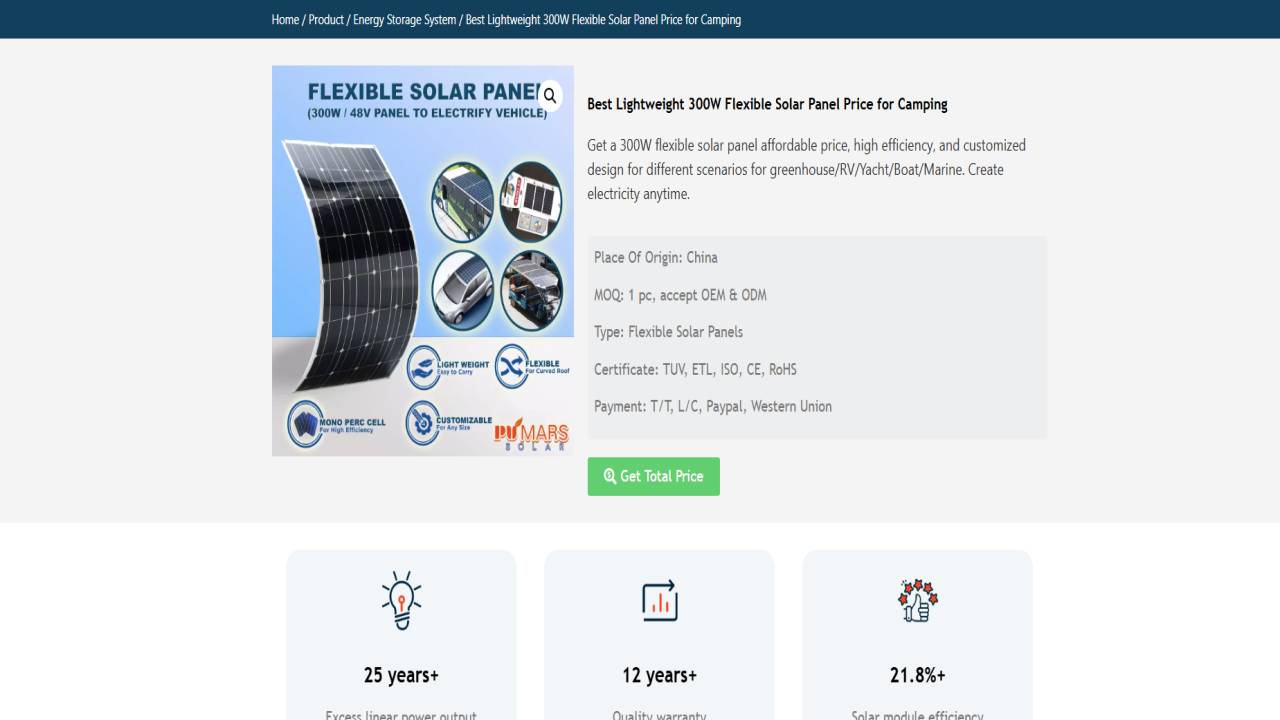
These are the modern solution. Lightweight construction, conformal design (fit curved surfaces), and continuously improving efficiency.
Real specifications:
- Weight: 0.25-0.35 pounds per watt
- Efficiency: 17-19%
- 300W flexible panel: 75-105 pounds (vs 195 pounds rigid)
- Weight savings: 60-65%
Best brands:
- Renogy flexible panels (most reliable, best warranty)
- Solbian (Italian premium, excellent quality)
- Ecoworthy lightweight systems
Pros:
- Extremely lightweight (the whole point)
- Conform to curved caravan roofs
- No roof reinforcement needed
- Lower profile (less wind resistance)
- Can be easily replaced
Cons:
- Slightly lower efficiency (3-5% less generation)
- Higher cost per watt
- Less robust (more prone to damage)
- Some degradation over time
Best for: Caravans with tight payload limits, curved roofs, or owners prioritizing weight above efficiency.
Type 2: Rigid Monocrystalline on Lightweight Frames
These use traditional high-efficiency panels but mount them on aluminum composite frames instead of traditional aluminum structures.
Real specifications:
- Weight: 0.40-0.50 pounds per watt
- Efficiency: 20-22%
- 300W panel on lightweight frame: 120-150 pounds (vs 195 pounds standard)
- Weight savings: 35-40%
Best brands:
- Renogy (their optimized lightweight mounts)
- Victron (German engineering, exceptional quality)
- Rich solar lightweight frames
Pros:
- High efficiency maintained
- Still lighter than standard rigid panels
- More durable than flexible panels
- Better performance in hot climates
Cons:
- Not as lightweight as flexible panels
- Requires relatively flat roof surface
- More expensive than standard panels
Best for: Caravans with moderate payload concerns, owners wanting maximum efficiency, or those with flat-enough roof surfaces.
Type 3: Hybrid Approach – Smaller Panels Distributed
Instead of one 300W panel, mount three 100W panels. Each weighs only 55-65 pounds.
Real specifications:
- Three 100W panels: 165-195 pounds total
- Mounting: Distributed across roof for better weight distribution
- Efficiency: Full 20-22%
Pros:
- No single heavy unit (distributed weight feels lighter)
- Better wind aerodynamics
- Partial shading affects only one panel
- Can replace individual panels
- Works on curved roofs
Cons:
- More complex mounting hardware
- Three junction boxes instead of one
- Slightly more wiring
Best for: Caravans with curved roofs or weight distribution concerns, or owners wanting redundancy (if one panel fails, you have partial power).
Real-World Weight Comparison
| Configuration | Total Weight | Payload Impact | Efficiency |
|---|---|---|---|
| No solar | 0 lbs | 0 | N/A |
| Standard 300W rigid | 195 lbs | Significant | 20-22% |
| Lightweight 300W rigid | 135 lbs | Moderate | 20-22% |
| Three 100W flexible | 105 lbs | Small | 17-19% |
| Hybrid approach (3×100W) | 165 lbs | Moderate | 20-22% |
Lightweight Solar Panel Performance Reality
A 300W flexible panel vs 300W rigid panel in the same conditions:
- Summer full sun: 95-97% of rigid panel generation
- Partly cloudy: 92-95% of rigid panel generation
- Winter conditions: 90-93% of rigid panel generation
The efficiency loss is minimal, but you save 60-90 pounds.
Is the weight savings worth 3-5% efficiency loss?
For most caravan owners with payload constraints: absolutely yes. Saving 60+ pounds means you can carry more water, fuel, propane, or food.
Best Lightweight Solar Panel Systems (Specific Products)
Budget Lightweight Option: Renogy Flexible 300W Kit
- Three 100W flexible panels
- Weight: 105 pounds total
- Cost: $1,500-$2,000
- Mounting: Adhesive or bracket system (simple installation)
- Efficiency: 17-19%
- Best for: Budget-conscious, weight-limited adventurers
Premium Lightweight: Solbian Flexible System
- Premium Italian-made flexible panels
- Weight: 95-110 pounds (depending on configuration)
- Cost: $2,500-$3,500
- Mounting: Professional installation recommended
- Efficiency: 19-21% (highest for flexible)
- Best for: Serious adventurers, long-term travel, premium quality
Best Hybrid: Victron Lightweight Rigid System
- 300W rigid on optimized lightweight mount
- Weight: 140 pounds
- Cost: $2,200-$3,000
- Mounting: Integrated frame (installation required)
- Efficiency: 21-22% (maximum efficiency)
- Best for: Those wanting lightweight PLUS maximum efficiency
What’s the Real Price of an Off-Grid Caravan Solar System?
You’re searching for this because: You’ve seen solar systems priced everywhere from $2,000 to $15,000+ and want to know what you actually get at each price point.
Complete Cost Breakdown by Budget Level
$2,500-$3,500 Budget System (Starter/Supplemental)
What you get:
- 100W solar panel: $300-$400
- 100Ah lithium battery: $1,200-$1,500
- 30-amp charge controller: $150-$200
- 1000W inverter: $200-$300
- Wiring and components: $300-$400
- Installation (DIY): Free
Real-world performance:
- Generates 400-600 watt-hours on cloudy days
- Fully recharges battery in 5-6 hours (sunny day)
- Powers lights and refrigerator only
- One cloudy day = trouble
- Best for: 1-2 night camping trips
Real cost consideration: This isn’t truly off-grid. It’s supplemental power. You’ll still need campground hookups for extended trips.
$4,500-$6,000 Budget System (Entry-Level Off-Grid)
What you get:
- 300W solar array: $800-$1,200
- 150Ah lithium battery: $1,800-$2,200
- 40-amp MPPT controller: $250-$350
- 1500W inverter: $400-$600
- DC-DC charger: $200-$300
- Wiring and monitoring: $500-$700
- Professional installation (optional): $800-$1,500
Real-world performance:
- Generates 1,200-1,800 watt-hours daily (avg weather)
- Supports 2-3 days between recharges
- Powers lights, refrigerator, electronics
- Partial cloudy period handling
- Best for: 2-3 day weekend trips, moderate usage
Real cost consideration: This is where off-grid begins. You can genuinely camp away from hookups.
$7,500-$9,500 Budget System (Serious Off-Grid)
What you get:
- 400W solar array: $1,200-$1,600
- 200Ah lithium battery: $3,000-$3,500
- 60-amp MPPT controller: $350-$500
- 2000W inverter: $600-$900
- Advanced monitoring system: $400-$600
- DC-DC charger with MPPT: $300-$400
- Wiring and safety components: $800-$1,000
- Professional installation: $1,000-$1,500
Real-world performance:
- Generates 1,600-2,400 watt-hours daily
- Supports 3-4 days between recharges
- Powers multiple appliances simultaneously
- Handles cloudy periods confidently
- Can run microwave or small heater briefly
- Best for: 3-5 day trips, year-round adventuring
Real cost consideration: This is the “sweet spot” for serious off-grid caravanners. Genuine independence without overcomplicated systems.
$12,000-$16,000 Premium System (Maximum Independence)
What you get:
- 600-800W solar array: $2,000-$2,800
- 300Ah lithium battery (or dual 150Ah): $5,000-$6,500
- Dual MPPT controllers: $700-$1,000
- 3500W inverter: $1,000-$1,500
- Advanced monitoring with cloud connectivity: $600-$800
- Generator interface (optional): $400-$600
- Professional wiring and safety: $1,500-$2,000
- Professional installation: $1,500-$2,500
Real-world performance:
- Generates 2,400-3,600+ watt-hours daily
- Supports 5-7 days between recharges
- Can run air conditioning for short periods
- Winter camping possible with discipline
- Simultaneous multiple appliance use
- Best for: Full-time off-grid living, extended expeditions, professional use
Real cost consideration: This is investment-level. You’re building a self-sufficient home.
Hidden Costs Nobody Mentions
Roof reinforcement: $1,000-$3,000
- Caravans aren’t always structurally ready for solar weight
- Professional assessment needed
- Sometimes roof reinforcement is necessary
Installation labor: $800-$2,500
- This isn’t a weekend DIY job for most people
- Electrical work should be professional
- Improper installation can damage components or cause fires
Wiring upgrades: $400-$1,500
- Your caravan’s existing 12V wiring may need upsizing
- Proper gauge wire prevents voltage drop and fire risk
Monitoring system installation: $200-$600
- Getting monitoring where you can see it (inside caravan)
- Professional-grade monitoring adds cost
Backup power (generator): $1,000-$2,500
- Even serious off-grid systems benefit from backup
- Small generator for emergency power
- Fuel, maintenance, storage
Professional design consultation: $200-$500
- Some caravans need custom designs
- Prevents expensive mistakes
Real-World Pricing Example: Mid-Range System
A family purchases a $7,500 off-grid system:
- System cost: $7,500
- Professional installation: $1,200
- Roof reinforcement (turned out to be needed): $1,500
- Interior monitoring installation: $400
- Wiring upgrades: $600
- Generator (small backup): $1,200
Actual total cost: $12,400
This is why knowing the “hidden costs” matters. The sticker price isn’t the full story.
What Affects Off-Grid System Pricing?
Location: Australian caravans often pay 20-30% more than UK prices Vehicle type: Motorhomes cost more to equip than caravans (more weight capacity) Installation: DIY saves $1,500-$2,500 but risks improper installation Component brands: Victron costs more but lasts longer Climate: Winter regions need larger systems (higher cost) Camping style: Full-time travel requires bigger investment
Cost Per Year of Off-Grid Freedom
Let’s calculate a $7,500 system over 10 years:
- Initial cost: $7,500
- Installation/hidden costs: $2,000
- Maintenance: ~$300/year = $3,000 over 10 years
- Battery replacement (if needed after 8 years): $2,500
Total 10-year cost: $15,000
That’s $1,500/year or roughly $4/day for complete energy independence.
Compare to campground fees:
- Average park fee: $30-$50/night
- 150 camping nights/year: $4,500-$7,500/year
- 10-year savings on campground fees alone: $45,000-$75,000
The math is clear: Off-grid systems pay for themselves within 2-3 years through savings on campground fees.
Frequently Asked Questions About These Specific Searches
“I keep seeing different motorhome solar panel kits with different prices. Why such huge variation?”
The price variation comes from:
- Battery type: Lithium costs 3-4x more than lead-acid
- Panel quality: High-efficiency panels cost more
- Charge controller: MPPT controllers cost 2x PWM but generate 30% more power
- Included accessories: Some kits include monitoring, others don’t
- Installation: Professional installation can double the cost
- Warranty: Premium brands with 10-year warranties cost more
A $3,000 system and $10,000 system aren’t comparable without understanding what’s included.
“Should I buy a complete caravan solar panel kit with battery, or build my own?”
Choose complete kit if:
- First-time solar user
- Want guarantee everything works together
- Prefer warranty coverage from one company
- Don’t want to research components
- Time is valuable
Choose DIY if:
- Comfortable with research and learning
- Want maximum control over component selection
- Can spend 15-20 hours learning and installing
- Want best value per watt
- Plan to upgrade components over time
“Is 300W really enough for caravan solar panels?”
Yes and no. It depends on:
- Your battery capacity (100Ah? 200Ah?)
- Your climate (summer sun vs winter?)
- Your usage (lights only, or appliances?)
- Your trip length (2 days? 7 days?)
For 2-3 day weekend trips in reasonable sunlight with moderate usage: absolutely yes, 300W is ideal.
For extended trips or winter camping: you likely need 400W+.
“I’m confused about caravan solar panels 300W vs 400W vs lightweight options. Which matters most?”
Priority ranking:
- Battery capacity (matters most)
- Determines how many days you can camp
- 100Ah = 2 days, 200Ah = 4 days, 300Ah = 6+ days
- Total solar wattage (matters second)
- Determines daily generation
- 300W = 1,800 watt-hours/day (typical)
- 400W = 2,400 watt-hours/day
- Weight (matters third)
- Only if caravan has tight payload limits
- If you have 200 pounds available: any panel type
- If limited: lightweight flex panels
“What’s the real difference between an ‘off-grid caravan solar system’ and a regular ‘caravan solar panel kit with battery’?”
They’re the same thing with different marketing names.
“Off-grid” emphasizes independence and autonomy. “Complete kit with battery” emphasizes that everything works together.
Both terms mean: batteries + panels + controller + inverter functioning as one system.
“Should I choose a motorhome solar panel kit or caravan solar panel kit?”
The difference:
- Motorhome kits: Heavier, more powerful (motorhomes can handle it)
- Caravan kits: Lighter, sufficient for typical use (caravans have weight limits)
If you drive a motorhome → motorhome kit If you tow a caravan → caravan kit If you have a campervan → depends on your vehicle weight capacity
“I want lightweight solar panels for my caravan. Should I choose flexible or rigid?”
Decision matrix:
Choose flexible if:
- Weight is critical (tight payload)
- You have curved roof
- Budget allows ($300-400 per 100W)
Choose lightweight rigid if:
- You want maximum efficiency
- You have flat roof space
- Can accept extra 40-60 pounds
- Want best value long-term
“What does ‘off-grid caravan solar system pricing’ actually include?”
When you see pricing for “off-grid system,” check if it includes:
- Panels
- Battery
- Charge controller
- Inverter
- Wiring and breakers
- Mounting hardware
- Installation labor (usually not)
- Roof reinforcement (if needed)
- Hidden component upgrades
Always ask: “What’s included and what costs extra?”
Conclusion: Which System Is Right for YOUR Specific Needs?
You’ve been searching for specific answers, not general information. Here’s how to choose:
You searched “best motorhome solar panel kit” → Dakota Lithium for simplicity, Renogy for customization, Victron for perfection
You searched “best caravan solar panel kit” → Renogy for most users, EcoFlow for tech enthusiasts, LithiumPro for premium
You searched “off-grid caravan solar system” → Budget: $4,500-$6,000, Mid: $7,500-$9,000, Premium: $12,000-$15,000
You searched “caravan solar panel kit with battery” → Complete all-in-one kits eliminate compatibility worry
You searched “caravan solar panels 300W” → Perfect middle ground: generates 1,800+ watt-hours daily, fits most caravans
You searched “lightweight solar panels for caravans” → Flexible panels save 60 pounds, rigid on lightweight frames save 35 pounds
You searched “off-grid caravan solar system pricing” → Start at $4,500, realistic cost with hidden expenses: $6,500-$12,000
Your specific questions have specific answers. Use this guide to find the system that matches your adventure style, budget, and vehicle type.
The best system isn’t the most expensive. It’s the one that powers your specific adventures and lets you escape crowded campgrounds for genuine freedom.