Whether you’re a weekend warrior exploring national parks or a full-time boondocker living off-grid, a reliable solar power system is absolutely essential for true RV freedom. Yet thousands of RV owners make the same preventable mistakes that lead to dead batteries, insufficient power, and frustrating troubleshooting sessions in the middle of nowhere.
In this comprehensive guide, we’ll walk you through the seven most critical RV solar panel mistakes, how to diagnose common problems, and proven solutions that actually work. By the end, you’ll have the knowledge to maximize your solar system’s performance and enjoy true energy independence on the road.

⚡ Why RV Solar Systems Fail: The Real Numbers
60%
Solar Issues in Year 1
40%
Due to Sizing Errors
$500+
Average Repair Cost
Before we dive into specific mistakes, let’s understand why solar systems fail. Unlike home solar installations, RV systems face unique challenges: constant vibration from highway travel, extreme temperature fluctuations from desert to mountains, varying sun angles as you move across the country, and the high demands of mobile living. These factors compound common installation and maintenance mistakes, leading to underperformance or complete system failure.
🔴 Mistake #1: Underestimating Your Power Needs
The Most Common and Costly Error New RV Owners Make
The Problem: Many RV owners install a basic 100-200 watt solar kit without properly calculating their actual daily power consumption. They assume a couple of panels will handle everything, only to discover their batteries drain completely overnight even on sunny days.
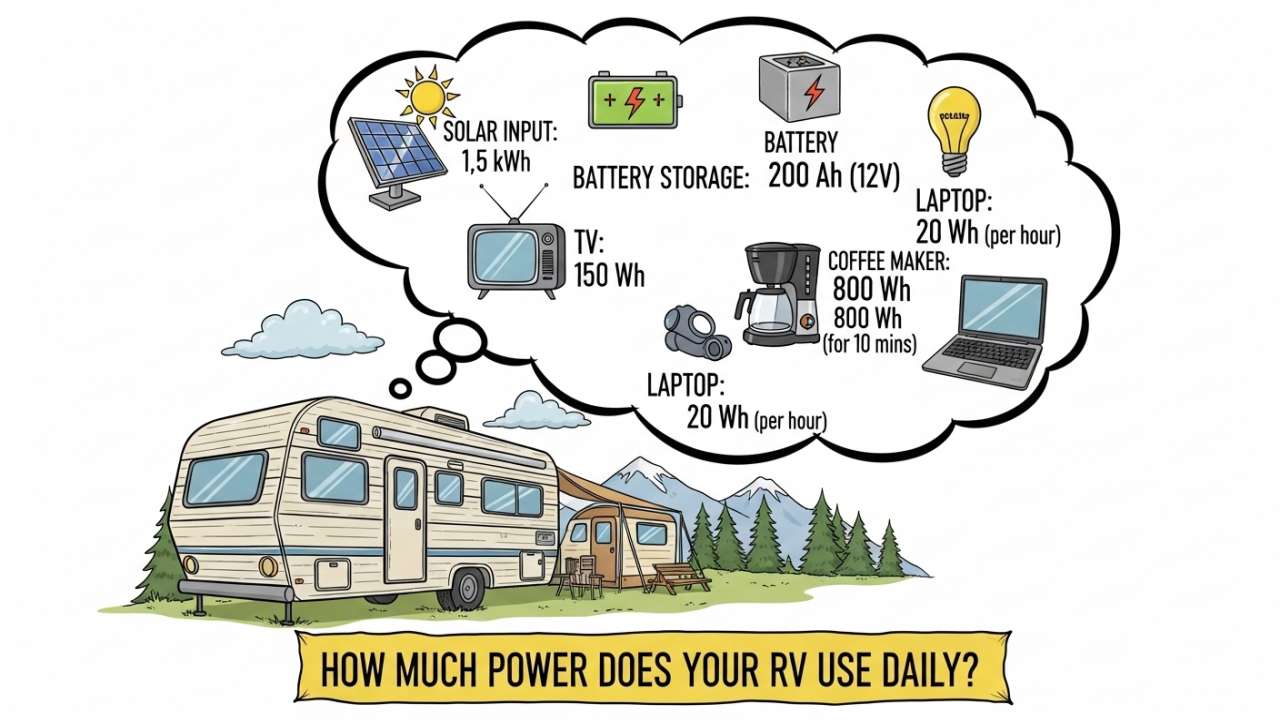
Let’s break down reality: Your RV refrigerator alone consumes 50-100 amp hours per day. Add LED lights (10-20 Ah), fans (20-30 Ah), water pump (5-10 Ah), phone and laptop charging (15-25 Ah), and entertainment systems (20-40 Ah), and you’re easily looking at 150-300 amp hours of daily usage. Meanwhile, a single 100-watt solar panel only produces about 30 amp hours per day under ideal conditions – that’s just 10-20% of what most RVers actually need!
The Solution: Calculate your actual power consumption BEFORE buying any panels. Use this proven formula:
- List every electrical device you use in your RV and find its wattage (check labels or manuals)
- Estimate realistic daily usage hours for each device (be honest with yourself)
- Multiply watts × hours to get watt-hours (Wh) for each device
- Add everything up for your total daily energy consumption
- Divide by 12 to convert to amp-hours (for standard 12V RV systems)
- Add a 30% buffer for cloudy days, winter months, and efficiency losses
Pro Tip: Install a battery monitor like the Victron BMV-712 or Renogy BT-2 and track your actual usage for 2 weeks BEFORE buying solar equipment. This gives you real data, not guesswork. Most RVers are shocked to discover they use 50-100% more power than they estimated!
🔋 Mistake #2: Choosing the Wrong Battery Technology
Lead-Acid vs. Lithium: Why Your Battery Choice Makes or Breaks Your System
Installing expensive high-efficiency solar panels with outdated lead-acid batteries is like buying a Ferrari but putting cheap gas-station tires on it. Your entire solar system’s performance is limited by your battery bank – it’s the foundation everything else builds on.
The Problem: Traditional lead-acid batteries (including AGM) only provide 50% usable capacity before damage occurs, weigh 2-3 times more than lithium alternatives, suffer from voltage sag under load, and degrade rapidly with deep discharges. Yet many RVers stick with them solely because of lower upfront costs, not realising the long-term expense.
The Solution: Invest in LiFePO4 (lithium iron phosphate) batteries from day one. Yes, they cost 2-3x more initially, but consider the real-world advantages:
- 90-95% usable capacity vs only 50% for lead-acid (twice the effective power!)
- 2,000-5,000 charge cycles vs only 300-500 cycles (10x longer lifespan)
- 50-70% lighter weight – crucial for payload capacity and gas mileage
- 4x faster charging rates – fully recharge in 2-3 hours vs 8-12 hours
- Zero maintenance required – no water topping or equalization charging
- Better performance in extreme temperatures – works down to -4°F and up to 140°F
- Stable voltage output – appliances run better with consistent 12V power
The math: Over 5 years, you’ll replace lead-acid batteries 3-4 times ($800-1,200 total) while one lithium bank lasts the entire period ($1,000-1,500). Lithium actually costs LESS long-term!
⚙️ Mistake #3: Skimping on the Solar Charge Controller
The Brain of Your System – Don’t Cheap Out Here!
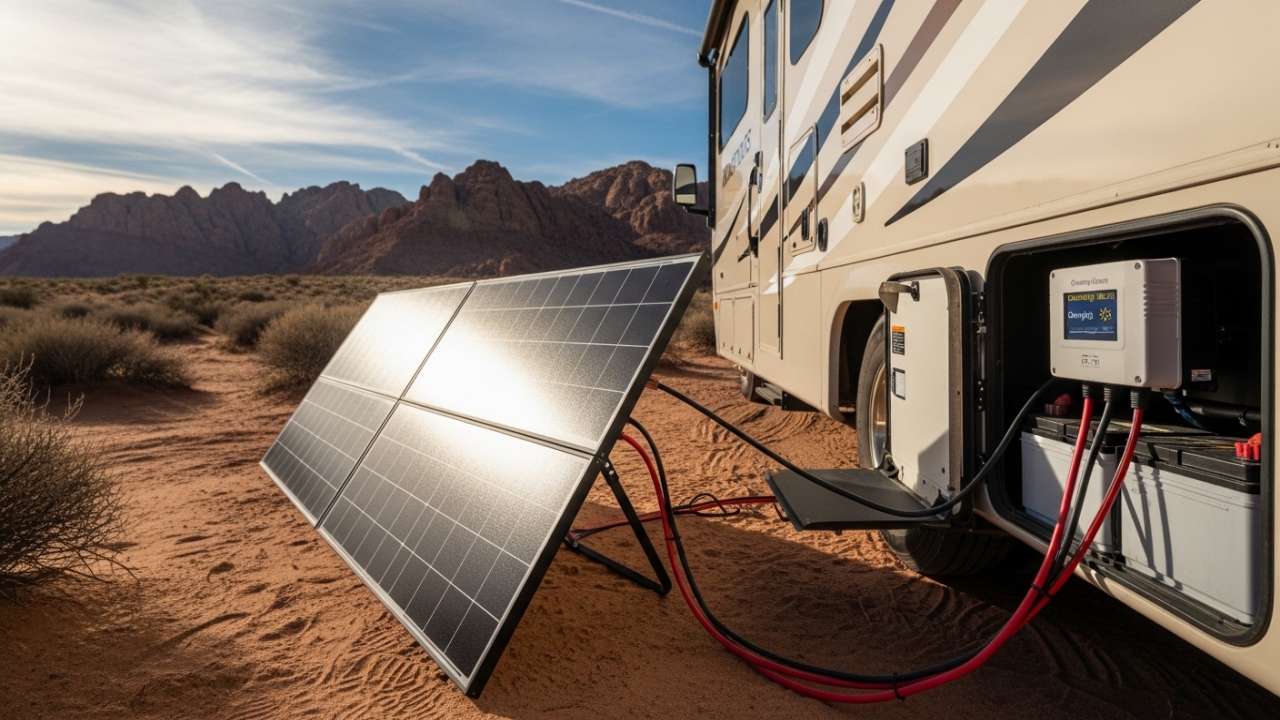
Your solar charge controller is literally the brain of your entire power system, managing how solar energy flows to your batteries. Yet it’s the component most commonly downgraded to save $100-200, sacrificing 15-30% of potential solar production every single day.
❌ The Problem: Basic PWM (Pulse Width Modulation) controllers can only charge batteries at the panel’s current voltage. When your 18V solar panel tries to charge a 12V battery, those extra 6 volts are completely wasted as heat. You’re literally throwing away 25-30% of your solar production!
✅ The Solution: ALWAYS use an MPPT (Maximum Power Point Tracking) charge controller. The benefits are undeniable:
- 15-30% more power production compared to PWM controllers – that’s like getting 1-2 extra panels for free
- Converts excess voltage into charging current – uses every bit of solar energy efficiently
- Superior performance in low-light conditions – charges even on cloudy/shaded days
- Handles higher voltage panels – easier system expansion without rewiring
- Advanced temperature compensation – adjusts charging for battery temperature
- Bluetooth monitoring – see real-time production on your phone
Top brands we recommend: Victron Energy (best monitoring), Renogy (great value), Morningstar (ultra-reliable), Epever (budget MPPT option)
Expert Tip:
Size your MPPT controller 25-30% larger than your current solar array. This costs an extra $50-100 now but allows future expansion without replacing the controller. A $300 40A controller today saves you $500+ when you want to add panels next year!