Most RV solar guides give you a vague “$500 to $10,000” range and call it a day.
That number is technically accurate. It’s also completely useless when you’re trying to figure out what you’ll actually spend.
Here’s what those guides skip: the real cost of an RV solar system isn’t the panels. It’s the battery bank. It’s the inverter. It’s whether you hire someone or do it yourself. It’s how off-grid you actually want to be versus how off-grid you think you want to be.
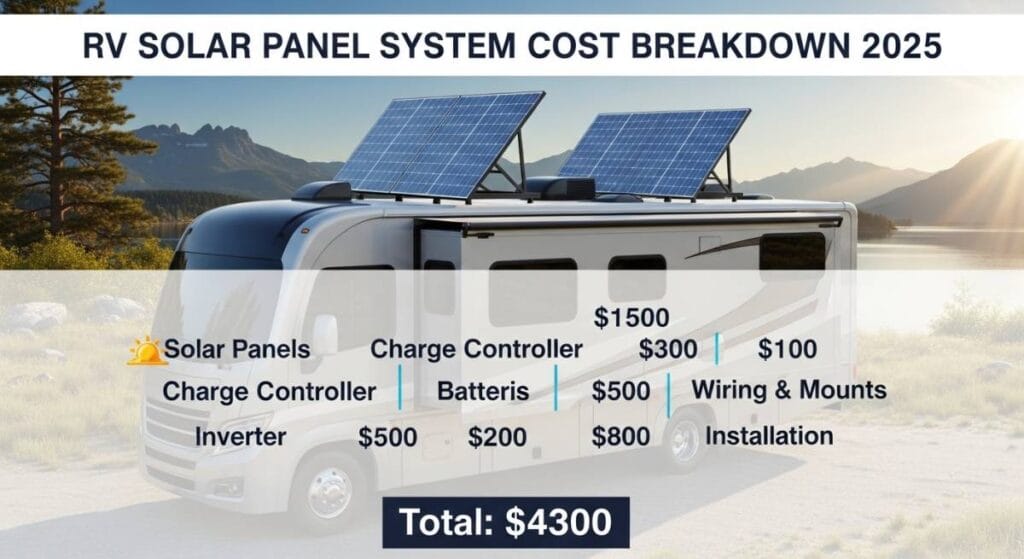
This guide breaks it all down with real 2026 component prices, three complete system builds from budget to full off-grid, and a clear-eyed look at where people waste money and where they cut corners that cost them twice.
Also Read:- RV Solar Panels in Montana Winter: Performance & Maintenance Tips 2026 (2026)
What Actually Makes Up an RV Solar System?
Before any prices make sense, you need to know what you’re buying. A solar system isn’t just panels on a roof. There are four core components — and you need all of them for a functioning system.
Solar Panels
Capture sunlight and convert it to DC electricity. They do not power your RV directly. They charge your battery bank. Think of panels as your income; batteries are your savings account.
Charge Controller
Sits between the panels and the battery. It prevents overcharging, manages voltage, and protects your batteries. Two types exist:
- PWM (Pulse Width Modulation) — cheaper, less efficient
- MPPT (Maximum Power Point Tracking) — more expensive, 20–30% more efficient
For anything over 200W, MPPT pays for itself in efficiency gains within 3–6 months.
Battery Bank
Stores the energy your panels collect. This is where most of your money goes. The bigger your battery bank, the longer you can run without sun. Most people undersize batteries and oversize panels — the exact opposite of what they should do.
Inverter
Converts DC power stored in batteries to 120V AC power, which is what your appliances and outlets use. If you only run 12V devices (lights, fans, phone charging), you can skip the inverter. If you want to run a coffee maker, microwave, or laptop, you need one.
Optional but invaluable: battery monitor, solar combiner box, inline fuses, roof mounting hardware, and cable management.
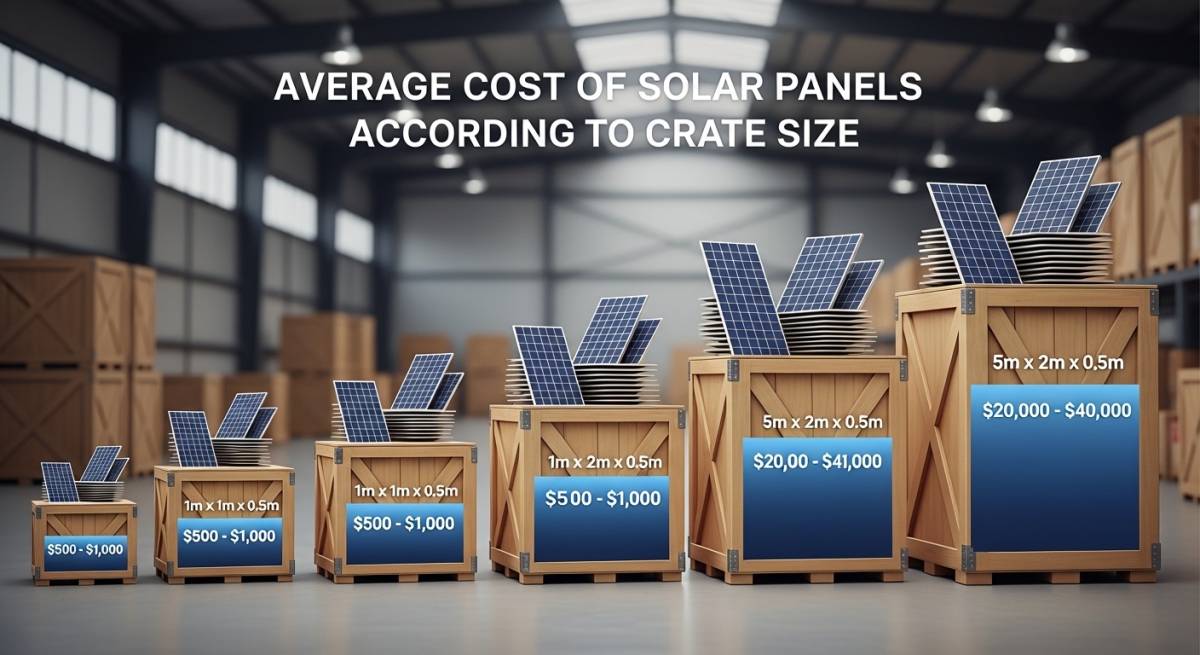
2026 Component Cost Breakdown
Here’s what each piece costs at current 2026 prices from major suppliers like Renogy, Battle Born, Victron, and Amazon.
Solar Panels
| Panel Type | Wattage | Price Per Panel | Best For |
|---|---|---|---|
| Rigid monocrystalline | 100W | $80–$120 | Permanent roof installs |
| Rigid monocrystalline | 200W | $150–$220 | Most common choice |
| Rigid monocrystalline | 400W | $250–$380 | High-output, fewer panels |
| Flexible monocrystalline | 100W | $100–$180 | Curved roofs, low clearance |
| Flexible monocrystalline | 200W | $180–$300 | Vans, curved surfaces |
| Portable folding panel | 100–200W | $150–$350 | No roof drilling, temporary |
Note: Panels are actually the most affordable part of the system in 2026. Buying a 400W system doesn’t mean buying four 100W panels — one or two 200W or 400W panels is cheaper and easier to wire.
Charge Controllers
| Type | Size | Price Range | Best For |
|---|---|---|---|
| PWM basic | 20A | $20–$50 | Tiny systems under 200W |
| PWM mid-range | 40A | $40–$80 | Budget builds under 400W |
| MPPT entry-level | 20–30A | $80–$150 | Most 200–400W setups |
| MPPT mid-range (Renogy, Epever) | 40A | $120–$200 | 400–800W systems |
| MPPT premium (Victron) | 100A | $300–$500 | Large systems, best data |
Always buy MPPT if your system is over 200W. The efficiency gain pays for the price difference within a few months.
Also Read:- Billings RV Solar Installation: Top 5 Local Shops + Complete DIY Guide (2026)
Battery Banks
This is where costs spike — and where most people make expensive mistakes.
| Battery Type | Capacity | Price Range | Usable Capacity | Lifespan |
|---|---|---|---|---|
| Lead-acid (flooded) | 100Ah | $80–$150 | 50Ah (50% DoD) | 200–400 cycles |
| AGM (sealed lead-acid) | 100Ah | $150–$250 | 50Ah (50% DoD) | 400–600 cycles |
| Lithium LiFePO4 (budget brands) | 100Ah | $250–$400 | 100Ah (100% DoD) | 2,000+ cycles |
| Lithium LiFePO4 (Battle Born, Renogy) | 100Ah | $400–$600 | 100Ah | 3,000–5,000 cycles |
| Lithium LiFePO4 | 200Ah | $600–$900 | 200Ah | 3,000–5,000 cycles |
The honest math on lithium vs. lead-acid: A 100Ah AGM battery gives you 50Ah usable. A 100Ah lithium battery gives you 100Ah usable. To get 200Ah usable storage from AGM, you spend $300–$500 on batteries that last 400 cycles. One 200Ah lithium battery at $600–$900 gives you the same usable storage and lasts 10x longer. Over 5 years of regular camping, lithium wins the cost comparison in almost every scenario.
Inverters
| Type | Wattage | Price Range | Best For |
|---|---|---|---|
| Pure sine wave (basic) | 1,000W | $80–$150 | Laptops, TVs, small appliances |
| Pure sine wave (mid) | 2,000W | $150–$300 | Most RV owners |
| Pure sine wave (Renogy, Victron) | 3,000W | $300–$600 | Heavy loads, full-timers |
| Inverter/charger combo | 2,000W | $400–$900 | Best for shore power integration |
Always buy pure sine wave. Modified sine wave inverters are cheaper but damage sensitive electronics over time — laptops, CPAP machines, and variable speed devices specifically.
Wiring, Hardware, and Misc
This category gets overlooked but adds up fast.
| Item | Estimated Cost |
|---|---|
| Mounting hardware and brackets | $40–$120 |
| MC4 connectors and combiner box | $20–$60 |
| Battery cables (4 AWG to 2/0 AWG) | $30–$100 |
| Inline fuses and breakers | $30–$80 |
| Battery monitor (Victron BMV-712, Renogy) | $60–$150 |
| Roof sealant and penetration covers | $20–$40 |
| Total misc | $200–$550 |
Also Read:- Billings RV Solar Installation: Top 5 Local Shops (2026)
Three Complete System Builds — Real 2026 Costs
Build 1 — Weekend Warrior (200W System)
Good for: charging phones and laptops, running LED lights, a 12V fan, and occasional small device charging. Not suitable for a residential fridge or microwave.
| Component | Item | Cost |
|---|---|---|
| Panels | 2x 100W rigid monocrystalline | $180–$240 |
| Charge controller | 20A MPPT | $80–$120 |
| Battery | 1x 100Ah AGM | $150–$220 |
| Inverter | 1,000W pure sine wave | $80–$120 |
| Wiring and hardware | Misc | $150–$250 |
| Total DIY | $640–$950 | |
| Total with pro install | Add $500–$900 labor | $1,140–$1,850 |
What it powers (per day):
- Phone charging: 2–4 hours
- Laptop: 6–8 hours light use
- LED lights: 8–12 hours
- 12V fan: continuous
- Small devices: basic use only
Build 2 — Weekend to Week-Long (400W System)
Good for: 12V compressor fridge running 24/7, laptop, TV, phone charging, lights, fan. This is the most popular build for travel trailer and Class C owners.
| Component | Item | Cost |
|---|---|---|
| Panels | 2x 200W rigid monocrystalline | $300–$440 |
| Charge controller | 40A MPPT | $120–$200 |
| Battery | 2x 100Ah LiFePO4 (budget brand) | $500–$800 |
| Inverter | 2,000W pure sine wave | $150–$280 |
| Wiring and hardware | Misc | $200–$350 |
| Total DIY | $1,270–$2,070 | |
| Total with pro install | Add $800–$1,500 labor | $2,070–$3,570 |

Build 3 — Full Off-Grid (800W+ System)
Good for: full-time RVers and serious boondockers. Runs residential fridge, microwave occasionally, multiple devices, CPAP machine, and lasts 2–3 cloudy days on battery alone.
Real-world scenario: You live in your RV full-time or spend 60+ nights per year boondocking. You need reliability, redundancy, and the ability to handle cloudy stretches. This is your system.
| Component | Item | Cost |
|---|---|---|
| Panels | 4x 200W rigid monocrystalline | $600–$880 |
| Charge controller | 60A MPPT (Victron or Renogy) | $200–$350 |
| Battery | 2x 200Ah LiFePO4 (Battle Born / Renogy) | $1,200–$1,800 |
| Inverter/charger | 3,000W pure sine inverter/charger | $500–$900 |
| Wiring and hardware | Full setup with battery monitor | $350–$600 |
| Total DIY | $2,850–$4,530 | |
| Total with pro install | Add $1,500–$3,000 labor | $4,350–$7,530 |
What it powers (per day):
- Residential fridge: 24/7
- Microwave: 15–30 min daily
- CPAP machine: 8 hours nightly
- Laptop/work equipment: 12+ hours
- TV: 6–8 hours
- Washing machine: occasional (with generator backup)
- Space heater: limited use
- All lights and fans: continuous
Expected off-grid days: 4–6 days without sun (with normal usage)
DIY vs. Professional Installation — The Honest Comparison
| Factor | DIY | Professional Install |
|---|---|---|
| Labor cost | $0 | $500–$3,000 depending on system size |
| Time required | 1–3 days for most systems | 1–2 days (you’re not doing it) |
| Skill required | Basic electrical comfort, can follow diagrams | None |
| Warranty coverage | Component warranties only | Often includes labor warranty |
| Risk of mistakes | Real — undersized wire, wrong fuse, bad roof seal | Low |
| Best for | Handy owners with time and patience | Owners who want it done right the first time |
Also Read:- Best RV Solar Panels for Wyoming: High Altitude Performance Guide 2026
When DIY Makes Sense
- You’re comfortable with basic 12V wiring
- You have a weekend to commit (realistically 2–3 days)
- You’re installing a relatively simple system (under 400W with straightforward roof access)
- You trust yourself with a drill and sealant
- You’ve watched installation videos or taken an online course
When to Hire a Pro
- Large systems over 600W (complexity, fire risk)
- Class A motorhomes with complex roof layouts (don’t guess on electrical)
- Any system involving inverter/charger integration with shore power
- You’ve never worked with wiring before
- Your roof has skylights, vents, or unusual penetrations
- You want a warranty on labor (roofing mistakes cost thousands to fix)
The hard truth: A bad roof penetration leaks for years. Undersized battery cables create fire risk. Some mistakes are worth paying $1,500 to avoid.
Where People Waste Money on RV Solar
WASTE #1: Buying Too Many Panels, Not Enough Battery
Panels are cheap in 2026. Battery storage is not. Twelve hours of sun charges your panels. You need 12 hours of darkness covered by batteries. Skimping on battery and oversizing panels leaves you dead by 9pm even with a 600W roof.
Example: You buy 600W of panels with 100Ah of AGM (50Ah usable). Your fridge runs 30Ah/day. By 6pm, you’re down to 20Ah. By 9pm, you’re flat. Meanwhile, those expensive panels aren’t doing anything in the dark.
Better approach: Size your battery first (based on your real usage). Then size panels to recharge that battery in 6–8 hours of average sun.
WASTE #2: Buying AGM to Save Money Upfront
AGM gives you 50% usable capacity and lasts 400–600 cycles. Lithium gives you 100% usable capacity and lasts 3,000–5,000 cycles.
If you camp more than 30 nights a year, lithium pays for itself within 3–4 years in most cases. After that, it’s pure savings.
Real math:
- 100Ah AGM: $150–$250, 50Ah usable, 400 cycles = $0.75–$1.25 per usable Ah per cycle
- 100Ah lithium: $350–$600, 100Ah usable, 3,000 cycles = $0.12–$0.20 per usable Ah per cycle
Over 5 years and 100+ camping trips, lithium is dramatically cheaper.
WASTE #3: Buying Cheap Modified Sine Wave Inverters
The $40 inverter on Amazon will:
- Damage your CPAP machine (the cooling won’t work)
- Confuse your laptop charger (potential battery damage)
- Shorten the life of variable-speed motors (fans, water pumps)
- Heat up and shut off under load
Pure sine wave costs $80–$150 for 1,000W. That $40 you saved costs you a $1,200 laptop.
SAVE MONEY HERE: Don’t Buy Everything as a “Kit”
Bundled kits often include one weak component (usually the battery) to hit a price point. Buy components individually from reputable brands.
DON’T SKIP THIS: Battery Monitor
You cannot tell how much power is left in a lithium battery by voltage alone. A $70 battery monitor tells you:
- Exact state of charge (%)
- Power flowing in/out (amps)
- Estimated time remaining (hours)
- Historical usage data
This single $70 purchase changes how you manage your system and prevents the panic of thinking you’re out of power when you still have 40% battery.
DON’T SKIP THIS: MPPT Charge Controller
Yes, it costs more than PWM. Yes, it pays for itself in 3–6 months through efficiency. Yes, you’ll get better data and integration with monitoring systems. MPPT is not optional for systems over 200W.
RV Solar Cost by RV Type
Your RV type affects installation cost, panel placement options, and how much power you realistically need.
| RV Type | Typical System Size | DIY Cost Range | Notes |
|---|---|---|---|
| Pop-up camper / tent trailer | 100–200W | $300–$700 | Limited roof space, often ground-mounted |
| Travel trailer (small) | 200–400W | $700–$1,500 | Most DIY-friendly install |
| Travel trailer (large) | 400–600W | $1,200–$2,500 | Straightforward roof, easy cable routing |
| Fifth wheel | 400–800W | $1,500–$3,500 | Large roof, complex front section |
| Class B van | 200–400W | $800–$2,000 | Curved roof adds cost for flexible panels |
| Class C motorhome | 400–800W | $1,500–$3,500 | Good roof space, generator backup available |
| Class A motorhome | 600–1,200W | $2,500–$6,000 | Large roof but complex install, usually pro jo |
RV Solar Cost by Wattage: 600W vs 1000W vs 1500W
| System Size | Panel Count | Battery (Lithium) | Inverter | Total DIY Cost (2026) | Best For |
|---|---|---|---|---|---|
| 600W | 3x 200W | 200Ah | 2,000W | $1,800–$2,800 | 3–5 day trips, occasional off-grid |
| 1000W | 5x 200W | 400Ah | 3,000W | $3,200–$4,800 | Weekly trips, regular boondocking |
| 1500W | 7–8x 200W | 600Ah | 4,000W | $4,500–$6,500 | Full-time RVing, serious off- |
Key insight: Wattage doesn’t matter as much as battery capacity. A 600W system with 400Ah beats a 1000W system with 100Ah every time.
Hidden RV Solar Costs Nobody Mentions
Beyond the major components, these expenses sneak up on people:
| Hidden Cost | Range | Why It Matters |
|---|---|---|
| Roof repairs (if needed before install) | $200–$1,000 | Rust, soft spots, previous leaks |
| Custom mounting for curved roofs | $100–$300 | Standard brackets don’t fit vans/Class Bs |
| Electrical code compliance/inspection | $50–$300 | Some states/counties require permits |
| Breaker and fuse upgrades | $50–$150 | Existing electrical might need updates |
| Battery vent system (lithium safety) | $30–$80 | Lithium can outgas in extreme temps |
| Disconnect switch installation | $20–$100 | Safe emergency shutdown capability |
| Monitoring system (app-based) | $60–$300 | Remote monitoring while driving |
| Generator integration/wiring | $200–$800 | Allowing auto-charging from generator |
| Total hidden costs | $610–$3,130 | Can double your effective system cost |
Frequently Asked Questions
How much does a basic RV solar system cost in 2026?
A basic 200W system for charging devices and running lights costs $640 to $950 for DIY components. Add $500 to $900 for professional installation. This covers panels, a small MPPT charge controller, one AGM battery, a small inverter, and wiring hardware.
If you choose lithium instead of AGM, add $200–$300 to component costs but gain double usable capacity.
What’s the most popular RV solar system size?
400W panels + 200Ah lithium battery is the sweet spot for 80% of RV owners. It handles:
- 12V fridge running 24/7
- 3–5 days off-grid in normal conditions
- TV, laptops, phones
- Realistic daily use without massive overbuying
Costs: $1,320–$2,120 DIY, $2,120–$3,620 professionally installed (March 2026).
Is RV solar worth it in 2026?
It depends entirely on how you camp:
Worth it if:
- You boondock 20+ nights per year
- You hate generator noise and fuel costs
- Your RV has unreliable shore power hookups
- You value independence and flexibility
Not worth it if:
- You always camp at full-hookup sites
- You camp fewer than 10 nights per year
- You’re on an extremely tight budget (start with a portable solar generator instead)
Payback period: 2–4 years if you boondock regularly. 5–7+ years if you do occasional trips to hookup campgrounds.
What is the biggest cost in an RV solar system?
The battery bank. In a properly sized system, batteries typically represent 35–55% of total component cost.
Example (400W system):
- Panels + controller: $400–$600 (25%)
- Batteries: $500–$800 (40%)
- Inverter: $150–$280 (15%)
- Wiring + install: $250–$400 (20%)
This is why choosing lithium over lead-acid matters — you get double the usable capacity and 5–10x the lifespan for roughly 2x the price.
How many solar panels do I need for a travel trailer?
For a typical travel trailer running a 12V compressor fridge, lights, and basic electronics: 400W of panels with 200Ah of lithium storage covers most 3–4 day trips without hookups.
The rule: Add more battery before adding more panels. Battery is what keeps you powered at night.
Can I add solar to my RV myself?
Yes — most travel trailer and fifth wheel installs are DIY-friendly if you’re comfortable with basic electrical work.
Main risks:
- Undersized wiring = fire risk
- Bad roof penetrations = leak risk for years
- Incorrect charge controller settings = battery damage
For systems over 600W or Class A motorhomes, professional installation is worth the cost to avoid catastrophic mistakes.
How long do RV solar systems last?
- Rigid monocrystalline panels: 20–25 years with gradual output decline (usually 80%+ at 20 years)
- LiFePO4 batteries: 10–15 years at normal cycling rates (3,000–5,000 cycles)
- MPPT charge controllers: 5–10 years, often replaced as technology improves
- Inverters: 5–10 years, high heat/cycling shortens lifespan
- Pure sine wave inverters: Often outlast their warranty but degradation starts around year 7
The panels almost never fail first — batteries and inverters are the components you’ll replace during the system’s lifetime.
What is the best RV solar brand in 2026?
Best overall value:
- Renogy — Best entry-to-mid range at every price point (panels, controllers, batteries, inverters)
Best for specific categories:
- Batteries: Battle Born (premium) and Renogy (mid-range)
- Charge controllers (premium): Victron SmartSolar (pricey but unmatched data and integration)
- Complete kits: Renogy bundles offer good value when bought as a package
- Budget lithium: Litime, Ampere (lower price, decent quality, emerging brands)
Pro tip: Don’t obsess over brands. Any MPPT controller from Renogy, Epever, or Victron will work. The difference is in monitoring features and warranty length, not performance.
How do I know what size system I need?
Step 1: Track your power usage for 3–5 camping trips (use a battery monitor)
Step 2: Calculate daily consumption (amps × hours)
Step 3: Multiply by 1.5 for safety margin and cloudy days
Step 4: Size battery to that number
Step 5: Size panels to recharge battery in 6–8 hours of average sun
Don’t guess. Guessing is how people end up with useless oversized panels and dead batteries by dinner.
Bottom Line
An RV solar system in 2026 costs $640 to $4,500 DIY and $1,200 to $7,500 professionally installed, depending entirely on how much battery storage you buy and how off-grid you want to live.
The panels are the cheap part. Budget for your batteries first, then size your panels to match. Buy lithium if you camp regularly. Buy MPPT over PWM for anything over 200W. And buy a battery monitor — it’s the $70 purchase that makes everything else make sense.
Start with the system that covers your real usage. You can always add panels and batteries later. You cannot easily swap out undersized wiring or a leaking roof penetration.