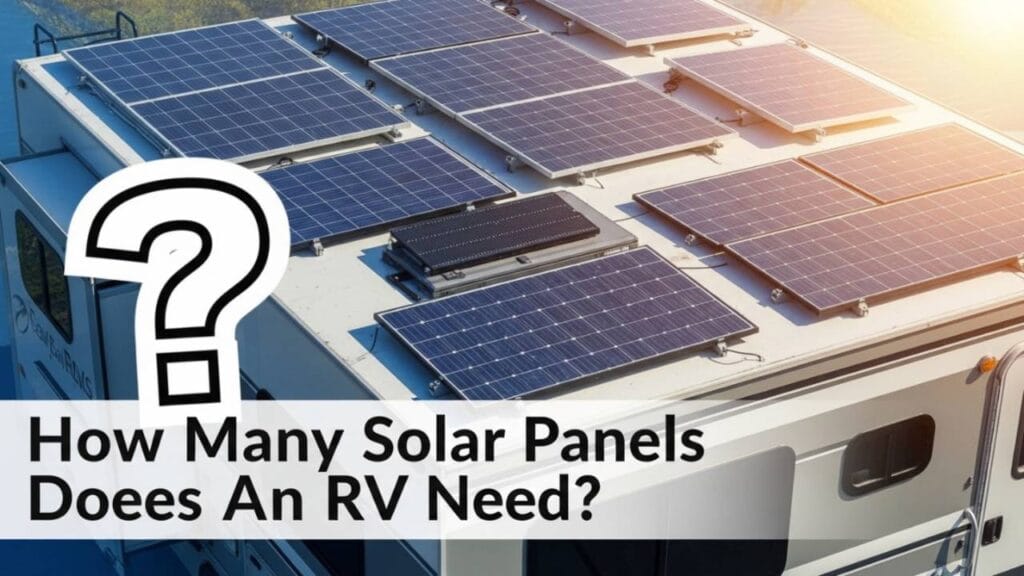
Most RVs need between 2 and 6 solar panels (400-1,200 watts), depending on your energy consumption. A weekend boondocker with basic needs might get by with 200-400 watts, while full-time RVers running air conditioning need 800-1,200+ watts. Your specific requirements depend on your RV type, appliances, travel style, and whether you have battery storage to handle nighttime power needs.
Understanding Your RV’s Power Needs
Before you can determine how many solar panels for RV use you’ll need, you must understand your daily power consumption. This is measured in watt-hours (Wh) or kilowatt-hours (kWh), and it’s the foundation of sizing your solar system correctly.
Think of it this way: if you run a 60-watt light bulb for 5 hours, you’ve consumed 300 watt-hours of energy. Every appliance in your RV draws power at different rates, and calculating your total daily usage requires accounting for each device and how long you use it.
Common RV Appliance Power Consumption
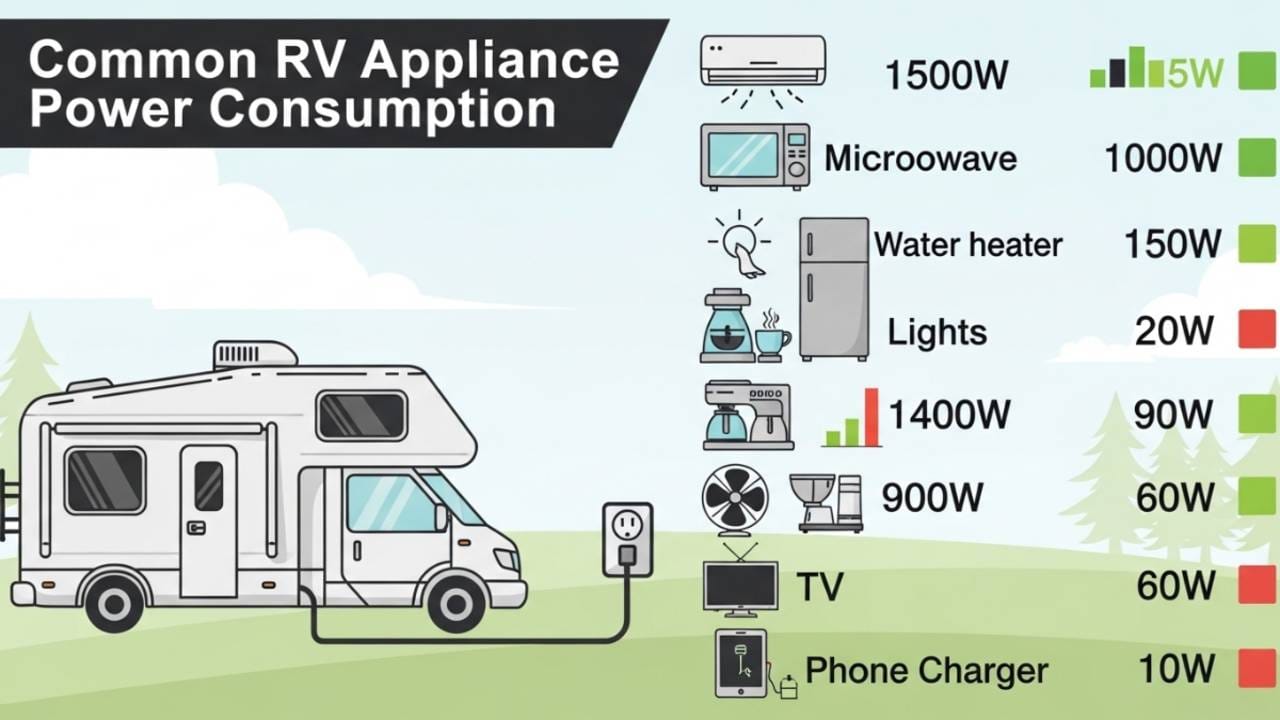
Here’s a breakdown of typical daily power consumption for common RV appliances:
Refrigerator (RV-specific, running on 12V DC): 30-50 watts continuous draw = 720-1,200 Wh per day
- LED Lights (6 lights, 4 hours/day): 5 watts each = 120 Wh per day
- Water Pump (1 hour total runtime): 45 watts = 45 Wh per day
- Phone/Tablet Charging (2 devices): 20 watts total = 40 Wh per day
- Laptop (4 hours): 50 watts = 200 Wh per day
- Microwave (15 minutes): 1,000 watts = 250 Wh per day
- Coffee Maker (30 minutes): 600 watts = 300 Wh per day
- TV (3 hours): 50 watts = 150 Wh per day
- Furnace Fan (4 hours): 60 watts = 240 Wh per day
- Air Conditioner (8 hours): 1,500 watts = 12,000 Wh per day
- Total without AC: Approximately 2,065 Wh per day
- Total with AC: Approximately 14,065 Wh per day
As you can see, air conditioning dramatically changes your power requirements. Running AC from solar power alone requires a substantial investment in panels and battery capacity.
Solar Panel Sizing Calculator by RV Type
Here’s a practical guide for determining how many solar panels your RV needs based on type and usage:
| RV Type | Typical Battery Bank | Light Use (Wh/day) | Moderate Use (Wh/day) | Heavy Use (Wh/day) | Recommended Solar Watts | Number of Panels (200W each) |
|---|---|---|---|---|---|---|
| Class A Motorhome | 400-800 Ah | 2,000-3,000 | 3,000-5,000 | 5,000-8,000 | 600-1,200W | 3-6 panels |
| Class B Van | 200-400 Ah | 1,000-1,500 | 1,500-2,500 | 2,500-4,000 | 400-800W | 2-4 panels |
| Class C Motorhome | 300-600 Ah | 1,500-2,500 | 2,500-4,000 | 4,000-6,000 | 500-1,000W | 2.5-5 panels |
| Travel Trailer | 200-400 Ah | 1,000-2,000 | 2,000-3,500 | 3,500-5,000 | 400-900W | 2-4.5 panels |
| Fifth Wheel | 300-600 Ah | 1,500-2,500 | 2,500-4,500 | 4,500-7,000 | 500-1,100W | 2.5-5.5 panels |
Usage Definitions:
- Light Use: Basic lighting, water pump, phone charging, minimal electronics
- Moderate Use: Above plus laptop, TV, microwave, coffee maker
- Heavy Use: Above plus extended electronics, hair dryer, or partial AC use
Also Read:- RV Solar Panels in Montana Winter: Performance & Maintenance Tips (2026)
Calculating Your Exact Solar Panel Requirements
To determine precisely how many solar panels for RV applications you need, follow this five-step process:
Step 1: Calculate Daily Energy Consumption
List every appliance you’ll use and multiply its wattage by hours of daily use. Add 20% as a safety buffer for inefficiencies and unexpected usage.
Example calculation:
- Refrigerator: 1,000 Wh
- Lights: 120 Wh
- Water pump: 45 Wh
- Electronics: 240 Wh
- Subtotal: 1,405 Wh
- With 20% buffer: 1,686 Wh per day
Step 2: Account for Sunlight Hours
Solar panels only produce their rated power under ideal conditions. You’ll need to account for your location’s average peak sun hours (typically 3-6 hours per day depending on season and location).
If you need 1,686 Wh per day and get 5 peak sun hours: 1,686 Wh ÷ 5 hours = 337 watts of solar panels needed
Step 3: Add Inefficiency Factors
Solar systems aren’t 100% efficient. Account for:
- Panel efficiency losses: 15-20%
- Charge controller losses: 5-10%
- Battery charging losses: 10-15%
- Dirt/shade on panels: 5-10%
Total system efficiency is typically 70-80%. To compensate: 337 watts ÷ 0.75 = 449 watts needed
This means you’d want about 450-500 watts of solar panels (2-3 standard 200W panels).
Step 4: Consider Battery Storage
Your solar panels charge batteries during the day, which power your RV at night. A common rule of thumb: your battery bank should store 2-3 times your daily consumption.
For 1,686 Wh daily use:
- Minimum battery capacity: 3,372 Wh (approximately 280 Ah at 12V)
- Recommended: 5,058 Wh (approximately 420 Ah at 12V)
Step 5: Plan for Cloudy Days
If you want energy independence during cloudy weather, increase your solar array by 50-100% to allow battery recharging even with reduced sunlight.
Also Read:- Billings RV Solar Installation: Top 5 Local Shops + Complete DIY Guide (2026)
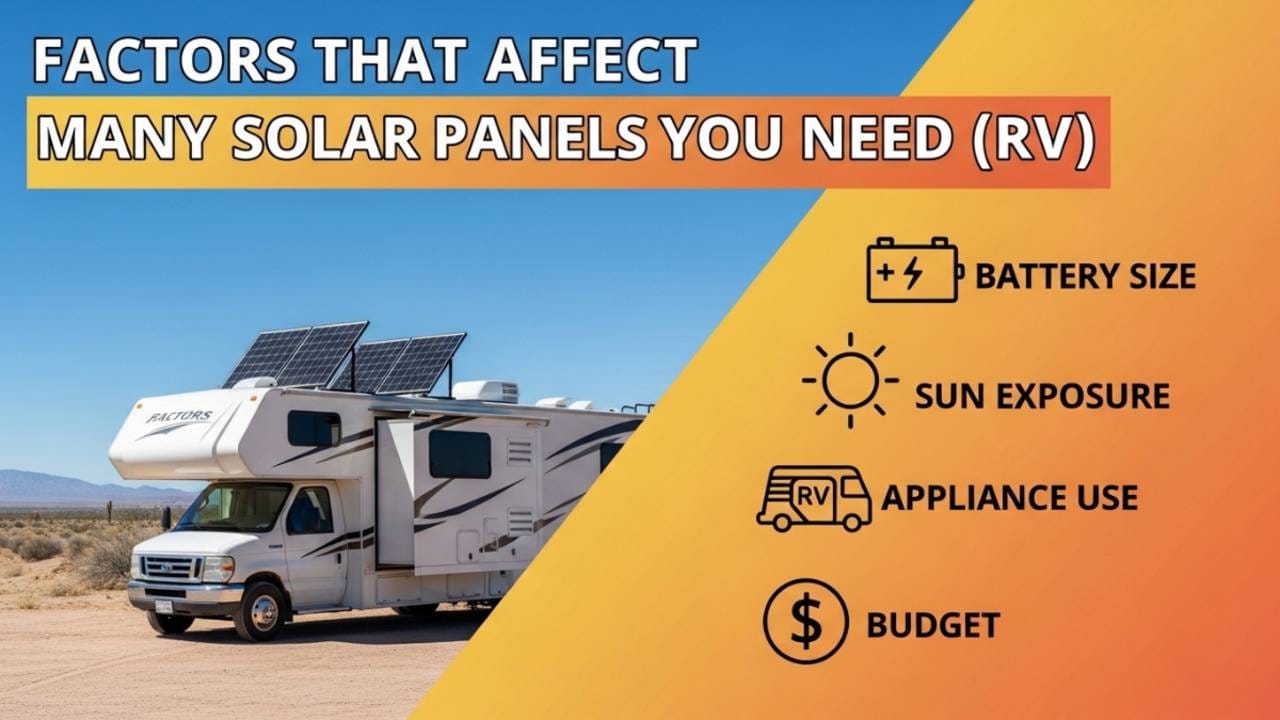
Factors That Affect How Many Solar Panels You Need
Geographic Location
Your location dramatically impacts solar production. Arizona gets significantly more annual sunshine than Seattle. If you travel, plan for the locations with less sun.
Seasonal Variations
Winter provides fewer daylight hours and lower sun angles, reducing panel efficiency by 30-50% compared to summer. Size your system for winter if you plan year-round camping.
Roof Space
Class B vans have limited roof space (typically room for 400-600 watts), while Class A motorhomes can accommodate 800-1,200+ watts. Measure your available space before purchasing panels.
Budget Considerations
Solar installations range from $1,500 for basic setups to $10,000+ for premium systems. A typical 400-watt system with batteries costs $2,500-$4,000 installed.
Future Expansion
Consider starting with fewer panels and leaving space for future additions. Most charge controllers can handle additional panels up to their rated capacity.
Special Considerations for Air Conditioning
Running RV air conditioning on solar power is the ultimate challenge. A typical RV AC unit draws 1,500 watts while running and cycles on and off to maintain temperature.
For 8 hours of runtime on a hot day:
- Power needed: 12,000 Wh
- Solar required (5 sun hours, 75% efficiency): 3,200 watts
- That’s 16 x 200-watt panels!
Most RVers use these alternatives:
- Soft-start devices reduce initial power draw
- High-efficiency mini-split systems use 50% less power
- Run AC during peak sun hours only
- Supplement with generator for extended AC use
- Park in shade and use fans to reduce AC runtime
A more realistic solar-assisted AC setup uses 800-1,200 watts of panels with a generator backup.
Recommended Solar Panel Configurations
Budget Setup (200-400W): $1,500-$2,500
- Perfect for weekend warriors
- Powers lights, water pump, phone charging, small TV
- 100-200 Ah battery bank
- 1-2 solar panels
Mid-Range Setup (400-800W): $3,000-$5,000
- Ideal for regular boondockers
- Handles all basics plus laptop, microwave, coffee maker
- 300-400 Ah battery bank
- 2-4 solar panels
Premium Setup (800-1,200W+): $6,000-$12,000
- For full-time RVers
- Supports all appliances (except full-time AC)
- 600-800 Ah lithium battery bank
- 4-6+ solar panels
- Possibly includes an inverter-generator hybrid system
Also Read:- Billings RV Solar Installation: Top 5 Local Shops (2026)
Installation Tips and Best Practices

When installing solar panels on your RV:
Panel Placement: Mount panels flat or with a slight tilt toward the sun. Tilting mechanisms add complexity but increase efficiency.
Wiring: Use appropriate gauge wire to minimize voltage drop. For 12V systems over 10 feet, use 10 AWG minimum.
Charge Controller: MPPT controllers cost more but provide 20-30% more efficiency than PWM controllers, especially in cold weather.
Monitoring: Install a battery monitor to track consumption and solar production in real-time.
Professional vs. DIY: Complex systems benefit from professional installation, while simple 200-400W setups are DIY-friendly for those comfortable with electrical work.
Maintenance and Longevity
Solar panels require minimal maintenance but benefit from:
- Cleaning 2-4 times yearly to remove dust, pollen, and debris
- Checking connections annually for corrosion
- Monitoring output to detect degradation early
- Inspecting mounting hardware for looseness from vibration
Quality solar panels last 25+ years with minimal degradation (typically 0.5% per year). Charge controllers and batteries have shorter lifespans (5-15 years depending on type and use).
Also Read:- RV Solar Panel System Cost Breakdown 2026
Making Your Final Decision
Determining how many solar panels for RV use ultimately depends on your unique situation. Start by honestly assessing your power consumption, then size your system appropriately. Remember:
- Start conservative: You can always add more panels later
- Prioritize battery capacity: Panels are useless without adequate storage
- Consider lithium batteries: They’re expensive but offer better performance and longevity
- Think long-term: Quality components cost more upfront but save money over time
- Be realistic about AC: Solar-powered air conditioning requires substantial investment
Most RVers find that 400-600 watts of solar panels provides excellent independence for boondocking without breaking the bank. This typically means 2-3 standard panels and a 300-400 Ah battery bank—enough to power all your essentials comfortably while enjoying the freedom of off-grid camping.