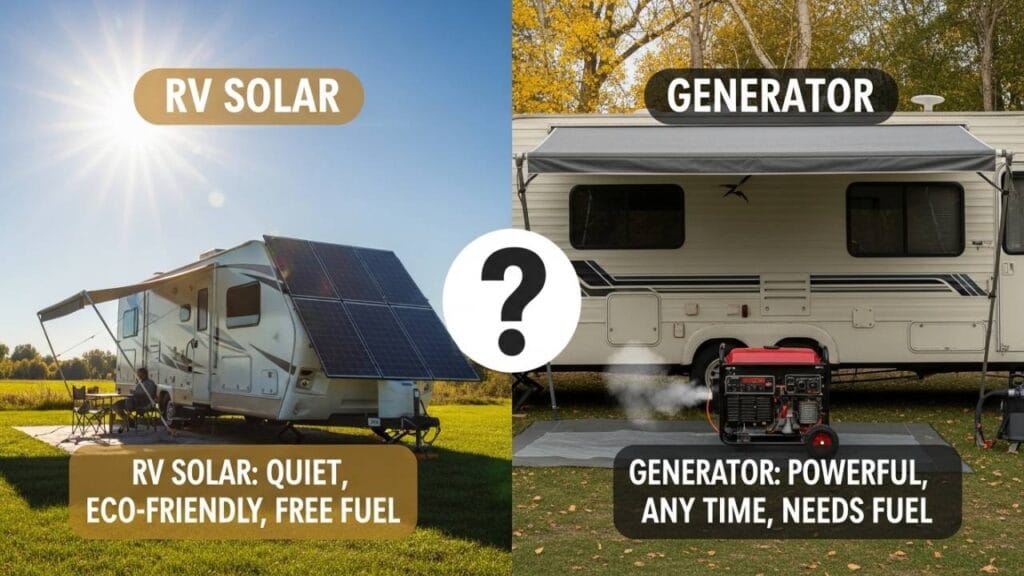
What’s the Difference Between RV Solar and a Generator?
Before comparing them, it helps to understand exactly what each one does.
RV solar works through a system of panels mounted on the roof of your rig (or set up as portables), connected to a charge controller, a battery bank, and an inverter. Sunlight hits the panels, gets converted to electricity, is stored in your batteries, and is then drawn on whenever you need it — day or night.
A generator — whether gas, diesel, or propane-powered — is essentially a small engine that burns fuel and produces electricity on demand. It doesn’t store power. It produces it in real time as long as it has fuel.
Both can power your lights, charge your devices, run your fridge, and keep your coffee maker happy. But the way they do it, and what that costs you over time, is very different.
RV Solar vs Generator — An At-a-Glance Comparison
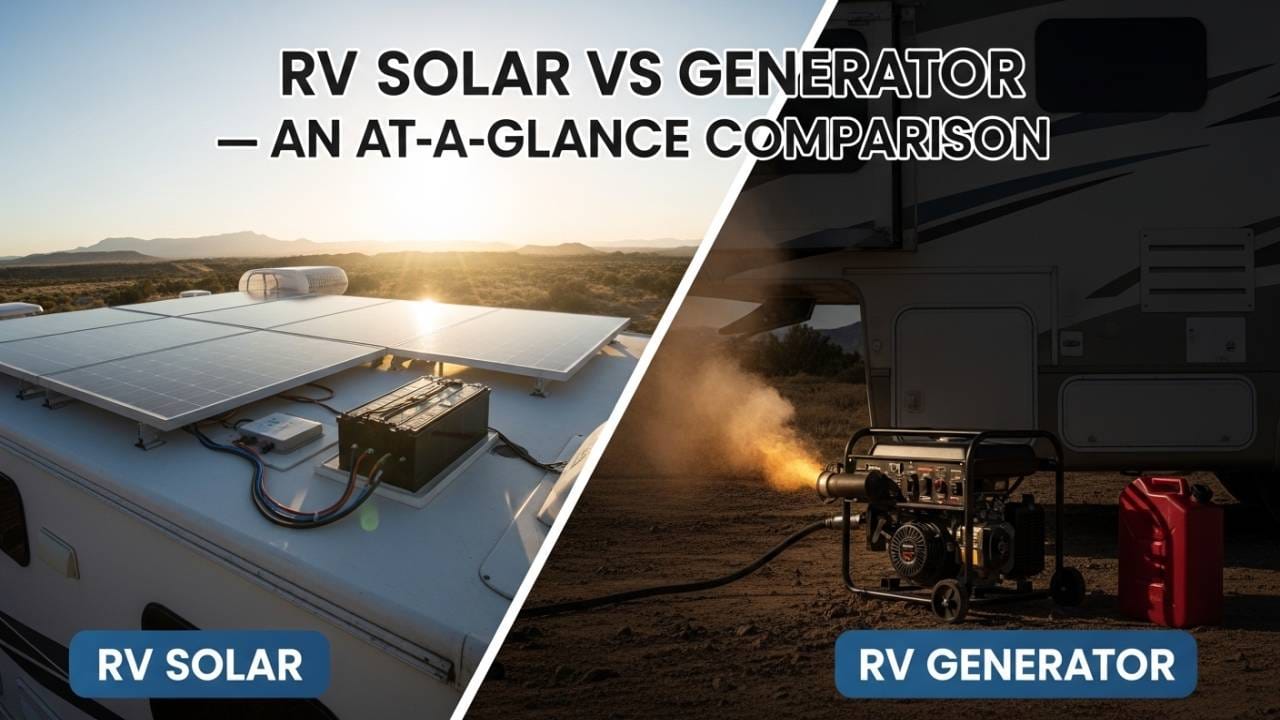
| Feature | RV Solar | Generator |
|---|---|---|
| Upfront Cost | $1,500 – $4,000+ | $500 – $1,500 |
| Ongoing Fuel Cost | $0 (sunlight is free!) | $5 – $15 per day |
| Noise Level | Completely silent | 50–65 decibels |
| Maintenance | Very low (clean panels) | High (oil, filters, spark plugs) |
| Emissions | Zero | CO2 + carbon monoxide |
| Power Output | Dependent on sunlight | Consistent anytime |
| Run Time | All day (sun-dependent) | As long as fuel lasts |
| Best For | Boondocking, full-timers | Backup power, heavy loads |
| Campground Friendly | Always allowed | Restricted hours/dB limits |
| Lifespan | 25–35 years (panels) | 10–15 years with maintenance |
| Break-Even Point | 2–4 years | No break-even (ongoing costs) |
| Ease of Setup | Moderate learning curve | Very easy — pull and go |
| Environmental Impact | Eco-friendly | Polluting |
| Off-Grid Independence | High | Limited by fuel supply |
The Real Cost Comparison: Upfront vs. Long-Term
One of the most Googled questions around this topic is: Is RV solar cheaper than a generator? The answer depends on your time horizon.
Generators win on upfront cost. A reliable portable inverter generator — the kind quiet enough to use at most campgrounds — will set you back anywhere from $500 to $1,500. A built-in coach generator can run $3,000 to $6,000 installed. Either way, you’re up and running relatively quickly.
Solar costs more upfront but pays off faster than most people expect. A basic rooftop solar setup for an RV — say 400 watts of panels, a lithium battery bank, a charge controller, and an inverter — can run $1,500 to $4,000 depending on components. A professional installation can add another $500 to $1,000. That stings initially.
But here’s the thing: once your solar system is installed, your ongoing fuel costs drop to zero. A generator user, by contrast, might burn through $5 to $15 worth of fuel per day during active use. Over a season of boondocking, that adds up fast.
For those who camp frequently — especially full-timers and weekend warriors who go out 20+ times a year — solar typically breaks even within two to four years. After that, it’s essentially free power for the life of the system, which can run 20 to 35 years.
Noise: The Campground Deal-Breaker
Ask any seasoned boondocker what they dislike most about generator camping, and noise will be top of the list.
Even the quietest inverter generators operate at around 50 to 65 decibels. To put that in perspective, a private office is about 50 dB. A normal conversation is around 60 dB. So even the “silent” generators are still making noise — constantly.
Many national parks and campgrounds across the USA cap generator use at 60 dB (measured at 50 feet), and most enforce strict quiet hours — typically 8pm to 8am — during which generators cannot run at all. Some sites enforce rules against sound levels exceeding 60 dB at 50 feet.
Solar is completely silent. There are no moving parts, no engine hum, no exhaust note. You can run your inverter at 2am and no one — not your camping neighbours, not the wildlife, not your sleeping partner — will hear a thing. For many campers, this alone is the deciding factor.
Also Read:- Billings RV Solar Installation: Top 5 Local Shops (2026)
Maintenance: What Each System Actually Demands
Generators require regular maintenance — and if you skip it, they will let you down at the worst possible moment.
A gas generator on a typical maintenance schedule needs oil changes, air filter inspections, spark plug replacements, and fuel filter swaps. If you’re running it hard across a camping season, that might mean servicing it every 50 to 100 hours of use. Propane generators are slightly less demanding but still need attention.
On top of routine care, you also need to think about fuel storage. Many local fire codes in the USA restrict how much petrol you can store in your vehicle. In remote areas, running out of fuel isn’t just inconvenient — it can leave you genuinely stuck.
Solar systems, by contrast, are nearly maintenance-free. There are no moving parts, which means mechanical failures are rare. The main upkeep? Keeping your panels clean and your battery terminals free from corrosion. That’s largely it. Solar systems often use lithium-ion batteries, which have a lifespan of 10–20 years. A specific type, lithium iron phosphate (LiFePO4), can handle over 10,000 charge-discharge cycles, making it a durable choice.
Less maintenance means less money spent over time, and far fewer opportunities for something to go wrong mid-trip.
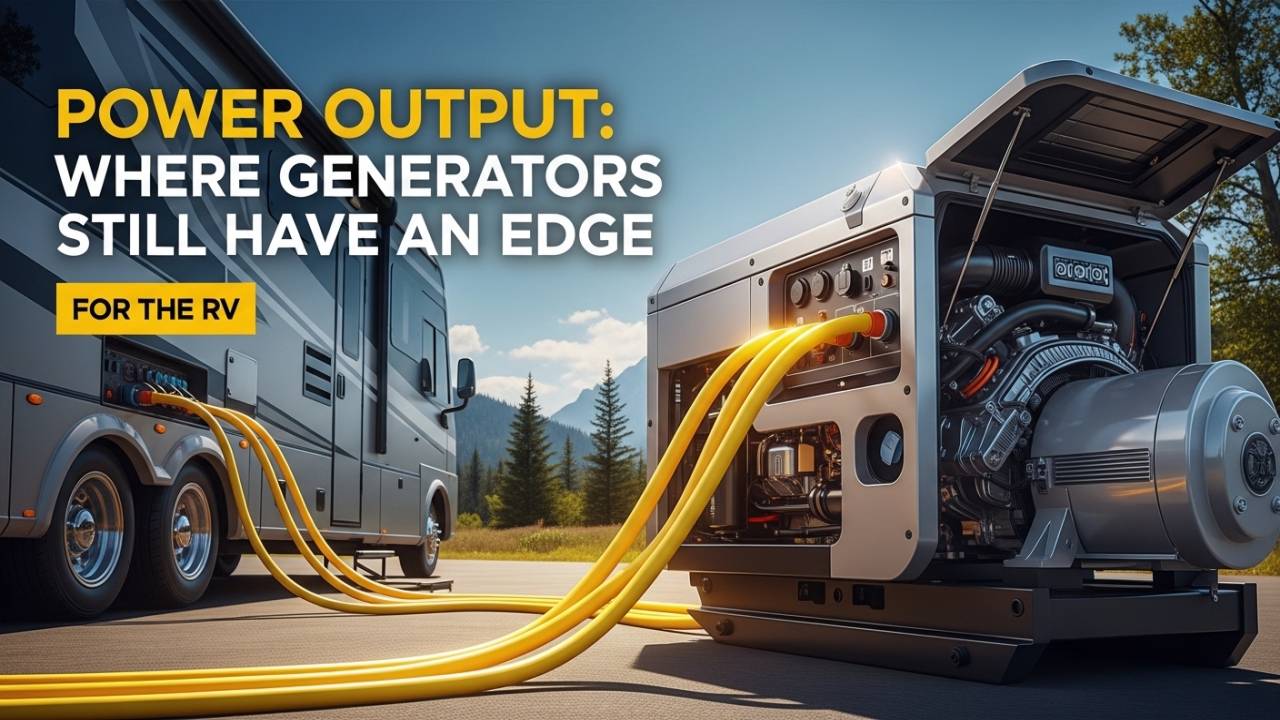
Power Output: Where Generators Still Have an Edge
Here’s where we have to be fair and honest — generators are not without their advantages.
If you need to run a full-size air conditioning unit, a microwave, or a large residential refrigerator at full tilt for hours on end, a generator can do that more easily than a comparably priced solar setup. Generators are a reliable source of power for off-grid camping, as they can deliver electricity consistently, even in less sunny or windy conditions, and can support larger appliances such as air conditioners.
For RVers who camp in shaded forest sites, spend time in cloudy Pacific Northwest conditions, or need to power a three-air-con rig across a blazing Arizona summer, a generator’s raw, consistent output is genuinely hard to match.
That said, solar technology has advanced significantly. A well-designed system with 600 to 1,200 watts of panels paired with a quality lithium battery bank can handle most modern RV loads comfortably — including running an air conditioner for part of the day in sunny conditions.
The key phrase there is sunny conditions. If you’re camping in the shade or under heavy cloud cover, your solar output drops considerably. This is exactly why many experienced RVers use both — solar as the primary system, with a small generator as a backup for cloudy days or high-demand situations.
Also Read:- RV Solar Panel System Cost Breakdown 2026
Environmental Impact: It’s Not Even Close
If environmental impact matters to you — and for a growing number of American campers, it genuinely does — solar wins this category without contest.
A 2 kW diesel generator emits around 2,800 kg of CO2 annually, along with other pollutants. Gas generators also release carbon monoxide, which is not only harmful to the environment but can be dangerous inside or near enclosed spaces.
Solar systems produce zero emissions during operation. Every watt of power they generate comes from the sun — a resource that is, by any reasonable measure, infinitely renewable. For campers who love wild spaces and want to help preserve them, the choice here feels clear.
Setup and Ease of Use
One thing generators undeniably have going for them is simplicity. Pull the cord (or push the button on a modern unit), and you have power. No need to understand battery state-of-charge, wiring diagrams, or inverter settings.
Solar systems do have a bit of a learning curve — particularly when it comes to understanding your battery bank and managing power consumption. First-time solar users often find themselves watching their battery monitor closely, worrying about whether they have enough charge to last through the night.
But once you’ve got a handle on your system’s capacity and your own daily power usage, solar becomes just as automatic. Turn on the inverter, and it works — silently and invisibly, drawing from the energy your panels collected during the day.
Portable solar generators — standalone units that combine panels, a battery, and an inverter in one package — are even simpler. Products like the EcoFlow DELTA Pro and the Jackery Solar Generator 3000 Pro are essentially plug-and-play, requiring no installation whatsoever. You unfold the panels, point them at the sun, and you’re done.
Boondocking and Off-Grid Camping: Solar’s Time to Shine
If you’re a boondocker — someone who camps on public lands, in the middle of nowhere, far from hookups — solar is probably your best friend.
When you’re parked in a remote spot for days at a time, you don’t want to worry about running out of diesel or petrol. You don’t want to be that person driving 40 miles to the nearest town for a jerry can of fuel. And you certainly don’t want to be banned from your favourite dispersed camping spot because your generator was too loud.
Solar gives you genuine independence. As long as the sun rises — and in most of the American West, it does so reliably and generously — you have power. Unlimited, free, quiet power.
This is why rooftop RV solar has become almost standard on new rigs, and why more and more full-time RVers are upgrading their systems every year.
Also Read:- How Many Solar Panels Does an RV Need?
Which Camping Situations Favour Each Option?
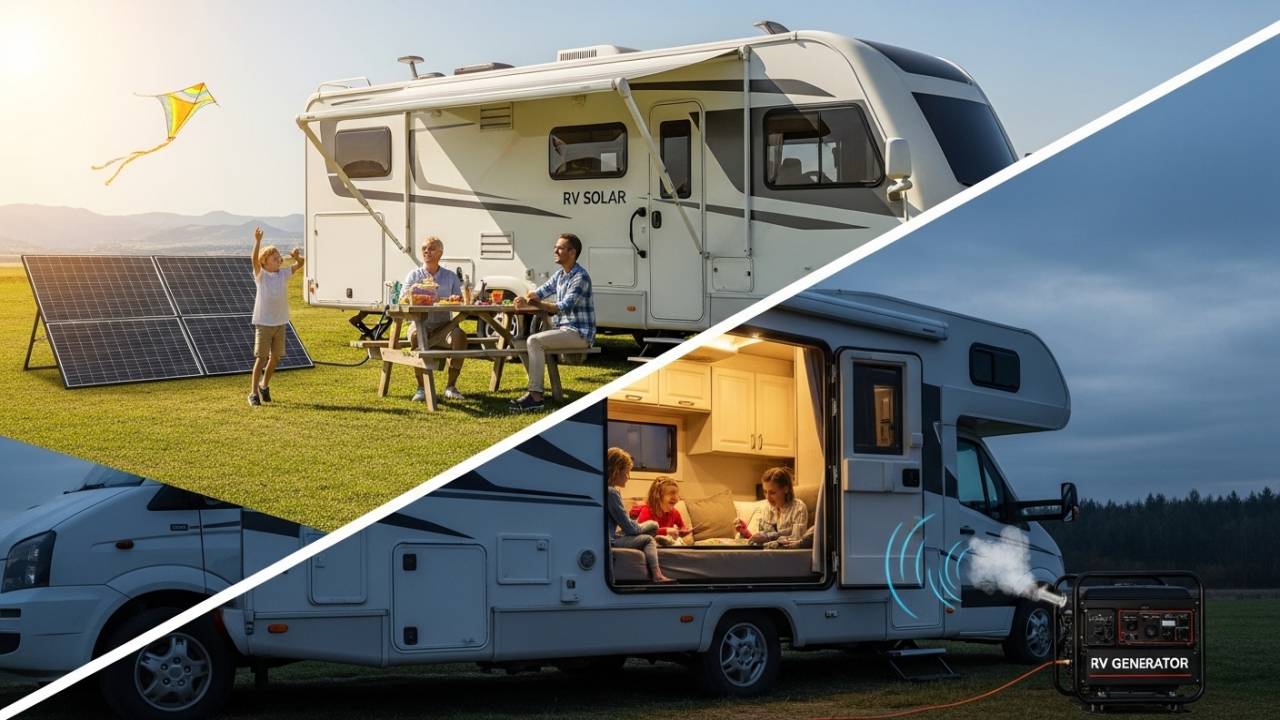
RV Solar is better for:
- Boondocking and dispersed camping on BLM or forest service land
- Long-term or full-time RV living
- Camping in the desert Southwest, Rocky Mountain region, or anywhere with reliable sunshine
- Campers who prioritise silence, sustainability, and low maintenance
- Anyone planning to keep their RV for several years
A Generator is better for:
- Camping in heavily shaded or wooded areas
- Short camping trips where upfront investment doesn’t make financial sense
- Running very high-demand appliances like multiple ACs in extreme heat
- Campers in the Pacific Northwest or other cloudy regions who need guaranteed power
- Emergency backup situations
Using both together is best for:
- Full-timers who need reliability in all weather conditions
- Campers who run power-hungry appliances but still want quiet evenings
- Anyone building a serious off-grid setup and wanting a safety net
The Verdict: Which Is Actually Better?
For the majority of American campers in 2025, RV solar is the better long-term choice. It’s quieter, cleaner, cheaper over time, and requires far less ongoing effort. The upfront investment is higher, but for anyone who camps more than a handful of times a year, the maths works out in solar’s favour within a few seasons.
Generators still have a place — particularly as backups, in low-sunlight environments, or for very high power demands. But the days of the gas generator being the default RV power source are genuinely numbered.
If you’re just starting out and not ready to invest in a full solar system, a quality portable solar generator is an excellent middle ground. It gives you the freedom and silence of solar without the commitment of a permanent installation.
And if you already have a generator? Consider adding even a small solar setup alongside it. Many experienced RVers say the combination — solar for everyday use, generator for emergencies — is the sweet spot that offers the best of both worlds.
Also Read:- RV Solar Setup for Yellowstone: Complete Wyoming Camping Guide
Quick FAQ: RV Solar vs Generator for Camping
Can RV solar run an air conditioner? Yes, but you need a sufficiently sized system — typically 600W of panels or more, combined with a quality lithium battery bank. In full sun, a modern solar setup can run a small RV AC unit for several hours.
How long do RV solar panels last? Quality solar panels can last 25 to 35 years. Lithium iron phosphate (LiFePO4) batteries, the preferred choice for RV solar, can handle thousands of charge cycles over 10 to 20 years of use.
Are generators allowed at campgrounds? Most campgrounds in the USA allow generators but restrict their hours (typically 8am–8pm) and decibel levels. Many national parks and dispersed camping sites enforce stricter rules. Always check in advance.
Is RV solar worth it for occasional campers? If you camp fewer than five or six times a year, the financial case for solar is weaker. A portable solar generator is a more flexible option for occasional campers who still want clean, quiet power.
What’s the best solar generator for RV camping? The EcoFlow DELTA Pro and Jackery Solar Generator 3000 Pro are two of the most highly rated options for RV use in the USA, offering high wattage output and expandable battery capacity.