Few destinations in the American West carry the cachet of Jackson Hole. Nestled at 6,200 feet in the shadow of the Teton Range, this high-altitude valley has long attracted discerning travelers who demand both adventure and refinement. As the primary gateway to Grand Teton National Park and a short drive from Yellowstone, Jackson serves as a basecamp for some of the most spectacular outdoor exploration in North America. The town square, famous for its elk-antler arches, is surrounded by world-class ski resorts, Michelin-caliber dining, and galleries that would hold their own in Manhattan. This is not your average RV stopover.
For RV travelers making their way through this storied landscape, reliable off-grid power is not a luxury—it is a necessity. Whether you are boondocking in the Bridger-Teton National Forest, staging for a multi-day backcountry expedition, or simply seeking a campsite with views of the Cathedral Group peaks, rv solar jackson hole solutions provide the energy independence that discerning adventurers expect. But setting up solar at elevation in Wyoming presents unique challenges that flat-land systems simply were not designed to handle.
This guide is written for the Jackson Hole traveler who understands that premium equipment and expert installation are investments, not extravagances. You will find panel recommendations engineered for mountain performance, insights into local installation services, and practical strategies for maximizing your solar output across every season in one of the most demanding —and rewarding—environments in the country.
Mountain Weather: Understanding Jackson’s Extreme Climate

Jackson Hole’s climate is nothing short of dramatic. Sitting at 6,200 feet above sea level, the valley experiences weather patterns that would humble solar systems optimized for warmer, lower-elevation environments. Understanding these conditions is the first step toward building an rv solar jackson hole setup that performs reliably year-round.
Also Read:- RV Solar System Setup Complete Beginner’s Guide (2026)
Winter: The Defining Challenge
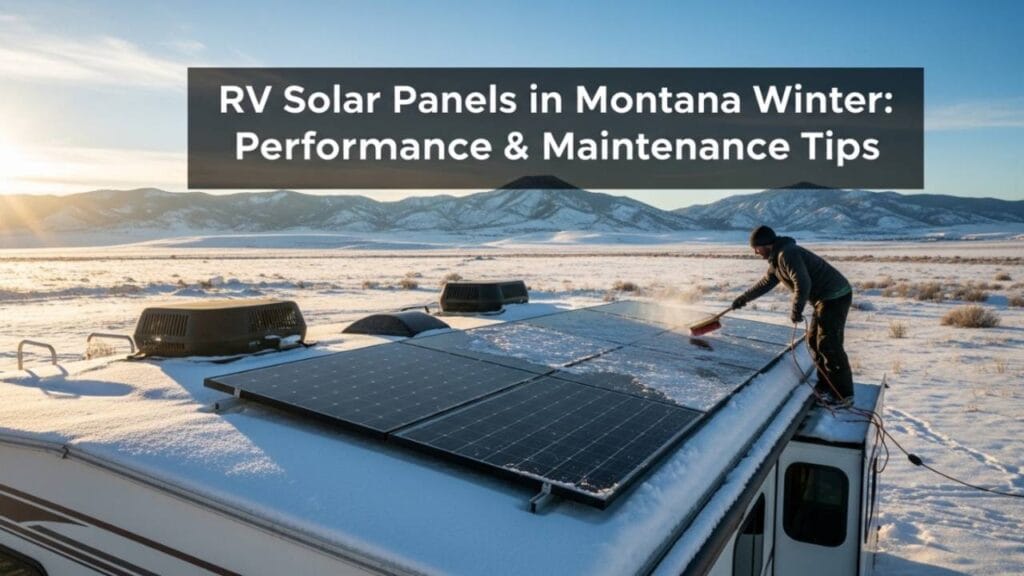
Jackson winters are genuinely severe. Temperatures regularly plunge to -20°F, and extended cold snaps are common from November through March. Deep snowfall—the valley averages over 400 inches annually at higher elevations—creates real solar panel management challenges. Snow accumulation on panel surfaces can eliminate production entirely for days at a time. For winter RV travelers, this means prioritizing panels with steep tilt capability, anti-soiling glass coatings, and robust battery storage to
bridge multi-day low-production periods. Cold temperatures actually boost panel efficiency—photovoltaic cells perform better in cold conditions—but the short daylight hours and frequent cloud cover partially offset this advantage.
Summer: Afternoon Thunderstorms and Intense Solar Radiation
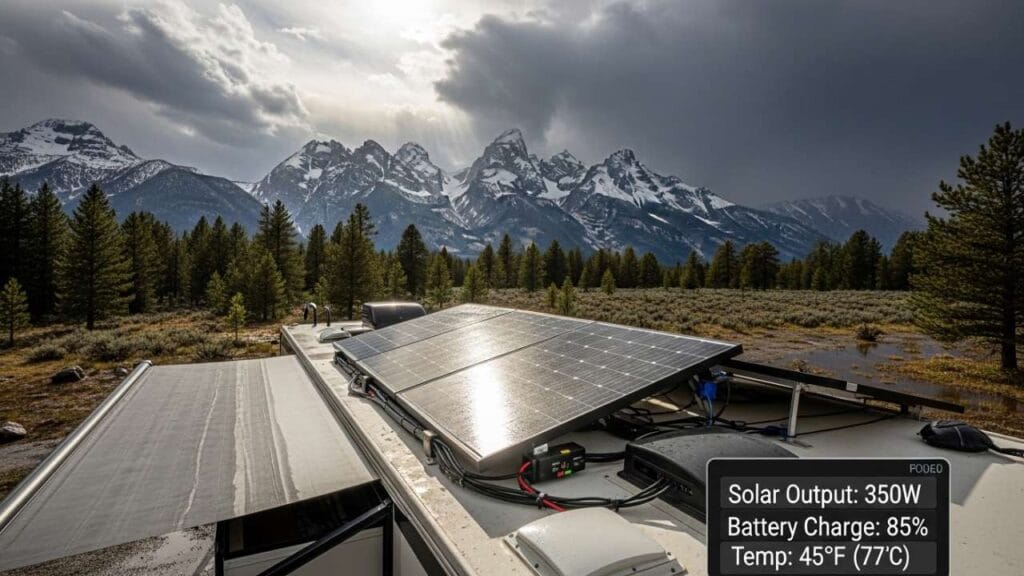
Summers in Jackson are mild and glorious, with daytime temperatures typically ranging from the mid-60s to low 80s°F. The elevation keeps things comfortable even during the warmest months, and those mild temperatures contribute to excellent panel efficiency. However, summer afternoons in the Tetons come with a near-daily ritual: towering cumulonimbus clouds build over the mountains and sweep through the valley with lightning, hail, and heavy rain. These storms typically arrive between 2:00 and 5:00 PM, which means your peak solar production window runs from morning through early afternoon. Experienced Jackson Hole solar users plan their energy-intensive tasks—charging devices, running appliances, topping off battery banks—before the afternoon storm window begins. High-quality panels with IEC-certified hail resistance are strongly recommended for this environment.
Elevation Advantage: More Sun Per Square Inch
At 6,200 feet, the atmosphere above Jackson is measurably thinner than at sea level. This means less air mass for sunlight to penetrate, resulting in solar irradiance approximately 5-8% higher than at equivalent latitudes at sea level. This elevation bonus meaningfully improves rv solar jackson hole performance, partially compensating for the shorter solar days in shoulder seasons. Panels rated at a given wattage will typically outperform their specs in Jackson’s high-altitude environment, provided they are properly installed and maintained. Spring and fall offer perhaps the best solar conditions of all—clear skies, cool temperatures, and extended daylight without summer’s afternoon storm interruptions.
Also Read:- Cheyenne RV Solar Installers: Top 5 Shops Reviewed (2026)
Best RV Solar Panels for Jackson Hole Conditions
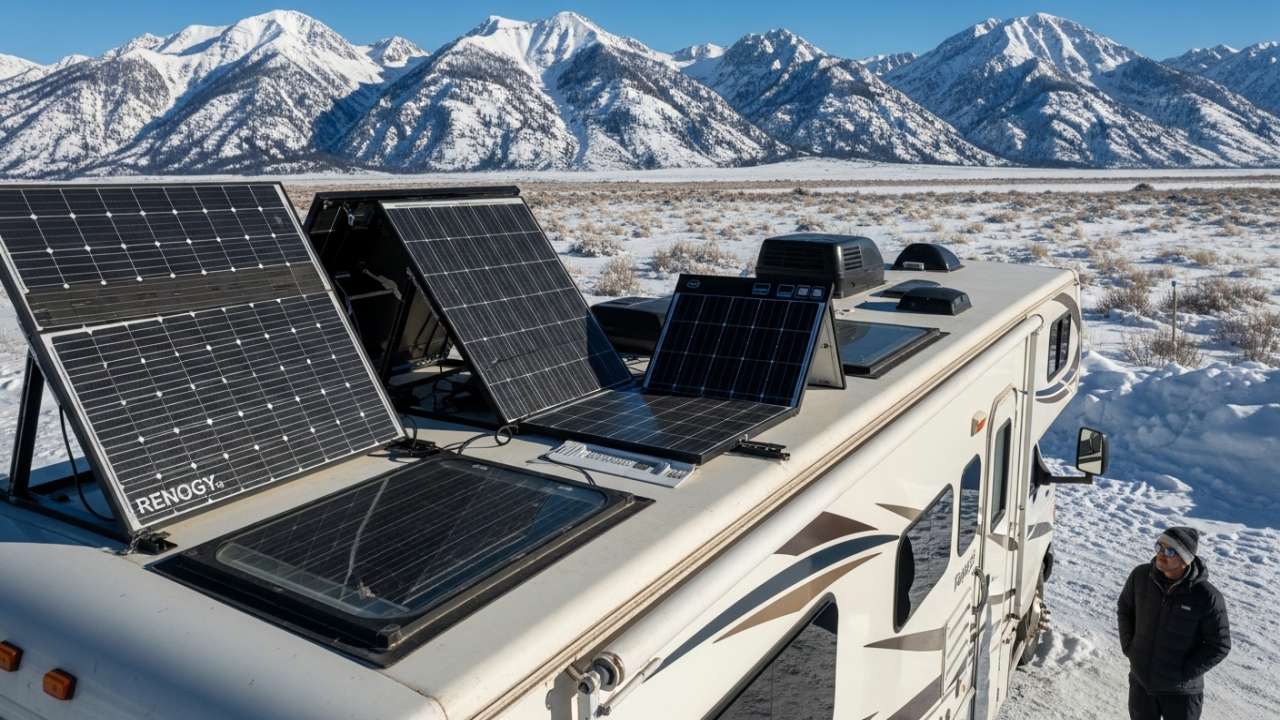
Not every panel on the market is built for the Tetons. The following five products represent the top tier of performance for high-altitude mountain environments, combining durability, cold-weather resilience, and output that justifies the investment level that Jackson Hole travelers expect.
1. SunPower Maxeon 6 Series (400W)
SunPower’s Maxeon cell technology represents the pinnacle of residential and RV solar engineering. The Maxeon 6 delivers a 22.8% efficiency rating—among the highest available for any panel in its form factor—which matters enormously when roof space is limited. The cell architecture is fundamentally different from conventional panels, using a copper foundation instead of traditional silicon wafer construction. This makes the cells extraordinarily resistant to the micro-cracking that freeze-thaw cycles cause at elevation. In Jackson’s brutal winters, where temperature swings of 50°F in a single day are possible, this structural resilience translates directly to longevity. SunPower panels carry a 40-year performance warranty, reflecting genuine confidence in mountain durability. Premium pricing places these at the top of the market, but for rv solar jackson hole installations where reliability is non-negotiable, the Maxeon 6 is the professional installer’s first recommendation.
2. Renogy 200W Rigid Monocrystalline (Bifacial Edition)
Renogy’s bifacial monocrystalline panels offer an intelligent solution for Jackson’s high-albedo environment. Bifacial technology captures light reflected from below—snow-covered ground, pale granite, and reflective surfaces—converting what would otherwise be wasted energy into usable power. In winter conditions with snow on the ground, bifacial panels can produce 10-30% more than their monofacial counterparts. The Renogy 200W rigid model is built on a high-transmission tempered glass face rated to IEC 61215 standards, providing meaningful hail resistance for afternoon thunderstorm exposure. The anodized aluminum frame handles thermal expansion gracefully across Wyoming’s extreme temperature range. For RV owners who spend significant time parked on reflective surfaces—sandy campgrounds, snow-covered pull-offs—this panel’s dual-sided capture capability provides a genuine production edge that monocrystalline competitors cannot match.
3. Victron Energy SmartSolar Series (175W Lightweight)
Victron Energy has built a devoted following among serious off-grid travelers, and their SmartSolar panel series demonstrates why. The 175W lightweight model pairs exceptionally well with Victron’s MPPT charge controllers, creating an integrated ecosystem with Bluetooth monitoring through the VictronConnect app. For Jackson Hole users navigating the complex variables of mountain weather—rapidly changing cloud cover, afternoon storm interruptions, temperature-driven efficiency swings—real-time production data is invaluable. The SmartSolar panels use PERC cell technology that performs measurably better than standard monocrystalline in low-light and diffuse light conditions, exactly the conditions that prevail under Jackson’s building storm clouds. The panel’s 25-year performance guarantee and Victron’s legendary build quality make this an rv solar jackson hole workhorse that will outlast the RV itself. The lightweight construction is particularly appreciated by weight-conscious van and Class B owners.
4. Goal Zero Boulder 200 Briefcase (Portable Edition)
Goal Zero’s Boulder 200 Briefcase addresses a specific Jackson Hole reality: not every campsite offers ideal roof-mount angles, and in a landscape where shade from canyon walls and dense conifer forest is common, portable panel positioning is a genuine advantage. The Boulder 200 folds to a manageable carry size and deploys in seconds, allowing users to position panels precisely in the optimal sun window throughout the day. For Grand Teton National Park camping, where permanent roof-mount systems can attract unwanted attention and rules around panel installation vary by campground, the portable format offers flexibility that fixed systems cannot. The monocrystalline cells deliver 200W of peak output with an integrated kick-stand that adjusts tilt from flat to near-vertical—useful for shedding snow in winter. Goal Zero’s build quality has earned trust among Jackson’s outdoor professional community, and the panels pair natively with Goal Zero’s Yeti power station ecosystem.
5. Solaria PowerXT 430R-PD (High-Output Premium)
Solaria’s PowerXT series brings utility-scale solar technology down to the RV format, making it particularly compelling for the high-end Jackson market. The 430R-PD uses a proprietary cell-overlapping design that eliminates the gaps between cells, maximizing active surface area and achieving a 21.2% module efficiency that rivals SunPower at a slightly lower price point. The design also significantly improves shade tolerance—critical in Jackson’s forested camping environments where partial shading from trees or canyon walls is routine. The frame is built to withstand 5,400 Pa mechanical load, well above the standards required even for heavy Wyoming snowfall. For RV owners investing in full-roof build-outs, the PowerXT’s 430W output means fewer panels are needed to hit target system capacity, simplifying wiring and reducing roof penetration points. This is the rv solar jackson hole choice for high-output systems where every square inch of roof space must produce maximum return.
Also Read:- RV Solar vs Generator — Which Is Better for Camping?
Installation Options in the Jackson Area
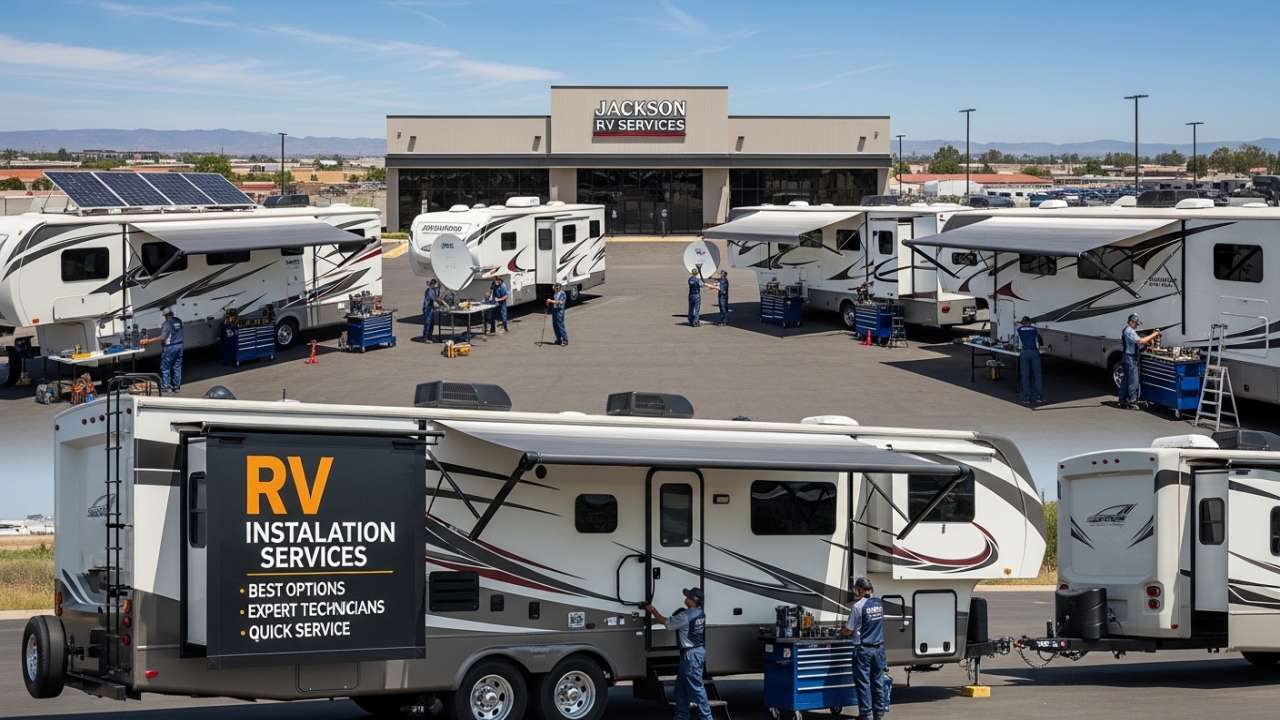
Installing rv solar jackson hole comes with a well-known caveat: everything in Jackson costs more. Labor rates reflect the cost of living in one of the most expensive small towns in the United States. You can reasonably expect installation to run 20-30% higher than comparable work in Cheyenne or Casper. For a complete rooftop system with quality components, budget accordingly and view it as the premium that comes with working in one of the most spectacular landscapes on earth.
Local Specialty Shops
Jackson and the surrounding communities of Wilson and Teton Village support a small but capable ecosystem of RV service providers, several of whom have developed solar specializations to serve the affluent RV traveler market. Local shops offer the significant advantage of familiarity with mountain-specific installation considerations: proper wire management for thermal expansion, tilt mount configurations that shed snow, and battery system sizing calibrated to Jackson’s actual solar irradiance data. When vetting local installers, ask specifically about experience with cold-weather battery management and MPPT controller programming for high-altitude environments. Quality local shops will readily discuss these details and welcome the conversation—it signals a client who values quality over price.
Mobile Installation Services
A growing number of mobile solar installation services operate throughout the Teton region, traveling to campgrounds, trailhead parking areas, and private properties to perform work on-site. This model is particularly well-suited to Jackson Hole, where travelers may be camped at a dispersed site in the Bridger-Teton National Forest or staged at a campground without easy access to traditional shop facilities. Mobile services typically carry a curated inventory of panels, charge controllers, and wiring components, allowing same-day or next-day completion of straightforward installations. The premium for mobile service is typically an additional 10-15% above shop rates, but the convenience factor in Jackson’s environment often makes it the practical choice. Booking ahead is strongly recommended during peak summer season, when demand from arriving RVers can push wait times to several days.
DIY Considerations at Elevation
Experienced RV owners comfortable with 12V electrical work can certainly tackle rv solar jackson hole installations themselves. However, Jackson’s environment creates specific DIY challenges worth acknowledging. Roof work at 6,200 feet elevation can be physically taxing, particularly during the summer heat of midday. Sealant performance is different at altitude and in extreme cold; standard lap sealants may not perform as intended, and roof penetrations must be approached with extra care given the valley’s significant snowfall and temperature cycling. For DIY installations, consider purchasing components from local suppliers rather than shipping, as this gives you access to local expertise and warranty support if issues arise.
Also Read:- RV Solar Setup for Yellowstone: Complete Wyoming Camping Guide
Grand Teton National Park: Camping with Solar Power
Grand Teton National Park offers some of the most scenically dramatic camping in the United States, and it draws correspondingly discerning visitors. For RV travelers, the park presents a mix of developed and primitive options, each with its own implications for solar power management.
Colter Bay Village, the park’s largest RV campground, offers electrical hookups at many sites, which can be used to supplement or recharge lithium battery banks during extended cloudy periods. Signal Mountain Campground sits on the shores of Jackson Lake with stunning Teton views, but its heavily forested character means partial shading is common. Here, portable panels that can be positioned in the open sky windows between trees pay meaningful dividends over fixed-mount systems pointed at a shaded roof plane.
Understanding your power needs before entering the park is essential. A typical RV running LED lighting, a residential refrigerator, phone and device charging, and a CPAP machine overnight will consume approximately 80-150 amp-hours per day. In peak summer conditions, a well-configured 400-600W solar system with a 200Ah lithium battery bank should comfortably meet these needs, with surplus available for morning coffee and electronics. For travelers running air conditioning or electric cooking appliances, battery capacity of 400Ah or more combined with 800W+ of panel output becomes necessary to maintain comfortable off-grid operation in the park’s variable weather.
Also Read:- How Many Solar Panels Does an RV Need?
Jackson Area Boondocking: National Forest Freedom
The Bridger-Teton National Forest, which wraps around Jackson Hole on three sides, contains millions of acres of dispersed camping opportunity. For RV travelers with capable rv solar jackson hole systems, these sites represent the ultimate expression of off-grid adventure within minutes of world-class amenities. Forest Road 30340 east of the valley, Teton Pass Road dispersed areas, and the Snake River corridor all offer accessible boondocking with spectacular scenery.
Boondocking in the Bridger-Teton requires self-sufficient power management at a higher standard than developed campgrounds. No hookups, no generators in designated quiet-hours areas, and no reliable cell service for weather forecasting in some zones. Experienced boondockers in this area size their systems conservatively—plan for 3-4 days of autonomy without solar input rather than the 1-2 day buffer that suffices in lower-risk environments. This typically means 400Ah+ of lithium battery capacity paired with 600-800W of high-efficiency panel output.
The Greys River Road corridor south of Jackson in the Bridger-Teton is a particular favorite among experienced boondockers, offering miles of dispersed sites along a pristine river drainage. Sites here tend to be more open and sun-exposed than heavily forested canyon alternatives, making them better solar producers. Elevation on many dispersed sites runs 7,000-8,000 feet, further boosting the irradiance advantage that already benefits rv solar jackson hole users in the valley itself. Always check forest road conditions before committing to dispersed sites; spring and late-fall conditions can make many roads impassable to low-clearance rigs.
Also Read:- RV Solar Panel System Cost Breakdown 2026
Frequently Asked Questions
How does Jackson Hole’s elevation affect solar panel output?
At 6,200 feet, the atmosphere is approximately 20% less dense than at sea level, which means sunlight travels through less air before reaching your panels. The practical result is roughly 5-8% higher solar irradiance compared to the same latitude at sea level. Additionally, the cooler average temperatures improve photovoltaic efficiency—panels produce more power per watt of sunlight in cool conditions than in heat. Combined, Jackson Hole’s rv solar jackson hole environment typically delivers measurably better panel performance than the manufacturer’s sea-level specifications suggest, particularly in spring and fall when conditions are ideal.
What type of battery works best for Jackson’s cold winters?
Lithium iron phosphate (LiFePO4) batteries are the professional recommendation for Jackson’s extreme winter environment. Unlike lead-acid batteries, which lose substantial capacity and can be permanently damaged when discharged in sub-zero temperatures, LiFePO4 chemistry handles cold significantly better. That said, even lithium batteries will not accept charging below freezing without a built-in Battery Management System (BMS) that includes a low-temperature charge cutoff. Premium lithium batteries from Battle Born, Renogy, or Victron include this protection. For -20°F winters, a battery heating blanket or insulated battery bay should be considered for any RV spending extended time in Jackson during cold months.
How much does a complete RV solar installation cost in Jackson?
Expect to invest significantly more in Jackson than in most other parts of Wyoming. A mid-range system—400W of quality monocrystalline panels, a 40A MPPT charge controller, 200Ah of lithium battery capacity, and professional installation—typically runs $4,500-$7,000 in the Jackson market versus $3,500-$5,500 in Cheyenne for comparable work. Premium builds with 800W+ of SunPower or Solaria panels, 400Ah lithium banks, and premium Victron or Schneider inverter-chargers can reach $15,000-$25,000 installed. Jackson’s labor rates run 20-30% above the Wyoming average, reflecting the high cost of living in the valley. View this premium as part of the Jackson Hole experience—the quality of work available here is commensurate with the pricing.
Are generators allowed in Bridger-Teton dispersed camping areas?
Bridger-Teton National Forest dispersed camping areas generally allow generator use, but there are no specific forest-wide quiet hours mandated at dispersed sites. However, Leave No Trace principles and strong community norms in Jackson Hole create significant social pressure against extended generator use in quiet natural settings. Most experienced boondockers in the area run generators sparingly and only during midday hours if needed. This is one of the strongest arguments for a robust rv solar jackson hole system—a well-designed setup eliminates the need for generators entirely in summer conditions, preserving the wilderness experience and respecting fellow campers. Always check current forest regulations before your visit, as fire restrictions can sometimes affect generator use.
Can I get same-day solar installation if I arrive in Jackson without a system?
Same-day installation for a basic portable system is usually achievable, but a complete rooftop build-out will typically require advance scheduling. Jackson’s peak tourist season from late June through early September is particularly busy, and quality installers can be booked a week or more in advance. For travelers planning to spend significant time in the area, reaching out to local rv solar jackson hole providers two to three weeks before arrival is strongly recommended. If you arrive without a system and need immediate power, Goal Zero and Jackery portable power stations are available at local outdoor retailers and can bridge the gap while a proper installation is scheduled. Several local shops also rent solar equipment on a daily or weekly basis, offering another option for shorter visits.
Conclusion: Premium Investment, World-Class Returns
Jackson Hole makes no apologies for its prices, and neither should you for the investment in quality rv solar jackson hole equipment and installation. The area demands excellence—from the travelers who visit it, from the businesses that serve them, and from the technology that powers their adventures. A properly designed, expertly installed solar system in this environment will reward that investment with years of reliable off-grid performance across one of the most spectacular landscapes in North America.
The key principles for rv solar jackson hole success are consistent: invest in panels rated for mountain weather and temperature extremes, pair them with lithium chemistry batteries that handle cold properly, work with installers who understand high-altitude system design, and size your system generously to accommodate the inevitable multi-day weather events that interrupt solar production. Budget for 20-30% above what you might pay in lower-elevation Wyoming markets, and view that premium as the cost of access to one of the finest outdoor recreation destinations on the planet.
From boondocking beneath the Cathedral Group peaks in the Bridger-Teton to staging for a Grand Teton climbing expedition at a lakeside National Park campground, the freedom that solar power provides transforms the Jackson Hole experience. The Tetons do not wait for perfect conditions, and neither should your power supply. A world-class system in one of the world’s great destinations is not just appropriate—it is essential.