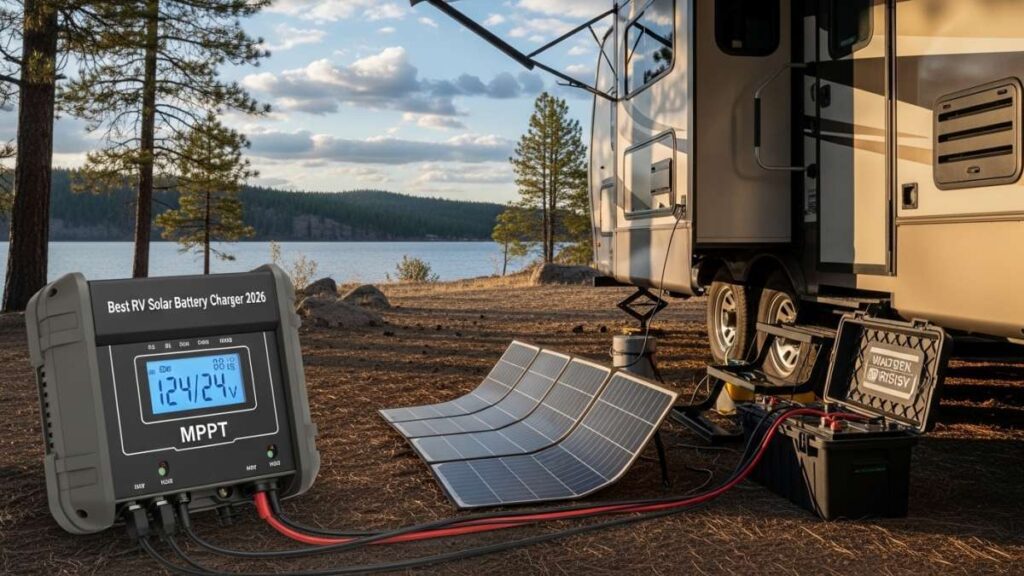
Your RV’s been sitting in storage for three months. You’re excited to finally take it out. You arrive at the storage lot, climb in, turn the key… and nothing happens—dead battery.
This happens to way too many RV owners. You’re not careless. You just forgot about one thing—or didn’t know you needed to do something in the first place. But here’s the thing: it’s completely preventable. A solar battery charger is honestly one of the best $100 you’ll spend on your RV.
I’m gonna walk you through exactly what these things do, why you actually need one, and how to pick the right one for your setup. Whether you’ve got a standard 12V system or a bigger 24V RV, we’ll cover what works best for you.
Why Your RV Battery Dies When Sitting
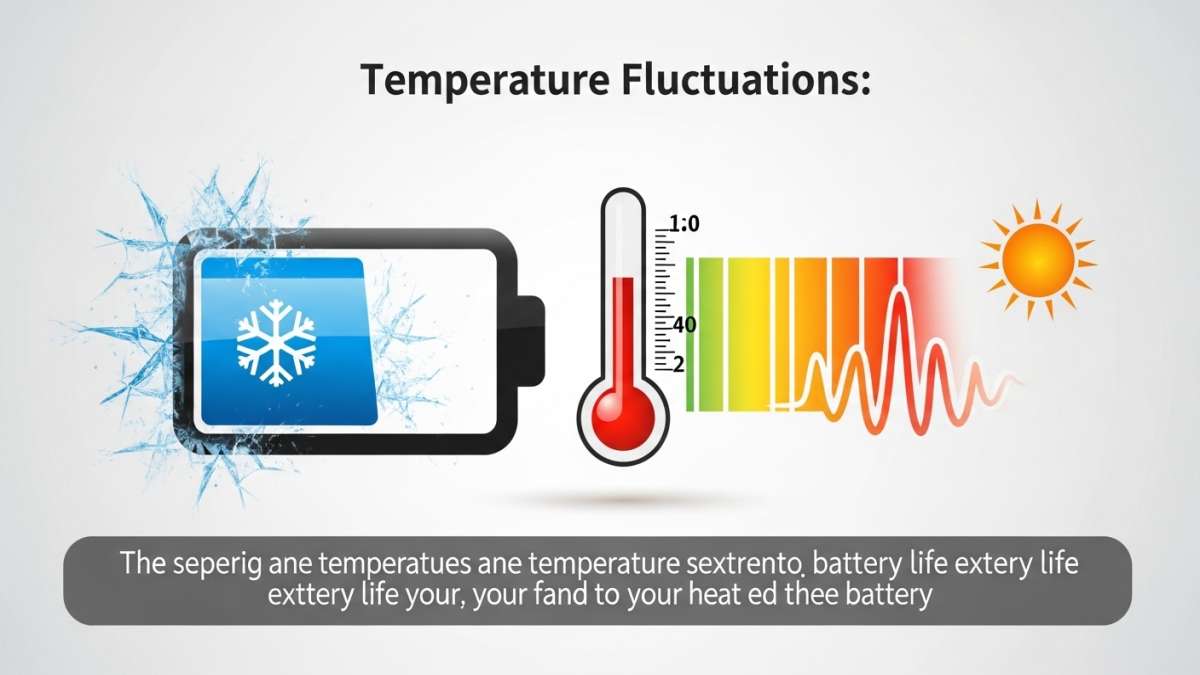
So your battery is losing power even though you’re not using anything. Seems weird, right? But it’s totally normal—and there are two reasons why it happens.
First, your battery naturally discharges. You lose about 0.5% to 2% of charge every day, just sitting there doing nothing. Over 30 days, that adds up to losing 15-60% of your total charge. Come back after three months? Your battery might be completely dead.
The second reason is sneakier. Your RV keeps drawing power even when you think it’s off. That propane detector? Running. Your fridge control board? Running. Your stereo memory? Running. Your LED lights? All running. These tiny power drains add up super fast and are called parasitic draws.
Now here’s the thing: if you flip your battery kill switch, you stop most of that parasitic drain. But natural discharge still happens. Your battery slowly loses power day after day, and after a few months, it’s gone.
This is where a solar charger comes in. It keeps topping off your battery the entire time you’re in storage. No outlets needed. No complicated setup. Just sunlight doing the work.
Also Read:- Rapid City RV Solar: The Complete Black Hills Installation Blueprint for Off-Grid Freedom
What Makes a Good RV Solar Charger (And Why Cheap Ones Suck)
Not every solar charger you find online is actually good. The difference comes down to what’s inside.
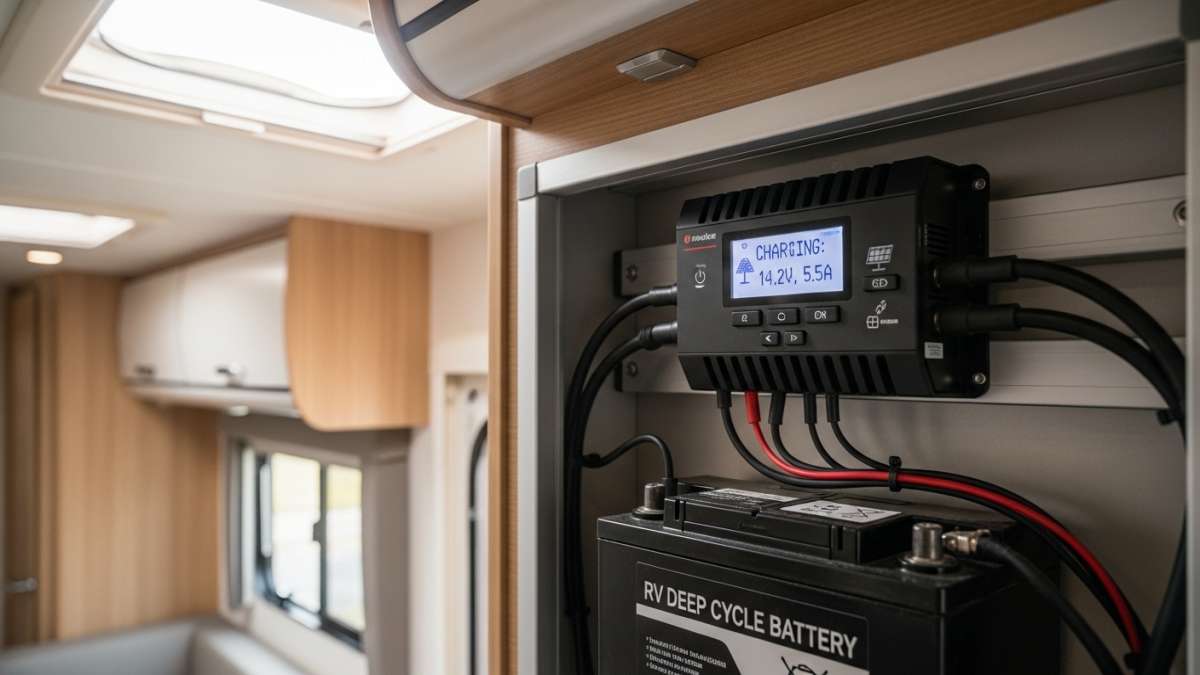
The Charge Controller Is the Key Part
You might think it’s just the solar panel that matters, but the real star is the charge controller. This little device sits between the panel and your battery and decides how much power actually goes in.
A decent charge controller does three important things:
It changes the power based on sunlight. If it’s cloudy, it doesn’t send the same power as when the sun is blasting. Your battery gets steady, consistent charging.
It keeps your battery at the right voltage. For a 12V system, that’s around 13.2 to 13.8 volts. Not higher, not lower—just right. This is called float voltage, and it’s the sweet spot where your battery stays charged but doesn’t get damaged.
It stops power from flowing backward at night. When the sun goes down, a good controller has a diode that prevents your battery from draining back through the panel. Cheap chargers don’t have this, and people complain that their solar chargers actually drained their batteries. That’s why.
It Needs to Survive Outside
Your RV’s probably stored outside in rain, snow, and heat. The charger needs to handle all that. Good ones use tempered glass on the panel, aluminum frames, and real seals. Cheap ones are just flimsy plastic that cracks in winter.
The Right Size for Storage
Here’s where people mess up. They think bigger is always better. But for storage, you don’t want a huge 100W system. That’s overkill and costs way too much.
For keeping your battery healthy while in storage, you want 10-30W. That’s enough to replace the power your battery loses naturally and from parasitic draw. You’re not trying to charge a dead battery—you’re maintaining a healthy one.
Also Read:- Your RV Slide Out Stuck or Not Working? The Complete Repair & Prevention Guide
How These Things Actually Work (Keep It Simple)
Here’s the process, and it’s pretty straightforward:
Sunlight hits the panel and creates electricity. The charge controller takes that power and regulates it so your battery gets the right amount—not too much, not too little. Your battery charges up. Once it’s full, the controller switches to maintenance mode and just trickles in tiny bits of power to keep it topped off. At night or on cloudy days, the controller blocks power from flowing backward and draining your battery.
That’s it. It’s a simple cycle that repeats every day automatically. No plugs to mess with. No charger to remember. Just set it and forget it.
The best part? It works completely off-grid. No AC outlet needed. No shore power. Just sunlight.
RV Solar Battery Charger Comparison: Finding the Right Solution
Not every RV solar charger is right for every situation. Here’s how to think about your options:
| Feature | Trickle Chargers (10-20W) | Mid-Range Chargers (20-50W) | Full Systems (100W+) |
|---|---|---|---|
| Best For | Long-term storage (3+ months) | Seasonal storage + light camping | Full-time off-grid living |
| Installation | Suction cups on windshield or rooftop | Rooftop mount or portable stand | Permanent roof installation |
| Power Output | 10-20 watts | 20-50 watts | 100-400+ watts |
| Average Cost | $50-120 | $150-300 | $500-2,000+ |
| Battery Maintenance | Excellent—built for this | Very good | Excellent but overkill for storage |
| Setup Complexity | 5 minutes | 30-60 minutes | 2-4 hours |
| Portability | Highly portable | Somewhat portable | Permanent installation |
| Required Equipment | Panel + Controller | Panel + Controller | Panel + Controller + Batteries + Inverter |
For most RV owners storing their rig between trips, a 15-20W trickle charger is the sweet spot. It’s affordable, requires minimal installation, and does exactly what you need: prevents a dead battery.
Also Read:- Why Is My RV Engine Overheating? Solutions & Prevention Tips
12V vs 24V Solar Battery Chargers (Which Do You Need?)
Here’s where people get confused. The voltage of your charger needs to match your battery system.
Most RVs run 12V systems. That’s the standard. Your battery, your lights, your water pump—all 12V. If you’re not sure, pop open your battery compartment and look at the terminals. It’ll say 12V right on the battery.
Some bigger RVs, especially Class A motorhomes, have 24V systems. This is two batteries wired in series. If your RV is massive and you have tons of power demands, you might have 24V.
Here’s the rule: your solar charger needs to match your battery voltage. A 12V charger on a 24V system won’t charge it properly. A 24V charger on a 12V system will fry your battery.
Most chargers online are 12V—that’s the standard. If you have 24V, you need to specifically search for “24V battery charger” or “24V solar panel.” Don’t guess. Check your battery first.
The Best RV Solar Battery Charger Types (What Actually Works)
When you’re shopping for the best RV solar battery charger, you’ll run into a few different types. Here’s what they are:
Trickle Chargers (The Standard Choice)
These are the most popular for a reason. They’re small (10-20W), cheap ($50-120), and do exactly one job: keep your battery from dying in storage. They’re not trying to fully charge your battery—they’re just replacing the power it loses naturally. This is what most RV owners should get.
Smart Chargers with PWM Controllers
These have a slightly better controller inside that adjusts power based on sunlight. Better for different weather and battery conditions. Still affordable ($80-150) and good for anyone who wants a little extra reliability.
MPPT Chargers (The Fancy Option)
MPPT stands for Maximum Power Point Tracking. These are the top-tier option—better in cloudy conditions, more efficient overall. But they cost $200+, which is honestly overkill for storage. They’re mainly used for off-grid living where you’re actually relying on solar every day.
For storage? Stick with a basic trickle charger or one with a PWM controller. That’s all you need.
Victron vs Other Brands: What’s Actually Worth The Money?

You’ll see expensive brands like Victron mentioned a lot. They’re good—no question. But they’re also $300-500+, which is way more than you need for keeping your battery alive in storage.
Here’s the deal: a $100 charger with a built-in controller does the exact same job as a $400 Victron for storage purposes. The Victron is built for durability and longevity over decades. But for your RV sitting in a storage lot? That’s overkill.
Save your money unless you’re building a serious off-grid system. For storage, a mid-range charger from a reputable brand is perfect.
Cheap vs Expensive Solar Battery Chargers: Where to Spend Money
This is where people get confused. You don’t have to buy the cheapest option, but you also don’t need the most expensive.
Cheap chargers ($20-40):
- Often no built-in controller
- Will damage your battery or fail
- Skip these completely
Good chargers ($50-150):
- Have a basic PWM controller
- Work fine for storage
- Good warranty (18+ months)
- This is what you should buy
Premium chargers ($200-500+):
- Fancy MPPT controllers
- Built like tanks
- Overkill for storage
- Good for off-grid living, not for storage
Spend between $80-150 and you’ll get everything you need.
RV Solar Battery Charger Comparison: Finding the Right Solution
Not every RV solar charger is right for every situation. Here’s how to think about your options:
| Feature | Trickle Chargers (10-20W) | Mid-Range Chargers (20-50W) | Full Systems (100W+) |
|---|---|---|---|
| Best For | Long-term storage (3+ months) | Seasonal storage + light camping | Full-time off-grid living |
| Installation | Suction cups on windshield or rooftop | Rooftop mount or portable stand | Permanent roof installation |
| Power Output | 10-20 watts | 20-50 watts | 100-400+ watts |
| Average Cost | $50-120 | $150-300 | $500-2,000+ |
| Battery Maintenance | Excellent—built for this | Very good | Excellent but overkill for storage |
| Setup Complexity | 5 minutes | 30-60 minutes | 2-4 hours |
| Portability | Highly portable | Somewhat portable | Permanent installation |
| Required Equipment | Panel + Controller | Panel + Controller | Panel + Controller + Batteries + Inverter |
For most RV owners storing their rig between trips, a 15-20W trickle charger is the sweet spot. It’s affordable, requires minimal installation, and does exactly what you need: prevents a dead battery.
What Size Should You Get?
For storage, 15-20W is the standard answer. This handles most parasitic drain and natural discharge without costing too much.
If your RV has more stuff that stays on (newer models with more electronics), 30W gives you extra room to breathe. But you probably don’t need more than that for storage.
If you’re actually boondocking and living off-grid, that’s a different conversation—you’d want 100W+. But this guide is about storage, so 15-20W is your target.
What to Actually Look For When Buying
Built-In Controller
Make sure it comes with one. This is non-negotiable. No controller = no automatic protection = dead battery or damaged battery.
LED Lights That Tell You What’s Happening
Blue light = getting sun. Red = charging. Green = battery is full. You look at it and instantly know the status. This is helpful for peace of mind.
Waterproof Rating (IP67 or Better)
Rain and snow won’t hurt it. Heat won’t hurt it. It’s tough enough for real weather.
Works With Your Battery Type
If you have AGM, gel, or regular flooded batteries, any good charger handles them. If you have lithium or LiFePO4, check the specs first to make sure it’s compatible. Older chargers might not work right with lithium.
Good Warranty
18 months or better. If a company stands behind their product, it’s usually worth buying.
Easy to Mount
Suction cups are fine for testing. Brackets that let you angle it south are better for long-term storage. Don’t buy something that’s a pain to set up.
Mistakes People Make With Solar Chargers (Don’t Do These)
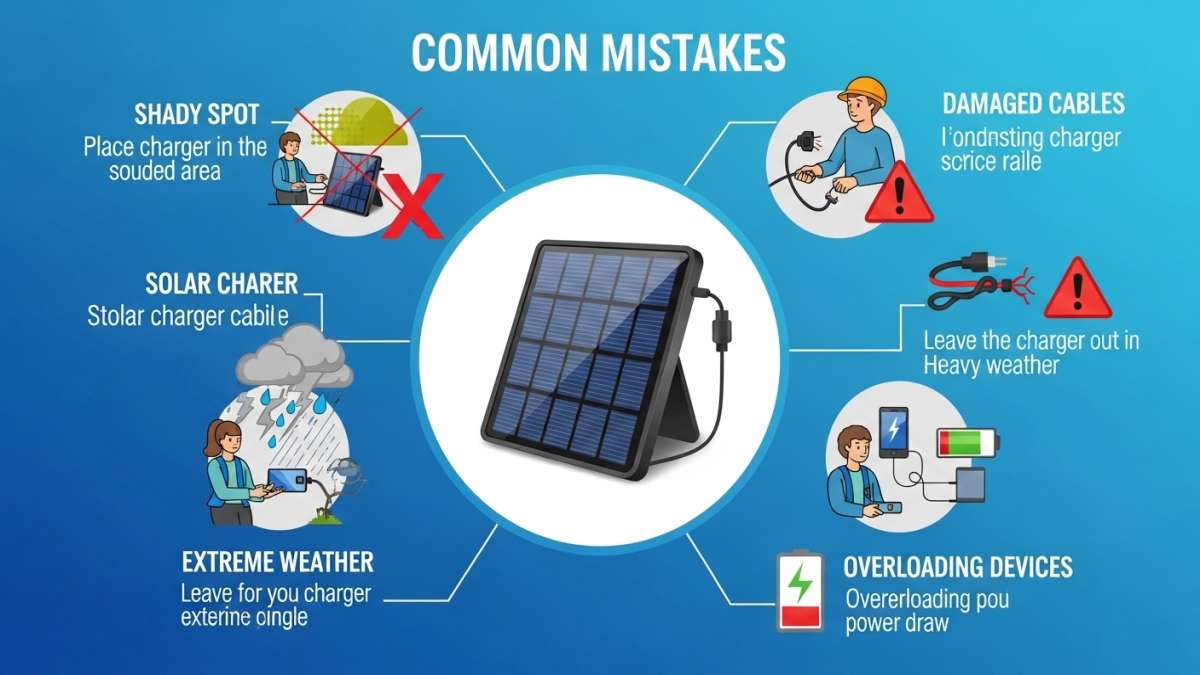
Not Getting a Controller
Some cheap solar panels don’t come with a controller. They just dump voltage directly into your battery. This damages it. Always check that you’re getting a controller included, or you need to buy one separately. It’s the most important part.
Putting It in the Shade
A panel under a tree, behind a windshield, or on the shaded side of your RV basically doesn’t work. You need direct sunlight for 4-6 hours every day. If your storage spot is in shade all the time, a solar charger might not help much. Think about where you’re parking.
Forgetting the Battery Kill Switch
This kills the whole point. You install this charger and then don’t flip the kill switch before storage. Your battery still drains because of parasitic draws, and the charger can’t keep up. Flip the switch first. That’s step one. The charger is your backup.
Buying the Absolute Cheapest Option
Two chargers might both say “20W” but one might have real protection and a good warranty, while the other is just plastic and will die in a year. Spend an extra $20-30 and get something that actually lasts.
Leaving the Panel Dirty
Dust and dirt block the sun. If your RV sits for months, that panel gets covered in pollen and grime. Once in a while, wipe it down. That’s all it takes.
How to Install One (It’s Actually Easy)
The Windshield Mount (5 Minutes)
Clean your windshield really well. Get all the dust and dirt off. Let it dry.
Stick the suction cups on the panel and press them hard onto the windshield.
Find your battery. It’s usually under the driver’s seat or down in the basement storage area.
See the red wire from the charger? That’s positive. Connect it to the red terminal on your battery using the clamps they give you.
The black wire is negative. Hook that to the black terminal.
Tuck the cable away so it doesn’t get pinched or caught on anything.
Flip your battery kill switch to “on.”
Look at the LED light on the charger. In the sun, it should turn blue or red. That means it’s working. If you see nothing after 10 minutes in direct sun, something’s wrong.
Done. That’s it.
Roof Mount (Better But Takes More Time)
If you want it permanent on the roof, you can do it yourself with drilling, or pay an RV service to do it for you ($100-200). The electrical part stays the same—just different mounting location. Most people call a pro for this because one bad roof hole causes leaks.
Questions People Actually Ask About This Stuff
Q: Can a solar charger bring a dead battery back to life?
A: No. That’s not what they’re built for. They maintain a healthy battery, not resurrect a dead one. If your battery’s completely dead, use a plug-in charger first to get it to 50%, then the solar charger keeps it there. This also prevents sulfation, which is permanent damage that happens to deeply discharged batteries.
Q: How long to charge a completely dead battery with solar?
A: Super long. Like 50+ hours of direct sun for a standard RV battery with a 20W panel. That’s why they’re for maintenance, not emergency charging. Keep a regular plug-in charger in your RV for dead battery situations.
Q: Can I use a phone solar charger for my RV?
A: No. Phone chargers are 5V. RV batteries are 12V. The voltage is completely different and would fry your battery. Use something made for 12V systems.
Q: Do I really need the battery kill switch if I have a solar charger?
A: Yeah. The kill switch stops most parasitic drain. The solar charger handles what’s left and natural discharge. Both together is the winning combo. One alone isn’t enough.
Q: Will snow and rain ruin it?
A: No. Good chargers are built to handle weather. Rain actually helps because it cleans the panel. Snow is only a problem if it completely blocks the sun. Once it melts, you’re back to normal.
Q: What’s PWM vs MPPT? Should I care?
A: MPPT is fancier and works better in cloudy weather, but costs more. PWM is simpler and cheaper. For small storage chargers, PWM is totally fine. Save your money.
Q: Can I use this on a boat or motorcycle too?
A: Yes. Any 12V battery system can use it. Boats and motorcycles often sit in storage, so they actually benefit a lot.
Q: How do I know it’s actually working?
A: Look at the LED. In sunlight, you should see blue or red. Green means your battery’s full. If you put it in direct sun and nothing lights up after 10 minutes, call the seller—something’s broken.
Q: Does the windshield block the sun too much?
A: A little. You lose 20-30% efficiency behind glass. Windshield mounting is easy but not ideal for storage. Rooftop or side mounting is better if you’re leaving it up for months. Trade-off: convenience vs. power.
Q: How do I pick the right size?
A: For storage, 15-20W is standard. 30W if you want extra safety margin. Anything bigger is overkill unless you’re boondocking off-grid. For storage, small is fine.
Q: Is there such a thing as a lithium battery charger that’s different from regular chargers?
A: Some chargers are specifically designed for lithium batteries with special controllers. Regular lead-acid chargers might not charge lithium properly. If you have lithium, check that the charger says “lithium compatible” on the specs.
Q: What’s the cheapest solar battery charger that actually works?
A: You can find basic ones for $40-60, but they usually don’t have controllers. Spending $80-120 gets you a real charger with a controller that won’t destroy your battery. Don’t go too cheap—you’ll regret it.
Q: Do I really need a Victron charger or are other brands fine?
A: Victron is excellent but expensive ($300+). For storage, a $100 charger from any reputable brand works just as well. Victron is overkill unless you’re living full-time off-grid. Save your money for storage situations.
Why You Should Actually Get One
Real talk: spending $100 to protect a $400 battery makes total sense.
Think about the alternatives. You could pay $100 for roadside service to jump-start you. You could replace a dead battery for $300-500. You could miss out on a trip because your RV won’t start. Or you can spend $100 once, install it, and stop worrying about it.
RV owners who use these chargers don’t come back from storage with a dead battery problem. That’s the whole point. No dead battery blues. No expensive repairs. No missed adventures because your RV won’t start.
Resources for Further Learning
For more detailed information about RV battery systems and solar charging, the Family Motor Coach Association offers comprehensive storage and maintenance checklists. Additionally, EnergySage’s solar education resources provide in-depth guides on solar technology and efficiency optimization.