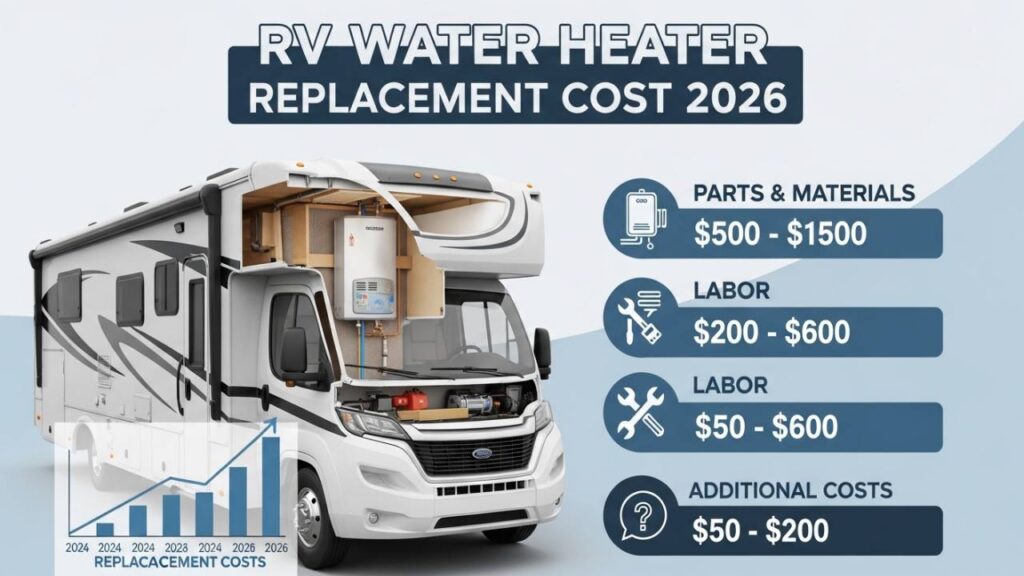
Quick Answer: Replacing an RV water heater in 2026 costs between $300 and $1,800 for the unit itself. Add professional installation, and your total lands between $700 and $2,500, depending on the type of heater, your RV, and who does the work. DIY? You can get it done for as little as $350 all-in.
What Drives the Cost of RV Water Heater Replacement?
Before you look at any price, understand that your final number depends on four things:
- 1. The type of water heater you choose. Tank-style units are cheaper upfront. Tankless units cost more but deliver unlimited hot water.
- 2. The size of the unit. Most RV water heaters come in 6-gallon, 10-gallon, and 12-gallon sizes. Bigger tanks cost more.
- 3. The power source. Propane-only, electric-only, dual-fuel (gas and electric), or tankless propane — each has a different price point.
- 4. Who does the installation? DIY costs almost nothing in labor. A dealer or certified RV technician will charge $75 to $150 per hour.
Full RV Water Heater Replacement Cost Breakdown — 2026 Numbers
| Heater Type | Tank Size | Unit Price Range | Best For |
|---|---|---|---|
| Propane-only tank | 6-gallon | $200–$400 | Budget builds, weekend campers |
| Dual-fuel (gas + electric) tank | 6-gallon | $400–$600 | Most RV owners are the best all-around |
| Dual-fuel (gas + electric) tank | 10-gallon | $500–$800 | Families, back-to-back showers |
| Dual-fuel (gas + electric) tank | 12-gallon | $600–$900 | Larger Class A and Class C rigs |
| Tankless (propane on-demand) | N/A | $600–$1,200 | Full-timers, boondockers |
| Tankless (Girard, Furrion premium) | N/A | $800–$1,500 | Serious off-grid campers |
Note: These are unit-only prices. Installation is separate and detailed below.
Also Read:- How Much Does It Cost to Add Solar Panels to an RV? (Real Numbers Inside)
Total Replacement Cost – DIY vs. Professional
| Scenario | Unit Cost | Labor / Extras | Total Budget |
|---|---|---|---|
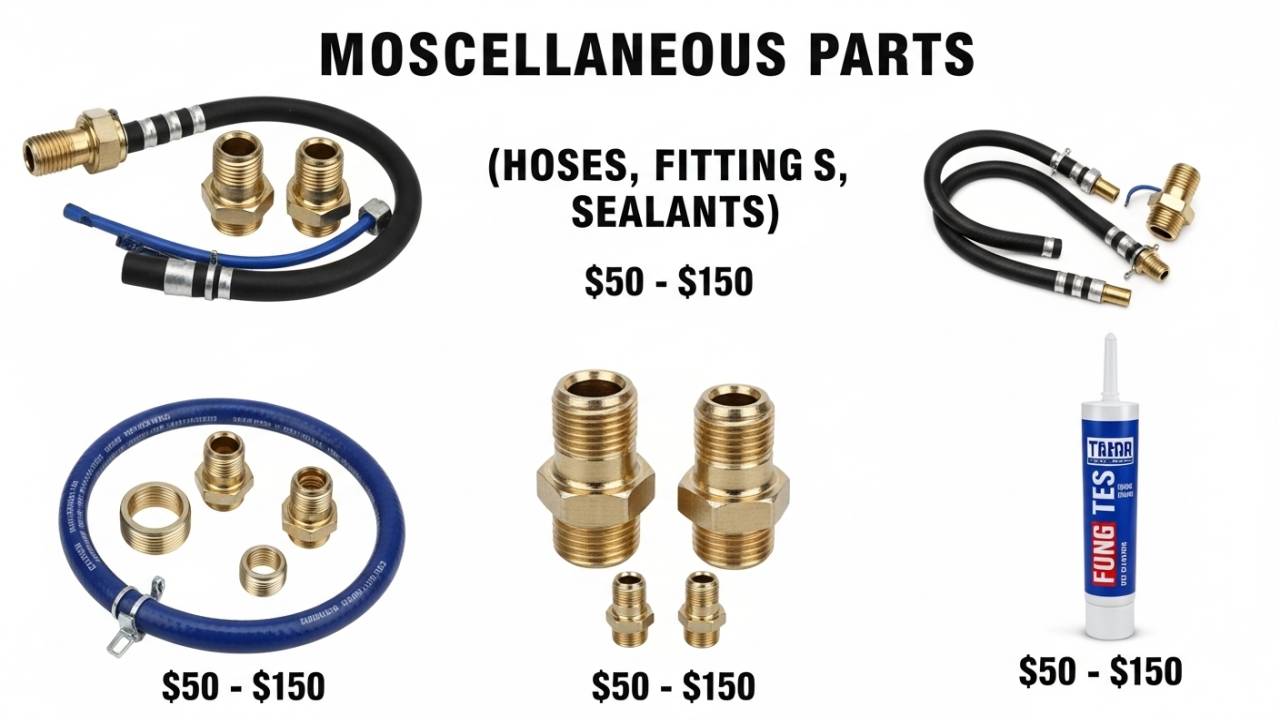
| DIY — basic 6-gallon swap (same brand) | $350–$550 | $30–$80 (fittings, sealant) | $380–$630 |
| DIY — tankless upgrade | $600–$1,200 | $100–$200 (extra parts, door kit) | $700–$1,400 |
| Pro install — basic 6-gallon same-brand swap | $350–$550 | $150–$400 (2–4 hrs labor) | $500–$950 |
| Pro install — dual-fuel 10-gallon upgrade | $500–$800 | $300–$600 (4–6 hrs) | $800–$1,400 |
| Pro install — tankless upgrade | $600–$1,200 | $400–$1,000 (6–10 hrs + door kit) | $1,000–$2,200 |
| Dealer service center (all-in estimate) | Varies | Typically marked up 20–30% | $900–$2,500 |
The Top RV Water Heater Brands in 2026 – And What Each Costs
Not all water heaters are made equal. Here is a plain-English breakdown of the brands you will actually encounter at RV parts stores and online.

Suburban — The Most Trusted Name in RV Water Heaters
Suburban has been the go-to brand for RV water heaters for decades. Their units are installed from the factory in Forest River, Keystone, Coachmen, and dozens of other brands. If your current heater has an anode rod visible from the outside, it is almost certainly a Suburban.
They are known for bulletproof durability, easy parts availability, and no-fuss installation—especially when you are doing a same-brand swap.
| Suburban Model | Type | Capacity | Price Range |
|---|---|---|---|
| SW6DE | Dual-fuel (gas + electric) | 6-gallon | $380–$480 |
| SW6DEL | Dual-fuel + direct spark | 6-gallon | $450–$550 |
| SAW6DEL | Atwood direct replacement | 6-gallon | $480–$580 |
| SW10DE | Dual-fuel | 10-gallon | $520–$650 |
| SW12DEL | Dual-fuel + direct spark | 12-gallon | $580–$750 |
Best for: RV owners who want reliability, easy DIY installation, and widely available replacement parts.
Dometic (formerly Atwood) — Modern Features, Premium Price
Dometic acquired the Atwood water heater line several years ago and discontinued the old Atwood models. Their current lineup focuses on efficiency and advanced features like hybrid technology and aluminum tanks (which resist corrosion better than steel).
If your RV originally had an Atwood heater, you will need to buy a Dometic replacement or switch to a Suburban SAW-series unit, which is designed as a drop-in Atwood replacement.
| Domestic Model | Type | Capacity | Price Range |
|---|---|---|---|
| WH-6GEA | Gas + Electric + Auto-ignition | 6-gallon | $550–$700 |
| WH-9GEA | Gas + Electric + Exothermal | 9-gallon | $650–$800 |
| WH-10GEA | Gas + Electric + Aluminum tank | 10-gallon | $750–$950 |
Best for: Full-timers who want energy efficiency, modern diagnostics, and premium construction. Expect to pay more and possibly need professional installation for some models.
Also Read:- How to Fix a Problem Solar RV Toilet Not Flushing? 5 Easy Fixes You Can Do Yourself
Girard — The Premium Tankless Choice
Girard is the brand that certified RV technicians consistently recommend when customers ask for a tankless upgrade. They are factory trained on Girard units; the build quality is exceptional, and they come with solid warranty support.
The Girard GSWH-2 is their flagship residential-feel tankless unit. It is not the cheapest option, but among full-timers and serious boondockers, it has a loyal following.
| Girard Model | Type | GPM Flow Rate | Price Range |
|---|---|---|---|
| GSWH-2 | Propane tankless | 2.1 GPM | $600–$800 |
| Girard Advantage (ST series) | Tankless upgrade | 2.4 GPM | $700–$900 |
Best for: RVers who boondock frequently, hate waiting for water to heat up, and want a unit that a certified technician will actually stand behind.
Furrion — The Tankless Newcomer with Good Reviews
Furrion has grown quickly in the RV appliance space. Their tankless water heaters feature antifreeze protection and precise temperature control. They have become popular in newer rigs from manufacturers like Jayco and Coachmen.
| Furrion Model | Type | Price Range |
|---|---|---|
| FWH09A | Propane tankless, 2.4 GPM | $600–$850 |
| FWH09A with digital controller | Propane tankless + wall display | $700–$950 |
Best for: RVers who already have a Furrion unit and want a direct replacement, or anyone upgrading to tankless with a modern feature set.
Fogatti — The Budget Tankless Option
Fogatti has gained traction on Amazon as a more affordable entry into the tankless market. Their InstaShower Pro line packs solid BTU output (up to 66,000 BTU) at prices that undercut Girard and Furrion significantly. The trade-off is that they are newer to the market, and parts availability can be hit or miss.
| Fogatti Model | Type | Price Range |
|---|---|---|
| InstaShower 9 Pro | Propane tankless, 66,000 BTU | $350–$550 |
Best for: Budget-conscious RVers who want tankless performance without the premium price tag and are comfortable doing their own maintenance.
Tank vs. Tankless: Which One Should You Actually Buy?
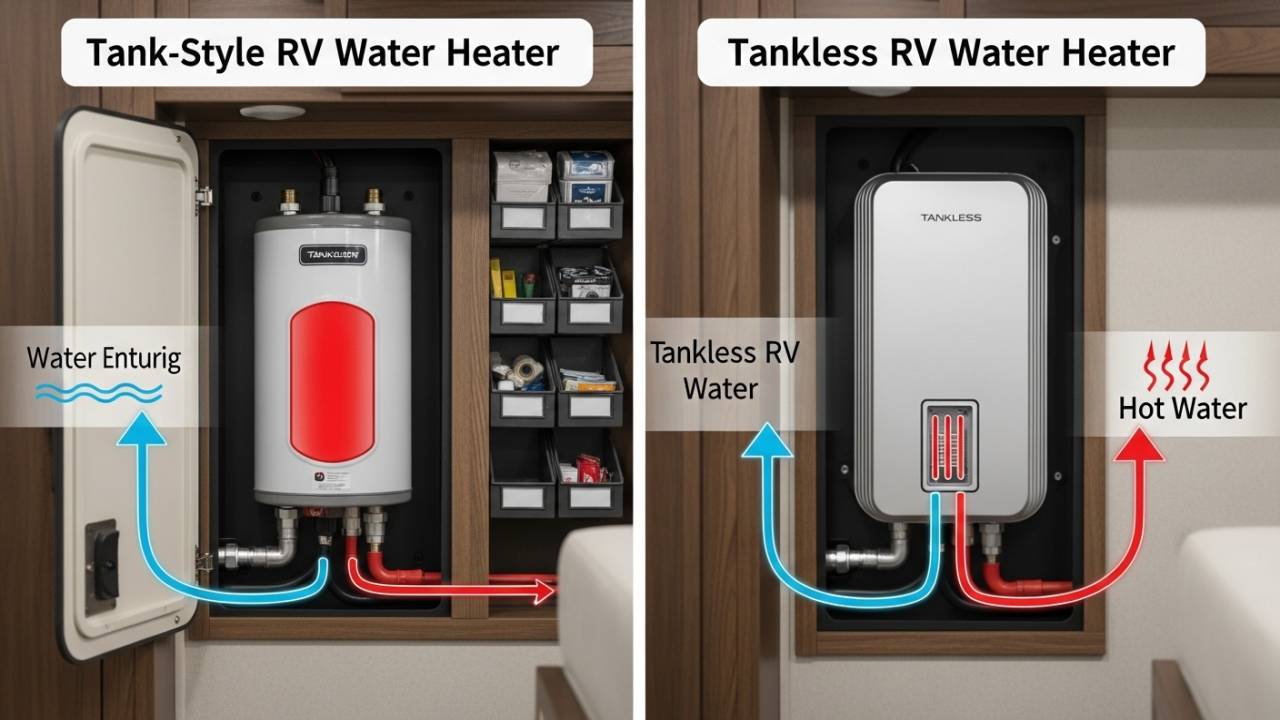
This is the question that trips up most RV owners. Here is a direct, no-nonsense comparison.
| Factor | Tank (6–12 gallon) | Tankless (On-Demand) |
|---|---|---|
| Unit cost | $200–$900 | $350–$1,500 |
| Hot water supply | Limited by tank size | Unlimited while propane lasts |
| Recovery time | 20–35 minutes to reheat | Instant (no recovery needed) |
| Water pressure required | Any | Minimum flow needed to activate |
| Works with navy showers | Yes | Sometimes problematic |
| Works while boondocking | Yes (propane or electric) | Yes (propane only, most models) |
| Installation complexity | Low to moderate | Moderate to high |
| Lifespan | 8–12 years | 12–20 years |
| Best for | Weekenders, budget buyers | Full-timers, larger families |
The honest reality about tankless: A significant number of RV owners who buy rigs with factory-installed tankless heaters end up swapping back to tank-style units. The most common complaints are error codes, inconsistent temperatures during low-flow use, and problems with navy showers not triggering enough flow to activate the heater.
If you boondock frequently and take full-pressure showers, tankless is excellent. If you are a conservation camper who does navy showers, a good 6-gallon dual-fuel tank unit will serve you far better.
Also Read:- Best RV Solar Panels for New Mexico: Desert Climate Guide 2026
DIY vs. Professional Installation: The Honest Breakdown
Going DIY — When It Makes Sense
If you are swapping a dead unit for the same brand and size, DIY is very doable. The job involves:
- Turning off the water supply and draining the tank
- Shutting off propane at the source
- Disconnecting the water lines, gas line, and electrical connections
- Sliding the old unit out of the exterior bay
- Sliding the new unit in and reconnecting everything in reverse
- Leak testing all connections before lighting
A straightforward same-brand 6-gallon swap takes most handy people 2 to 3 hours. You will need a multimeter, an adjustable wrench, Teflon tape, pipe dope or thread sealant, and a few basic hand tools.
Where DIY gets tricky: Switching from tank to tankless, or switching brands, often requires rerouting PEX water lines, running a new 12V wire for the display panel, buying a new exterior door kit, and potentially adding a 120V AC circuit if you are adding electric heating capability. If any of these apply to your situation, factor in extra time and parts cost.
For safety guidance on propane connections, the National Fire Protection Association (NFPA) publishes standards for LP gas appliance installations that apply to RVs.
Also Read:- What Is a Solar Charge Controller and Why Does Your RV Need One?
Hiring a Professional
Most RV service centers and mobile RV technicians charge $75 to $150 per hour for labor. A basic same-brand swap runs 2 to 4 hours. A tankless upgrade or brand switch runs 4 to 8 hours.
| Job Type | Estimated Hours | Estimated Labor Cost |
|---|---|---|
| Same-brand 6-gallon swap | 2–3 hours | $150–$450 |
| Brand change, same tank size | 3–5 hours | $225–$750 |
| Tankless upgrade from a tank | 5–8 hours | $375–$1,200 |
| Full tankless system with door kit and wiring | 6–10 hours | $450–$1,500 |
Where to find certified technicians: Look for RVIA-certified service centers. The RV Industry Association maintains a directory of certified technicians across the US who are trained to meet manufacturer and code standards.
Three Real-World Cost Scenarios
Scenario 1: The Budget Repair on a Travel Trailer
A family camping with a 2019 Jayco travel trailer discovers their 6-gallon Suburban SW6DE has a cracked tank after a winter freeze. They want to keep costs low.
| Item | Cost |
|---|---|
| Suburban SW6DE replacement unit | $430 |
| Anode rod (required for Suburban) | $12 |
| Teflon tape, pipe dope, fittings | $18 |
| Total (DIY) | $460 |
They watched one YouTube walkthrough, took a Saturday morning, and had hot water by noon. Total time: about 3 hours.
Scenario 2: Upgrading from Atwood to Dometic on a Fifth Wheel
A couple with a 2016 fifth wheel has a failed Atwood 6-gallon unit. Atwood is discontinued. They hire a mobile RV technician to install a Dometic WH-6GEA.
| Item | Cost |
|---|---|
| Dometic WH-6GEA unit | $640 |
| Technician labor (3.5 hrs at $120/hr) | $420 |
| Exterior door kit | $55 |
| Misc fittings and sealant | $30 |
| Total (Pro installed) | $1,145 |
The technician handled the minor plumbing adjustments needed since Dometic and Atwood have slightly different connection layouts.
Scenario 3: Full Tankless Upgrade on a Class A Motorhome
A full-time RVing couple in a 2018 Class A replaces their aging 10-gallon Suburban with a Girard GSWH-2 tankless unit for unlimited hot water on their desert boondocking trips.
| Item | Cost |
|---|---|
| Girard GSWH-2 tankless unit | $750 |
| New exterior door kit (Girard-specific) | $85 |
| RVIA-certified RV technician (7 hrs at $130/hr) | $910 |
| PEX fittings, 12V wiring, misc parts | $130 |
| Total (Pro installed) | $1,875 |
They noted that the Girard technician rerouted two PEX lines, ran a new 12V wire for the display panel, and pressure-tested all connections before signing off.
Signs Your RV Water Heater Needs to Be Replaced (Not Just Repaired)
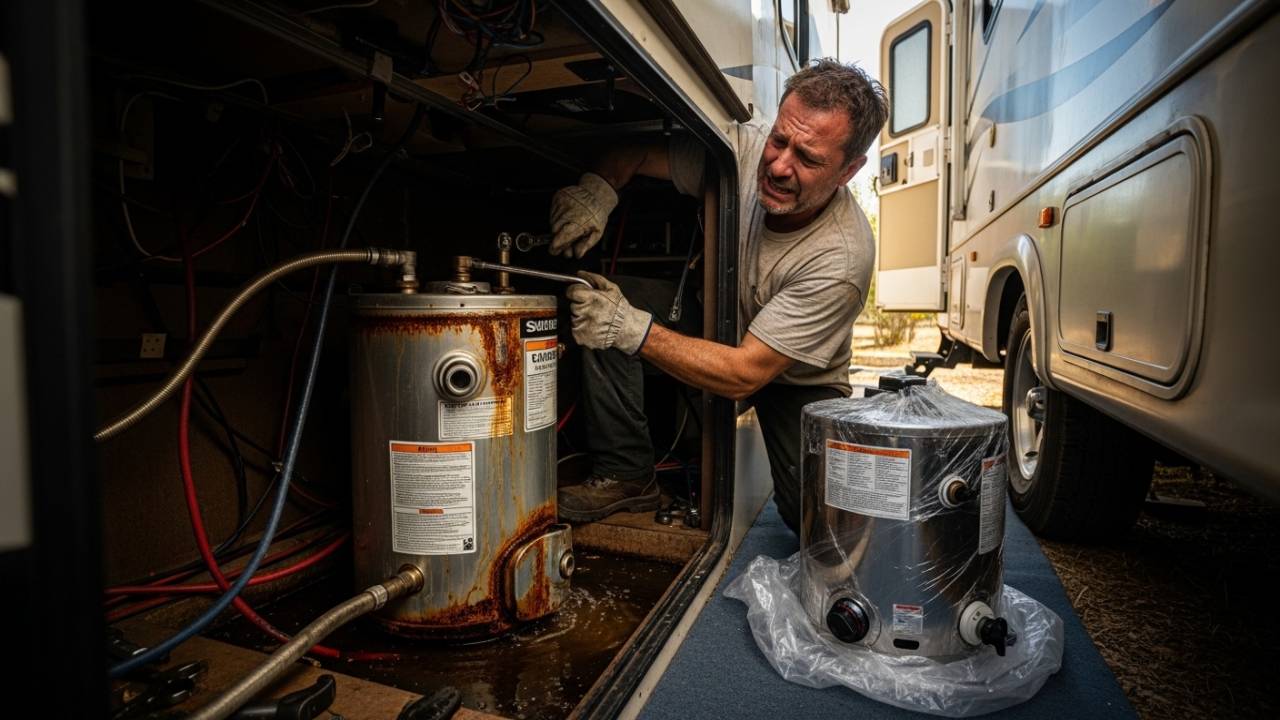
Not every problem means a full replacement. But some signs point clearly toward “time to buy new.” Here is how to tell:
Replace it when you see:
- A cracked or corroded tank (especially after a freeze)
- Active leaking from the tank body itself (not just a fitting)
- Rust-colored water consistently comes from hot taps
- The unit is more than 10–12 years old and failing regularly
- Atwood unit that can no longer get replacement parts
Repair first if you have:
- An igniter that won’t spark (usually a $15–$30 part)
- A failed anode rod, causinga smell or sediment (replace annually)
- A faulty thermostat or temperature limit switch
- A bad heating element on the electric side
- A pressure relief valve that is dripping (replace the valve, not the unit)
Money-Saving Tips for RV Water Heater Replacement in 2026
- Buy from RV parts suppliers, not dealerships. Sites like United RV Parts, RV Parts House, and Amazon regularly sell the same Suburban and Dometic units at 15 to 30 percent less than dealer prices. Always compare before you commit.
- Do the same-brand swap yourself if you can. A Suburban-to-Suburban or Dometic-to-Dometic swap is the most DIY-friendly replacement you will find. The connections are in the same location, the door fits the same cutout, and the wiring is identical.
- Replace the anode rod every season. A $12 anode rod replacement takes 10 minutes and can add years to your tank’s life. This is the single most neglected maintenance step in RV water heater care.
- Ask your technician to quote labor separately from parts. Dealer service centers often mark up parts 25 to 40 percent above retail. Buying your own unit and paying labor only can save you $100 to $300.
- Check for recall notices and warranty coverage. If your water heater is under 5 years old, check whether the manufacturer has an active warranty claim process. Suburban offers a 2-year unit warranty and a 5-year tank warranty on many models. Dometic has similar coverage. A covered repair or replacement could cost you nothing.
F&Q
How much does it cost to replace a 6-gallon RV water heater?
A 6-gallon RV water heater costs $350 to $600 for the unit, depending on the brand and whether it is propane-only or dual-fuel. With professional installation, the total cost runs $600 to $1,100. DIY brings the total cost down to $380 to $650, including parts.
What is the most reliable RV water heater brand in 2026?
Suburban is consistently the most recommended brand among RV technicians and long-term owners for tank-style heaters. For tankless, Girard has the strongest reputation among certified technicians. Dometic (formerly Atwood) is a solid choice for efficiency and modern features.
Can I replace my RV water heater myself?
Yes, if you are replacing a failed unit with the same brand and size. The job involves turning off propane and water, disconnecting lines, sliding out the old unit, and sliding in the new one. Where DIY gets complicated is when you are switching brands, switching from tank to tankless, or adding new electrical capability. Those jobs are better handled by a professional.
How long does RV water heater replacement take?
A simple same-brand tank swap takes 2 to 4 hours for a DIYer or 1 to 2 hours for an experienced technician. Tankless upgrades or brand changes take 4 to 8 hours, depending on the modifications needed.
Should I upgrade to a tankless water heater when replacing my RV water heater?
It depends entirely on how you camp. If you boondock regularly and want unlimited hot water with no wait time, tankless is a genuine upgrade. If you do short showers, conserve water, or camp mostly at hookups, a quality 6 or 10-gallon dual-fuel tank unit is a smarter and simpler choice. Many full-timers who tried tankless have switched back to tank-style units due to low-flow triggering issues.
What is the lifespan of an RV water heater?
Tank-style RV water heaters typically last 8 to 12 years with proper maintenance,e including annual anode rod replacement and regular flushing. Tankless units can last 12 to 20 years due to fewer moving parts and no corrosion risk from standing water.
Why did my RV water heater fail so early?
The most common causes of premature failure are: neglected anode rods that allowed the tank to corrode from the inside, winter freeze damage from not draining the unit before storage, sediment buildup from hard water that coated the heating element, and igniter failure from lack of use during long off-seasons.