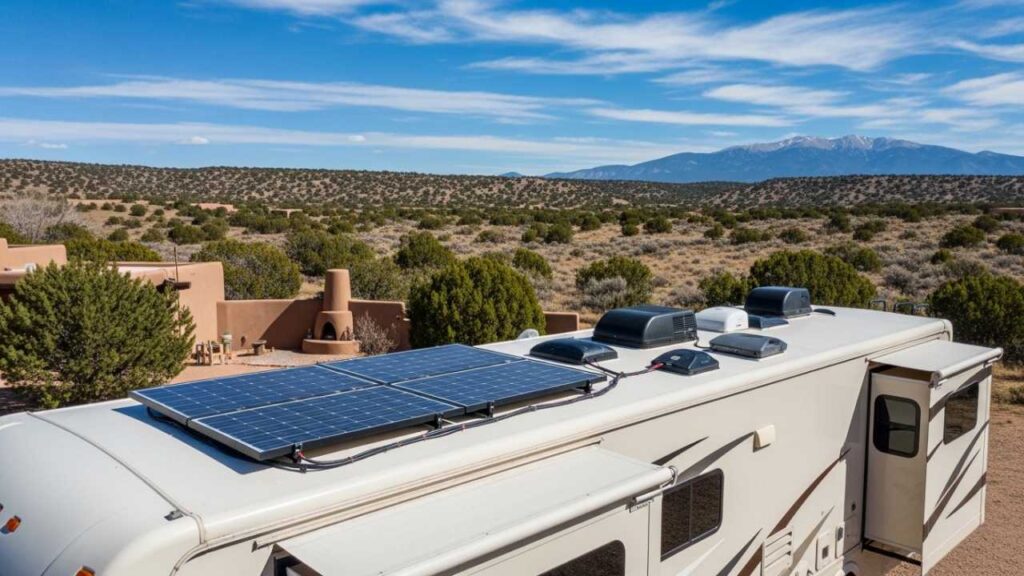
Santa Fe sits at an elevation of 7,000 feet—nearly 2,000 feet higher than Albuquerque. This matters enormously for your RV solar system. You’ll generate more power per watt installed, but you’ll also face unique challenges: extreme temperature swings, intense UV exposure, and occasional snow that catches many boondockers off guard.
This guide walks you through elevation-specific solar performance, what changes from lower-altitude installations, and exactly how to maintain a system in Santa Fe’s high-desert climate.
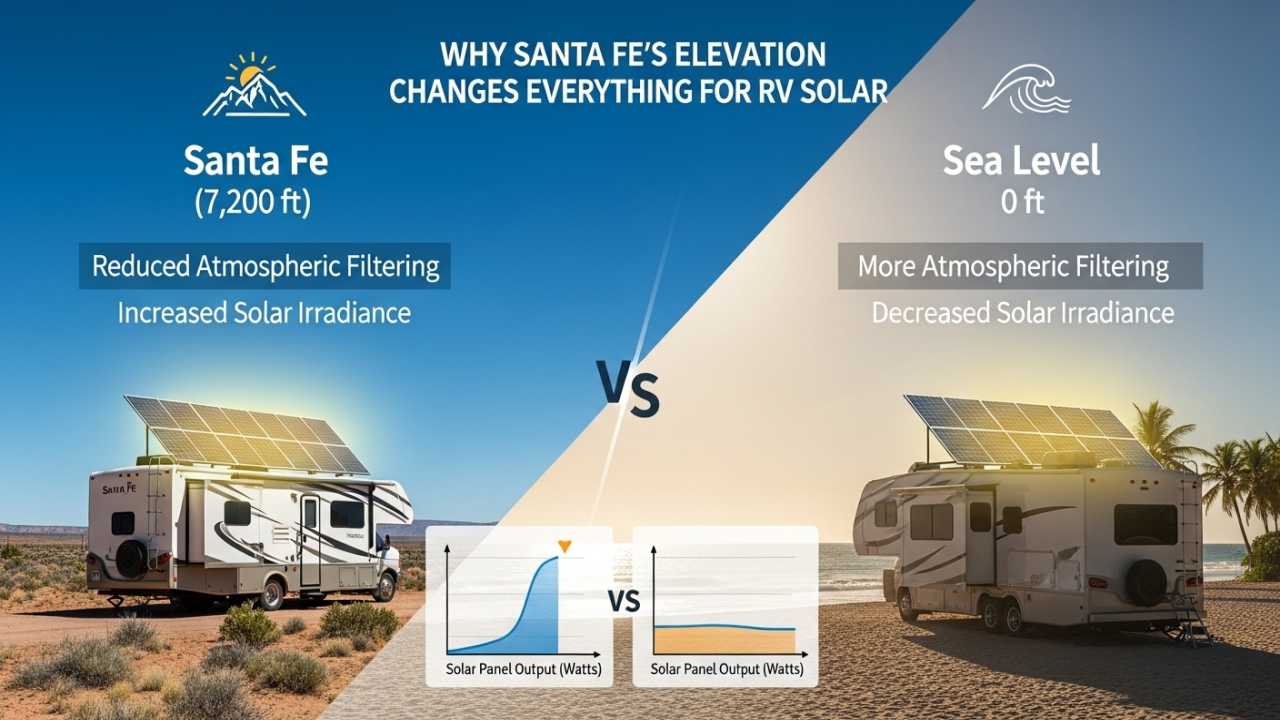
Why Santa Fe’s Elevation Changes Everything for RV Solar
The Scientific Advantage You Actually Have
At 7,000 feet, Santa Fe receives solar radiation that outperforms lower-altitude locations by 15-25%. This isn’t marketing hype—it’s atmospheric physics.
Here’s what happens at elevation:
The thinner atmosphere between you and the sun means less air absorbing infrared radiation. Studies from Swiss Alps installations (similar elevation to Santa Fe) show that high-altitude sites capture more direct solar radiation and experience less “diffuse radiation loss”—the scattered light that lower elevations waste.
Practically speaking: your 400-watt solar panel performs like a 450-480 watt panel would at sea level. That 50-80 watt bonus compounds daily and never appears in marketing materials.
Peak Sun Hours Comparison:
- Santa Fe (7,000 feet): 6.8-7.2 peak sun hours annually
- National average (sea level): 4.5-5.5 hours
- That’s roughly 40% more solar productivity.
Also Read:- RV Solar Installation in Albuquerque: Your Complete Guide to Top Shops + DIY Setup
The Hidden Challenge: Voltage Stress at Elevation
Here’s where it gets technical, but it matters for system reliability:
For every 1,000 meters of elevation gain, solar panel voltage ratings require approximately a 1.5% downward adjustment. Santa Fe at 7,000 feet (2,134 meters) means your voltage systems experience real stress that manufacturers design to handle, but only if you chose components rated for high altitude.
What this means practically:
If you bought a charge controller rated for 150 volts maximum at sea level, you need to recalculate its performance at Santa Fe’s elevation. The air’s reduced density means worse cooling, so components run hotter despite cooler ambient temperatures.
This is why cheap imported components sometimes fail mysteriously at altitude—not because they’re defective, but because they weren’t engineered for these conditions.
The Solution: When sizing charge controllers and inverters for Santa Fe, add 10-15% safety margin beyond your calculated needs. A system that looks adequate on paper might overheat in practice.
Santa Fe RV Solar Performance Expectations
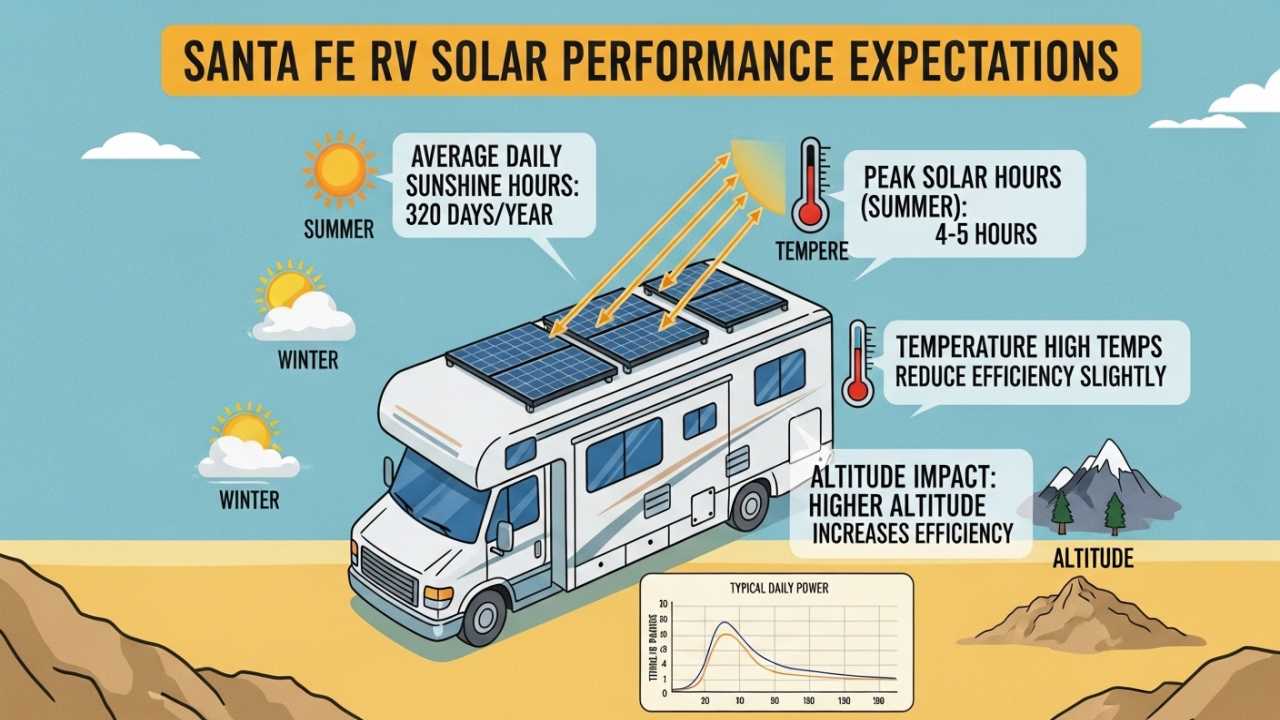
Santa Fe averages 283-300 sunny days yearly. More importantly, these aren’t weak winter days like southern states.
Seasonal Breakdown for a 400W Panel Array:
| Season | Daily Production | Notes |
|---|---|---|
| Summer (June-Aug) | 2,200-2,600 Wh | Peak conditions: afternoon clouds are rare |
| Spring/Fall (March-May, Sept-Nov) | 1,800-2,100 Wh | Unpredictable wind; dust storms possible |
| Winter (Dec-Feb) | 1,200-1,600 Wh | Snow occasionally sticks; melts within hours |
| Annual Average | 1,650 Wh per day | More consistent than most US locations |
For Context: An RVer consuming 1,500 Wh daily can operate year-round on Santa Fe solar alone—something you can’t reliably do in Colorado, Oregon, or most northern states.
The trade-off? Extreme daily temperature swings.
Temperature Extremes—Your Real Maintenance Challenge
Albuquerque vs. Santa Fe: Same High Desert, Very Different Conditions
Albuquerque (5,300 feet):
- Summer highs: 95°F
- Winter lows: 35°F
- Daily range: ~50°F swings
Santa Fe (7,000 feet):
- Summer highs: 82-85°F
- Winter lows: 20-28°F
- Daily range: ~55-60°F swings
That might not sound dramatic, but thermal cycling destroys solar equipment.
Also Read:- How to Charge RV Battery with Solar: Best Solar Chargers, Panels & RV Solar Power Systems
Why Extreme Temperature Swings Accelerate Component Degradation
When your solar panels experience a 50-60 degree temperature swing daily, several things happen:
Expansion and Contraction Stress: Solar panels use aluminum frames. Aluminum expands at a different rate than glass and silicon cells. Repeated cycling eventually loosens connections and fractures solder joints inside the panel. After 5-7 years of Santa Fe thermal cycling, panels begin failing at the internal micro-fracture level—still producing power, but losing efficiency 5-8% annually.
Sealant Breakdown: Dicor sealant (standard for RV roof penetrations) hardens in Santa Fe’s extremes. After 3-4 years, it becomes brittle and stops sealing properly. Winter freeze-thaw cycles complete the destruction.
Battery Performance Impact: Lithium batteries perform well in cold but suffer in heat. A 100°F summer day followed by a 25°F winter night stresses lithium management systems. Lead-acid batteries suffer worse—water loss accelerates, plates deteriorate faster.
Maintenance Requirements Specific to Santa Fe
Monthly (During Boondocking Season):
- Inspect sealant around all panel penetrations for cracks
- Wipe panel surface with microfiber cloth and distilled water (dust storms happen)
- Check battery bank voltage after cold nights (lithium can enter protection mode)
Quarterly:
- Deep inspection of all metal components for oxidation (altitude plus UV accelerates this)
- Check inverter cooling vents for dust accumulation
- Verify charge controller is functioning—Santa Fe’s UV exposure can degrade display screens
Annually:
- Reseal all panel mounting points (Dicor has 3-year lifespan at sea level, 2-3 years in Santa Fe)
- Replace any corroded hardware with stainless steel equivalents
- Test battery bank under load (winter mornings are ideal)
- Inspect wiring for UV damage to insulation
Installation Considerations Unique to Santa Fe
Roof Mounting: Higher Wind Loads
Santa Fe’s elevation exposes you to stronger wind forces. The thinner air means less wind resistance, but gustier conditions still develop, particularly in spring.
Mounting Requirements:
- Use heavy-gauge stainless steel bolts (galvanized corrodes at elevation)
- Apply nylon lock washers—regular washers vibrate loose faster at elevation
- Consider angle of panel mounting: Santa Fe’s latitude (35.6°N) suggests 35-40° tilt angle is optimal
- Ensure mounting brackets don’t flex—any play in the structure will accelerate seal failure
Penetration Strategy: Unlike lower elevations where you might compromise on sealant, Santa Fe demands professional-grade penetration work. Consider:
- Using existing vents (refrigerator vent, plumbing vent)
- If drilling required: use marine-grade silicone sealant (better UV resistance than standard Dicor)
- Seal with butyl tape underneath, then sealant on top—never trust one method alone
Component Selection for Santa Fe-Specific Challenges
Charge Controllers
MPPT controllers are mandatory at Santa Fe elevation. PWM controllers won’t handle the voltage stress properly.
Recommendation: Victron SmartSolar MPPT
- Explicitly rated for high-altitude operation
- Voltage adjustment for elevation built into firmware
- Temperature sensors included (critical for Santa Fe)
- 10-year warranty honored by US distributors
Alternative (Budget): Renogy Adventurer MPPT
- Solid for 400W systems
- Decent high-temperature derating
- Less sophisticated than Victron but reliable
Batteries: Lithium Wins for Santa Fe
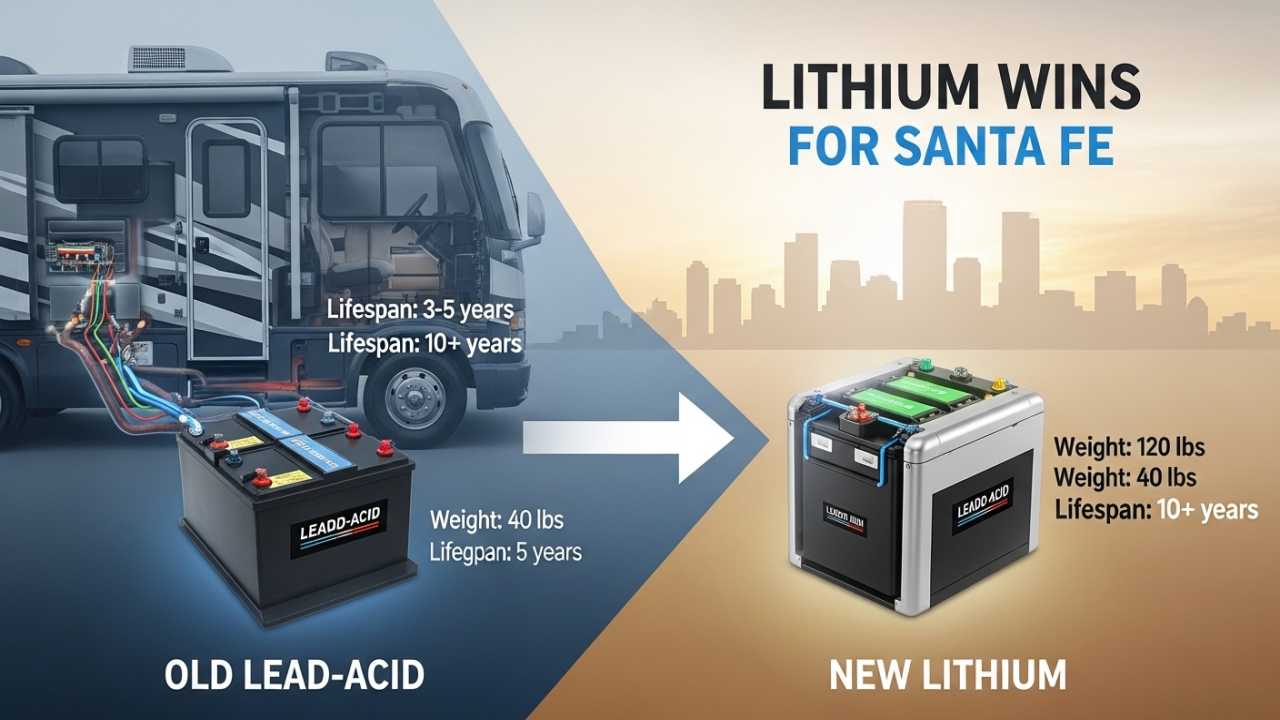
Lithium’s temperature tolerance (-20° to 158°F) spans Santa Fe’s extremes. Lead-acid’s limited range (roughly -10° to 130°F) means winter underperformance and summer stress.
Recommended: Battle Born 12V LiFePO4 (200-300Ah)
- Designed for RV conditions
- BMS (battery management system) includes altitude-aware voltage regulation
- Holds charge through Santa Fe’s cold nights better than competitors
- 10-year warranty
Why not Tesla Powerwall? Cost is $10K+ vs $5-6K for lithium batteries, and Powerwalls require 240V AC wiring that most RVs don’t have.
Also Read:- Best RV Water Heater for the Money in 2026: Tested Models, Real Talk & the One That Actually Wins
Inverters: The Heat Management Challenge
Your inverter sits inside the RV. In summer, you’re already dealing with 85°F ambient—adding an inverter’s waste heat requires active cooling strategy.
Recommendation: Victron MultiPlus (3000W)
- Quiet operation (important for Santa Fe’s peaceful boondocking)
- Excellent thermal management
- Can sense grid AC and switch automatically
- Handles soft-start loads (microwave draws vary)
Alternative: Xantrex XW+ (good budget option)
- Performs adequately to 3000W
- Less sophisticated cooling but adequate for RVs
- Cheaper than Victron
Critical Installation Point: Mount your inverter in the coolest location possible—under-bed installations work, but ensure airflow with ventilation grates.
Santa Fe Weather Realities & System Impacts
Spring Wind (March-May): Your Biggest Mechanical Stress
Santa Fe’s spring winds can gust 30-40 mph. Your solar panels are designed to handle sustained 90+ mph winds, but the vibration from frequent gusting accelerates seal failure.
Mitigation:
- Check mounting bolts monthly during spring
- Ensure weatherstripping around cable entries is intact
- Consider temporary cover (yes, this reduces production, but protects seals)
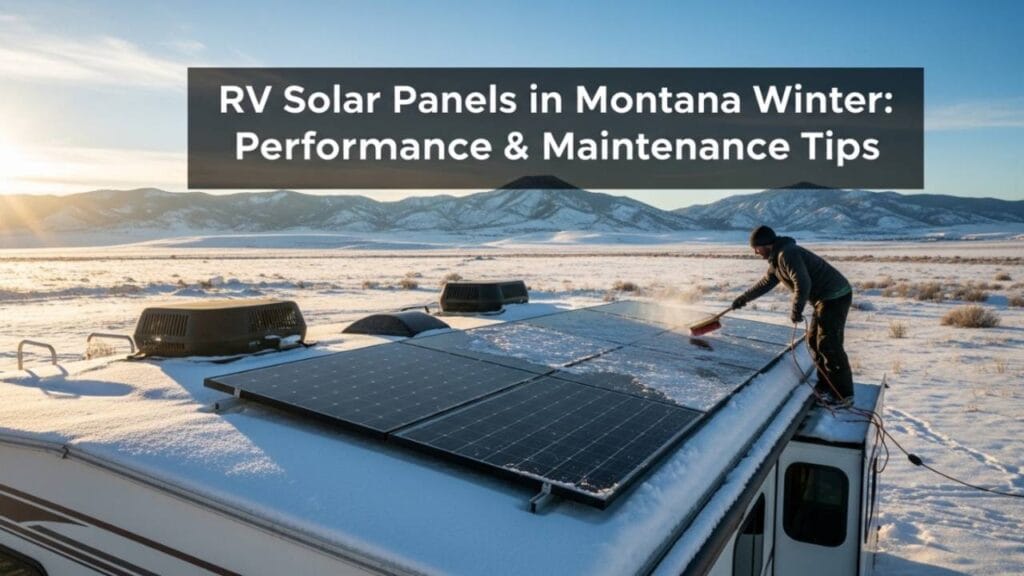
Snow: Rare but Consequential
Santa Fe gets 30-45 inches of snow annually, but most melts within 24-48 hours due to high elevation sun angle and thin air.
When Snow Doesn’t Melt Immediately (rare):
- Never use metal scrapers—you’ll permanently etch the glass surface
- A microfiber cloth with distilled water is safe
- Many RVers just wait—panels will produce partial power even when covered
- Snow melting on panels (when sun angle is low) actually helps—melting water cleans panel surface
Winter Production Reality: Count on 40-50% reduction during December-February, not zero.
Dust & Pollen: More Significant Than Snow
Santa Fe’s dry climate means occasional dust storms (haboobs) can coat panels heavily. Unlike snow, dust doesn’t melt.
Maintenance:
- After dust storms, clean panels within 2 days (dust becomes baked on)
- Use DI (deionized) water, not tap water—minerals leave spots
- Microfiber cloth only (paper towels scratch)
- Early morning cleaning is best (cooler panels = safer access)
Cleaning Frequency: 3-4 times yearly vs. 2 times at lower elevations.
Santa Fe RV Solar: Real-World Q&A
“Will My Battery Freeze at Night?”
Lithium batteries with proper BMS won’t freeze. However, their voltage output drops in extreme cold (below 20°F). A 300Ah lithium bank might deliver 280Ah usable capacity at 0°F.
Solution: Size your battery bank 20% larger if you plan winter boondocking. A 360Ah system gives you 288Ah even in extreme cold.
Lead-acid performs worse—expect 30-40% capacity loss below 0°F.
“Can I Really Run Everything Year-Round?”
Yes, if you:
- Size your system for winter production (not summer)
- Keep consumption realistic (no AC, minimal heating)
- Have backup (small generator for 2-3 days per winter when clouds persist)
An RVer consuming 1,200 Wh daily with 300Ah lithium can operate year-round with careful power management.
“What About that Extreme Heat Damage from 85°F Summers?”
Solar panels have slightly lower efficiency in heat, but at Santa Fe’s elevation, summers don’t exceed 85°F midday ambient. Your actual panel temperature reaches ~120-130°F (not the 160°F+ you’d see at sea level in 100°F weather).
This is one of Santa Fe’s rare solar advantages—summer doesn’t degrade efficiency as much as you’d expect.
“Is DIY Installation Viable at Santa Fe’s Elevation?”
Yes, with caveats:
- High altitude poses no physical danger to installers (Santa Fe isn’t 14,000 feet)
- Installation process is identical to lower elevations
- Component selection requires more care (voltage ratings, temperature specs)
- Permitting through Santa Fe County can be slower than Albuquerque
Pro tip: Have a licensed electrician (Santa Fe requires this) do the battery and inverter connections. DIY panel mounting and charge controller wiring is fine.
Santa Fe Solar Installers & Professional Options
Positive Energy Solar
Location: Albuquerque-based, serves Santa Fe area
Specialization: High-end residential and RV systems
Experience: 25+ years in New Mexico (understands elevation impacts)
What sets them apart:
- Explicitly mentions high-altitude design accommodations
- Free on-site assessment (they travel to Santa Fe)
- Handles all permitting with Santa Fe County
- SolarInsure 30-year warranty (covers parts and labor)
Cost expectation: Premium pricing ($4,000-6,000 for 400W RV system) but includes professional design accounting for elevation.
Sol Luna Solar
Location: Santa Fe (local)
Specialization: Residential but does RV work
Experience: 40 years construction, 15+ years solar
What’s good:
- Local understanding of Santa Fe’s specific weather patterns
- Family-owned (responsive to questions)
- Understands traditional Santa Fe architecture (helpful if your RV is parked near historic structures)
Cost expectation: Mid-range ($3,000-4,500) with solid warranty.
Online Retailers + Licensed Local Electrician
Cost: $1,500-2,200 (DIY panels) + $800-1,200 (electrician for connections)
Components sourcing:
- Renogy or Go Power panels (widely available, good reviews)
- Victron or Renogy MPPT controller
- Battle Born or Lion Energy lithium batteries
- Xantrex or Victron inverter
This approach works if you’re comfortable with DC wiring basics and have time to coordinate with electricians.
Legal & Permitting in Santa Fe
Santa Fe County has specific requirements for solar installations:
Required Documentation:
- Signed engineered plans (stamped by PE)
- Electrical single-line diagram
- Roof structural analysis (though RVs rarely need this)
- Property setback diagram (showing fire department access requirements)
Timeline: 4-8 weeks typical approval time
Key Contacts:
- Santa Fe County Sustainability Office: Free solar consultations
- Santa Fe County Building Permits: (505) 986-6200
Tax Incentives for New Mexico Residents:
- Federal 30% tax credit (through 2032)
- New Mexico 10% state tax credit (up to $6,000/year)
- Property tax exemption for solar systems
These incentives apply to stationary installations, not RVs. However, if you’re a New Mexico resident registering your RV there, consult a tax professional about application.
Maintenance Calendar for Santa Fe Climate
Monthly (Year-Round)
- Visual inspection of panel connections for corrosion
- Check sealant for new cracks
- Verify battery voltage readings
Quarterly
- Clean panels (dust storms happen unpredictably)
- Inspect charge controller display for readability (UV degrades screens)
- Test the inverter by running a brief heavy load (microwave)
Spring (Before Wind Season)
- Tighten all mounting bolts
- Replace any corroded hardware
- Reseal cable entries
Fall (Before Cold Season)
- Test battery performance at 20% charge (cold stress test)
- Verify winterization procedures
- Check antifreeze in any plumbing systems (unrelated but important)
Annually
- Full sealant replacement (every 2-3 years for Santa Fe specifically)
- Battery capacity test
- Wiring insulation inspection
- Professional thermal imaging of connections (optional but recommended)
FAQ
Q: Will panels produce less power in winter than in summer?
A: Yes, 40-50% less. But Santa Fe’s winter production is more reliable than most US locations due to elevation and dry climate. You can operate year-round with proper sizing.
Q: What’s the cost per watt at Santa Fe elevation?
A: Installation: $2.94-3.50/watt (slightly higher than national average due to elevation-specific engineering). DIY: $1.50-2.00/watt if you source components carefully.
Q: Should I use micro-inverters instead of one big inverter?
A: Micro-inverters have advantages for permanent installations but are unnecessary for RVs. One centralized inverter is simpler to troubleshoot and more cost-effective. Use MPPT charge controller instead for efficiency.
Q: Can I install panels myself and just hire an electrician?
A: Yes. Panel mounting is DIY-friendly. Electrician work (battery connections, inverter wiring) requires licensing in Santa Fe County.
Q: Is lithium really worth the extra cost at Santa Fe elevation?
A: Absolutely. Lithium’s temperature tolerance directly addresses Santa Fe’s extreme swings. Payback period: 4-6 years vs. lead-acid. If you plan 5+ years of boondocking, lithium is the better investment.
Q: How do I know if my inverter is rated for high altitude?
A: Check derating curves in the technical specs. Look for “operating altitude” specifications. If it doesn’t mention altitude at all, contact manufacturer support. Many consumer-grade units have altitude limitations above 5,000 feet.
The Santa Fe Advantage: Why It’s Worth the Maintenance Effort
Santa Fe’s elevation transforms RV solar from “nice to have” into genuinely viable year-round power independence. That 7,000-foot elevation gives you a 40% productivity advantage over national averages.
Yes, you’ll maintain components more frequently due to thermal cycling and UV exposure. Yes, component selection matters more because of altitude-specific engineering. But the result is a solar system that actually works in winter, reduces generator runtime dramatically, and lets you boondock in one of America’s most beautiful high-desert locations.
The early morning light in the Sangre de Cristo Mountains. The dry, clear nights. The 280+ days of sunshine. That’s what Santa Fe solar powers.