You’re sitting in your RV watching the battery percentage drop. It’s 2 p.m., the sun is blazing, and you’ve got 400 watts of solar on the roof. But your battery is only at 65% charge. What’s going wrong?
Here’s the reality most RV owners don’t understand: having lots of solar panels doesn’t automatically mean fast charging. The actual speed depends on five things working together—panel sizing, battery type, controller efficiency, angle, and how you’re actually using your system. Get even one of these wrong, and you’ll be waiting hours longer than necessary to charge.
This guide shows you exactly how to charge RV batteries faster with solar, using real numbers and practical changes you can make today.
Why Your RV Solar Charging Is Slower Than It Should Be
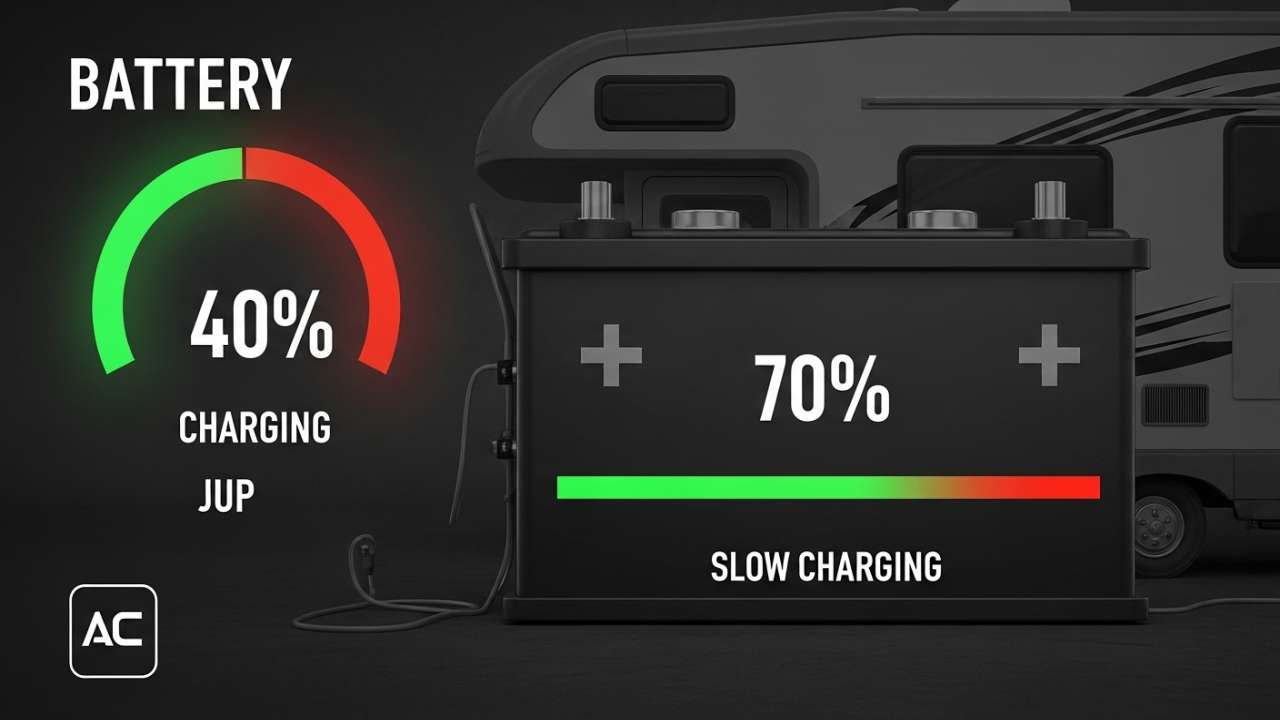
Before you buy anything new, let’s figure out why you’re sitting at 65% when you should be at 90%.
Panel Angle is Making You Lose 20-30% of Power
Here’s something most people don’t think about: solar panels only produce maximum power when the sun hits them straight on. If your panels are laying flat on your RV roof, you’re getting about 70-80% of their rated output most of the day. Tilt them even slightly and that number jumps to 95%+.
This isn’t a small difference. A 200-watt panel laying flat might only produce 140-160 watts on average. That same panel tilted 30 degrees produces 190-200 watts. You’re literally throwing away 40-60 watts per panel by not tilting.
For a deeper dive into exactly how much angle matters for your specific location and time of year, check our RV solar panel angle guide. It breaks down the math and shows seasonal optimization strategies that actually work.
Shade From One Tree Branch Can Cut Your Output in Half
One branch. That’s all it takes. A single tree branch creating a shadow across one of your panels can reduce your entire system’s output by 30-50%. This isn’t because the shaded panel produces zero power—it’s because when panels are wired in series, the lowest-producing panel becomes your bottleneck.
You think you’re in full sun. You’re actually getting partial shade for 3-4 hours. That’s hours of charging speed you’re giving away.
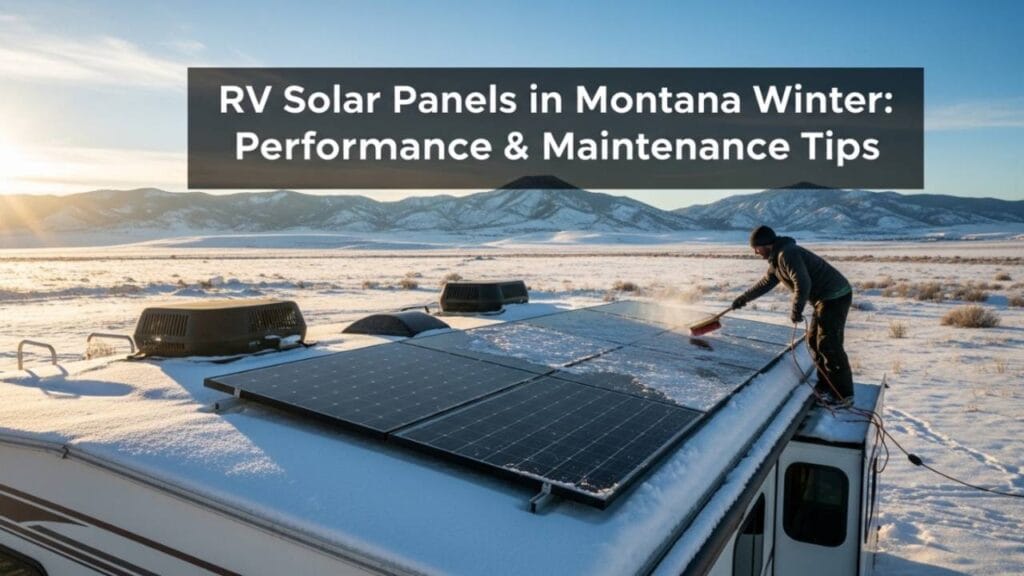
Your Panels Get Dirty and Nobody Notices
Dust, pollen, bird droppings, salt spray from coastal camping—it all reduces output. Dirty panels produce 10-15% less power than clean ones. Most RVers clean their panels once a year, if that. Your panels could be losing 100+ watts right now without you realizing it.
Your Battery Type Determines Your Charging Speed Ceiling
A lithium battery charges 5-10 times faster than a lead acid battery. This isn’t an exaggeration. A 100Ah lithium can accept 100 amps of charging current. A 100Ah lead acid can only safely accept 10-20 amps. You can have 1000 watts of panels, but if you’re charging into lead acid, your charging speed is still capped.
Your Charge Controller Might Be Wasting 20-40% of Your Solar Power
If you’ve got a basic PWM charge controller, you’re losing power every single day. A 200-watt panel producing 40 volts trying to charge a 12-volt battery means those extra 28 volts are just wasted as heat. An MPPT controller takes that wasted voltage and converts it into extra amps charging your battery.
The difference is real: same panel, same battery, but 20-40% more charging current reaching your battery with MPPT instead of PWM.
Real Charge Times: What to Expect
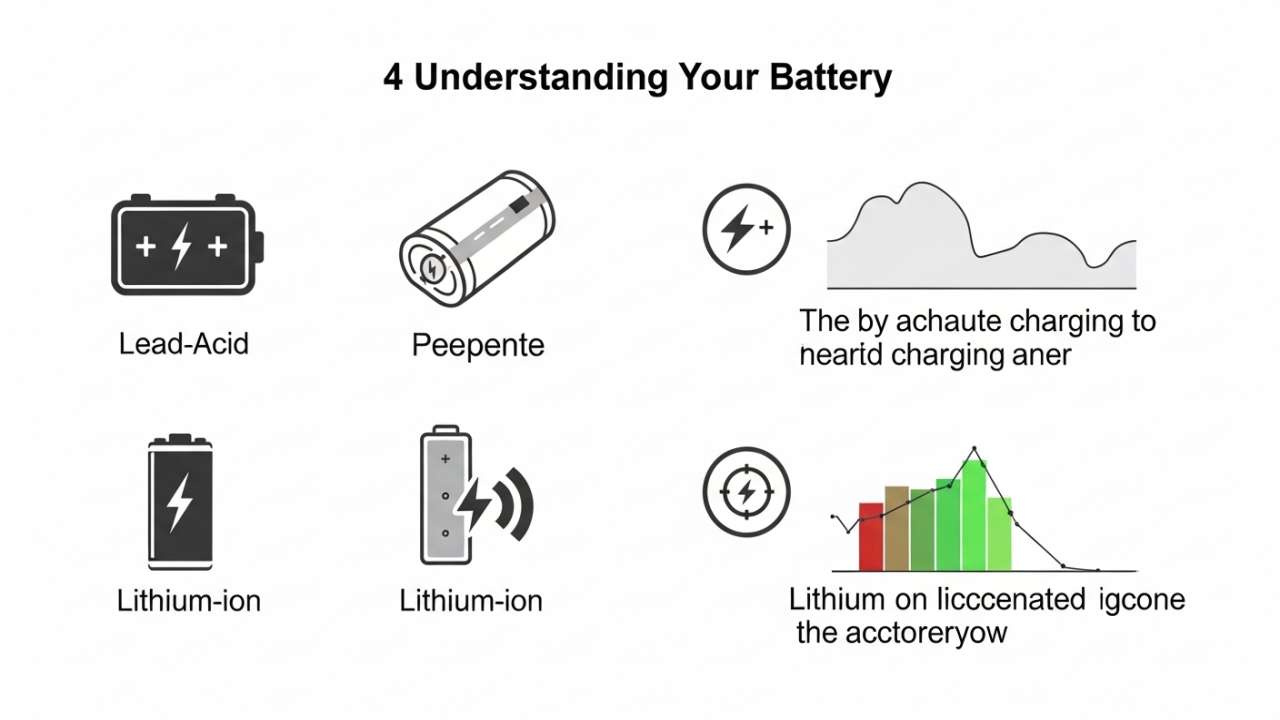
Stop guessing. Here’s what actually happens with different panel sizes, battery types, and real-world conditions.
These numbers assume:
- 6 hours of decent sunlight (not perfect, not terrible)
- MPPT charge controller
- Panel angle is decent (not optimized, not flat)
- Clean panels
- Charging from 50% to 100% state of charge
Charging a 100Ah Battery Bank
| Panel Size | Lead Acid | AGM Battery | Lithium |
|---|---|---|---|
| 100W | 14-16 hours | 11-13 hours | 6-8 hours |
| 200W | 9-11 hours | 7-9 hours | 3-5 hours |
| 400W | 5-7 hours | 4-5 hours | 2-3 hours |
| 600W | 4-5 hours | 3-4 hours | 1.5-2 hours |
These times change if you:
- Upgrade to MPPT (subtract 15-20% from any time)
- Optimize panel angle better (subtract 10-15%)
- Keep panels clean (subtract 10%)
- Charge from 0% instead of 50% (add 20-30%)
- Camp in shade part of day (add 30-50%)
Real talk: Most RVers with lead acid and undersized panels are looking at 10-14 hour charge times. Switch to lithium and MPPT, and suddenly you’re at 3-5 hours. That’s the difference between running your generator for afternoon power and actually being self-sufficient.
Panel Sizing: The Math That Actually Matters
You need enough panels to charge at a reasonable speed. But how much is enough?
A 100Ah battery holds about 1,200 watt-hours. Charging it fully from empty requires 1,200 Wh. But you’re not charging from empty—you’re charging from 50% (600 Wh needed).
In 6 hours of usable sun, reaching 600 Wh means you need 100 watts of actual output. But real-world losses (inefficiency, wiring, shade, less-than-perfect angle) mean you need about 150 watts of rated panel capacity to reliably hit that.
Here’s what the different wattages actually mean:
- 100-150W total panels: This is maintenance mode. You’ll keep your battery above 40-50% if you’re not using much power. Fast charging? No. You’ll take 12+ hours to go from 50% to 100%.
- 200-300W total panels: This is the sweet spot. 6-8 hours to charge from 50% to 100% on a good day. You can actually run your RV loads and still be charging. This is what most boondockers should aim for.
- 400W total panels: Now you’re getting somewhere. 4-5 hours from 50% to full. Fast enough that you can charge mid-morning and be done by early afternoon.
- 600W+ panels: This is for people running air conditioning off solar or working power-heavy jobs in their RV. Charges in 2-3 hours. Requires serious roof real estate.
Most RVers undersize their panels thinking they can’t fit more on their roof. Then they spend 10-14 hours charging every day. If you’re stuck with limited roof space, check out our guide on adding more solar panels to your existing system—it walks through expansion options, series vs. parallel wiring, and whether your charge controller can handle more.
MPPT Controllers: Why They Charge 20-40% Faster
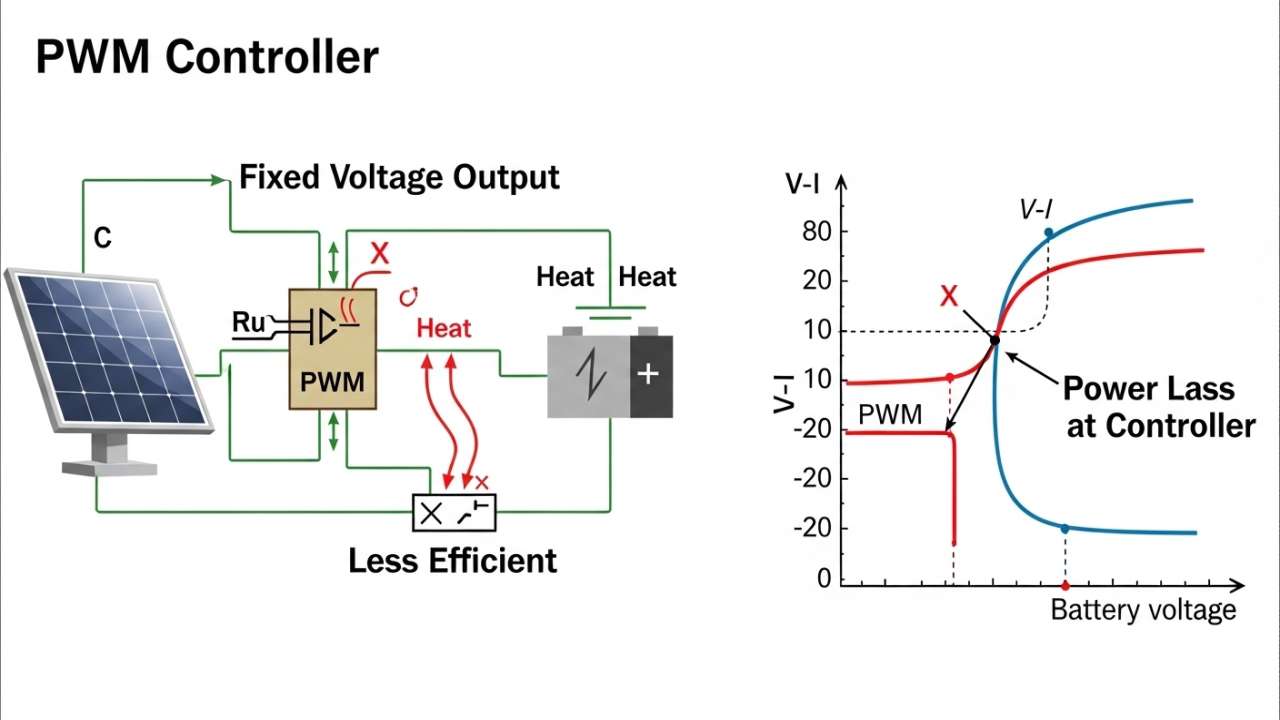
A PWM (Pulse Width Modulation) charge controller is simple. Too simple. It directly connects your panels to your battery at the panel’s voltage. When a 37V panel tries to charge a 12V battery, the extra 25 volts just turns into heat. You lose it.
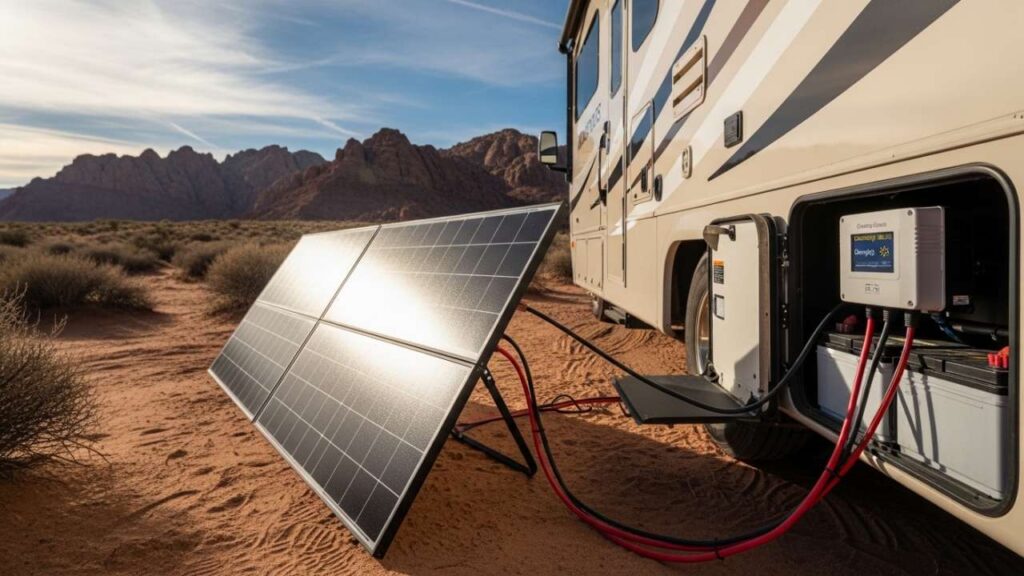
An MPPT (Maximum Power Point Tracking) controller is smarter. It’s literally a small computer managing the conversion. It takes that 37V coming from the panel, converts it to the right voltage for your battery, and pushes all the extra power into charging amps instead of wasting it.
Real example: A 200W panel on PWM might push 12 amps to your battery. The same panel on MPPT pushes 16-18 amps. That’s 33-50% more current, which compounds over hours of charging.
If you’ve got a PWM controller and you’re frustrated with speed, upgrading to MPPT is the single best investment you can make. You don’t need new panels. You don’t need more space. You just need a smarter controller. A 40A MPPT controller costs $250-350 and will immediately speed up your charging by 20-40%.
Battery Type: Your Charging Speed Ceiling
Not all batteries charge at the same speed. Your battery type determines how many amps your system can safely push into it.
Flooded Lead Acid
Safe charging rate: 10-20 amps maximum, continuously. Push more and you damage the plates inside. Yes, your panels might be capable of delivering 50 amps, but your battery literally cannot accept it safely.
Real result: Even with 400W of panels, a flooded lead acid battery charges slowly. 5-7 hours to go from 50% to 100%. And after 300-500 charge cycles (about 3-5 years of boondocking), your battery is dead.
AGM (Absorbed Glass Mat)
Safe charging rate: 20-30 amps. A bit better than flooded lead acid. Charges slightly faster, lasts longer (500-800 cycles), and doesn’t need watering. But still fundamentally limited compared to lithium.
Real result: With decent panels and MPPT, 4-5 hours to fully charge from 50%.
Lithium (LiFePO4)
Safe charging rate: 100% of rated capacity. A 100Ah lithium battery can handle 100 amps continuously without damage. This is game-changing.
Real result: With 400W of panels and MPPT, you’re charging at 30-40 amps, getting from 50% to 100% in 2-3 hours. With 600W panels, you can do it in 1.5 hours.
The catch? Lithium costs 3x more upfront. A 100Ah lithium bank is $2,500-4,000 vs $800-1,200 for lead acid. But here’s the kicker: lithium lasts 3,000-5,000 charge cycles vs 300-500 for lead acid. You’ll replace lead acid 5-10 times before lithium needs replacing. Over 15 years, lithium actually costs less.
Seven Practical Ways to Charge Faster Right Now
You don’t need to buy new panels or a new battery tomorrow. Some of these changes give you 20-30% faster charging today.
1. Tilt Your Panels Toward the Sun
If your panels are laying flat, get them tilted. Even a basic manual tilt mount costs $100-200 and adds 20-30% to your charging power. Adjust seasonally: flat in summer when the sun is high, steeper in winter when the sun is lower.
Better yet, invest in a motorized tracker if you’re serious. Some track the sun automatically throughout the day. That’s overkill for most people, but a manual seasonal adjustment is totally worth it.
2. Scout Your Campsite BEFORE You Park
Find shade and your charging is dead. The number one reason RVers have slow charging is they park under beautiful trees that block the sun for half the day. Look at where the sun is at noon (peak charging time). Position your RV so panels get full sun from 9 a.m. to 3 p.m. That’s where most of your charging happens.
3. Clean Your Panels Every 2-4 Weeks
Seriously. Dust, pollen, salt—it’s reducing your output right now. Clean panels produce 10-15% more power. That’s 20-60 extra watts per panel. With four panels, that’s 80-240 watts difference.
Use water and a soft cloth. Don’t use harsh chemicals. Just rinse with a hose if you can.
4. Stop Draining Your Battery Below 50%
This is counterintuitive but true. When you charge from 50% to 100%, you’re working with smaller voltage differences, which actually charge faster. When you drain to 20% and then try to charge, it crawls up slowly at first.
If you discipline yourself to never let your battery drop below 50% state of charge, your charging speed actually improves. It’s a small mindset shift that helps a lot.
5. Turn Off Non-Essential Loads While Charging
Every amp being drawn from your battery is an amp NOT going into charging. Turn off your water heater, fridge compressor (use propane), water pump, and fans while you’re in active charging mode. Turn them back on once you’re mostly charged.
This can add 20-30% to your charging speed on sunny days.
6. Keep Your Batteries Cool
Hot batteries charge slower. A 20-degree temperature increase can reduce charging speed by 10-15%. If your battery box gets direct sun, shade it or add ventilation. Simple but effective.
7. Check Your Charge Controller Voltage Settings
Some MPPT controllers let you adjust absorption voltage. If it’s set too conservatively, you’re leaving charging speed on the table. Check your manual—increasing absorption voltage by 0.2-0.5 volts can speed up charging. Not all controllers allow this, but many do.
Five Common Questions About Faster Solar Charging
Q: If I add 100W more panels, how much faster will I charge?
Not 50% faster. Your charging speed doesn’t scale linearly with panel power. If you add 100W to an existing 200W system (50% increase), you might only see 20-30% faster charging. Why? Because your battery has a charge acceptance limit. Once you hit that limit, more panels don’t help. You need more battery capacity or a better battery chemistry to see real speed improvements.
Q: Can I use a bigger charge controller to charge faster?
Only if your current controller is the bottleneck. If you’ve got a 30A controller and your 400W panels are only pushing 20A, upgrading the controller won’t help—you need more panels or better panel positioning. But if your 20A controller is maxed out with 30A trying to flow through it, upgrading to 50A helps.
Q: Does battery bank size matter for charging speed?
No. Two 50Ah batteries in parallel still charge at the same speed as one 100Ah battery. Larger battery capacity just means you can run longer before needing to charge. It doesn’t make charging itself faster.
Q: Should I upgrade my whole system at once or piece by piece?
Piece by piece is smarter. First, make free or cheap improvements: tilt panels, move out of shade, clean panels, turn off loads. Then, if you need speed, upgrade your charge controller to MPPT ($250-350). Then, if you still need more, add panels or consider lithium batteries on your next replacement.
Q: Is portable solar better than rooftop for faster charging?
Not really. Portable panels charge at the same speed as rooftop panels. The advantage of portable is flexibility—you can position them in better sun. But if you’ve got good rooftop placement already, rooftop is cheaper and simpler.
Related Articles That Help You Charge Faster
If you’re serious about optimizing charging, these guides cover the next-level stuff.
Check out our RV solar panel angle guide to see exactly how much seasonal angle adjustments improve your specific situation.
Read our RV solar system maintenance checklist to keep your panels producing at peak output—dirty or broken connections kill charging speed faster than anything else.
Learn how to monitor your RV solar system output so you can actually see whether you’re getting the charging speeds you expect or if something’s wrong.
If you need more solar capacity, check our guide on adding more solar panels to existing systems—it walks through expansion options and whether your controller can handle more.
For regional performance optimization, read our RV solar in Santa Fe guide—high-desert locations have different charging patterns and maintenance needs than coastal areas.