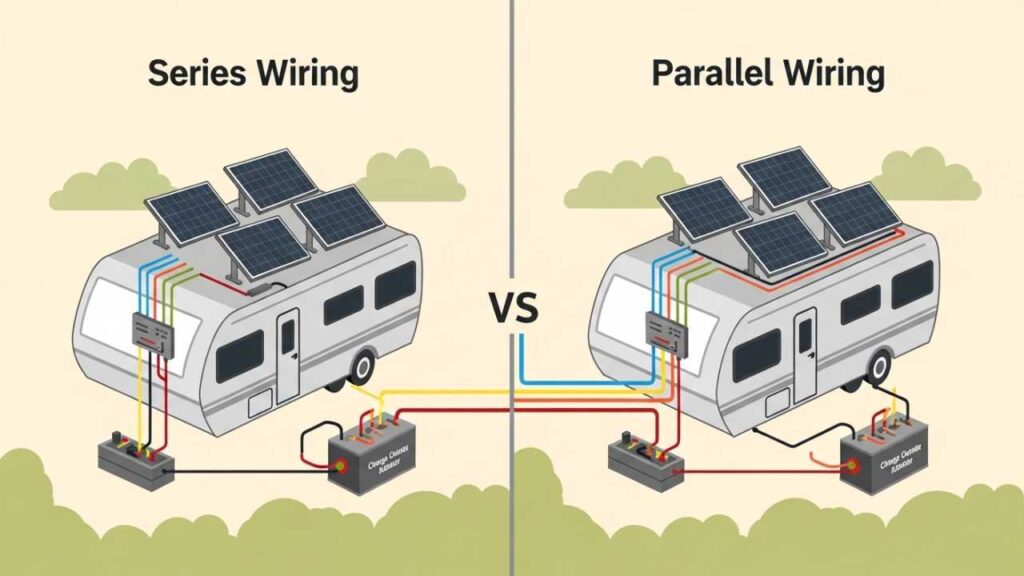
One of the most important decisions when setting up RV solar is how to wire your panels together. Should you connect them in series, parallel, or a combination of both? The answer isn’t one-size-fits-all. It depends on your charge controller type, how much power you need, and whether shade is a problem where you park.
This guide breaks down series and parallel wiring, shows you the real-world differences, and helps you choose the right configuration for your RV.
Series Wiring Explained
In series wiring, you connect panels end-to-end: the positive wire from panel 1 goes to the negative wire of panel 2, and the positive wire of panel 2 goes to your charge controller. This creates a chain.
What happens electrically: Series wiring adds up voltages. Two 100V panels in series produce 200V. Amperage stays the same—if each panel produces 10 amps, the series string produces 10 amps total.
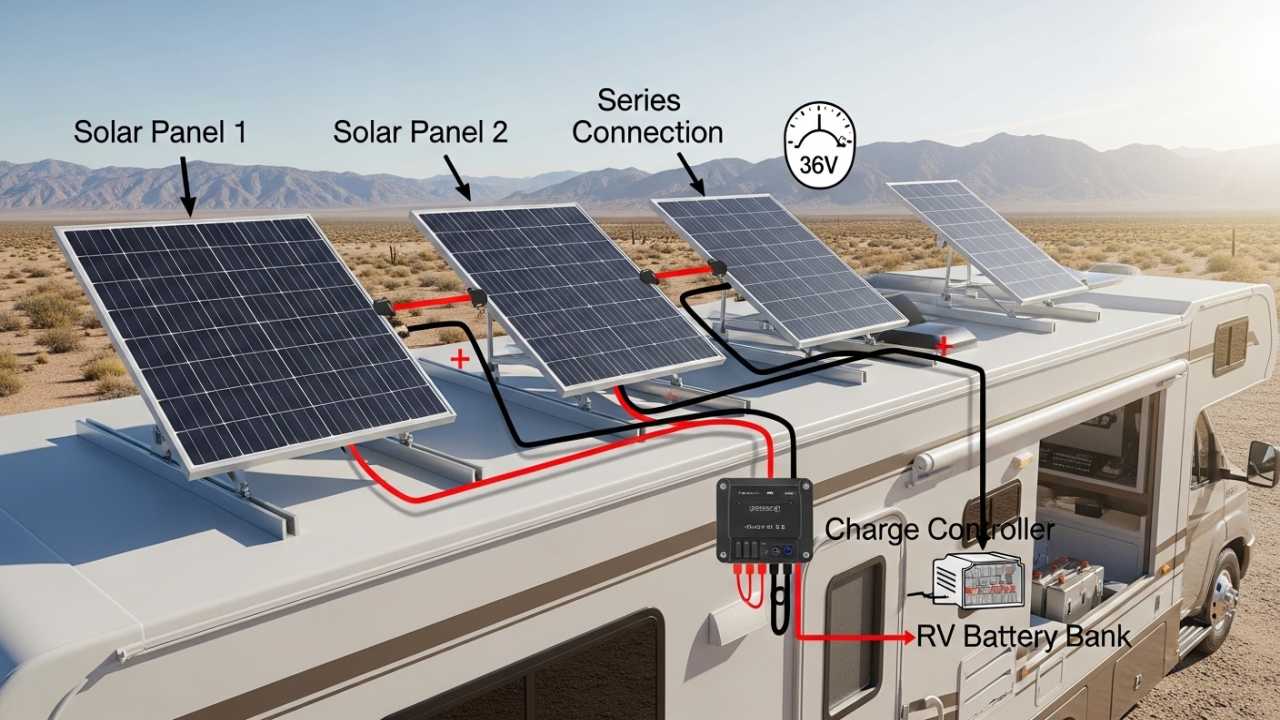
Example: Two 200-watt panels, each producing 37V and 5.4A:
- Series output: 74V, 5.4A (total 399W)
- Your charge controller sees high voltage and moderate current
Best for: MPPT (Maximum Power Point Tracking) controllers. MPPT thrives on high voltage because it can step the voltage down and increase the current, which is exactly what MPPT is designed to do. Series wiring is also simpler to install because you only run two main wires to the controller.
Parallel Wiring Explained
In parallel wiring, all positive wires connect together, and all negative wires connect together. Panels sit side-by-side electrically.
What happens electrically: Parallel wiring adds up amperages. Two 100V panels in parallel produce 100V. Current (amps) adds up—if each panel produces 10 amps, the parallel string produces 20 amps total.
Example: Two 200-watt panels, each producing 37V and 5.4A:
- Parallel output: 37V, 10.8A (total 399W)
- Your charge controller sees moderate voltage and high current
Best for: PWM (Pulse Width Modulation) controllers and 12V systems. PWM controllers can’t handle high voltage efficiently, so parallel’s lower voltage is ideal. Parallel is also better if you have shade issues because a shaded panel in parallel only affects that panel, not the entire string.
Side-by-Side Comparison Table
| Aspect | Series Wiring | Parallel Wiring |
|---|---|---|
| Voltage output | Sums voltages (100V + 100V = 200V) | Stays same as single panel (~100V) |
| Amperage output | Stays same as single panel (~10A) | Sums amperages (10A + 10A = 20A) |
| Total power | Same (e.g., 2 × 200W = 400W) | Same (e.g., 2 × 200W = 400W) |
| Wiring complexity | Simple (2 main wires to controller) | Complex (requires combiner box or dual inputs) |
| Best controller type | MPPT (high voltage optimized) | PWM (high current optimized) |
| Efficiency with MPPT | High (85-95%) | Lower (70-80%) |
| Efficiency with PWM | Lower (70-75%) | Higher (80-90%) |
| One panel shaded | Output drops significantly (maybe 50%) | Output drops modestly (maybe 10-15%) |
| Wire gauge needed | Thinner (less current to carry) | Thicker (more current to carry) |
| Voltage at the battery | Needs step-down; MPPT handles this | Direct use; minimal losses |
| Cold weather performance | Better (voltage increases in cold) | Same (voltage is voltage) |
| Long wire runs | Better (high voltage = less voltage drop) | Worse (high current = more voltage drop) |
| Cost | Lower (fewer components) | Higher (combiner box, breakers for each string) |
Real-World Example: 2 × 200-Watt Panels
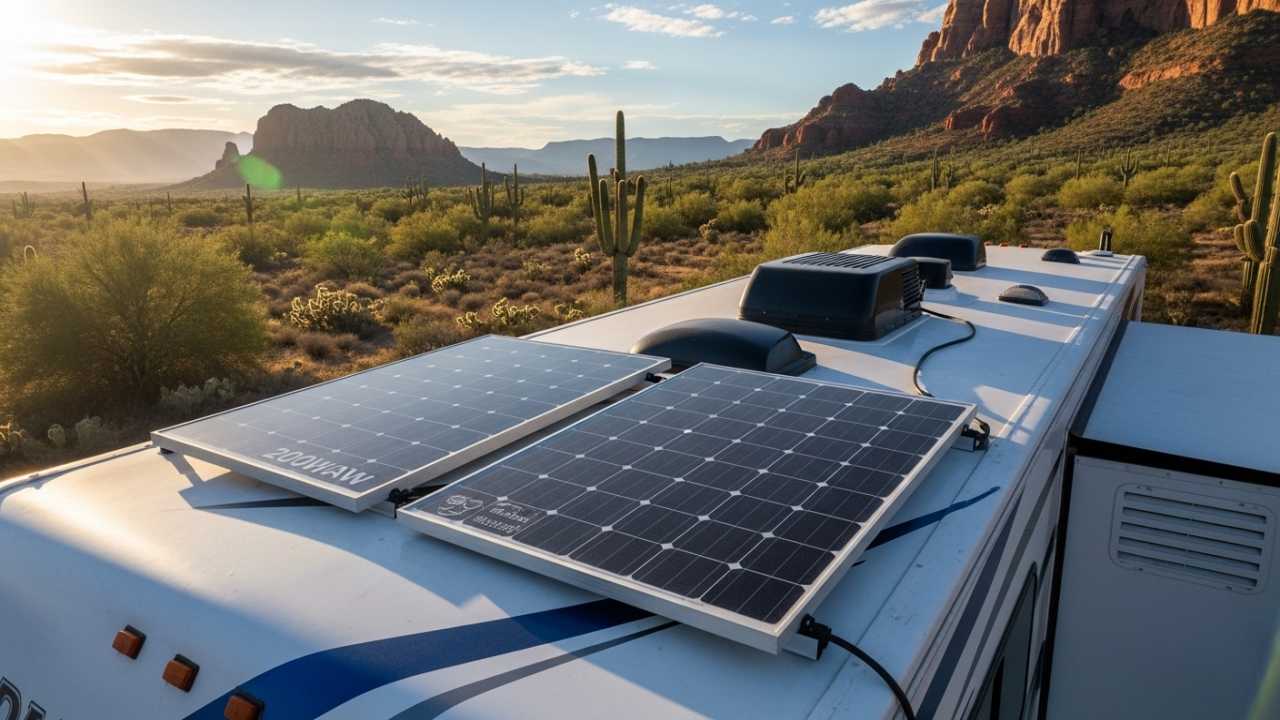
Let’s compare actual output from the same two 200-watt panels wired differently.
Panel specs:
- Each panel: 37V nominal, 5.4A nominal
- Total power: 400 watts
Series configuration:
- Total voltage: 74V
- Total amperage: 5.4A
- Total power: 399W
With an MPPT controller attached to a 48V battery:
- MPPT steps the 74V input down to 48V (the battery voltage)
- In doing so, it increases the current proportionally
- Output to battery: roughly 48V, 8.3A = 399W (minus small MPPT losses)
- Daily charge into battery: ~25-30 amp-hours on a sunny day (depending on sun hours)
Parallel configuration:
- Total voltage: 37V
- Total amperage: 10.8A
- Total power: 399W
With a PWM controller attached to a 48V battery:
- The controller doesn’t step voltage efficiently; it just switches power on/off
- PWM drops the excess voltage as heat
- Output to battery: roughly 48V, 8.3A = 399W (minus PWM losses)
- Daily charge into battery: ~20-25 amp-hours on a sunny day
Real difference: Series with MPPT delivers 5-10 more amp-hours per day than parallel with PWM on the same sunny day. Over a week, that’s 35-70 more amp-hours—the difference between comfortable and cramped power reserves.
But here’s the catch: If one panel gets shaded (by a tree, antenna, or vent):
Series configuration: One shaded panel throttles the entire string. Output might drop from 5.4A to 2.7A (the shaded panel produces half power). Total output: ~200W instead of 400W. Loss: 50%.
Parallel configuration: The shaded panel throttles itself, not the whole string. The shaded panel drops to 2.7A, but the sunny panel keeps producing 5.4A. Total output: ~300W. Loss: 25%.
Parallel wins when shade is a factor. Series wins when shade isn’t an issue.
The Verdict: Which Configuration Is Better?
Choose series if:
- You have an MPPT charge controller (most modern RVs do)
- You rarely encounter shade where your panels are mounted
- You want maximum efficiency and daily charge accumulation
- You’re running a 48V battery bank (higher voltage benefits from series)
The series is the better choice for most RV owners with modern systems. MPPT controllers are now standard, and the efficiency gain is significant—roughly 15 to 20 percent more output than parallel.
Choose parallel if:
- You have a PWM controller (older systems or budget setups)
- You’re running a 12V system (high current is less of a problem)
- Your RV parks under trees or in partially shaded spots regularly
- You want to add panels later (easier to add another parallel string)
Parallel is better if shade is unavoidable or if your controller is PWM. The shade-tolerance alone is worth it for RVs that camp in variable light.
The hybrid approach (best of both worlds): Many RV owners with modern MPPT controllers use two parallel strings in series. Example: two panels in series, then that string in parallel with another string of two panels.
This gives you:
- High enough voltage for MPPT to work efficiently
- Shade tolerance (one shaded string doesn’t kill the other)
- Better scalability (add more strings as needed)
This setup is common in larger RV solar systems and is the sweet spot if you have space for 4+ panels.
Real-World Considerations
Temperature impact: Series wiring is better in cold climates. Panel voltage increases in cold weather (counterintuitively, solar panels are more efficient at lower temperatures). Series configuration gets even higher voltage in winter, which is excellent for MPPT controllers. Parallel configurations see the same voltage regardless of temperature, so they don’t gain this benefit.
Wiring cost and installation: Series is cheaper. You run two wires from the rooftop to the charge controller—one positive, one negative. Parallel requires either a combiner box (a junction box with breakers or fuses for each string) or a dual-input charge controller. A combiner box adds $50-$200 and complexity.
Future expansion: If you start with one panel and plan to add more later, parallel is simpler. You can add another panel to the parallel string without reconfiguring. Series expansion requires more planning because voltage quickly becomes too high (more than 100V is risky for small controllers).
Battery bank size: The larger your battery bank, the more series wiring benefits you. A 48V system with 200Ah of lithium can absorb the high current from MPPT-optimized series wiring. A 12V system with 100Ah is limited by current-handling (very thick wires needed for 100+ amps), making parallel more practical despite lower efficiency.
FAQ: RV Solar Wiring Configuration Questions
1. Can I mix series and parallel on the same charge controller?
Yes, and this is actually recommended for larger systems. Run two or three panel strings in series, then connect those strings in parallel to your charge controller (or through a combiner box). This gives you enough voltage for MPPT to work efficiently while providing shade tolerance. Most MPPT controllers can handle two inputs, but check your controller’s specs—some are limited to one series string.
2. If I have an MPPT controller, does wiring really matter that much?
It matters, but less than with PWM. MPPT can handle parallel wiring more gracefully than PWM because it can adjust both voltage and current. That said, series wiring is still 10-15 percent more efficient because MPPT works best with higher input voltage. If efficiency isn’t critical (you have plenty of sun), parallel with MPPT is fine.
3. What happens if I accidentally wire panels in series-parallel incorrectly?
If you reverse polarity on one panel, the whole string shuts down—the reversed panel blocks current flow. Your controller shows 0V. Check your connections: positive to positive, negative to negative. If you wire a panel backward (180 degrees), it’s not immediately dangerous, but it produces 0W. If you wire three panels in series and accidentally parallel the third one, you’ll get unusual voltage readings that confuse your controller. Always take a photo of your wiring diagram before any work.
4. My RV is parked mostly in shade. Is series or parallel better?
Parallel, without question. If shade is chronic (like under a carport or among trees), a series configuration will disappoint you. You’ll lose 40-60 percent of output when one panel gets partial shade. Parallel loses only 10-20 percent because the shaded panel doesn’t drag down its neighbors. This is the primary reason some RV owners stick with parallel despite owning MPPT controllers.
5. Can I switch from series to parallel after installation, or do I have to rebuild?
If you started with a series, switching to parallel requires: (1) disconnecting panels from the controller, (2) rewiring them in parallel, (3) potentially installing a combiner box, and (4) reconfiguring the controller (some controllers need settings changed based on input voltage). It’s not hard—maybe 2 hours of work—but it’s not trivial. Plan your configuration from the start. If you’re uncertain, start with parallel and upgrade to series later (easier transition).
Installation Tips for Both Configurations
For series wiring:
- Use the correct breaker size (match your panel’s maximum current rating, usually 5-15A per string)
- Use a fused disconnect switch between panels and controller
- Keep total voltage below your controller’s maximum (usually 100-150V)
- Check voltage after connecting but before connecting to the controller to verify correct series connection
For parallel wiring:
- Use a combiner box with individual breakers for each string (required by code in most areas)
- Match wire gauge to the amperage (thicker wire for more amps)
- Check that all panels are the same voltage before connecting in parallel
- Verify that each string has its own breaker rated to that string’s maximum current
For hybrid (series-parallel):
- Keep each series string below 100V (two 50V panels max)
- Use a combiner box to join the strings in parallel
- This is the safest, most scalable approach for 4+ panel systems
The Bottom Line
Series wiring with MPPT delivers 15-20 percent more efficiency than parallel—if shade isn’t an issue. Parallel offers 25 percent better performance when one panel is shaded. Most modern RV owners with MPPT controllers choose series because they park in open sunlight and the efficiency gain is substantial.
The hybrid approach (series-parallel) is the best choice if you have 4+ panels and want both efficiency and shade tolerance. It costs slightly more but gives you the benefits of both configurations.
Start by knowing your charge controller type. If it’s MPPT and you have good sun exposure, series wins. If it’s PWM or you’re shadowed regularly, parallel is better. Either way, you’ll have a reliable solar system—the configuration difference is about optimization, not viability.
Also Read:-