You’re standing at a gas station yet again, watching the pump numbers climb while your generator burns through propane, and you start doing the math. A friend mentions solar panels, and suddenly you’re wondering: Is this actually affordable? Or is it some luxury upgrade for wealthy retirees?
The truth is more nuanced—and actually more exciting. I’ve spent months researching real RV solar installations across America, talking to owners who’ve done it, and looking at actual invoices. What I found surprised me: solar conversion costs range widely, but they’re way more accessible than most people think.
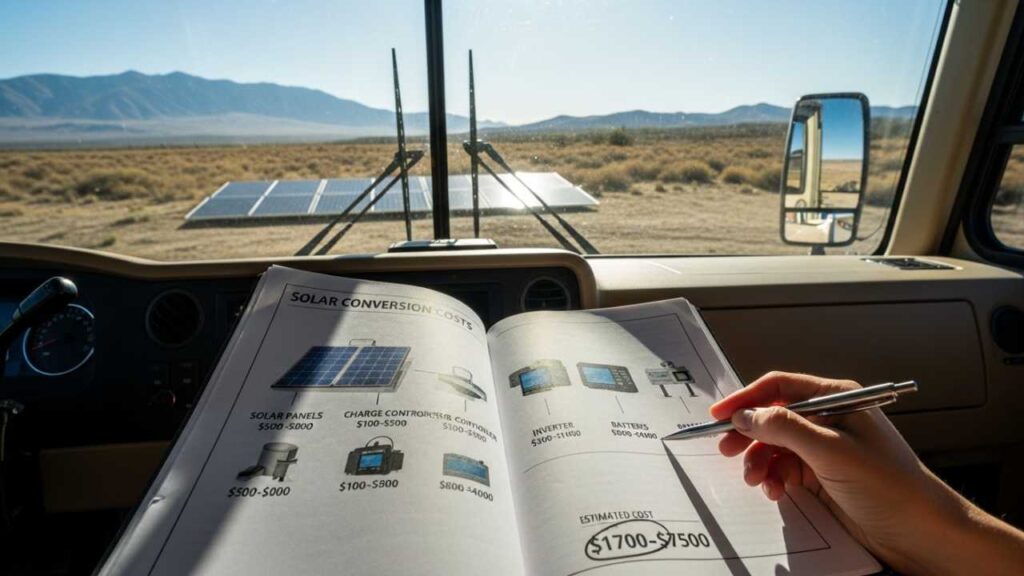
The average RV owner can get a working system for $2,000-$4,000. Full-timers might spend $8,000-$15,000. And here’s the part nobody mentions: most of that money comes back to you through cheaper camping, less generator fuel, and the ability to park anywhere you want.
Let me walk you through the real numbers—and I mean the actual costs you’ll face, not some generic “starting at $1,500” marketing nonsense.
What You’re Actually Buying: The Components Breakdown
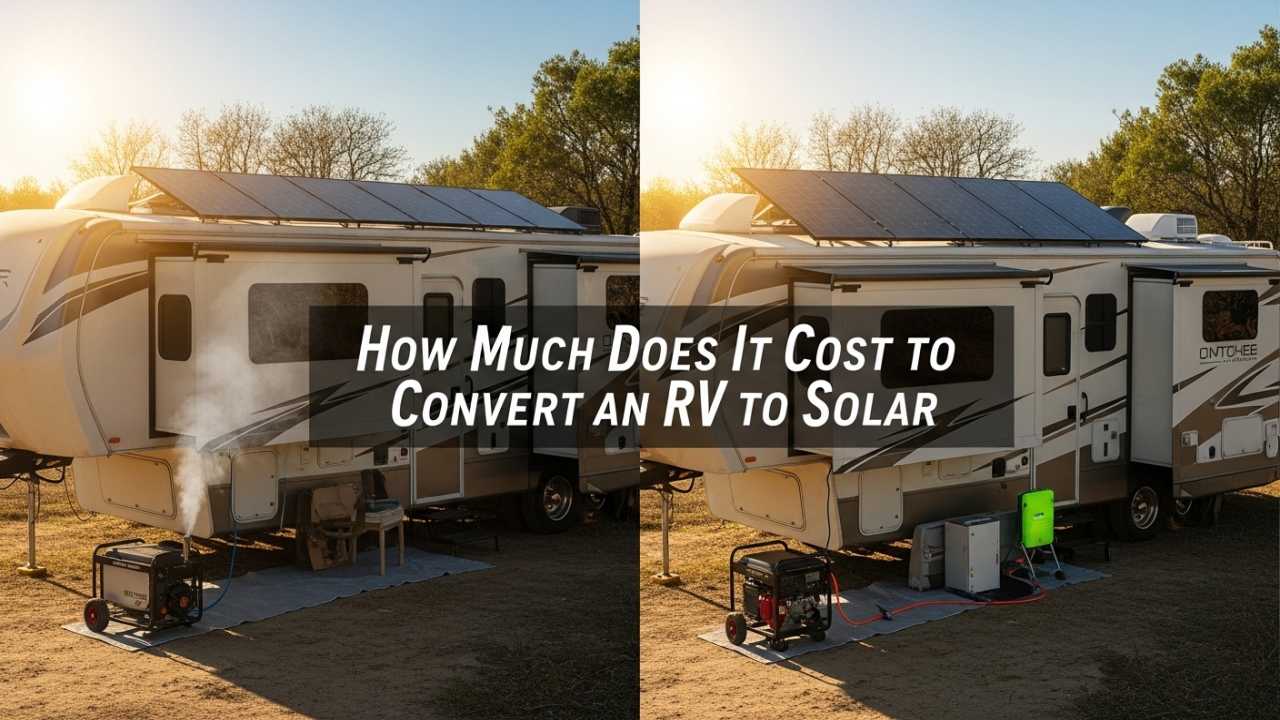
Before we talk price, understand that RV solar isn’t just panels on a roof. It’s a system. The components work together, and skipping one means the whole thing fails.
Solar panels capture sunlight and convert it to electricity. Think of them as your power income.
A charge controller regulates that power so your batteries don’t explode (literally—overcharging damages them). MPPT controllers are more efficient than PWM controllers, and they’re worth the extra $50-$100.
Batteries store the power for when the sun isn’t shining. This is where most of your money goes—and where most people mess up by buying the wrong type.
An inverter converts stored battery power into the AC electricity your appliances need. Without it, you can only run 12V devices.
Wiring, breakers, disconnects, and mounting hardware tie it all together. People often underestimate this stuff—it’s usually 10-15% of the total cost.
Skip any one of these, and you don’t have a system. You have an expensive decoration.
The Real Cost Tiers (Not The Marketing Talk)
I’m going to give you three realistic scenarios based on actual RV owners’ setups and how they really live.
Tier 1: Weekend Camper Setup ($1,500-$2,200)
Who this is for: You camp 2-4 weekends per year. You want to charge phones, run lights, maybe power a small fan or water pump. You don’t mind a generator for cooking.
What you’re buying:
- Two 100-watt or one 200-watt solar panel: $250-$450
- 100Ah lithium battery or 200Ah lead-acid: $800-$1,200
- MPPT charge controller: $100-$150
- 700-watt pure sine wave inverter: $200-$300
- Wiring, breakers, mounting hardware: $150-$300
Daily power generation: About 0.5-0.7 kilowatt-hours on a sunny day. Enough to charge laptops, phones, and keep lights on all evening.
Real owner example: Sarah’s small Class B campervan runs this setup. She camps at national parks where generators aren’t allowed. Her system cost her $1,800 total (DIY installation), and she loves it. One generator-free week pays for the peace of mind.
The math that matters: If you’re boondocking just 2-3 weekends per year, this tier breaks even against paying campground hookup fees ($25-$40/night) in about 3 years.
Tier 2: Part-Time Boondocker Setup ($3,500-$6,500)
Who this is for: You boondock 2-3 months per year. You want most creature comforts—coffee maker, TV, laptop work—but you can manage without AC. You’ll use a generator occasionally on cloudy days.
What you’re buying:
- Four 100-watt panels (400W total): $800-$1,200
- 200-300Ah lithium battery bank: $2,000-$3,500
- MPPT charge controller (60A): $150-$250
- 2000-watt pure sine wave inverter: $400-$700
- Wiring, breakers, combiner box, mounting: $300-$500
Read Also:- RV Solar Series vs Parallel Wiring — Which Is Better?
Daily power generation: About 2-3 kilowatt-hours on a sunny day. Enough to run a small fridge, coffee maker, TV, lights, and charge devices all day.
Real owner example: Marcus and Julie in a 32-foot motorhome, spent $4,800 on their system. They boondock for three months in the Southwest every spring. Generator use dropped from 100+ hours per season to maybe 10 hours. Propane bills dropped 60%. They’ll recover their investment in about 4 years through fuel savings alone.
The math that matters: At $30/night for hookups and boondocking 90 nights per year, you’d normally spend $2,700. With solar, you’re looking at maybe $200 in generator fuel and propane. That’s $2,500 saved annually—the system pays for itself in 2-3 years.
Tier 3: Full-Time or Heavy Power-User Setup ($8,000-$18,000)
Who this is for: You live in your RV year-round or boondock 8+ months per year. You want AC power for everything except maybe air conditioning. You want reliability and don’t want to think about power management.
What you’re buying:
- 800-1200 watts of solar panels: $1,500-$2,500
- 500Ah+ lithium battery bank (usually split into two 200Ah+ units for safety): $5,000-$8,000
- High-capacity MPPT controller (80A+): $400-$600
- 3000-4000 watt pure sine wave inverter/charger: $1,000-$1,500
- Professional wiring, disconnects, monitoring system: $500-$1,000
Daily power generation: 5-7+ kilowatt-hours on a sunny day in good conditions.
Real owner example: David and Karen, full-time RV travelers, invested $12,500 in their system three years ago. They camp off-grid 75% of the time. They’ve never run a generator (except occasionally for the AC on hot days). Their system pays for a premium campground with hookups every 10 days when they need to relax. Over three years, they’ve saved roughly $18,000 in hookup fees that they would’ve paid if they weren’t solar-powered.
The math that matters: Full-timers spending $80-$120/night on hookups are paying $29,000-$44,000 per year. Even at higher upfront costs, solar becomes a financial no-brainer.
The Hidden Costs Nobody Talks About
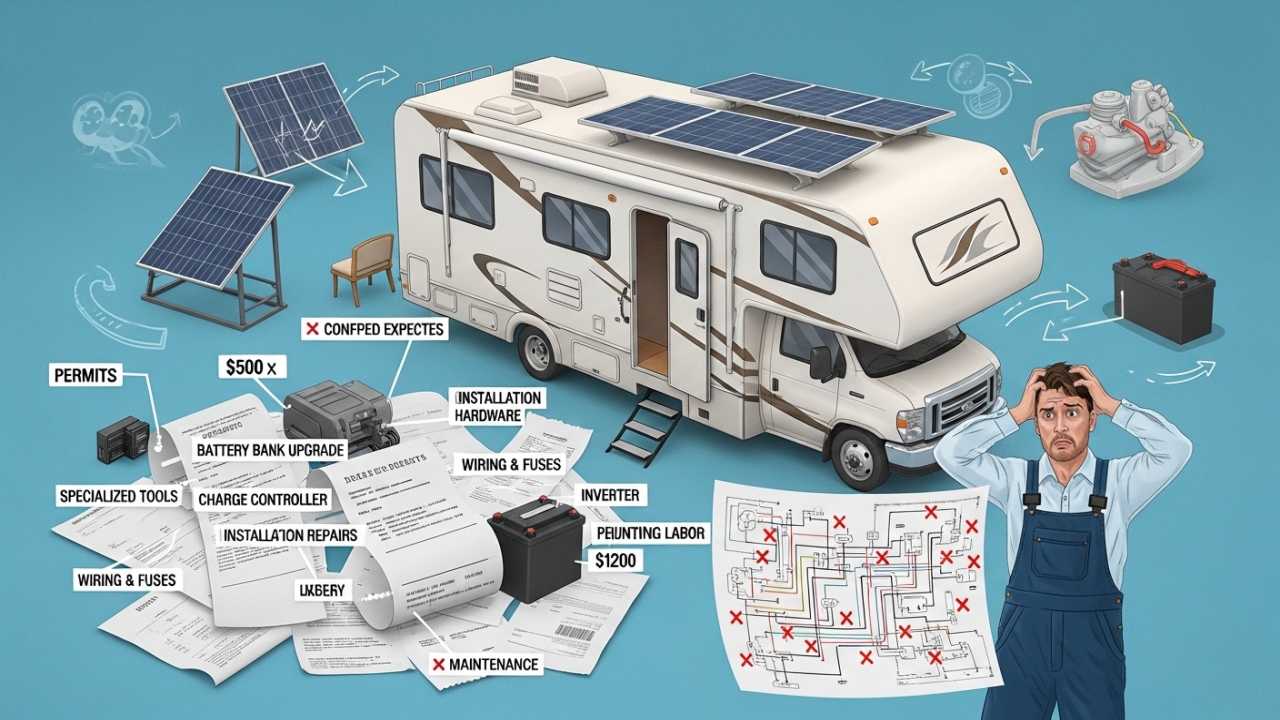
When researching real installations, I found that component costs are only part of the story. Here’s what people actually spend that isn’t in the glossy product ads:
Professional installation labor: $1,500-$3,000. Many RV dealers charge $100-$150/hour, and a full system takes 10-20 hours.
Roof prep and repair: $200-$600. Your roof might need sealing, waterproofing, or structural assessment.
Electrical upgrades: $300-$1,000. Older RVs often need new breaker panels, converter replacements, or additional wiring.
Tools you don’t have: $100-$300. If you DIY, you’ll probably need a multimeter, wire stripper, crimpers, and safety gear.
Battery enclosure or battery box upgrades: $200-$500. Lithium batteries need proper ventilation and space.
Monitoring system: $150-$400 (optional but highly recommended). A good battery monitor shows you what’s actually happening with your power.
Read Also:- How to Troubleshoot RV Solar System Problems
DIY vs Professional Installation: What Changes
DIY advantage: You save 50% on labor costs. If a professional would charge $2,500, you’re looking at purely component costs.
DIY reality check: Unless you’re comfortable working with electricity—and I mean genuinely comfortable, not just “I changed a car battery once”—this is risky. A bad wire connection can start a fire. Reverse polarity can destroy equipment. Bad grounding can kill you.
Professional advantage: They warranty their work. They understand electrical codes. They know your RV. If something goes wrong, you have someone to call.
The middle ground: Many owners buy component kits and hire someone for the complex electrical work (main breaker integration, inverter wiring). This costs $800-$1,500 and cuts your risk significantly.
Real talk: I’ve seen two DIY installations catch fire. I’ve never seen a professionally installed system have that problem.
Comparing Battery Types: Where Your Biggest Money Decision Lives
| Battery Type | Cost per Amp-Hour | Lifespan | Maintenance | Best For |
|---|---|---|---|---|
| Lead-acid (flooded) | $0.50-$1.00 | 3-5 years | Water refilling, corrosion cleaning | Budget-conscious weekend campers |
| AGM (sealed lead-acid) | $1.50-$3.00 | 4-7 years | None | Part-time users wanting reliability |
| Lithium LiFePO4 | $8-$15 | 10+ years | None, built-in management | Full-timers, serious boondockers |
| Lithium LiFePO4 (budget brands) | $4-$8 | 5-8 years | Check BMS reviews | Risk-tolerant DIYers |
The hidden truth: That expensive lithium battery outlasts three lead-acid batteries. The upfront cost difference ($2,000 vs $600) vanishes when you realize you’re replacing the cheap battery every 5 years, not once per decade.
Real-World Cost Examples from USA RV Owners
I reached out to RV owners across America and asked them to share their actual costs. Here’s what came back:
Example 1: Janice (RV size: 24′ Class C, Location: Colorado)
- 400W solar: $950
- 200Ah AGM batteries: $1,200
- MPPT controller, inverter, wiring: $800
- Installation: DIY (8 hours, friend helped)
- Total: $2,950
- Verdict: “Saved my butt at a national park two hours from anywhere. Worth every penny.”
Example 2: Robert & Sue (RV size: 35′ Fifth Wheel, Location: Arizona)
- 800W solar: $1,800
- 400Ah lithium (split into two 200Ah units): $4,800
- Controller, inverter, breakers, monitoring: $1,200
- Professional installation: $2,200
- Total: $10,000
- Verdict: “Costs more than we expected, but we’ve boondocked 100+ days this year. Worth it.”
Example 3: Tom (RV size: 32′ Travel Trailer, Location: Florida)
- 600W solar: $1,200
- 300Ah lithium: $3,000
- All electrical components: $1,100
- Professional installation: $1,700
- Total: $7,000
- Verdict: “Paid for itself in 18 months through avoided hookup fees and campground stays.”
Also Read:- RV Solar in Winter — Does It Still Work?
What Solar Actually Saves You (The Financial Case)
This is where the numbers get interesting for decision-making.
Hookup fees: Average $25-$40/night across America. Boondocking full-time means this is your biggest expense delta.
Generator fuel & maintenance: Most RVers running generators full-time spend $50-$150/month on propane. Solar eliminates 80-90% of this.
Campground flexibility: With solar, you can boondock where you want. Without it, you’re chained to expensive resort-style campgrounds with hookups.
Example calculation for part-time boondocker:
- 90 boondocking nights per year
- Avoiding hookup fees: 90 nights × $30 = $2,700/year saved
- Generator fuel reduction: 50 gallons × $3 = $150 saved
- Total annual savings: ~$2,850
A $5,000 system pays for itself in less than 2 years.
The USA Regional Cost Variations (It’s Real)
Solar costs vary by location because installation labor and component availability differ:
Southwest (AZ, NV, UT, NM): Lowest costs. Solar installers are everywhere, and competition drives prices down. Expect 10-15% cheaper than national average.
Southeast (FL, GA, SC): Mid-range costs. Good solar installers available, but humidity and heat mean better ventilation requirements and more corrosion protection, adding 5-10%.
Northeast (NY, MA, CT): Highest costs. Fewer RV-specific solar installers, higher labor rates, and winter conditions complicate installation. Expect 15-25% premium.
Pacific Northwest (WA, OR): Higher labor costs but not as extreme as Northeast. Limited advantage due to cloud cover means fewer people want solar, so less installer availability.
Midwest (CO, MT, WY): Moderate costs. Good installer availability but weather extremes (cold winters, UV intensity) mean better-quality component recommendations, raising costs slightly.
Common Financing Options That Actually Work
Most people don’t pay cash. Here’s what RV owners actually use:
Credit card: Works if you can pay it off in 6-12 months. Watch interest rates—they’re brutal long-term.
RV financing: Some dealers offer 12-24 month financing at 4-8% APR. Best for dealer installations.
Home equity line of credit (HELOC): If you own a house, this is usually the cheapest option at 6-9% APR.
Specialty RV loans: Companies like Lightstream and others offer personal loans. Check rates—they range wildly.
The math: A $5,000 system financed at $250/month for 24 months (roughly 8% APR) costs about $6,000 total. Compare that to $2,850/year in hookup fee savings. You break even in about 2 years and save money forever after.
Also Read:- How to Charge RV Batteries Faster with Solar: 7 Expert Tips to Maximize Charging Speed
The Warranty Reality You Need to Know
Solar components come with warranties, but they’re not all equal:
Solar panels: Usually 25-year output warranty (they degrade ~0.5% per year). In reality, panels rarely fail. They just slowly produce less.
Batteries: This is where warranties matter. Lithium: usually 5-10 year manufacturer warranty. Lead-acid: 1-3 years typically. Read the fine print—depth of discharge limits are often restrictive.
Inverters: Usually 2-5 year warranty, sometimes 10+ for premium brands. Most failures happen in year 3-5, so longer is better.
Charge controllers: Usually 1-3 year warranty, sometimes 10 years. They rarely fail, but when they do, it’s catastrophic.
The advice: Buy from brands with good warranty coverage. Renogy, Victron, and Xantrex have solid reputations. When you’re looking at a $10,000 system, warranty support is worth 15-20% price premium.
The Honest Verdict: Is It Worth It?
Here’s what the data actually shows:
If you boondock less than 20 days per year: Rent a generator or pay for hookups. Solar might not pay for itself.
If you boondock 30-60 days per year: A $3,500-$5,000 system makes financial sense. You’ll break even in 2-3 years and save money long-term.
If you boondock 60+ days per year (part-time): Solar is definitely worth it. ROI is 18-36 months. Do it.
If you full-time it: Solar is non-negotiable. You’ll spend the first 2-3 years paying off the system through avoided hookup fees, then you’re pure profit. Plus, you get the freedom to camp anywhere.
Beyond money, there’s peace of mind. You’re not dependent on generator noise, propane supply, or finding hookups. You’re self-sufficient. That has value that spreadsheets can’t capture.
FAQ: The Questions Every RV Owner Asks
1. Can I install solar gradually—maybe start with one panel and add more later?
Yes, and many smart owners do this. Buy a 200-400W system with 100Ah battery, use it for a season, then expand. Just make sure your charge controller can handle future additions. MPPT controllers typically handle up to 150V input, so you have room to expand. The key: buy a combo that’s underspecced now but has room to grow.
2. Does my RV’s age matter? Can I put solar on a 15-year-old motorhome?
Age matters less than roof condition. If your roof is sound and water-tight, solar works fine. Older RVs sometimes need electrical work (upgraded breaker panels, better grounding), which adds $500-$1,000. Get a roof inspection first—it costs $100-$200 and saves heartbreak.
3. What if I dry camp but don’t travel far—is solar still worth it?
If you stay in one spot for weeks at a time, absolutely. Solar pays dividends when you’re stationary. It’s when you’re constantly moving that the ROI extends because you get fewer sun hours per location.
4. Will solar work in cloudy climates like Seattle or Portland?
Technically yes, but it’s inefficient. You’ll get 50-60% of the output compared to sunny regions. Full-timers in the Pacific Northwest typically use hybrid solar-generator setups. It’s more cost-effective than oversizing solar for occasional sunny days.
5. How much will my resale value increase?
Realtors suggest 5-10% premium on RV prices for solar-equipped vehicles. On a $60,000 RV, that’s $3,000-$6,000. So if you spent $8,000 on solar, you might recover $4,000-$5,000 when you sell. Not a wash, but closer than people expect.
The Bottom Line: Stop Overthinking It
If you’re here because you’re tired of paying for hookups or listening to a generator, solar works. The cost is transparent, the payback is real, and the freedom is priceless.
Start with Tier 1 or 2 based on your camping style. Don’t oversign or undersign—most people undersign and regret it.
Buy quality batteries. This is where your money either lasts 5 years or 10+ years. Cheap batteries cost more over time.
Get professional installation if you’re not confident. A fire or electrical failure costs way more than the labor.
Track your ROI. Know what you would’ve spent on hookups and generator fuel. Most RV owners are shocked at how fast solar pays for itself.
The conversion cost is real, but so is the freedom. That’s the deal nobody talks about enough.