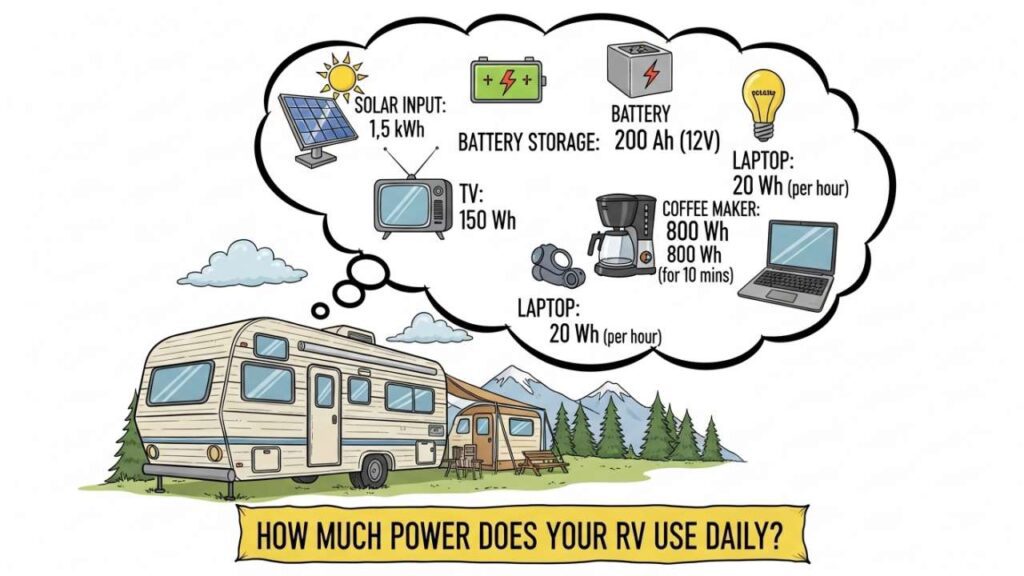
You’re sitting in your RV at a beautiful boondocking site, sun setting over the mountains, and you realize something terrifying: you have no idea if your solar system will actually power your fridge overnight, keep the lights on tomorrow, and charge your laptop. You didn’t calculate your power needs before buying panels. Most RV owners don’t.
That’s a problem because undersized solar systems don’t just disappoint you—they destroy your whole RV lifestyle. You’re rationing power, running generators constantly, and basically living in the dark half the time.
The good news? Calculating your actual power consumption is simpler than you think. It’s literally just multiplication and addition. Within 30 minutes, you’ll know exactly how many panels and batteries you need.
Why RV Power Consumption Matters More Than You Think
Here’s what most people get wrong: they buy solar panels based on a gut feeling or a salesman’s recommendation. Then they get out on the road and reality hits hard.
A properly sized RV solar system does three things at once:
- Generates enough power on sunny days to cover what you use
- Stores enough energy in batteries for cloudy days and nighttime
- Keeps you from running a generator (which is loud, expensive, and defeats the purpose of boondocking)
The only way to accomplish all three is to actually calculate your power consumption. Not estimate. Calculate.
Why? Because RV power consumption is incredibly personal. A couple who boondocks in winter needs way more battery capacity than weekend campers in summer. Someone who uses AC all day needs a completely different system than someone who manages without it.
Your power consumption is the foundation for everything else. Get this number wrong, and nothing else matters.
Also Read:- Best RV Solar Panels for New Mexico Extreme Heat (2026 Desert Solar Guide)
Understanding the Basics: Watts, Watt-Hours, and Amp-Hours
Before we do any math, you need to understand three terms. They’re not complicated—they’re just units of measurement.
Watts (W): This is power—the amount of electricity something uses right now. Your fridge might draw 150 watts while the compressor is running.
Watt-Hours (Wh): This is energy over time. If your fridge runs at 150 watts for 8 hours, it uses 1,200 watt-hours (150 × 8 = 1,200).
Amp-Hours (Ah): This is the same thing as watt-hours, just measured differently. Batteries are rated in amp-hours. You convert between them using your voltage (usually 12V for RVs).
Here’s the simple conversion: Amp-Hours × Voltage = Watt-Hours
So a 100 amp-hour battery at 12V stores 1,200 watt-hours.
For this guide, we’ll use watt-hours because it’s more intuitive. We’ll convert to amp-hours at the end if you need batteries.
RV Appliance Power Consumption
This is your starting point. Find your appliances and note the wattage. Most appliances have a label on the back or bottom. If you can’t find it, Google “[appliance name] wattage” and you’ll get results in seconds.
| Appliance | Typical Wattage | Daily Usage (Hours) | Daily Wh |
|---|---|---|---|
| REFRIGERATOR | 150W | 24 | 3,600 Wh |
| 12V Refrigerator | 80W | 24 | 1,920 Wh |
| Lights (LED, 1 fixture) | 10W | 6 | 60 Wh |
| Lights (LED, 4 fixtures) | 40W | 6 | 240 Wh |
| TV (32-inch LED) | 80W | 4 | 320 Wh |
| Laptop (charging) | 65W | 3 | 195 Wh |
| Phone (charging) | 10W | 2 | 20 Wh |
| Water Pump | 12W | 2 | 24 Wh |
| Ceiling Fan | 25W | 8 | 200 Wh |
| Microwave (1500W peak) | 1,500W | 0.5 | 750 Wh |
| Coffee Maker | 1,000W | 0.25 | 250 Wh |
| Air Conditioner (15K BTU) | 1,500W | 4 | 6,000 Wh |
| Propane Furnace (12V blower) | 40W | 4 | 160 Wh |
| Bathroom Exhaust Fan | 12W | 1 | 12 Wh |
| USB Chargers | 5-10W each | 3 | 15-30 Wh |
| CPAP Machine | 80-120W | 8 | 640-960 Wh |
| Laptop (gaming/intensive) | 120W | 2 | 240 Wh |
- Most small devices barely matter (phone, USB chargers)
- Fridge is your baseline load (24/7, always there)
- AC is the power monster (unless you’re okay using a generator)
- Microwave and coffee maker have high peak watts but low duration
- LED lights are your friend (pennies of power consumption)
Also Read:- Santa Fe RV Solar (2026): Complete High-Altitude Desert Power Guide
Step-by-Step: Calculate Your Daily Power Consumption
Now let’s do the actual calculation. I’ll walk through a real example so you can see how this works.
Step 1: List Every Device You Actually Use
Don’t list “things I might use someday.” List what you actually use. Here’s a typical example:
Sarah’s Weekend RV (used 2-3 days/week):
- 12V refrigerator (24 hours/day)
- 4 LED lights (6 hours/day combined)
- TV (4 hours/day)
- Laptop (charging, 3 hours/day)
- Water pump (2 hours/day)
- Ceiling fan (4 hours/day summer)
- Phone (charging, 1 hour/day)
- Occasional microwave (20 minutes, 1-2 times/week)
Step 2: Find the Wattage of Each Device
Most have labels. Sarah checks:
- 12V fridge: 80W (found on label inside)
- LED lights: 10W each (Google “12V LED RV light”)
- TV: 80W (spec sheet online)
- Laptop: 65W (power adapter label)
- Water pump: 12W (specs online)
- Ceiling fan: 25W (label on fan)
- Phone: 5W (charger label)
- Microwave: 1,200W (label inside)
Step 3: Calculate Watt-Hours for Each Device
Use this formula: Watts × Hours = Watt-Hours
| Device | Wattage | Hours/Day | Watt-Hours/Day |
|---|---|---|---|
| 12V Fridge | 80W | 24 | 1,920 |
| LED Lights (4) | 40W | 6 | 240 |
| TV | 80W | 4 | 320 |
| Laptop Charging | 65W | 3 | 195 |
| Water Pump | 12W | 2 | 24 |
| Ceiling Fan | 25W | 4 | 100 |
| Phone Charging | 5W | 1 | 5 |
| SUBTOTAL (regular use) | — | — | 2,804 Wh/day |
| Microwave (2x/week average) | 1,200W | 0.33 | 396 Wh/week = 56 Wh/day average |
| TOTAL DAILY AVERAGE | — | — | 2,860 Wh/day |
Also Read:- Albuquerque RV Solar Installation (2026): Top Shops, Cost Breakdown & DIY Setup Guide
Step 4: Determine Your Peak Power Demand
This is important because your inverter needs to handle the maximum watts you draw at one time.
If Sarah runs the microwave (1,200W) while the TV (80W) is on, that’s 1,280W peak. She needs an inverter rated for at least 1,500W to handle this safely (add 20% margin).
Your peak demand = the sum of the biggest things you’ll run simultaneously.
For Sarah: 1,200W (microwave) + 80W (TV) + 40W (lights) = 1,320W peak. She needs a 2,000W inverter to be safe.
Converting Watt-Hours to Amp-Hours (For Battery Shopping)
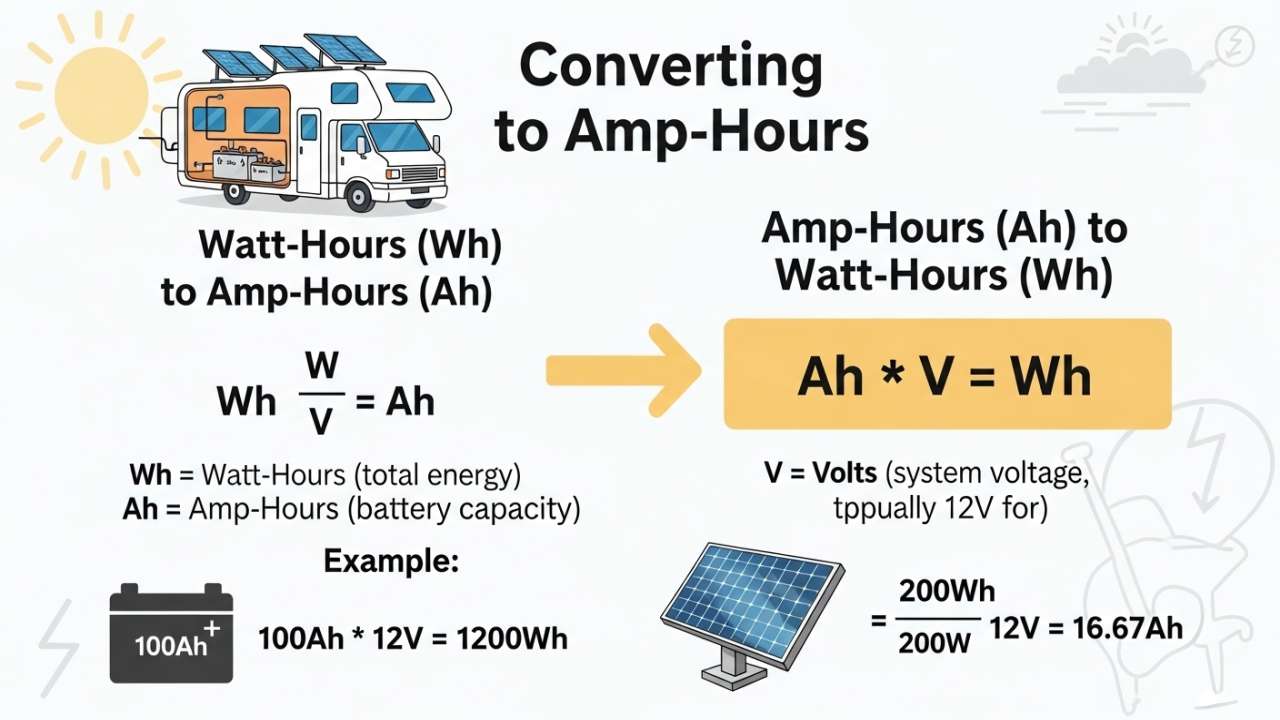
Now you know you need a system that handles 2,860 Wh per day.
Batteries are sold in amp-hours, so let’s convert:
Watt-Hours ÷ Voltage = Amp-Hours
Sarah’s system is 12V. So:
2,860 Wh ÷ 12V = 238 Amp-Hours
But wait—you need to account for battery discharge limits. Lead-acid batteries shouldn’t be discharged more than 50%. Lithium (LiFePO4) can go to 80%.
For Lithium: 238 Ah ÷ 0.8 = 298 Ah battery capacity (round to 300 Ah)
For Lead-Acid: 238 Ah ÷ 0.5 = 476 Ah battery capacity (round to 500 Ah)
Sarah should buy 300 Ah of LiFePO4 or 500 Ah of lead-acid. (Lithium is better, but more expensive.)
Now, How Many Solar Panels Do You Need?
Here’s where location matters. The amount of usable sunlight varies dramatically by where you are.
Typical usable sun hours per day:
- Summer in Arizona/New Mexico: 6-7 hours
- Summer in northern climates: 5-6 hours
- Winter in any climate: 3-4 hours
- Cloudy regions: 3-4 hours year-round
You’ll generate approximately 30 amp-hours per day for every 100W of solar panels in good sun (6 hours). In cloudy regions, cut that in half.
Sarah needs to replace 238 Ah per day in summer (6 hours of sun):
238 Ah ÷ (6 hours ÷ 5.5 amp average per 100W) = 238 Ah ÷ 1.09 = 218 Ah
To generate 218 Ah from panels at 5.5 A per 100W panel:
218 Ah ÷ 5.5A = 39.6 panels worth of 100W power
So approximately 400W of solar panels (four 100W panels or two 200W panels).
But add 25% buffer for cloudy days and inefficiency:
400W × 1.25 = 500W of solar panels recommended
The Final Output: Here’s What Sarah Needs
Based on her 2,860 Wh daily consumption:
Solar Panels: 500W (four 125W panels or two 250W panels)
Battery Bank: 300 Ah LiFePO4 (or 500 Ah lead-acid)
Inverter: 2,000W (to handle the 1,320W peak demand)
Charge Controller: MPPT 60A minimum (handles 500W array safely)
This system will:
- Power her fridge, lights, TV, and laptop indefinitely
- Handle occasional high-demand items like the microwave
- Work on sunny days without running a generator
- Survive 1-2 cloudy days on battery alone
Real Talk: The Air Conditioner Question
Here’s where RV solar conversations get honest: most people don’t size their systems for AC.
AC uses 1,500-2,000W continuously. Running it for 8 hours adds 12,000-16,000 Wh to your daily needs. That means:
- Battery bank: 1,000+ Ah (expensive)
- Solar panels: 2,000W+ (won’t fit on most RV roofs)
- Cost: $15,000+
Most RV owners do this instead:
- Size their solar for non-AC loads (like Sarah did)
- Run a generator for AC on hot days
- Use passive cooling (shade, fans, ventilation)
This is totally reasonable. You’re not “failing” if you use a generator for AC.
FAQ: Common Questions About RV Power Consumption
Q: What if I don’t know my appliance wattage?
A: Google “[appliance name] wattage RV” and you’ll find it instantly. Or look for the spec label on the device itself. Most modern devices have it clearly marked. If absolutely stuck, estimate conservatively high—it’s better to oversize than undersize.
Q: Do I really need to use all these devices at once?
A: No. But your inverter and charge controller need to handle it if you do. That’s why peak power demand matters. Size your components for the maximum simultaneous load you might reasonably use.
Q: Why is my fridge using so much power?
A: It runs 24/7. Even though it’s only drawing power when the compressor cycles (not continuously), the math shows it’s your biggest daily load. That’s why choosing a 12V fridge instead of a 120V AC fridge cuts your power needs nearly in half. It’s the single best efficiency improvement most RV owners can make.
Q: Should I just add more panels and batteries to be safe?
A: Yes, oversizing is good practice. Add 25% buffer to your solar and 20% buffer to your batteries. This covers cloudy days, aging panels, and higher-than-expected use. It’s cheaper to buy extra panels now than to upgrade later.
Q: What about winter boondocking?
A: Winter sun is weaker and shorter. Usable sun hours drop 30-50%. Your system might not fully recharge on cloudy winter days. Plan to either boondock less in winter, add portable panels, or run a generator during winter months. This is realistic planning, not failure.
Q: Can I run everything on 100W of solar panels?
A: You can temporarily, but you’ll drain your batteries faster than you recharge them. Over a week, you’ll go dead. Solar panels are like your RV’s engine—they need to be powerful enough to keep up with your consumption plus recharge batteries. Undersized panels mean constant generator use, which defeats the purpose.