It’s 6 AM at your favorite remote campground.
No hookups. No shore power. Just you, your RV, and silence.
But then the generator kicks on.
For the next 30 minutes, that diesel engine roars while you’re trying to enjoy your coffee. It’s burning $2–4 worth of fuel just to run your fridge and charge devices. Your neighbors give you the side-eye. And somewhere inside, you know there’s a better way.
Here’s what most RV owners don’t realize: that generator doesn’t have to run all day. With a proper battery backup system, you can power your RV for hours—sometimes a full day—on battery alone. Silence. No fuel cost. No guilt.
But “battery backup system” sounds complicated. Lithium vs. lead-acid? 100 amp-hours or 400? Do you need solar? How much does it cost?
This guide strips away the confusion. We’re walking through exactly what a battery backup system is, how to size it for your needs, and how to set it up so you genuinely can camp anywhere. Whether you’re boondocking for a weekend or living full-time off-grid, you’ll know exactly what you need.
What Is an RV Battery Backup System? (And Why It Matters)
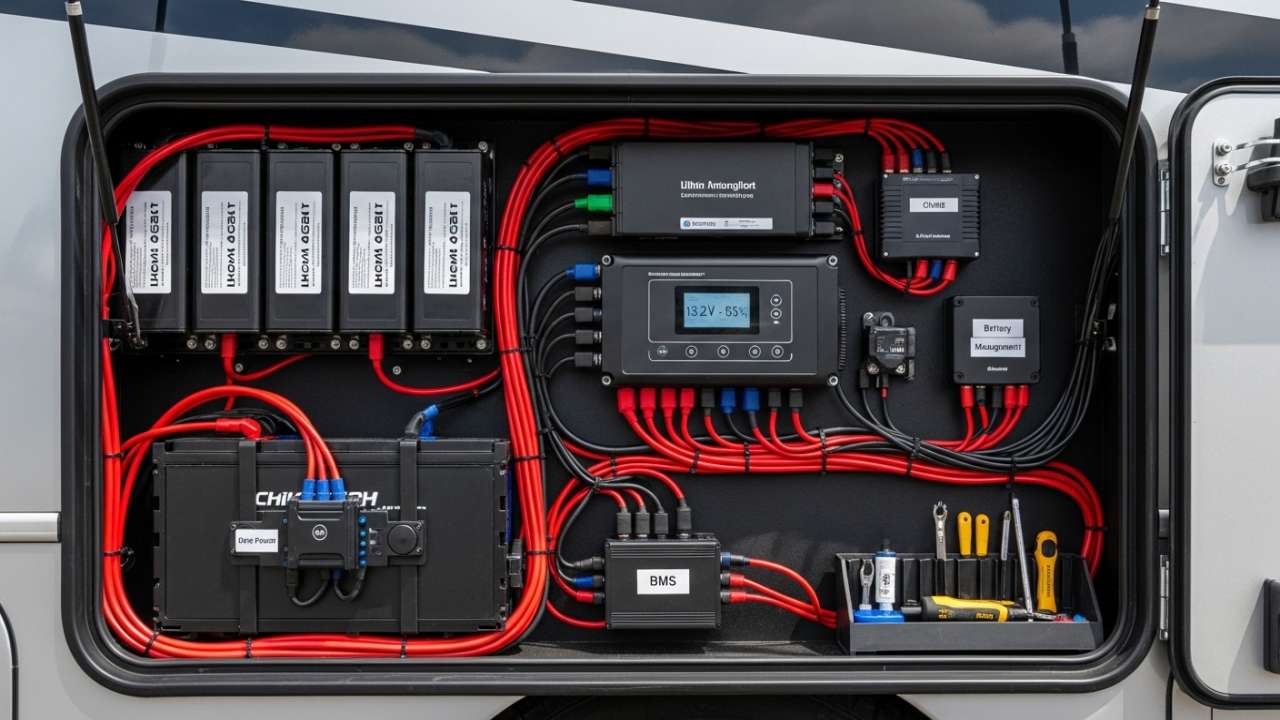
Your RV’s electrical system has two parts: 12-volt DC (your house battery) and 120-volt AC (your shore power system).
A battery backup system upgrades your 12V system so it can power your RV for extended periods without shore power or a generator.
Here’s the difference:
Stock RV System — One 200-amp-hour lead-acid battery. Runs lights, water pump, and fridge for maybe 12–24 hours before dying. Then you either hook up shore power or fire up the generator.
Upgraded Battery Backup System — Multiple lithium batteries (400–800 amp-hours total), a battery management system, and often solar panels. Runs everything for 2–5 days without generator or hookups. Some setups go even longer.
The key insight: your generator is an emergency backup now, not your daily power source.
Why this matters:
Silence — Generator off = peaceful mornings and evenings. Your neighbors aren’t woken up. You hear birds instead of diesel.
Fuel savings — Generators burn $1–2 per hour. A battery system eliminates that cost entirely for boondocking. Save $50–100+ per week.
Freedom — No campground fees. No hookups required. Park anywhere with your own power.
Longer camping trips — With solar adding charge during the day and batteries storing it, you can camp indefinitely without moving.
Reliability — Generators fail. Batteries don’t (with proper maintenance).
Quiet operation — Essential if you’re in quiet zones or near other RVers.
Think of a battery backup system as freedom. It’s the difference between being tethered to a generator and actually camping.
Also Read:- RV Solar System Cost 2026: Real Prices Nobody Tells You
Battery Types: Lead-Acid vs. Lithium vs. LiFePO4
Not all RV batteries are equal. The type you choose determines cost, lifespan, and performance.
Lead-Acid Batteries (Traditional)
These are what most stock RVs come with.
How they work: Chemical reaction produces electricity. When drained, you recharge them.
Pros:
- Cheap ($100–200 per 100 amp-hours)
- Familiar—every RV owner knows them
- Can handle overcharging slightly
Cons:
- Only 50% usable capacity (you can’t fully drain them without damage)
- Short lifespan (3–5 years)
- Heavy (30+ lbs per 100 amp-hours)
- Slow to charge
- Require maintenance (water top-ups on flooded types)
- Can’t handle cold well
Real math: A 200 Ah lead-acid battery actually gives you ~100 Ah of usable power. That’s 1,200 watts for one hour, or 600 watts for two hours. Not much.
Best for: Budget-conscious RVers who don’t mind running generator daily or staying at hookups.
Lithium (LiPO) Batteries
These are the middle ground—more expensive than lead-acid, cheaper than LiFePO4.
How they work: Lithium ions move between electrodes, creating current. Different chemistry than lead-acid.
Pros:
- 80–90% usable capacity (much more usable power than lead-acid)
- Longer lifespan (5–10 years)
- Lighter weight (15 lbs per 100 amp-hours)
- Fast charging
- Handle cold better than lead-acid
Cons:
- More expensive ($400–600 per 100 amp-hours)
- Need a battery management system (BMS) to prevent damage
- Can be damaged by over-discharging (require a cutoff system)
Real math: A 400 Ah lithium battery gives you ~320 Ah usable power. That’s 3,840 watts for one hour. Way more practical.
Best for: RVers who boondock regularly and want better performance than lead-acid.
LiFePO4 Batteries (Lithium Iron Phosphate) — THE BEST CHOICE
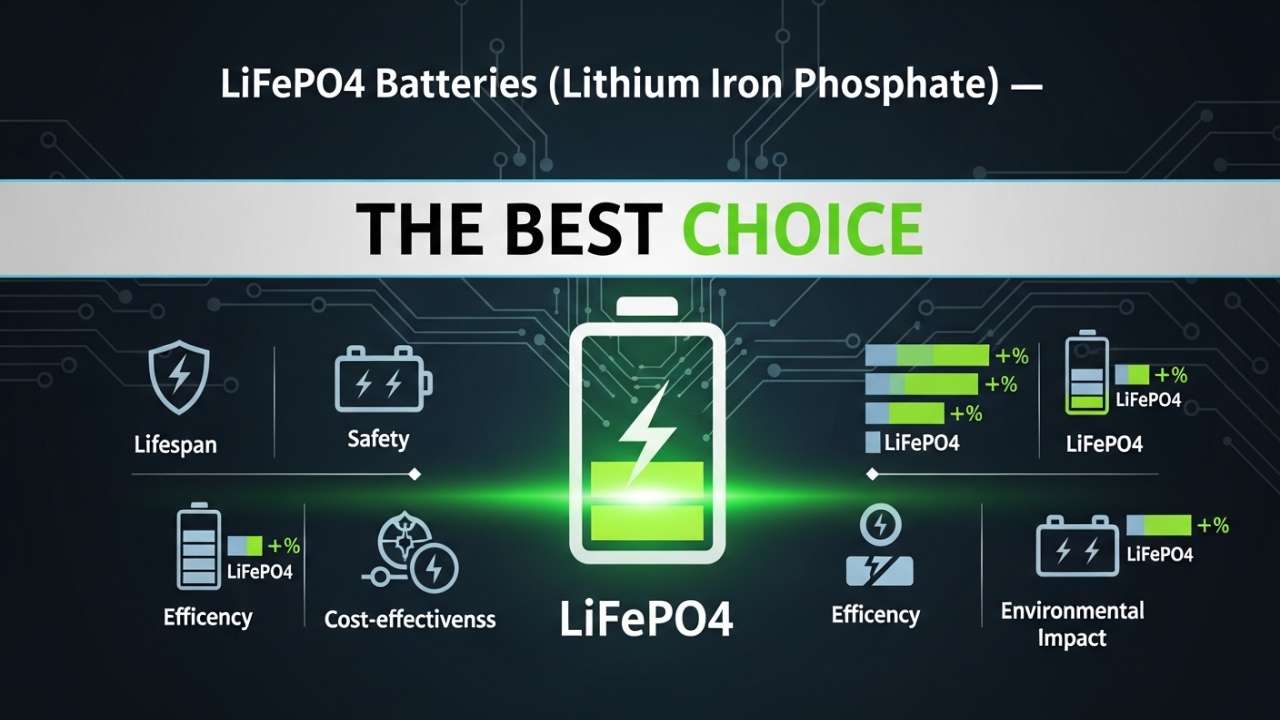
This is what serious RVers use now.
How they work: Iron phosphate chemistry is more stable than standard lithium. Safer, longer-lasting, handles deep cycles better.
Pros:
- 100% usable capacity (you can fully drain without damage)
- Longest lifespan (10–15+ years, some claim 20)
- Safest chemistry (less fire risk)
- Fast charging (1–2 hours)
- Handle cold temperature better
- Work great with solar
- Battery management system (BMS) built-in on quality brands
Cons:
- Most expensive ($600–900 per 100 amp-hours)
- Overkill for weekend warriors
- Require compatible chargers (standard RV chargers won’t work well)
Real math: A 400 Ah LiFePO4 battery gives you full 400 Ah usable power. That’s 4,800 watts for one hour. And it lasts 10+ years vs. lead-acid’s 3–5.
Best for: Full-time RVers, boondocking enthusiasts, anyone serious about off-grid living.
Also Read:- They Stole My RV Battery in 30 Seconds — Here’s What I Do Now (2026 Guide)
Sizing Your Battery Backup System (The Critical Calculation)
Here’s where most people mess up. They either buy too much battery (wasting money) or too little (frustrated later).
The answer depends on three things:
1. How many amps do your appliances draw?
Each appliance uses a certain amount of current (measured in amps).
| Appliance | Amps (12V) | Watts |
|---|---|---|
| LED lights (per light) | 0.5–1A | 6–12W |
| Refrigerator | 2–4A | 30–50W |
| Water pump | 3–5A | 40–60W |
| Furnace blower | 4–6A | 50–70W |
| Microwave (inverter needed) | 100A+ | 1200W+ |
| Coffee maker (inverter needed) | 80A+ | 1000W+ |
| Air conditioner (inverter needed) | 120A+ | 1500W+ |
Notice: high-draw appliances like AC and microwaves need a huge inverter and drain batteries fast.
2. How long do you want to run on battery?
- Weekend boondocking? 24 hours
- Week-long trip? 3–5 days
- Full-time living? 5–7 days (with solar charging during day)
3. What’s your daily usage pattern?
- Heavy users: AC, fridge, lights all day = 100+ amp-hours/day
- Medium users: fridge, some lights, water pump = 50–75 amp-hours/day
- Light users: minimal appliances, mostly off-grid minimalist = 20–40 amp-hours/day
The Sizing Formula:
Amp-hours needed = (Daily usage) × (Days without charging)
Example:
- You boondock 3 days without solar
- You use 60 amp-hours per day
- 60 Ah × 3 days = 180 Ah needed
But add buffer: 180 × 1.2 = 216 Ah minimum
For lead-acid (50% usable): Need 432 Ah physical capacity For lithium (80% usable): Need 270 Ah physical capacity For LiFePO4 (100% usable): Need 216 Ah physical capacity
Real example: Full-time boondocking with solar
- Daily usage: 80 Ah
- Days without sun: 2 (solar usually covers the 3rd day)
- 80 Ah × 2 = 160 Ah
- Add 20% buffer: 160 × 1.2 = 192 Ah
- LiFePO4 battery: 200 Ah bank = covers 2 days comfortably
System Components: What You Actually Need
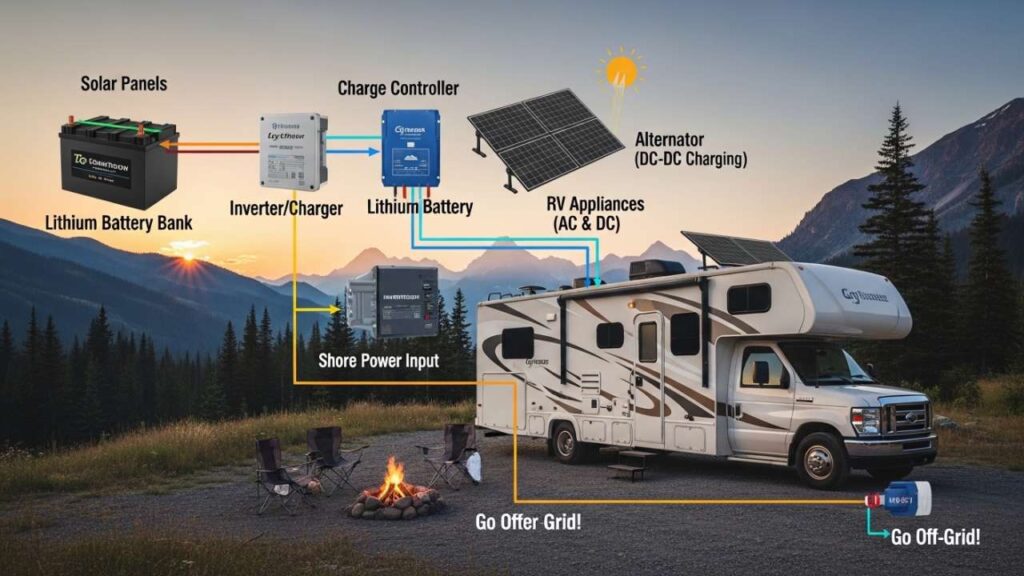
A battery backup system isn’t just a battery. It’s an ecosystem.
The Battery — Your power storage (200–800 Ah depending on needs)
Battery Management System (BMS) — A smart controller that protects the battery from:
- Over-charging
- Over-discharging
- Temperature extremes
- Short circuits
Most quality LiFePO4 batteries include BMS built-in. Lead-acid needs external monitoring.
Charger/Converter — Converts shore power (120V AC) to 12V DC for charging
- Stock RV converters are often weak (30–40 amps)
- Upgrade to 60–100 amp charger for faster charging
- Modern “smart chargers” optimize charging and prevent overcharging
Inverter — Converts 12V DC to 120V AC for high-power appliances
- Optional if you only use 12V appliances
- Necessary if you want to run coffee maker, microwave, or air conditioner off battery
- Sizes range from 1000W to 6000W
- Larger inverters cost more and draw more power standing by
Battery Monitor — Displays remaining amp-hours, voltage, current draw, and time remaining
- Essential for knowing when to start the generator
- Good ones cost $150–300
- Tells you exactly how much power you have left
Breakers and Fuses — Safety devices that prevent overcharging, short circuits, and fires
- Battery should have main breaker (100–200 amps depending on bank size)
- Inverter needs its own breaker
- Charger needs its own breaker
Wiring and Connectors — Heavy-gauge wires sized to handle current without overheating
- 2/0 gauge or larger for main battery cables
- Proper connectors rated for high current
Optional but Popular:
- Solar charge controller — Regulates solar panel charging (MPPT or PWM)
- Solar panels — 400–800 watts common for RVs
- Disconnect switches — Ability to isolate battery in emergency
Also Read:- Why Your RV Electrical System Fails (And How to Fix It Without a Technician)
Battery Backup System Setup Options (From Budget to Full-Power)
Not everyone needs the same system. Here are real options:
Option 1: Budget Boondocking ($1,500–2,500)
For: Weekend RVers who want to quiet their generator use
Components:
- 1× 200 Ah lithium battery ($800–1,200)
- 60A charger ($200–300)
- Battery monitor ($200)
- Wiring, breakers, fuses ($150)
What it does:
- Runs fridge, lights, water pump for 12–18 hours
- Enough for weekend boondocking
- Generator still needed for high-draw appliances (AC, microwave)
Daily use pattern:
- Morning: battery powers coffee, shower, breakfast (2–3 hours)
- Midday: solar or generator tops it up
- Evening: battery covers dinner and lights (4–5 hours)
Option 2: Serious Boondocking ($3,500–6,000)
For: Weekly boondocking, some full-timers
Components:
- 2× 200 Ah LiFePO4 batteries (400 Ah total, $1,600–2,400)
- 100A smart charger ($400–600)
- 3000W inverter ($400–600)
- Battery monitor ($250)
- MPPT solar controller ($200–300)
- 600W solar panels ($1,000–1,500)
- Wiring, breakers, fuses ($300)
What it does:
- Runs almost everything except AC for 2–3 days
- Solar recharges during day
- Generator barely runs (maybe 2–3 hours/week)
- True boondocking freedom
Daily use pattern:
- All day: battery + solar covers normal needs
- Cloudy days: battery gets you through
- Generator runs only for backup or heavy loads (AC in extreme heat)
Option 3: Full-Time Off-Grid Living ($7,000–12,000+)
For: Full-time boondockers, digital nomads, homesteaders
Components:
- 3–4× 200 Ah LiFePO4 batteries (600–800 Ah total, $2,400–3,600)
- 200A smart charger ($800–1,200)
- 6000W inverter ($1,200–1,800)
- Advanced battery monitor ($300–500)
- MPPT solar controller ($400–600)
- 1200+ watts solar panels ($2,000–3,000)
- Wiring, breakers, fuses, mounting ($500)
What it does:
- Powers AC, multiple appliances, heavy loads
- Survives 5+ cloudy days on battery alone
- Generator is emergency backup only
- Genuinely independent power
Daily use pattern:
- Solar covers 80–90% of daily needs
- Battery provides backup for nights and cloudy days
- Generator starts maybe once a month
- High comfort with true independence
Solar Integration: The Game Changer
A battery system without solar is half the solution.
Here’s why: batteries store energy, solar creates it.
Without solar, your battery only lasts as long as it’s charged. Then you fire up the generator to recharge (defeating the purpose).
With solar, your battery recharges itself during the day while you use it.
How Solar Changes Everything:
Lead-acid battery (100 Ah usable) without solar:
- Runs 12 hours
- Needs generator to recharge
- Generator runs 2–3 hours
- You hear it every day
Same battery with 400W solar:
- Runs 12 hours on battery
- Solar adds 100 Ah during the day (usually more)
- Battery stays charged indefinitely
- Generator never starts
Sizing Solar for Your RV:
The rule: 1 watt of solar per 2 watts of daily load
Example:
- Daily load: 1,000 watts (average RV usage)
- Solar needed: 500 watts minimum
- Better: 600–800 watts for cloudy days
- Best: 1,000+ watts for year-round reliability
Real numbers:
- Roof space limits you to 600–1,000 watts typically (RVs aren’t big)
- Portable panels (200–400W) can add extra capacity
How much will solar add per day?
- 400W panels in ideal sun: 80–120 amp-hours/day (varies by season/location)
- 600W panels in ideal sun: 120–180 amp-hours/day
- Winter/cloudy climates: 30–50% less
Maintenance & Monitoring (Keep It Running Forever)
Battery backup systems last 10–15 years if maintained properly.
Monthly Checks:
Battery health:
- Check voltage: LiFePO4 should show 12.8–14.4V at rest
- Monitor amp-hour readings on your battery monitor
- Look for corrosion on terminals (unlikely with lithium, but check)
System performance:
- Test that battery provides power (run something on it)
- Check that charger is working (plug into shore power, monitor should show charging)
- Verify inverter powers 120V appliances
Visual inspection:
- Any loose wiring or connections?
- Any burn marks or damage?
- Solar panels clean? (Dust reduces output 5–20%)
Quarterly Maintenance:
Battery balance check (LiFePO4 only):
- Modern batteries do this automatically via BMS
- If you have older lithium, a balance charge every 3 months is good
Inverter test:
- Run a microwave, coffee maker, or high-load appliance
- Should start smoothly without dimming lights
- If sluggish, inverter might be aging
Charger output:
- When plugged into shore power, does battery voltage rise steadily?
- Should hit full charge in 4–8 hours depending on charger size
- Slow charging might indicate failing charger
Solar output verification:
- In good sun, does solar controller show current flowing?
- Expected output: watts = panel wattage × (sun intensity / 100)
- Less than 20% of rated wattage = panels need cleaning or controller issue
Annual Deep Tasks:
Charger replacement (if lead-acid):
- After 5 years, consider upgrading to smart charger
- Old chargers overcharge and damage batteries
Inverter servicing:
- Some inverters benefit from dust cleaning (use compressed air)
- Check for burn marks internally if you open it
- If over 8 years old, replacement might be smart
Battery capacity test:
- Fully charge battery, then discharge to 20% while monitoring
- Time how long it takes—compare to specs
- 20% loss in capacity = battery aging normally
- 40%+ loss = consider replacement
Wiring inspection:
- Check for corrosion, loose connections, or damage
- Retighten all main connections yearly
- Look for any fraying insulation
Also Read:- Why Your RV Propane Stopped Working (And How to Fix It Fast)
Real-World Use Cases: Three Different RVers
Case Study 1: Weekend Warrior (Budget Setup)
RV: Class B van, minimal systems Setup: 1× 200 Ah lithium battery, no solar, small inverter Cost: $2,000 Usage: 3–4 weekends per month boondocking
Typical week:
- Friday: Drive to remote spot, arrive with full battery
- Saturday: Battery powers fridge and lights all day, runs down 50%
- Sunday: Morning on battery, generator tops it off for 1 hour before driving home
- Monday–Thursday: Parked at home, plugged into 120V charger
Result: Generator runs 1–2 hours per month instead of 30+. Worth it? Yes. Saves $200/month in fuel and hearing.
Case Study 2: Serious Boondocker (Mid-Range Setup)
RV: Full-size motorhome, frequent off-grid trips Setup: 2× 200 Ah LiFePO4 (400 Ah), 600W solar, 3000W inverter Cost: $5,000 Usage: 2–3 weeks boondocking per month
Typical week:
- Day 1: Arrive with full battery from shore power
- Days 2–7: Solar charges battery during day, battery runs fridge/lights/pump/inverter at night and cloudy times
- Day 8: Still 60% battery left, generator never started
- Shore power recharges in 4 hours
Result: Generator runs 3–4 times per month for backup, not daily. Electric bills are $0 during boondocking months. Can stay in remote areas indefinitely.
Case Study 3: Full-Time Off-Grid Living (Premium Setup)
RV: Luxury motorhome, stationary or moving slowly Setup: 3× 200 Ah LiFePO4 (600 Ah), 1000W solar, 6000W inverter Cost: $10,000 Usage: Full-time, year-round
Typical week:
- Solar provides 100–150 Ah per day year-round
- Battery never drops below 40% even on cloudy days
- Can run AC for 2 hours per day
- Microwave and coffee maker available whenever needed
- Generator hasn’t started in 6 months (only for emergency)
Result: Completely energy independent. No campground fees. No generator noise. System pays for itself in 18–24 months through fuel savings and campground fee elimination.
Battery Types & Systems at a Glance
| System Type | Battery Type | Capacity | Usable Power | Lifespan | Cost |
|---|---|---|---|---|---|
| Stock RV | Lead-acid | 200 Ah | 100 Ah | 3–5 yrs | $200 |
| Budget Boondocking | Lithium | 200 Ah | 160 Ah | 5–10 yrs | $2,500 |
| Serious Boondocking | LiFePO4 | 400 Ah | 400 Ah | 10–15 yrs | $5,500 |
| Full-Time Off-Grid | LiFePO4 | 600–800 Ah | 600–800 Ah | 10–15 yrs | $10,000+ |
Generator vs. Battery Backup Economics
| Metric | Generator Daily Use | Battery + Solar System |
|---|---|---|
| Initial cost | $1,500–3,000 | $5,000–10,000 |
| Monthly fuel cost | $150–200 | $0 |
| Annual fuel cost | $1,800–2,400 | $0 |
| Maintenance cost/year | $200–400 | $50–100 |
| Noise level | 80–100 dB | Silent |
| Lifespan | 5–10 years | 10–20 years |
| 5-year cost | $10,000–14,000 | $5,500–10,500 |
| 10-year cost | $19,000–26,000 | $6,500–12,000 |
The takeaway: Battery systems cost more upfront but save $8,000–15,000 over 10 years, plus silence and independence.
FAQ: Your RV Battery Backup Questions Answered
Q: Can I use a car battery or a deep-cycle marine battery instead of a proper RV battery? A: Car batteries are designed for quick bursts (starting engines), not sustained discharge. Marine batteries are better but still not optimal for RVs. Proper RV deep-cycle batteries (lead-acid, lithium, or LiFePO4) are designed for 500–3,000 charge cycles. Use the right tool for the job.
Q: How long does it actually take to recharge a depleted battery with solar? A: Depends on panel size and sun. A 400W solar panel in full sun adds roughly 30 amp-hours per 4 hours. So a fully depleted 200 Ah lithium battery would take 8 hours of perfect sun. In reality, with clouds and angle variations, plan for 10–12 hours for full recharge.
Q: Will my RV’s stock charger work with a lithium battery? A: Stock converters (usually 40 amps, old design) will charge lithium, but not optimally. They may damage lithium batteries over time through incorrect charging profiles. Upgrade to a lithium-compatible smart charger for $300–600. It’s a worthwhile investment.
Q: Do I need to disconnect my battery in winter if I’m not using my RV? A: Lead-acid batteries lose charge sitting unused (5–10% per month). Lithium/LiFePO4 batteries hold charge much longer (1–2% per month). Either way, if storing more than 2 months, disconnect the negative terminal to prevent parasitic drain.
Q: Can I use multiple different battery types together (mix lead-acid and lithium)? A: No. They charge and discharge at different rates, causing the system to malfunction. Each charger and system is optimized for one chemistry. Mixing creates damage and unsafe operation.
Q: What happens if I completely drain my lithium battery to 0%? A: LiFePO4 batteries have built-in protection that prevents complete discharge. Once voltage hits a threshold (usually 9–10V), the BMS cuts off load to prevent damage. Lead-acid will sulphate and fail if fully drained multiple times.
Q: Is it safe to upgrade from lead-acid to lithium in my RV? A: Yes, but requires some changes: new charger (must be lithium-compatible), possibly battery monitor upgrade, and wiring check. Don’t use an old lead-acid charger with lithium—it will damage the battery. Budget $500–1,000 for safe upgrade.
Q: How much solar do I really need? Can I get away with 200W instead of 600W? A: Depends on your usage. 200W panels produce 30–50 Ah per day in good sun. If your daily usage is under 50 Ah, it works. If over, 200W won’t keep up and you’ll rely on generator or hookups. Bigger is better—extra solar costs $200–400 more but gives you true independence.
Conclusion: Freedom Doesn’t Require a Generator
An RV battery backup system sounds complex until you break it down. It’s just a bigger battery, a solar charger, and a monitor.
But the freedom? That’s everything.
Next time you’re at a remote campground with no hookups and no generator running, you’ll understand. You’ll sip your coffee in silence, listen to birds instead of diesel engines, and realize you’re exactly where you want to be—powered by your own system, independent, and free.
Start with realistic expectations. A weekend boondocker needs $2,000 and a 200 Ah battery. A full-timer needs $8,000+ and 600+ Ah. But whatever your level, a battery backup system pays for itself in fuel savings, campground fee elimination, and peace of mind.
Your next adventure doesn’t need generator noise. Build a battery system and discover what real camping feels like.