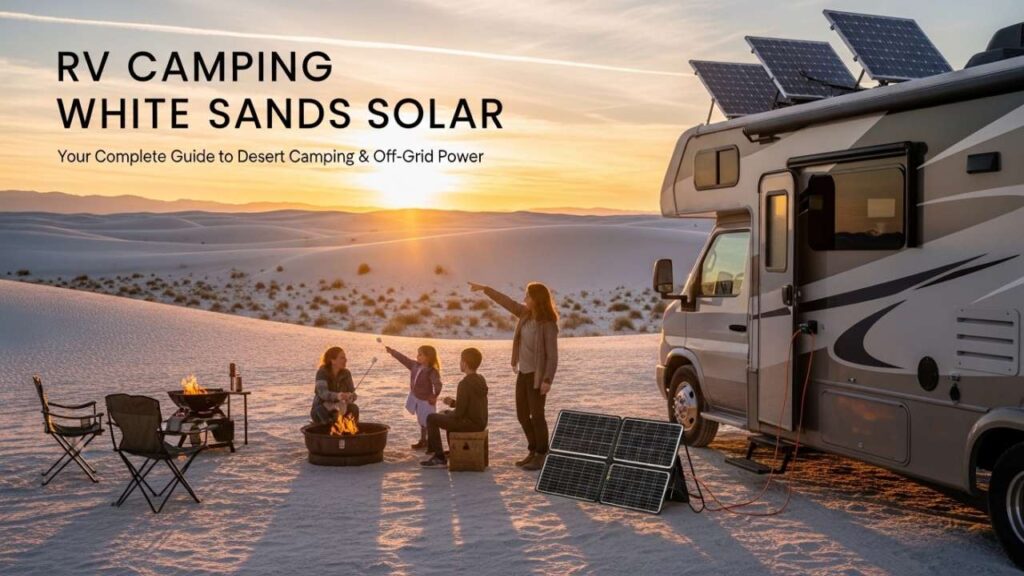
You’re parked at White Sands National Monument, the sun’s hammering down, and your RV’s interior feels like a sauna. Your RV solar panels are working overtime, but you’re wondering if they’ll actually keep you powered through the day—especially with the dust coating everything and extreme temperatures swinging wildly between night and day. Sound familiar? Welcome to RV camping at White Sands, where the landscape is stunning, but the conditions are ruthless. This guide breaks down exactly how to set up solar power for White Sands RV camping, protect your gear from the desert, and stay comfortable off-grid in one of America’s most extreme—and rewarding—camping destinations.
Why White Sands RV Camping Is Worth the Challenge
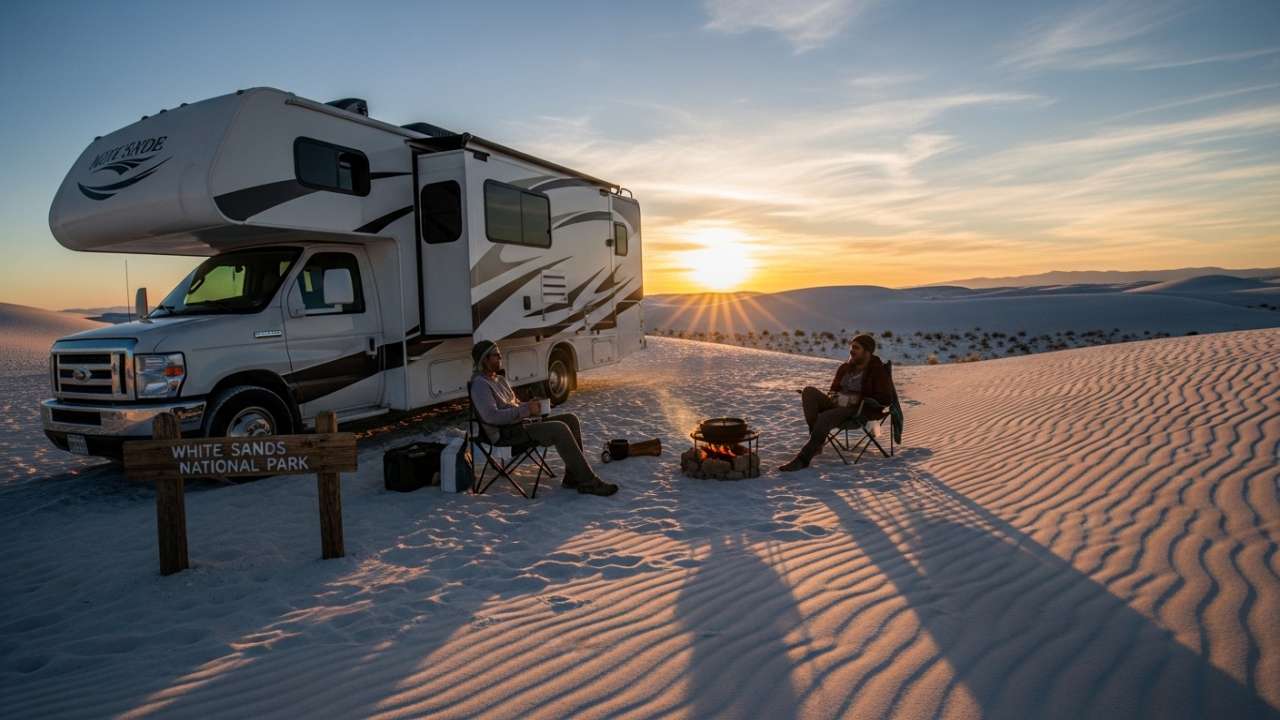
White Sands National Monument sprawls across 275 square miles of gypsum dunes in southern New Mexico. It’s not your typical campground. The landscape is alien, pristine, and absolutely mesmerizing. But here’s the reality: it’s also hot, windy, dusty, and unforgiving. RV camping here means dealing with:
- Extreme heat (90–110°F+ in summer)
- Intense sun exposure (14+ hours of direct sunlight in peak season)
- Fine gypsum dust that infiltrates everything
- Temperature swings (cold desert nights, hot days)
- Limited hookups (most spots are dry camping)
- Wind that can reach 30+ mph
For off-grid RV camping, White Sands forces you to be self-sufficient. That’s where RV solar setup becomes non-negotiable. The upside? Abundant sunlight and the kind of solitude and natural beauty that make every challenge worth it.
Understanding White Sands RV Camping Conditions
Before you set up solar panels for desert RV camping, you need to understand what you’re up against.
Temperature Extremes and Solar Panel Performance
Solar panel efficiency drops in high heat. Most panels are rated at 77°F (25°C). For every degree above that, you lose roughly 0.4–0.5% efficiency. At 110°F, your panels might be operating at 85% capacity instead of 100%.
At night, White Sands temperatures can plummet to 40–50°F, even in summer. This actually helps panels (cooler = more efficient), but it drains your batteries faster because you’re heating the RV and running heaters or fans.
Solar insolation at White Sands is among the highest in the continental US—roughly 5.5–6 peak sun hours daily even accounting for dust and atmospheric conditions. This is excellent for RV solar power production, but it also means intense UV exposure and rapid panel degradation if not maintained.
Dust and Gypsum: The Silent Panel Killer
White Sands dust is different from regular desert sand. It’s fine gypsum particles that cling to surfaces, reflect light, and degrade panel output by 10–20% if left uncleaned for just a few days. Unlike sand, gypsum is slightly soluble, so it can leave residue on glass.
A layer of dust reduces solar panel output far more than you’d expect. Clean panels vs. dusty panels can mean the difference between 60 amps and 40 amps coming into your charge controller.
Wind and Physical Stress
White Sands is notoriously windy. Gusts can reach 40+ mph, putting stress on roof-mounted panels, awnings, and satellite dishes. Improperly secured solar arrays can shift, crack, or detach.
Setting Up RV Solar at White Sands: The Complete System
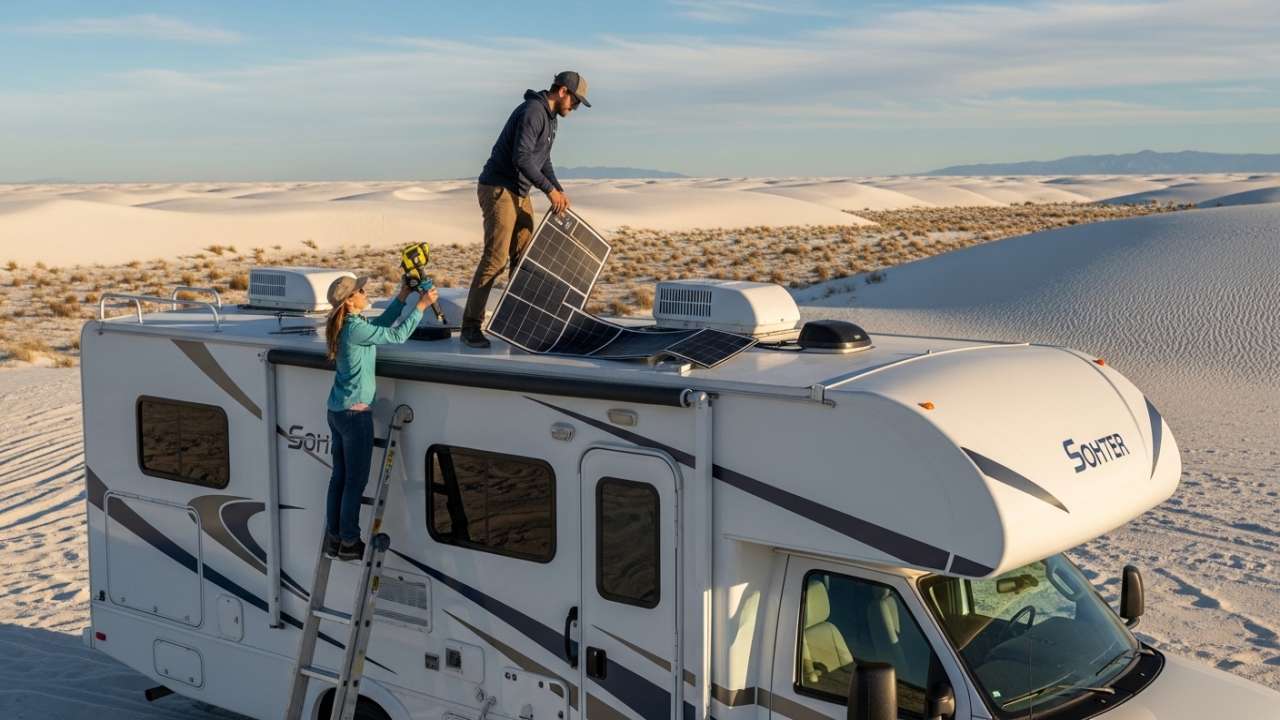
A proper off-grid RV solar setup for White Sands needs five core components, each chosen for desert durability.
1. Solar Panels: Wattage and Mounting for Desert Conditions
For White Sands RV camping, aim for at least 400–600 watts of panel capacity if you’re staying 3+ days dry camping. Here’s why:
- Dust reduces output by 10–20%
- High heat reduces efficiency by 15–20%
- You need buffer for cloudy days (rare, but they happen)
Panel types for desert:
| Panel Type | Pros for White Sands | Cons | Best For |
|---|---|---|---|
| Monocrystalline (rigid roof-mount) | High efficiency (18–22%), handles heat well, durable | Heavy, fixed angle, difficult to clean, vulnerable to wind stress | Full-time dry camping, longer stays |
| Flexible monocrystalline (roof adhesive) | Lightweight, low profile, less wind drag | 15–17% efficiency, harder to repair, adhesive fails in extreme heat | Weight-conscious rigs, lower power needs |
| Portable/folding panels (200–400W) | Easy to reposition, clean, and store; angle toward sun; pack away in wind | Less efficient per dollar, takes setup time, theft risk | Short stays, flexibility needed, windy days |
| Bifacial panels (ground-mount) | Capture reflected gypsum light (25–30% bonus output) | Expensive, need ground space, require repositioning | High-power needs, extended stays |
Mounting angle: In summer (June–August), tilt panels 20–25° from horizontal. In winter, 40–45°. White Sands RV solar systems benefit from adjustable mounts or folding arrays because the sun’s angle changes dramatically season to season.
2. Charge Controller: MPPT for Maximum Heat Handling
Use an MPPT (Maximum Power Point Tracking) charge controller, not PWM. MPPT controllers are 15–25% more efficient in high-heat conditions and handle voltage drops from long wiring runs better.
For a 400–600W system:
- 60–80A MPPT controller (Victron, Epever, Renogy, or similar)
- Ensure it has temperature compensation built in (it adjusts for ambient temp)
- Look for controllers rated to 140–158°F (60–70°C) to handle White Sands heat
Mount the controller inside the RV, away from direct sun. Even in shade, it will run hot in the desert.
3. Battery Bank: Capacity and Heat Protection
White Sands dry camping requires 2–4 days of autonomy, meaning your RV battery bank needs to store enough energy for 2–4 nights without charging (accounting for heat losses and inefficiencies).
Battery chemistry matters in desert heat:
| Battery Type | Heat Tolerance | Capacity for White Sands | Cost | Maintenance |
|---|---|---|---|---|
| LiFePO₄ (lithium) | Excellent (up to 140°F) | 300–400Ah for 3–4 days | $3,000–$6,000 | Minimal; BMS monitors temp |
| AGM (lead-acid) | Moderate (up to 120°F); above that, lifespan drops fast | 400–600Ah (2–3 batteries) | $800–$1,500 | Monthly checks; heat-sensitive |
| Flooded lead-acid | Poor (above 100°F, lifespan halves) | 600+ Ah needed | $600–$1,000 | Weekly maintenance; not recommended for White Sands |
| Gel | Moderate (similar to AGM) | 400–600Ah | $1,200–$2,000 | Monthly checks |
For White Sands specifically, lithium is worth the investment. It handles extreme heat better, charges faster with abundant sunlight, and doesn’t degrade in high temperatures like lead-acid batteries.
Battery placement: Install the battery bank in a shaded, ventilated spot (e.g., exterior compartment with airflow, not in direct sun). Use reflective covers or insulation rated for heat.
4. Wiring and Connections: Oversizing for Heat and Voltage Drop
Heat accelerates copper oxidation and increases resistance. In a White Sands RV solar system, don’t skimp on wire gauge.
- Panel to controller: 6–10 AWG (depending on distance and total wattage)
- Controller to battery: 4/0–2/0 AWG (thick!)
- Use crimped, sealed connectors (not just twisted wire)
- Fuse everything (100A fuse between panels and controller, 150A between controller and battery)
Oversized wiring reduces voltage drop, which is critical when panels are hot and output voltage drops. Even a 2V loss from undersize wire can reduce charging by 10%.
5. Inverter: Pure Sine for Sensitive Loads
For off-grid RV camping, get a pure sine inverter (not modified sine). Inverters run hot, too; mount it in a ventilated location, away from direct sun.
- 2,000–3,000W inverter for a mid-size RV
- Ensure it’s rated for continuous operation in 100°F+ temps (many aren’t)
- Look for models with temperature derate (they reduce output in high heat, but stay safe)
White Sands RV Solar Protection: Heat, Dust, and Wind
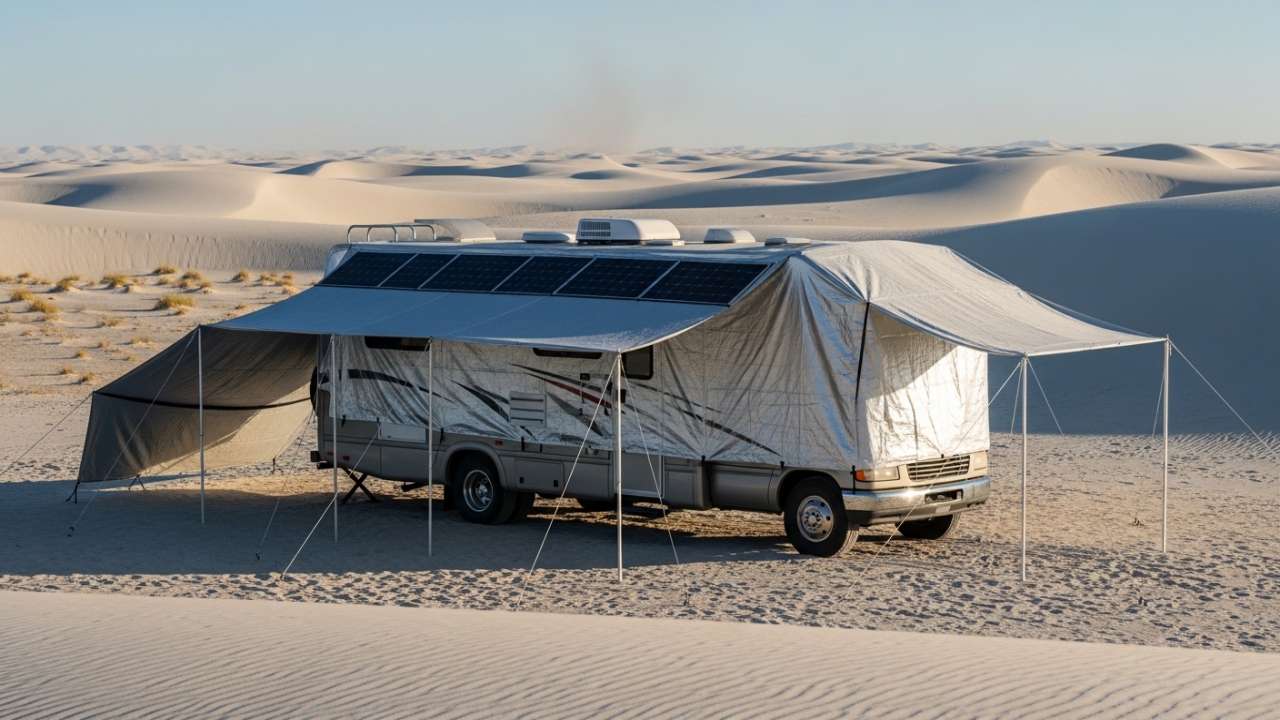
Setting up the system is one thing. Protecting it in White Sands conditions is another.
Protecting Panels from Extreme Heat
Heat management for solar panels:
- Ensure airflow beneath panels. Don’t mount them flush against the roof. Leave 2–3 inches of gap for air circulation. This alone can drop panel temperature by 10–15°F and boost efficiency by 5–7%.
- Use reflective roof paint. Paint the RV roof white or light gray. It reduces overall roof temperature and creates a cooler environment for batteries and controllers.
- Monitor panel temperature. Some charge controllers display panel temp. If panels exceed 140–150°F, you’re losing significant efficiency. Shift their angle or add shade if possible (use a shade sail or awning 2–3 feet above).
- Rinse panels regularly. In morning or late evening (not midday—thermal shock can crack glass), spray panels with cool water to remove dust. A 20°F drop temporarily boosts output by 10–15%.
Protecting Against Gypsum Dust Accumulation
White Sands dust is relentless. You’ll see panel output drop visibly after just 2–3 days without cleaning.
Dust protection strategies:
- Clean panels every 2–3 days. Use distilled water (tap water leaves mineral deposits) and a soft brush or squeegee. Avoid abrasive pads; gypsum particles are harder than you think.
- Install a panel cleaning system. Some RVers use automatic sprinklers or drip systems triggered at dawn. Cost: $200–$500. Worth it for extended stays.
- Cover panels when parked long-term. If you’re staying a week+ and not actively using the RV, cover panels with light fabric (not solid tarps—traps heat). Remove covers during peak sun hours.
- Position panels to catch wind. A slight angle toward prevailing wind helps blow dust off naturally. At White Sands, winds typically come from the southwest.
- Use hydrophobic or anti-dust coatings. Some aftermarket products (PolyMet, Aqua Shield) create a slick surface that sheds dust more easily. Cost: $50–$100 for a kit. Results vary, but worth testing.
Wind Protection and Securing Your Array
White Sands wind gusts can exceed 40 mph. Loose panels are dangerous and inefficient.
Wind-proofing your solar array:
- Use heavy-duty L-brackets or clamps. Not the lightweight hardware that came with your panels. Upgrade to stainless steel or aluminum brackets rated for 60+ mph wind.
- Reinforce roof attachment points. If panels are roof-mounted, ensure mounting rails are bolted (not screwed) to roof rafters or structural beams, not just to plywood.
- Consider portable arrays. If you’re visiting for a few days, a 300–400W portable solar kit can be anchored with stakes and guy wires, then collapsed during high winds. Takes 30 minutes to set up/break down, but it’s safer.
- Monitor wind forecasts. NWS provides hourly wind predictions for White Sands. If gusts are expected >35 mph, lay panels flat or remove them temporarily.
- Use surge protectors and lightning arrestors. White Sands gets afternoon thunderstorms in summer. Lightning strikes on metal solar arrays are rare but catastrophic. Add surge protection to your DC and AC circuits ($100–$300).
Also Read:- How to Fix RV Plumbing: Leaks, Clogs, Low Pressure & Frozen Pipes
Managing Power Consumption at White Sands
Even with 600W of RV solar panels, your power budget matters. White Sands forces discipline.
Daily Power Budget Example (3-Day Dry Camp)
| Device | Hours/Day | Watts | Daily (Wh) |
|---|---|---|---|
| Fridge (12V compressor) | 24 | 40 | 960 |
| LED lights (6 bulbs, 5W each) | 6 | 30 | 180 |
| Water pump (intermittent) | 2 | 60 | 120 |
| Laptop/devices charging | 4 | 100 | 400 |
| Fan (cooling) | 8 | 50 | 400 |
| Heater (6am–8am, 6pm–8pm) | 4 | 1,500 (via inverter) | 6,000 |
| Total daily consumption | ~8,060 Wh |
With a 400Ah lithium battery (12.8V nominal = ~5,100 Wh usable at 80% DoD) and 500W solar array producing ~2,500 Wh on a clear White Sands day:
- Day 1: Solar + battery = surplus energy; charge battery, run all loads
- Night 1: Battery alone = 8,060 Wh demand × 2 nights = ~16,000 Wh needed
- Problem: One battery isn’t enough for 2 nights without supplemental power
Solution: Either expand battery to 600–800Ah, or limit nighttime heating to 2–3 hours/day, or reduce other loads. Most White Sands campers use portable heaters sparingly and rely on RV insulation + layered bedding.
Power-Saving Tips for White Sands
- Use 12V loads directly (no inverter). Inverter conversion loses 10% efficiency. Run 12V pumps, LED lights, and fans off battery.
- Run the fridge 24/7. Modern RV fridges (especially 12V compressor units) use surprisingly little power. Running it continuously is more efficient than cycling on/off.
- Limit AC inverter use to mornings/early evenings. If you need to use an AC laptop charger or coffee maker, do it mid-morning (peak solar production) when panels are generating max power.
- Close blinds during the day. Reflects ~30% of solar heat back out, reduces interior temperature by 5–10°F, and lowers cooling demand.
- Use passive cooling. Open vents and roof fans at dawn/dusk when outside temps drop. Close everything by 8am before heat builds.
Best RV Camping Spots at White Sands for Solar Setups
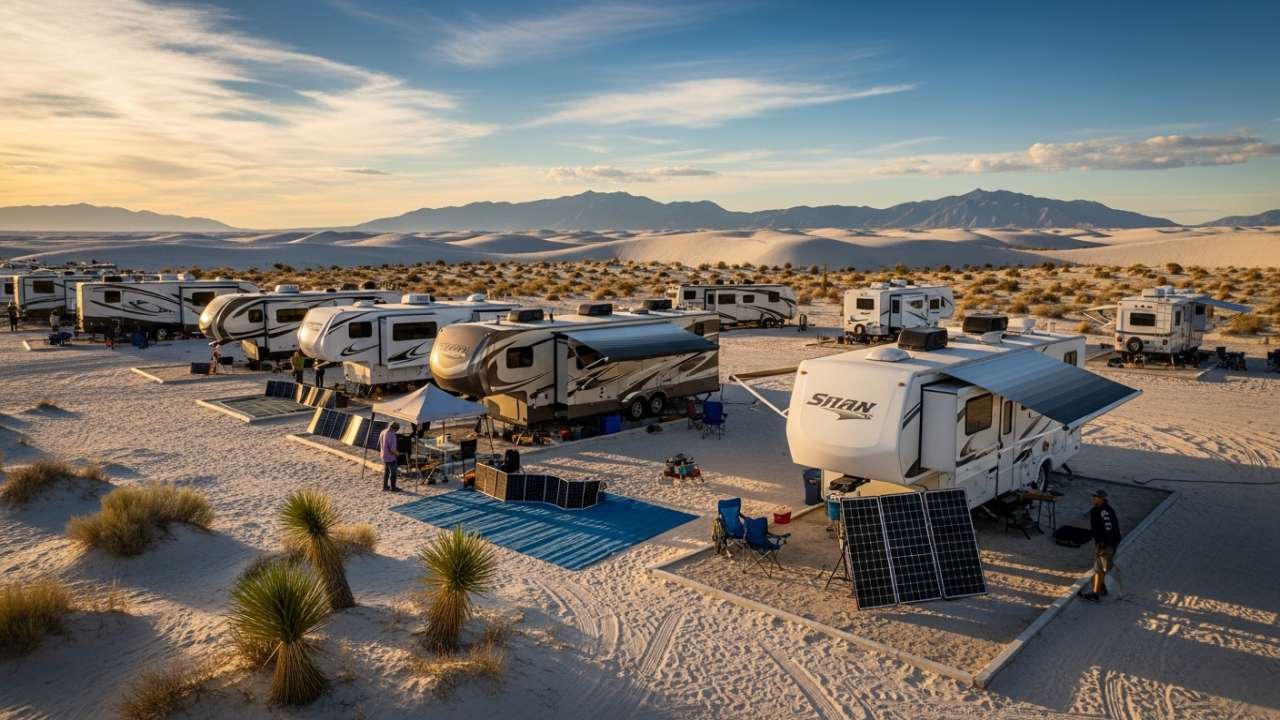
White Sands National Monument has no RV hookups on-site, but nearby areas offer both full-hookup and dry camping.
On or Near Monument Grounds
| Location | Hookups | Cost/Night | Best For Solar |
|---|---|---|---|
| Alamogordo KOA (15 miles south) | Full | $40–$60 | Not needed (hookups available) |
| Oliver Lee State Park (20 miles east) | None | $15–$20 | Excellent; open, sunny, low trees |
| White Sands Missile Range Recreation Area | None (dry camp) | $10–$15 | Outstanding; open playa, zero shade, peak sun |
| Alamogordo RV Park (downtown) | Full | $35–$55 | Not needed |
| BLM dispersed camping (15+ miles away) | None | Free | Variable; some areas excellent, others shaded |
For maximizing RV solar power production, aim for Oliver Lee or WSMR Recreation Area—both are open, high-elevation (4,400–4,900 ft), and get nearly unobstructed sun.
Also Read:- RV Air Conditioner Not Working? Troubleshoot & Fix in 30 Minutes (No Technician
Set-Up Tips for Each Spot
- Oliver Lee: Bring 50+ feet of hose for the water source; shade is limited. Park facing south to maximize morning/afternoon sun.
- WSMR (White Sands Missile Range Recreation Area): Permits required ($3/vehicle). Most exposed to wind—secure everything. Outstanding for solar.
- BLM land: Scout in advance. Some spots near Alamogordo are shaded by piñon/juniper forests—poor for off-grid RV solar. Head north toward Salinas Peak for more open terrain.
Detailed Maintenance Schedule for White Sands Conditions
White Sands’ heat, dust, and wind mean more frequent maintenance than typical RV camping.
Daily (During Stay)
- Inspect panels for dust buildup. If visible, plan evening cleaning.
- Check battery voltage and temperature. Lithium batteries should stay below 120°F; AGM below 110°F.
- Monitor charge controller temp. Should stay below 130°F (fan cooling helps).
- Visual roof inspection. Scan for loose brackets or panel shift after wind.
Every 2–3 Days
- Clean panels with distilled water and soft brush. Gypsum dust accumulates fast. Morning cleaning (before 9am) is safest.
- Check all wiring connections for corrosion or looseness. Heat accelerates oxidation; tug gently on connectors to confirm they’re seated.
- Top off water tanks if using fresh water for panel cleaning.
- Inspect seals around roof penetrations. Wind-driven dust can work into tiny gaps.
Weekly (If Staying Longer)
- Deep clean panels with a mild soap solution (diluted RV wash or car wash). Rinse thoroughly with distilled water.
- Inspect and clean DC breakers/fuses for corrosion (remove covers, use compressed air).
- Verify battery terminal connections. Use a small wrench to ensure bolts are tight (vibration from wind can loosen them).
- Test inverter operation. Run a 2,000W load for 10 minutes; listen for unusual fan noise; check temp.
- Walk the perimeter and check guy lines or stakes (if portable panels).
Before Departure
- Full panel inspection and cleaning (even if you’ll return soon).
- Disconnect batteries and charge controller if leaving >2 weeks (prevents parasitic drain).
- Cover or store portable panels in a secure, shaded location.
- Seal any roof penetrations or gaps where dust entered.
Real-World RV Solar Performance at White Sands
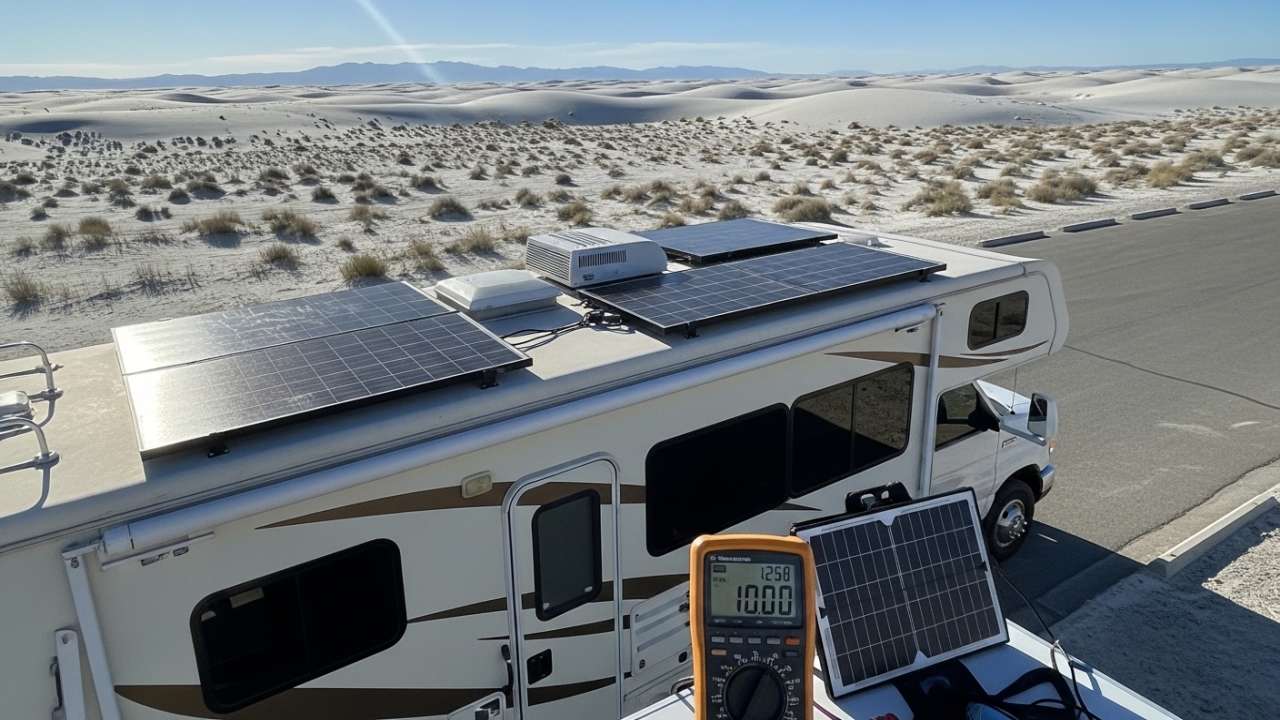
Here’s what you can actually expect:
Summer (June–August)
- Peak sun hours: 5.5–6/day (excellent)
- Panel output: 600W array → ~3,300–3,600 Wh/day (accounting for dust, heat, angle losses)
- Condition: Extreme heat (95–115°F), intense UV, frequent dust storms
- Battery charging: Can fully charge 400Ah lithium in 8–10 hours of strong sunlight
- Challenge: Heat reduces efficiency by 15–20%; daily dust cleaning necessary
Spring/Fall (March–May, September–November)
- Peak sun hours: 4.5–5.5/day
- Panel output: 600W array → ~2,700–3,300 Wh/day
- Condition: Moderate temps (70–90°F), clear skies, occasional dust
- Battery charging: Slower, but panel temps are optimal; 10–12 hours for full charge
- Challenge: More manageable; most RVers camp in this window
Winter (December–February)
- Peak sun hours: 3.5–4/day (lower sun angle)
- Panel output: 600W array → ~2,100–2,400 Wh/day
- Condition: Cool nights (30–50°F), mild days (60–75°F), rare clouds
- Battery charging: Slower production, but lower consumption (less cooling needed)
- Challenge: Cold batteries lose capacity temporarily; panel angle must be steep (40–50°)
Real-world note: Most experienced White Sands RV campers visit March–May or September–October when conditions are ideal—temperatures are moderate, solar production is solid, and dust storms are less frequent.
Also Read:- How to Charge RV Battery with Solar: Complete Guide + Calculator
Troubleshooting: Common Issues at White Sands
Problem 1: Panels Producing Far Less Than Rated Capacity
Likely cause: Dust accumulation (most common)
Solution: Clean panels immediately and daily thereafter. Even a light dust film cuts output 10–20%.
Backup diagnosis:
- Check panel temperature (if available via controller display). If >140°F, heat is reducing efficiency.
- Verify charge controller is operating (look for light indicating charging status).
- Check for shading (even partial shade from RV antenna or nearby rock reduces output significantly).
Problem 2: Battery Not Charging Despite Sunny Day
Likely causes:
- Panels are dusty (see Problem 1)
- Wiring connection is loose or corroded (especially in heat)
- Fuse is blown
- Battery is at 100% charge (not an issue; normal)
Solution:
- Visually inspect DC wiring from panels to the controller. Look for loose connectors and green corrosion on copper.
- Check fuses in-line; swap with a known-good fuse to test.
- Verify charge controller is not in absorption/float mode (display will show this); if so, battery is full—normal.
Problem 3: Inverter Shutting Off in the Afternoon
Likely cause: Inverter overheating (common in 100°F+ temps)
Solution:
- Move inverter to shadiest, most-ventilated location in RV (e.g., an exterior compartment with airflow).
- Reduce AC load (turn off non-essential devices).
- Upgrade to a higher-wattage inverter rated for continuous 140°F+ operation (Victron, Aims Power, Magnum Energy have good high-temp models).
- Use a 12V mini fan to cool inverter location.
Problem 4: Rapid Battery Discharge at Night
Likely cause: Excessive load or parasitic drain
Solution:
- Calculate daily consumption (see power budget table above).
- Identify high-draw devices (heater, AC, space heater). Limit nighttime use.
- Check for parasitic loads: inverter on standby (60–80W draw), fridge, water pump. Turn off inverter if not in use overnight.
- If battery is old, capacity may be degraded; run voltage check (lithium should hold 13.2V+ at rest; lead-acid should hold 12.6V+).
Problem 5: Controller Displaying Error or Overheat Warning
Likely causes:
- Excessive panel voltage (rare, but happens if panels overheat)
- Controller overheating
Solution:
- Move controller to shaded, ventilated location.
- Reduce panel input by repositioning array or covering partially during peak heat (10am–3pm).
- Ensure controller ventilation vents aren’t blocked by dust.
- Check wiring; if oversized wires are coiled tightly, they can trap heat.
FAQ
Q: Can I run AC (air conditioning) on solar at White Sands?
A: Not practically. A window AC unit draws 1,500–2,000W continuously. With a 600W solar array, you’d need 10,000+ Wh of battery to run it for 4 hours, plus perfect sun conditions. Most RVers at White Sands rely on shade, ventilation, and fans instead. If you must have AC, you need a massive 3,000W+ array and 800Ah+ battery—borderline infeasible for most RVs.
Q: Is a lithium battery really worth it for White Sands camping?
A: Yes, especially if you’re staying >3 days. Lithium handles heat better, charges faster with abundant solar, and lasts 5,000–10,000 cycles vs. 500–1,000 for lead-acid. Initial cost is higher ($4,000 vs. $1,000 for lead-acid), but it pays back over 5–7 years. For short visits (1–2 nights), lead-acid is fine.
Q: How often do I really need to clean panels at White Sands?
A: Every 2–3 days if you want to maintain output. After a dust storm, clean same day. If you’re only staying 2 nights, clean once on arrival, and you’re fine. For extended stays (1+ week), daily cleaning is worth the 20-minute effort.
Q: Can I use a portable generator as backup at White Sands?
A: Yes, but off-grid RV solar is quieter and more fuel-efficient. A portable generator (2,000–3,000W) is a good backup for extended cloudy periods or if you miscalculate power needs. Bring fuel (and a full tank isn’t legal due to fire risk at White Sands). Cost: $400–$800 for a quiet model. Use it sparingly—noise carries across the dunes.
Q: What’s the cheapest way to camp at White Sands with solar?
A: Free dispersed BLM camping 15–30 miles away + a 400W portable solar kit ($800–$1,200) + a 200Ah lead-acid battery bank ($600–$800) + a basic MPPT controller ($300–$500). Total: ~$1,700–$2,500 for the solar system. Total camping cost: $15/night. You’ll have modest power (basic fridge, lights, water pump, limited AC use), but it works for budget-conscious travelers.
Q: Are there any shade options at White Sands for parking?
A: Almost none on the monument itself. Oliver Lee State Park has scattered piñon trees; BLM land varies. Most campers park in open, accept full sun, and use reflective tarps or awnings for shade. The trade-off: full sun = better solar.
Q: Can I camp right at White Sands National Monument?
A: No RV camping on monument grounds. Nearest camping is 15–20 miles away (Oliver Lee, WSMR, Alamogordo area). Day-use visitors can explore freely; overnight RV camping requires leaving the monument.
Q: What about cell service and internet at White Sands?
A: Spotty. T-Mobile and Verizon have coverage in Alamogordo (15 miles away) but weak/no signal on the monument or BLM land. Download maps and entertainment before arriving. Starlink or mobile hotspot (if you have signal) are options, but expect low speeds. Many campers embrace the digital detox.
Conclusion:
RV camping at White Sands with solar is entirely doable—thousands of RVers do it every year. The key is respecting the environment: extreme heat, relentless dust, and powerful wind demand a properly sized and maintained off-grid RV solar system.
Start with at least 400–600W of panels, a quality MPPT controller, and a lithium or quality AGM battery bank sized for 2–3 days of autonomy. Protect your array from dust (clean every 2–3 days), heat (ensure airflow, rinse in morning), and wind (secure with heavy-duty hardware). Monitor your power consumption honestly—know your limits, and you’ll never run out of juice.
The reward? Unobstructed starry nights, pristine dunes under your wheels, and the self-sufficiency that comes with mastering RV solar power. White Sands tests you, but it’s worth every drop of sweat.
Ready to hit the dunes? Start with a solid solar setup, respect the desert, and enjoy one of America’s most extraordinary RV destinations.