
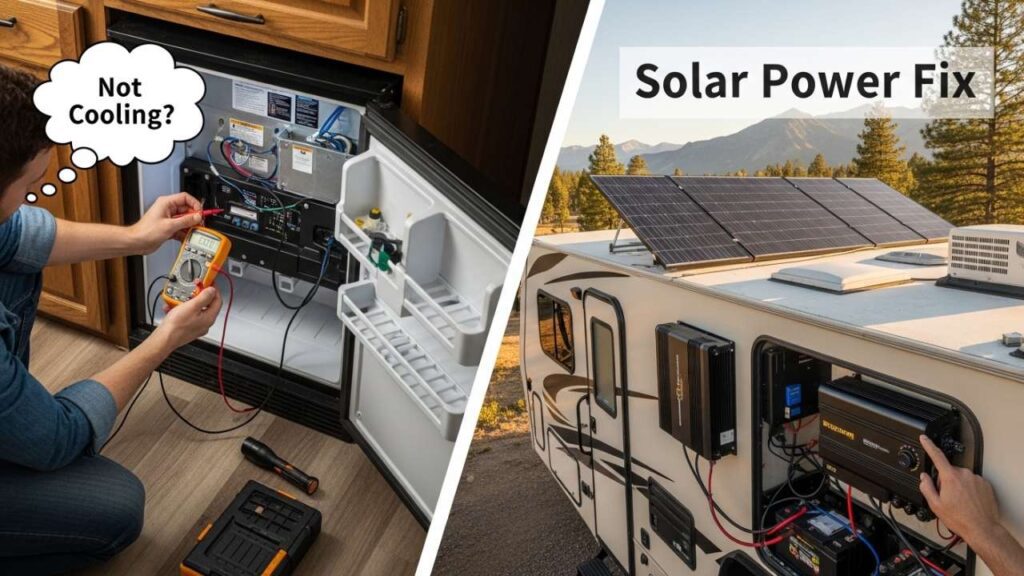
Your RV refrigerator was running perfectly yesterday. This morning, you open it up and the food is warm. Your solar power system is producing electricity, your batteries show decent voltage, but somehow your fridge went from ice-cold to useless overnight. Sound familiar? This is the nightmare scenario for anyone running an off-grid RV fridge—and it’s way more common than you’d think. The problem usually isn’t the fridge itself. It’s the interaction between your RV refrigerator solar power setup and how much energy that fridge actually consumes. A 12V RV fridge can drain your battery bank faster than any other single appliance, and if your RV fridge battery drain goes unchecked, you’ll be eating warm food and drinking lukewarm beer within hours. This guide walks you through every reason your RV fridge stops cooling, why solar battery drain happens when your fridge runs 24/7, and exactly how to troubleshoot and fix the problem—whether it’s a mechanical failure or a power management issue.
Why RV Fridges Fail (And Why Solar Power Systems Struggle With Them)
An RV refrigerator power management problem is almost always one of three things: mechanical failure, insufficient power supply, or user misunderstanding. But before we diagnose, let’s understand why fridges are so hard on your solar-powered RV system.
Also Read:- RV Solar & Power System Maintenance: Complete Seasonal Guide to Keep Your Off-Grid System Running
The Fridge Power Draw Problem
A typical 12V refrigerator power draw looks like this:
| Fridge Type | Power Draw (Watts) | Daily Consumption (Wh) | % of 400Ah Battery |
|---|---|---|---|
| 12V absorption fridge (dometic) | 30–50W continuous | 720–1,200 Wh | 14–24% |
| 12V compressor fridge (smaller) | 40–80W when running | 960–1,920 Wh | 19–38% |
| 12V compressor fridge (larger) | 100–150W when running | 2,400–3,600 Wh | 48–72% |
| 120V AC fridge (inverter-powered) | 60–100W continuous via inverter | 1,440–2,400 Wh | 29–48% |
Here’s the brutal reality: A 12V RV refrigerator can consume 25–50% of your daily battery capacity—before you run any lights, water pump, inverter, or other loads.
For an off-grid RV fridge running on your RV solar system, this means:
- On a sunny day: Your solar panels barely keep up with fridge demand alone
- On a cloudy day: Your fridge drains batteries faster than solar can recharge
- At night: Fridge runs entirely on stored battery power (8–12 hours of pure drain)
- In winter: Low solar production + high fridge draw = battery dead by day 2
This is why solar battery drain from a running fridge is the #1 power management problem in off-grid RVing.
Why Your Fridge Stops Cooling (The Real Reasons)
Most people assume their fridge broke. Usually, it’s one of five issues:
- Power too low (battery voltage dropped below fridge operating minimum—typically 10.5V for 12V units)
- Cooling unit iced over (absorption/propane fridges can freeze interior coils, blocking airflow)
- Thermistor/thermostat faulty (fridge can’t sense interior temp, stops cooling or cycles wrong)
- Compressor failure (for compressor fridges; rare but catastrophic)
- Propane valve stuck (for propane/absorption fridges; propane not flowing to burner)
We’ll diagnose each one. But first, understand this: Most RV fridge “failures” are actually power supply failures masquerading as mechanical problems.
Step 1: Power Supply Diagnosis (Check This First)
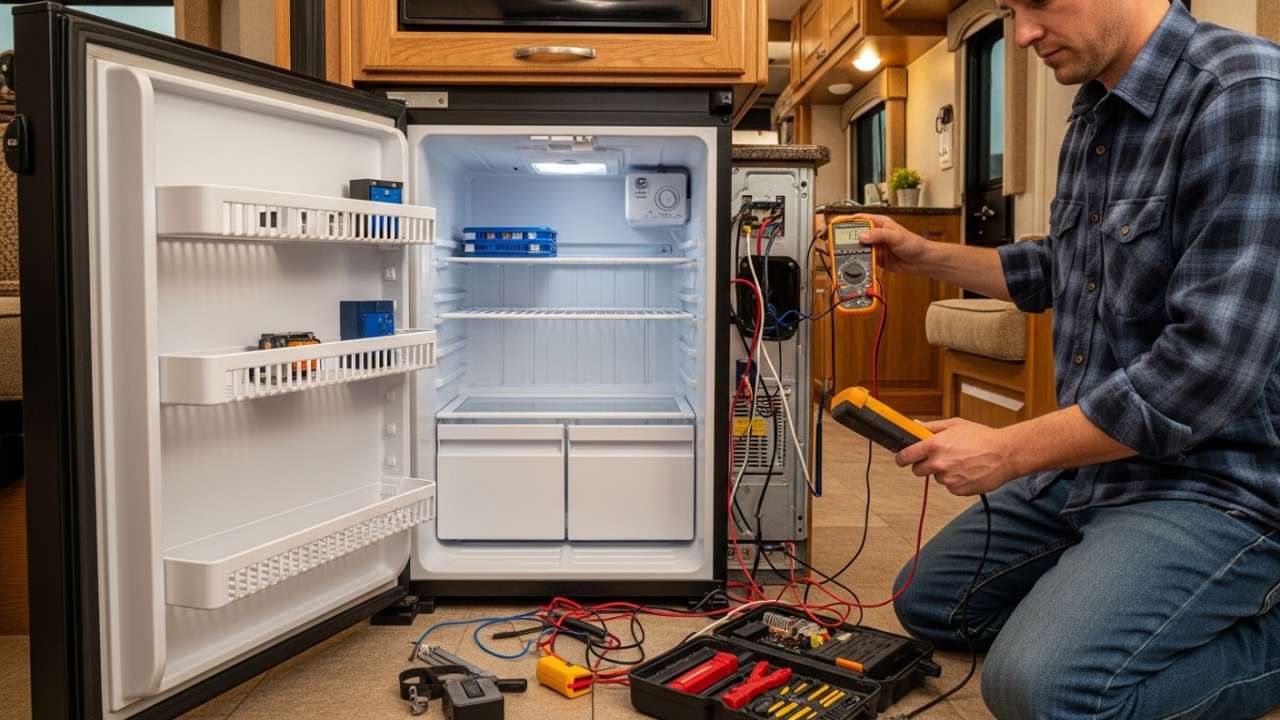
Before you tear apart your fridge, verify you actually have power reaching it.
Check Battery Voltage
What you need: Multimeter (digital, $10–$20)
Steps:
- Set multimeter to DC voltage (V with —)
- Touch red probe to positive battery terminal, black to negative
- Read voltage
Healthy voltage for 12V system:
- At rest (no charging, no loads): 12.6–12.8V = Good
- Under fridge load: Should stay above 11.5V (fridge needs minimum 10.5V, but efficiency drops below 11.5V)
- Critical: Below 10.5V = Fridge won’t cool, may not power on at all
If the voltage is low:
| Voltage Reading | What It Means | Fix |
|---|---|---|
| 12.6–12.8V | Battery full, healthy | Fridge should work fine |
| 12.2–12.5V | Battery ~50% charge | Fridge works but slower cooling |
| 11.5–12.1V | Battery ~30% charge | Fridge cooling compromised |
| 10.5–11.4V | Battery <20% charge | Fridge may not cool or cycles weakly |
| <10.5V | Battery critically low | Fridge won’t power on or work at all |
Real example: Sarah’s fridge stops cooling at 11.2V battery voltage. She thinks the fridge broke. Actually, her RV fridge battery drain from yesterday left her with insufficient power. Once she charged the battery to 12.5V (via solar or generator), fridge cooled perfectly.
Also Read:- RV Camping White Sands Solar: Your Complete Guide to Desert Camping & Off-Grid Power
Check Voltage Under Fridge Load
This is critical. Voltage at rest is misleading. You need to know what happens when the fridge compressor kicks on.
Steps:
- Make sure fridge is on and compressor is running (you’ll hear it kick in every few minutes)
- Wait until compressor engages (listen for hum)
- Quickly check voltage with multimeter
- Read voltage while compressor is running
Voltage under load:
- 12.0V+ = Normal (fridge runs fine)
- 11.5–12.0V = Acceptable but fridge cooling slows
- 11.0–11.5V = Poor (fridge barely cools, may not freeze ice)
- <11.0V = Fridge won’t cool effectively
If voltage drops >0.5V when compressor runs: You have a power supply problem (weak solar, bad wiring, or battery capacity too low). Not a fridge problem.
Check Solar Charging
On a sunny day, your RV solar panels should be actively charging the battery while the fridge runs. If not, fridge will drain battery despite adequate sunlight.
Steps:
- Note battery voltage at 9am (should be charging on sunny day)
- Note again at 12pm (peak sun hours)
- Compare to evening voltage
Healthy charging pattern:
- Morning: 12.0V
- Noon: 13.5–14.5V (charging actively)
- Evening: 12.8V (charged, holding steady)
If voltage isn’t rising mid-day despite full sun:
- Panels are dirty (clean immediately)
- Charge controller not working (check display)
- Wiring loose (inspect connections)
- Battery faulty (test further or replace)
Step 2: Mechanical Diagnosis (Fridge-Specific Checks)
If power supply is healthy, the fridge itself may have failed. Test these systems.
For Compressor Fridges (Most Common in Modern RVs)
Compressor fridges are electric only. They use a small AC compressor (like a car AC unit) to pump refrigerant and cool the interior.
Test 1: Compressor Running?
- Turn fridge on, wait 2–3 minutes
- Listen inside fridge for quiet humming sound (compressor cycling on/off)
- Feel cold airflow from cooling vent inside fridge
- Place thermometer inside fridge; should drop temp noticeably within 10 minutes
If compressor isn’t running:
- Check power reaches fridge (use multimeter on fridge power input terminals)
- If power present but compressor silent: compressor motor may be seized or burned out (requires replacement, ~$300–$600)
- If no power: check wiring and 12V breaker supplying fridge
Test 2: Refrigerant Leak?
Compressor fridges use sealed refrigerant loops. If leak exists, fridge won’t cool no matter what.
Signs of leak:
- Compressor running but interior not getting cold
- Oil stains around compressor or copper tubing (refrigerant carries oil)
- Compressor runs continuously (never cycles off)
Fix: Requires professional service (seal or replace compressor). DIY not practical. Cost: $300–$800.
For Absorption Fridges (Older RVs, Propane-Capable Models)
Absorption fridges use heat (propane or electric heating element) instead of a compressor. They’re simpler but can fail in specific ways.
Test 1: Heating Element Working?
- Set fridge to 120V AC mode (if available)
- Feel back panel of fridge (where burner/heater is located)
- Should get warm within 5 minutes
- If ice cold after 30 minutes: heating element failed
Test 2: Propane Valve Open?
- Set fridge to propane mode
- Smell near fridge venting (you should smell faint propane)
- Listen for propane hiss or burner ignition click
- If no propane smell or burner sound: valve stuck or propane line blocked
Diagnosis:
- Propane not flowing: Check propane tank (may be empty), valve (may be stuck), or regulator (may be faulty)
- Burner not igniting: Igniter may be dead (needs replacement, ~$50–$100)
Test 3: Cooling Coils Iced Over?
This is the most common absorption fridge failure. Interior cooling coils freeze, blocking airflow, and fridge stops cooling entirely.
Signs:
- Fridge was cooling fine, then suddenly stops
- Interior vents feel blocked or limited airflow
- Frost/ice visible inside fridge
- Fridge feels cold to touch inside but isn’t cooling
Why it happens:
- Defrost cycle failed (absorption fridges need periodic defrost)
- Thermostat stuck (fridge cooling too aggressively)
- Exterior temperature too cold (freezing coils)
- Improper leveling (absorption fridges need <3° tilt to operate correctly)
Fix:
- Turn fridge off completely for 4–6 hours (let ice melt)
- Check RV leveling (should be level side-to-side, very slight nose-up angle)
- Turn fridge back on and monitor cooling
If icing continues: Thermostat may need replacement (~$100–$200).
Also Read:- How to Charge RV Battery with Solar: Complete Guide + Calculator
Step 3: RV Refrigerator Solar Power Management (The Real Solution)
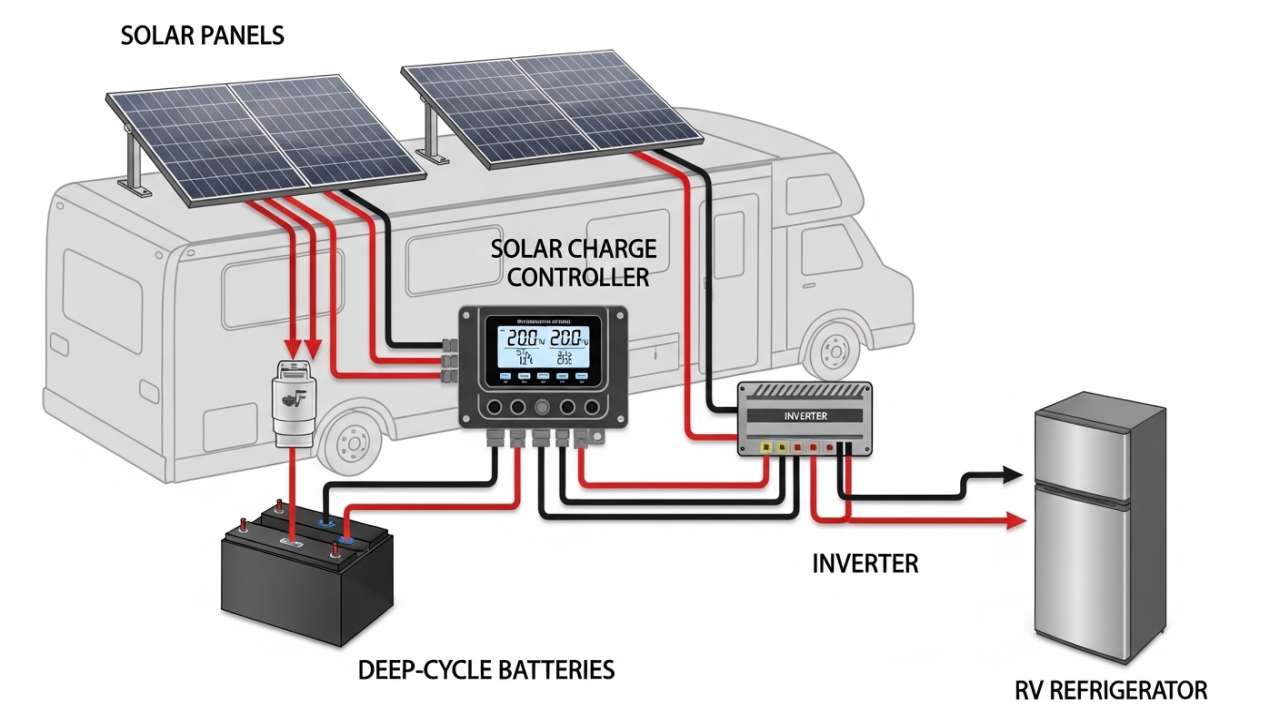
Here’s what most RV guides miss: Even a perfectly functioning fridge will stop cooling if your solar power system can’t handle its power draw. This is the core issue for anyone running an off-grid RV fridge.
Understanding Your RV Fridge Power Draw
First, know how much power your specific fridge consumes. Check the manual or label inside fridge door.
Typical specs:
| Fridge Model | Power Mode | Draw | Daily Consumption |
|---|---|---|---|
| Dometic RMS 8405 (absorption) | 120V AC | 50W | 1,200 Wh |
| Dometic RMS 8405 (propane) | Propane + ignition | 10W | 240 Wh |
| Vitrifrigo C85 (compressor) | 12V DC | 80W (avg) | 1,920 Wh |
| Isotherm Cruise 65 (compressor) | 12V DC | 60W (avg) | 1,440 Wh |
| Engel (compressor) | 12V DC | 40–70W | 960–1,680 Wh |
The problem: A 1,500–2,000 Wh daily fridge draw means your 12V refrigerator power management requires:
- Solar array: Minimum 400–600W to keep up (accounting for dust, angle, clouds)
- Battery bank: Minimum 300–400Ah to buffer night usage
- Charge controller: MPPT rated for your array size
- Wiring: Properly sized (no voltage drops)
If you have less, your solar battery drain problem is real—and you need to manage power differently.
Power Management Strategy 1: Maximize Solar Production
On sunny days, fridge draw is negligible relative to solar output. Problem is cloudy days and nights.
Steps:
- Clean panels weekly (dust reduces output 10–20%)
- Optimize panel angle (seasonal adjustment: 15–25° summer, 40–50° winter)
- Expand array if possible (upgrade from 400W to 600W gives 50% more daily production)
- Upgrade charge controller (MPPT 60–80A if using older PWM)
Expected result: Fridge runs continuously during sunny season; manageable drain on cloudy days.
Power Management Strategy 2: Run Fridge Selectively (Budget Approach)
If solar is limited, don’t run fridge 24/7. Run strategically.
High-power-budget approach:
- Run fridge 24/7 (assumes 400Ah+ battery + 500W+ solar array)
- Monitor battery voltage (keep above 12.2V)
- Run generator if voltage drops below 11.5V
Budget approach (limited solar):
- Run fridge only during peak sun hours (9am–5pm)
- Turn off at night (transfer food to cooler with ice)
- Resume next morning
- Daily RV fridge power draw: Drops from 2,000 Wh to 700 Wh (65% reduction)
- Result: Fridge lives longer, battery lasts through night, less solar needed
Super budget approach (very limited solar):
- Run fridge only 4–6 hours mid-day (11am–5pm)
- Use passive coolers (propane absorption fridge in propane mode only, or propane camp stove to freeze ice blocks overnight)
- This is extreme, but works in off-grid situations
Power Management Strategy 3: Switch to Propane (For Absorption Fridges)
Absorption fridges can run on propane, which consumes almost no battery power (only ~10W for ignition).
If your fridge has propane option:
- Run on propane during day/night (saves 1,500–2,000 Wh battery drain)
- Use 12V AC only if propane unavailable
- Propane cost: ~$15–$30/month (cheaper than expanded solar + battery system)
Result: RV fridge battery drain drops 95%. Solar handles lights, water pump, inverter. Fridge independently powered by propane.
Power Management Strategy 4: Upgrade Battery Bank
If your array and charge controller are healthy, but fridge still drains battery:
Battery capacity is your limiting factor.
Current setup: 200Ah lead-acid (12.8kWh usable at 80% DoD)
- Fridge 24/7: 2,000 Wh/day
- Other loads: 1,000 Wh/day
- Total: 3,000 Wh/day = Battery fully drained in 4 days
Upgraded setup: 400Ah lithium (5.1kWh usable at 90% DoD)
- Same consumption: 3,000 Wh/day
- Battery lasts 17 days on storage alone
- Solar catches up easily between drain cycles
Cost: ~$4,000–$6,000 for lithium upgrade, but fridge operates worry-free for 8+ years.
Detailed Troubleshooting: Fridge Works But Cooling Is Weak
Sometimes your fridge powers on, compressor runs, but it’s not getting cold enough. Food isn’t freezing, beer isn’t chilled.
Problem 1: Low Battery Voltage Reducing Cooling Speed
Symptom: Fridge runs but food cools slowly. Freezer doesn’t freeze.
Cause: Battery voltage below 12.0V reduces compressor efficiency.
Solution:
- Check battery voltage under load (as described in Step 1)
- If below 11.5V: Charge battery (solar + time, or generator)
- Once voltage reaches 12.5V+: fridge cooling improves noticeably
Example: At 11.0V, compressor runs at 80% efficiency. At 12.5V, it runs at 100%. That difference = cold food vs. warm food.
Problem 2: Thermostat Set Too High
Symptom: Fridge is cooling but not cold enough; thermostat dial has options.
Solution:
- Locate fridge thermostat (dial on interior wall)
- Turn to coldest setting
- Wait 30 minutes
- Check interior temperature with thermometer
Expected: Should drop 5–10°F within 30 minutes of thermostat adjustment.
If no change: Thermostat may be faulty (needs replacement, ~$50–$150).
Problem 3: Clogged Cooling Vents (Interior)
Symptom: Fridge is running but airflow inside is blocked.
Cause: Dust, frost, or debris blocking interior vents.
Solution:
- Unload fridge
- Look for vent openings (usually back wall or bottom)
- Vacuum gently or use compressed air to clear dust
- Remove any frost buildup (hairdryer on low heat, or defrost cycle)
- Close fridge and monitor cooling
Problem 4: Exterior Vent Blocked (Heat Exhaust)
Symptom: Compressor runs constantly but doesn’t cool well. Fridge housing feels hot.
Cause: Exterior heat exchanger vent blocked, trapping heat.
Solution:
- Locate RV exterior vent for fridge (usually rear wall)
- Inspect for blockages (insect nests, dust buildup, leaves)
- Clean with compressed air or brush
- Ensure vent isn’t covered by awning or blocked by bumper
Why this matters: Compressor generates heat that must exhaust outside. Blocked vent = heat buildup = poor cooling = compressor overheating.
Problem 5: Low Ambient Temperature (Winter) Causing Freezing Issues
Symptom: Absorption fridge cooling coils freezing over. Compressor fridge cooling inefficiently in cold.
Cause: Cold exterior temperature causing interior coils to freeze.
Solution:
- Insulate fridge exterior (wrap with blanket or foam)
- Improve RV insulation (seal gaps around fridge vent)
- Run RV heater periodically (raises interior temp, prevents freezing)
- Check RV leveling (absorption fridges fail if tilted >3°)
Also Read:- RV Air Conditioner Not Working? Troubleshoot & Fix in 30 Minutes (No Technician
The Complete RV Refrigerator Power Management Solution
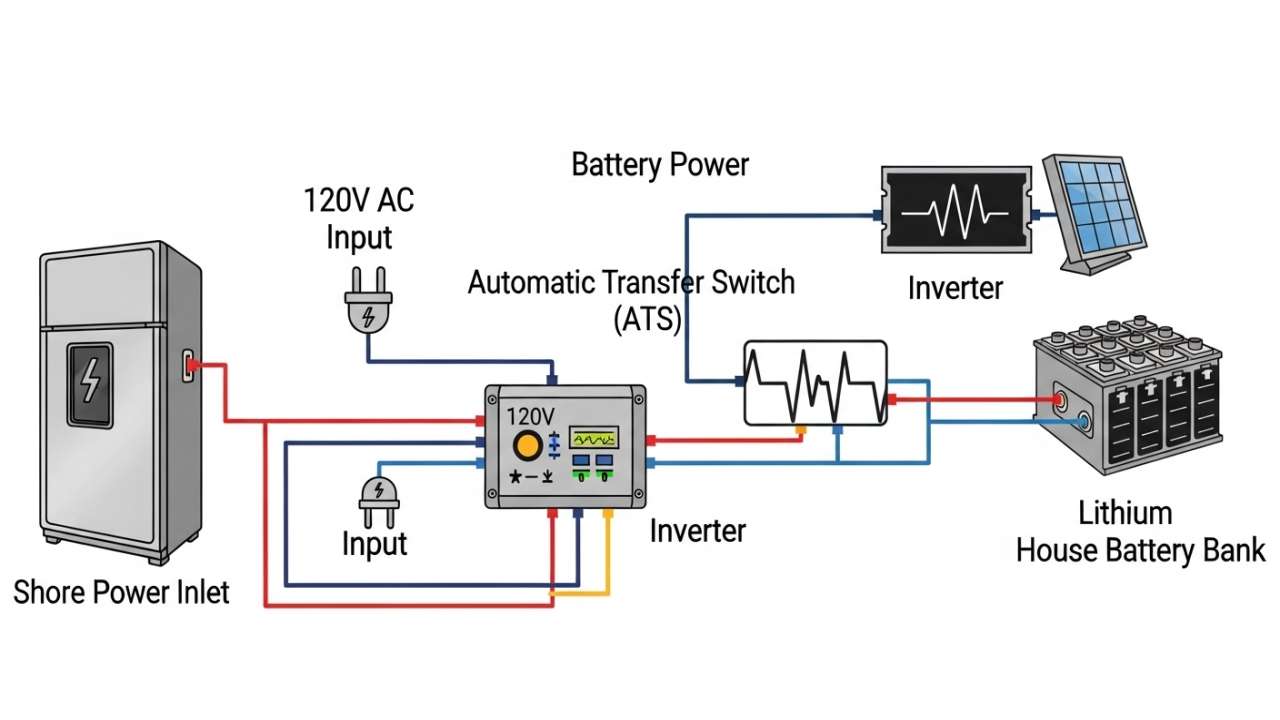
Here’s the reality: Most RV fridge “problems” are actually RV refrigerator solar power problems. The fridge works fine; the power system doesn’t support it.
Your 3-Step Diagnostic Flowchart
Step 1: Battery Voltage Test
- Is voltage 12.0V+ under load?
- YES → Go to Step 2
- NO → Charge battery or expand solar array. Problem solved.
Step 2: Fridge Mechanical Test
- Does compressor run (you hear humming)?
- YES → Go to Step 3
- NO → Fridge has mechanical failure (compressor, thermostat, etc.). Needs repair or replacement.
Step 3: Cooling Performance Test
- Does interior temperature drop 5–10°F within 30 minutes?
- YES → Fridge is fine. Your problem is solar battery drain management. Manage power usage.
- NO → Fridge has internal failure (refrigerant leak, frozen coils, etc.). Needs service.
Recommended Setup for Off-Grid RV Fridge (No Compromises)
If you want fridge to run 24/7 without worry:
| Component | Spec | Cost |
|---|---|---|
| Solar array | 600W (mono panels) | $1,200–$1,800 |
| Charge controller | 80A MPPT | $400–$600 |
| Battery bank | 400Ah lithium 12V | $4,000–$6,000 |
| Wiring/hardware | 4/0 gauge + breakers | $200–$300 |
| Total system | $5,800–$8,700 | |
| Fridge | 12V compressor (mid-size) | $1,200–$1,800 |
| TOTAL | Full off-grid fridge setup | $7,000–$10,500 |
What this gives you:
- Fridge runs 24/7 without battery management
- Works on cloudy days
- Survives 3–4 days of zero sun
- Lasts 10+ years with minimal maintenance
Budget-conscious alternative:
- Use propane-capable absorption fridge (run on propane, not electric)
- Smaller solar array (400W, $800–$1,200)
- Smaller battery (200Ah lead-acid, $600–$800)
- Total cost: $2,400–$3,000
- Trade-off: Propane cost (~$15–$30/month), less battery comfort
Also Read:- How to Fix RV Plumbing: Leaks, Clogs, Low Pressure & Frozen Pipes
FAQ:
Q: How much power does an RV fridge really use?
A: Compressor fridge: 40–150W depending on size and temp setting (average 60–80W). Absorption fridge on electric: 40–60W. On propane: <10W (ignition only). A 12V compressor running 24/7 uses 1,440–3,600 Wh/day—massive for a small solar system.
Q: Why does my frige stop cooling when my battery voltage drops?
A: Compressor and absorption fridges need minimum voltage to operate. Below 10.5V, fridge may not power on. Below 12.0V, compressor efficiency drops (runs slower, cools less). Absorption fridges also reduce heat output at low voltage.
Q: Should I run my fridge on AC (via inverter) or DC (12V)?
A: DC (12V) is more efficient—no inverter losses. But if your system can support it, AC (via inverter) gives you options if 12V fails. Most off-grid setups should run DC to save power.
Q: Can I run a 120V household fridge in my RV on solar?
A: Not practically. A 120V AC fridge draws 60–100W = 1,440–2,400 Wh/day via inverter (add 15% inverter loss = 1,650–2,760 Wh). You’d need 600W+ solar array + 400Ah battery minimum. Not worth it. Use a 12V RV fridge instead.
Q: Why is my fridge icing over inside?
A: (Absorption fridges mostly) Thermostat stuck in cooling mode, or defrost cycle failed. Or RV is too tilted. Fix: Turn fridge off 4–6 hours to defrost, check leveling, reset and retry. If persists: thermostat needs replacement.
Q: What’s the most reliable RV fridge for off-grid use?
A: Compressor fridges (Vitrifrigo, Isotherm, newer Dometic) are most reliable. They work at any angle, handle power fluctuations better, and last 10+ years. Absorption fridges (older Dometics) work great on propane but fail on 12V power fluctuations.
Q: Can I use a regular propane cooler to backup my fridge?
A: Yes. Propane coolers are cheap ($200–$400) and extremely reliable. Run your electric fridge on solar/battery during the day, switch to propane cooler at night or on cloudy days. This hybrid approach reduces RV fridge battery drain by 50%.
Q: My fridge works fine, but pulls battery voltage down too fast. What should I do?
A: You have a power management problem, not a fridge problem. Options: (1) Expand solar array, (2) Upgrade battery, (3) Run fridge selectively (not 24/7), (4) Switch to propane-only operation, (5) Use passive coolers to supplement. No single “fix”—choose based on budget and lifestyle.
Q: How often should I service my RV fridge?
A: Compressor fridges: Annual cleaning of exterior vents, check seals. Absorption fridges: Annual check of thermostat, propane line, heating element. Both: Monthly inspection of cooling airflow.
Q: Is it worth upgrading to lithium battery just for fridge reliability?
A: If fridge is your primary power draw (which it usually is), yes. Lithium handles constant 24/7 loads better than lead-acid, lasts 2–3x longer, and doesn’t sulfate from deep discharges. Cost is high (~$4,000–$6,000) but justified for 8+ year lifespan.
Conclusion:
Your RV refrigerator isn’t the problem. Your RV refrigerator solar power management is.
If your fridge suddenly stops cooling, run through the diagnostic flowchart: Check battery voltage first (90% of the time, it’s low voltage, not a broken fridge). Then check compressor/thermostat (mechanical), then check cooling performance (determines if it’s a power or refrigerant issue).
For off-grid RV fridge operation, accept this reality: A 12V fridge is the single largest power consumer in your RV. You either need a properly sized RV solar system (600W+ array, 400Ah+ battery, quality charge controller), or you run the fridge selectively, or you use propane as your primary cooling method.
Most RVers discover this the hard way: freezer empty, batteries dead, no time to charge. Don’t be that person. Size your system for the fridge, manage your RV fridge power draw honestly, and you’ll never deal with warm food again.