Your RV fridge was working fine when you left the house. Now you’re sitting at a campground, and nothing’s keeping your food cold—not electric, not gas, nothing. Your cold cuts are warming up. Your milk is sweating. And you’re staring at your Norcold refrigerator thinking, What went wrong?
This is one of the most frustrating problems RV owners face. But here’s the good news: in most cases, you can fix it yourself in 15 minutes to an hour. Most Norcold refrigerator not cooling problems aren’t catastrophic failures—they’re simple oversights that thousands of RVers have already solved.
This guide walks you through every reason your Norcold fridge died on both electric and gas, and exactly what to do about each one. Whether it’s a blown fuse, a blocked chimney, or a failed thermistor, you’ll find the fix here—and you’ll know when to call a professional.
Why Your Norcold Fridge Stopped Cooling on Both Electric and Gas
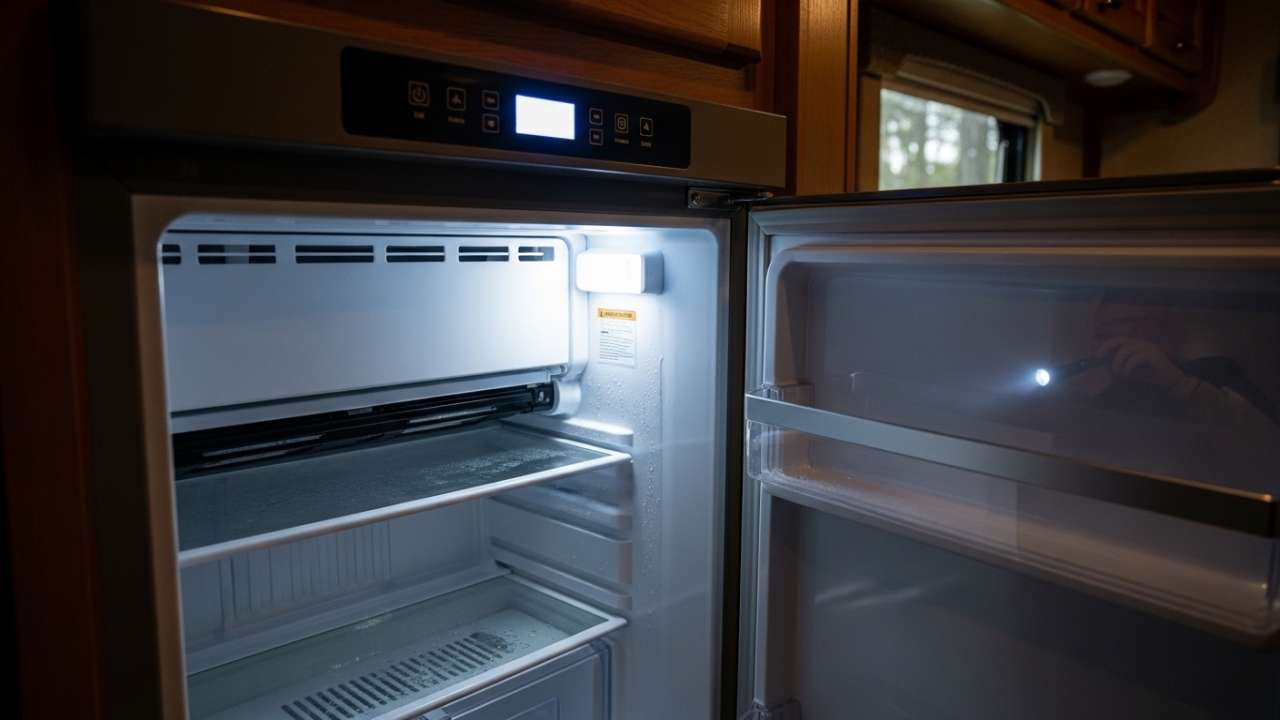
Before you panic and book a $200 service call, understand how your Norcold fridge actually works.
Your RV refrigerator is an absorption cooler, not a conventional compressor-based fridge like the one in your house. It has two heating methods: electric (AC/DC power) and propane (gas burner). When either one heats the boiler unit at the back of the RV fridge, it circulates ammonia through a sealed cooling system, pulling heat out of your food compartment.
Here’s the critical part: if it’s not cooling on EITHER source, the problem isn’t the power supply. It’s the cooling system itself.
This means you’re not looking at:
- A blown breaker
- A broken power cord
- A gas regulator failure
You’re likely looking at:
- A blocked or clogged cooling unit
- A failed thermistor (temperature sensor)
- A broken control board
- A tripped-overheat safety switch
- Improper RV leveling
Let’s diagnose each one.
Also Read:- RV Refrigerator Not Cooling? Troubleshooting & Solar Power Fix
Quick Check 1: Is Your RV Level?
Time required: 2 minutes
Before you touch anything else, check if your RV is level. This matters more than most owners realize.
Norcold absorption fridges rely on gravity to circulate ammonia through the cooling fins. When your RV is tilted more than 5-10 degrees side-to-side, the ammonia solution doesn’t flow properly. The cooling fins don’t get enough liquid ammonia, and you lose cooling—sometimes completely.
How to check leveling:
- Use a bubble level on your kitchen counter
- Check left-to-right and front-to-back
- Many RVs have a built-in level on the exterior (check around the fridge area)
- If you’re off, adjust your leveling blocks and retest the fridge after 2-3 hours
Many RV owners have reported that driving over bumpy terrain or stopping at a slightly unlevel campground directly caused their Norcold to stop cooling. Once they leveled properly, it worked again.
Pro tip: If you’re parked unlevel and want immediate cooling, try running the fridge while you’re driving. The vehicle’s movement sometimes restarts ammonia circulation. Once level, let it run for 4-6 hours before judging whether it works.
Quick Check 2: The Magnet Reset (The Secret Most People Miss)
Time required: 5 minutes
There’s a safety interlock switch on the outside of your fridge (behind the back panel). This is a magnetic reset device that trips if the fridge overheats or if water gets inside the control box.
When tripped, your Norcold won’t run on electric OR gas—and you’ll see no obvious signs of failure.
How to reset it:
- Go to the back of your RV (where the fridge exterior access panel is)
- Look for a small metal box mounted near the fridge cooling unit
- You’ll see a small button or switch—this is the overheat/interlock device
- Use a strong magnet (refrigerator magnets often work) and hold it near the switch
- You may hear a click
- Wait 5 minutes and turn the fridge back on
Why it trips:
- Water splashed on the exterior control box (rain, sprinkler, washing the RV)
- The fridge got too hot (blocked vents, extreme outdoor temperatures)
- Manufacturing defect
This single trick has fixed more Norcold fridges than any other troubleshooting step. Search YouTube for “Norcold magnet reset” and you’ll find dozens of grateful RV owners.
Also Read:- RV Solar & Power System Maintenance: Complete Seasonal Guide to Keep Your Off-Grid System Running
Check 3: Clean the Condenser Coils (The 1 Real Problem)
Time required: 30 minutes
Now we’re getting to the actual mechanical issue. The most common reason your Norcold stops cooling on both electric and gas is a blocked or clogged condenser system.
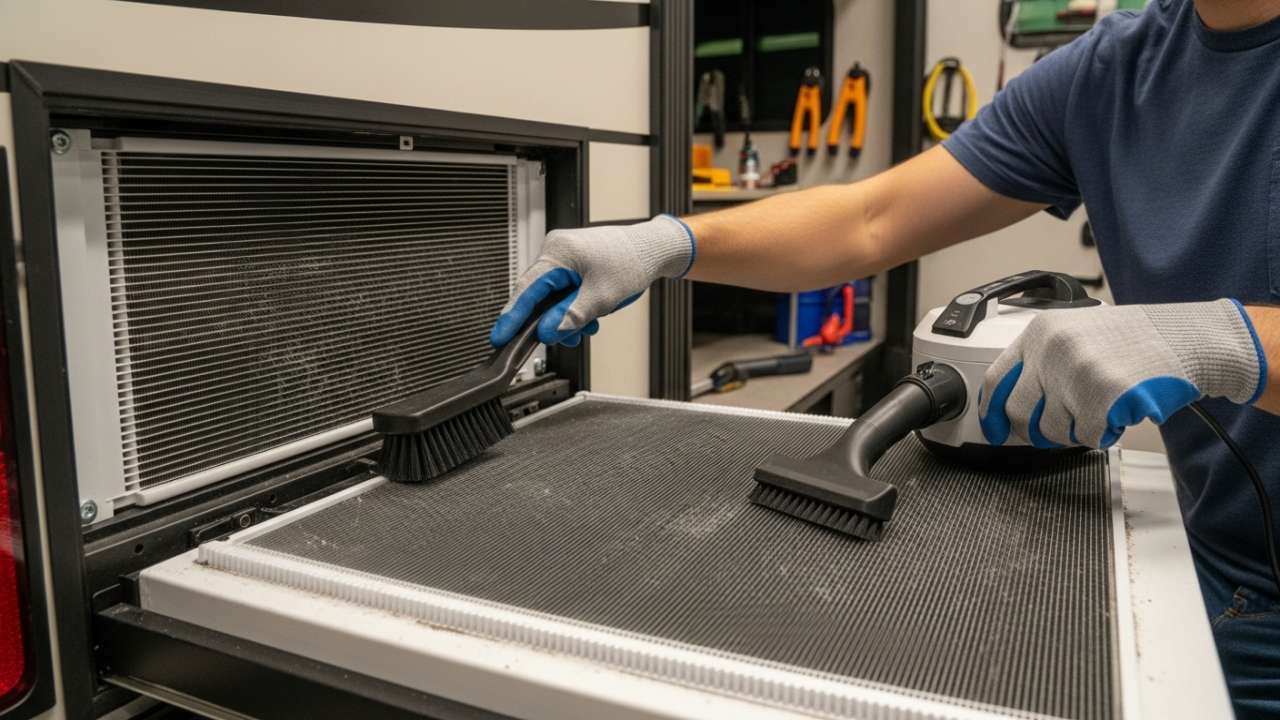
Your RV fridge has cooling fins on the back that look like a heat exchanger—a series of tubes running up and down. These tubes contain ammonia solution and need unobstructed airflow to work. When dust, RV insulation fibers, debris, or pet hair clogs these fins, the ammonia can’t release heat, and your fridge dies.
How to clean the condenser:
- Turn off the fridge and let it cool for 30 minutes
- Access the back panel: Remove the exterior vent cover by unscrewing the butterfly knobs or twist tabs
- Inspect the cooling fins: Look for visible dust, debris, or blockages. You may see RV insulation fibers (pink or white) clogging the aluminum tubes
- Vacuum carefully: Use a handheld vacuum with a brush attachment. Work gently—the fins are delicate and can be bent
- Use compressed air: A can of compressed air works great for blowing debris out from between the fins
- Check the chimney: The flue tube that vents heat should be clear. If it’s blocked, neither electric nor gas heating will work
After cleaning, reassemble the panel and let the RV refrigerator run for 4-6 hours. Many owners report instant improvement after this cleaning.
Why this happens so often:
- RV manufacturers mount the fridge cooling unit right against insulation
- Vibration during travel shakes loose insulation fibers
- Campground dust and pollen accumulate over time
Check 4: Test the Thermistor (Temperature Sensor)
Time required: 20 minutes with a multimeter
If cleaning didn’t fix it, the thermistor (temperature sensor) may have failed. This small component sits on the cooling fins inside the RV fridge and tells the control board whether the fridge is cold enough.
When it fails, the control board thinks the fridge is already at temperature and shuts off the heating system—even though nothing’s actually cold.
Signs of thermistor failure:
- No cooling on either source
- No error codes on the display
- The fridge runs briefly then stops
- The fridge runs constantly but never gets cold
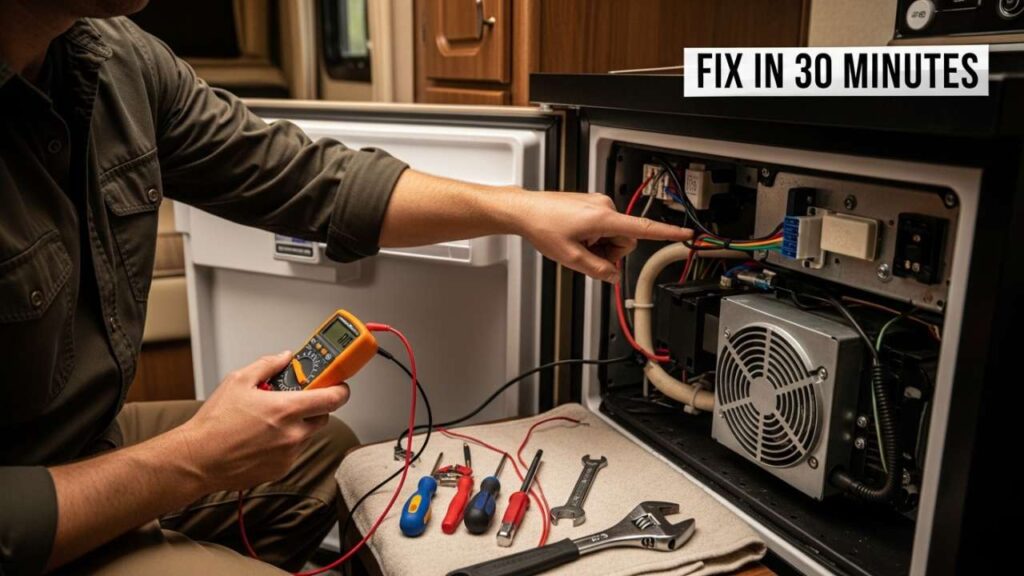
How to test it (if you have a multimeter):
- Find the thermistor: It’s on the cooling fins inside the RV refrigerator, usually toward the back-right
- Locate its connector (usually clips into a shared harness with the interior light)
- Disconnect it
- Set your multimeter to ohms (resistance) mode
- Place the thermistor in a glass of ice water for 5 minutes
- Test the resistance reading
- Compare to the Norcold manual’s ohm chart for your model
If the reading doesn’t change when temperature changes, it’s failed.
Cost: Thermistor replacement is $15–35 and takes 5 minutes to swap out. You can even bypass a failed thermistor temporarily by moving its connector to ensure it’s working—some RVers do this as an emergency fix.
Check 5: Listen for the Propane Burner (Gas Mode Only)
Time required: 10 minutes
If your RV fridge works on electric but NOT on gas, focus on the propane system.
How to diagnose gas-mode-only failure:
- Switch the RV refrigerator to Gas mode
- Listen near the back panel for a clicking sound (the igniter trying to light)
- If you hear clicking but no burner flame, the igniter or burner assembly failed
- If you hear nothing, check:
- Is propane flowing? Make sure the tank valve is open and you have gas (check pressure gauge if available)
- Is the gas line clear? Propane filters and lines can clog—purging is a temporary fix
- Is the control board sending power to the igniter? This requires a multimeter or professional diagnostics
Common gas-mode failures:
- LP filter or propane regulator pressure issues that prevent proper ignition
- A faulty thermocouple (flame sensor) that won’t light
- Blocked burner jet
- Failed control board relay
If you hear clicking but no flame, the igniter may need replacement ($40–80). If you hear nothing, the problem is likely electrical upstream (control board or power supply).
Check 6: Examine for Ammonia Leaks (The Catastrophic Failure)
Time required: 5 minutes
If your cooling unit has failed internally, you may see evidence of an ammonia leak.
Signs of ammonia system failure:
- Yellowish powder or staining on the back of the fridge
- Strong ammonia smell (distinct, sharp, unpleasant odor)
- Brown or black discoloration inside the cooling unit tubes
Do NOT ignore this. A ruptured cooling system can’t be repaired—the entire absorption unit must be replaced. Repair costs are $800–1,500+.
If you see these signs, your RV fridge is done. Call a professional or budget for a replacement unit.
Also Read:- How to Charge RV Battery with Solar: Complete Guide + Calculator
Norcold Cooling Failure Diagnosis (Basic Issues)
| Problem | Symptoms | Fix & Cost |
|---|---|---|
| Blocked condenser coils | No cooling on either source | Easy fix – $0–30 (vacuum/compressed air), 30 min |
| Tripped overheat switch | No lights, no response to controls | Very easy – $0 (magnet reset), 5 min |
| Failed thermistor | Runs constantly, won’t cool | Easy – $15–35, 10 min |
| Improper leveling | Works while driving, fails parked | Very easy – $0, 2 min |
| Blown fuse (12V or 120V) | No power to the control board | Easy – $5–15, 5 min |
Norcold Cooling Failure Diagnosis (Advanced Issues)
| Problem | Symptoms | Fix & Cost |
|---|---|---|
| Failed igniter (gas mode) | Clicking but no flame | Moderate – $40–80, 30 min |
| Ammonia system leak | Yellowish powder, ammonia smell | Professional repair – $800–1,500+ |
| Control board failure | No response on any mode | Moderate – $200–400, 1–2 hours |
| Blocked flue/chimney | Won’t heat on gas, sometimes electric | Easy – $0–50, 20 min |
| Propane regulator failure | No gas supply or low pressure | Moderate – $100–250, 1–2 hours |
Step-by-Step Troubleshooting Checklist
Follow this order to save time:
Step 1: Level the RV (2 min)
- Check all directions with a bubble level
- Adjust blocks if needed
- Wait 2–3 hours and retest
Step 2: Reset the Overheat Switch (5 min)
- Locate the magnetic reset device on the back panel
- Use a magnet to reset it
- Retest immediately
Step 3: Clean the Condenser (30 min)
- Remove back panel
- Vacuum the cooling fins gently
- Use compressed air to clear stubborn debris
- Reassemble and wait 4–6 hours
Step 4: Check Fuses (5 min)
- Locate fuses near the fridge and in the main panel
- Replace any blown fuses (common sizes: 5A, 12A, 15A)
- Retest
Step 5: Test the Thermistor (20 min)
- If you have a multimeter, test the sensor
- Compare ohm readings to manual charts
- Replace if out of spec ($15–35)
Step 6: Verify Propane System (Gas Mode Only) (10 min)
- Check the tank valve and gas gauge
- Listen for the igniter clicking
- Verify pressure if possible
If none of these work, call a professional RV technician. You likely have a failed control board or internal cooling system damage.
Why Norcold Fridges Fail: Maintenance Tips to Prevent This Again
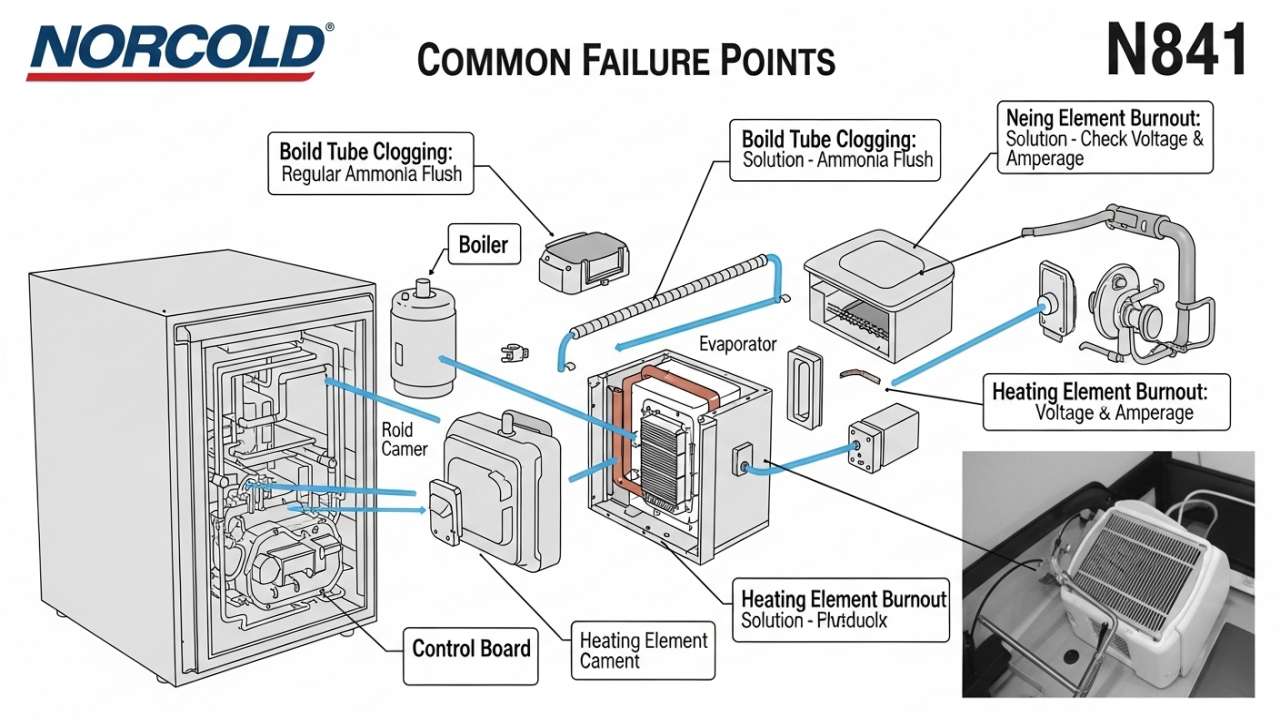
Once you’ve fixed your fridge, don’t let it happen again.
Monthly maintenance:
- Ensure the RV is level when parked (even at home)
- Check that the exterior access panel is secure and weatherproof
- Vacuum the condenser every month during camping season
Every 6 months:
- Clean the cooling fins thoroughly with compressed air
- Check fuses and electrical connections
- Verify propane supply lines have no leaks (soapy water test)
Annually:
- Have the control board and igniter system inspected
- Test both electric and gas modes for 12+ hours each
- Clean or replace the propane filter
Avoid these mistakes:
- Parking unlevel, even for short periods
- Blocking airflow around the exterior vents
- Leaving water sitting in the RV fridge during storage
- Running the fridge at max cold (setting 5)—it wears components faster
Also Read:- RV Air Conditioner Not Working? Troubleshoot & Fix in 30 Minutes (No Technician
Frequently Asked Questions
Q: My fridge works on electric but not gas. Do I need a new fridge?
A: No. This is almost always a propane system problem—faulty igniter, regulator issue, or clogged gas line. Cost to fix: $40–250. Professional service: $150–300. Replacement: $1,200+. Try the gas troubleshooting steps first.
Q: How long does a Norcold fridge last?
A: With proper maintenance, 15–20 years is common. Failures accelerate after year 7–10, especially if the RV fridge wasn’t leveled regularly or cleaned annually.
Q: Can I bypass the failed thermistor to keep food cold?
A: Temporarily, yes—some RVers unplug the thermistor to see if the fridge runs and cools. This is a bandage fix. Replace the thermistor ($15–35) as soon as you can. Running without a proper sensor wastes propane and electric power.
Q: My fridge has an error code. What does it mean?
A: Norcold error codes vary by model. Check your manual or search your model number + error code online. Common codes: “n” = thermistor fault, “FF” = control board issue. Some can be reset; others require part replacement.
Q: Should I run my fridge on Auto mode, or stick to Electric/Gas?
A: Auto mode is fine if both systems work. It automatically switches to propane when shore power is lost, which is convenient. But if one system fails, switch to the working mode and stay there until you fix the problem.
Q: Why does my fridge only cool when we’re driving?
A: This strongly suggests improper leveling at your campsite. The RV’s motion while driving restarts ammonia circulation. Relevel the RV or try driving over bumpy ground to see if that temporarily fixes it.
Q: Can dust and debris really prevent cooling?
A: Yes. Blocked cooling fins are the #1 cause of Norcold failures. This is why monthly cleaning saves thousands in repair bills.
Q: I smell ammonia. Is that dangerous?
A: Yes. An ammonia leak means your cooling system has ruptured. This is a safety and mechanical failure. Don’t use the fridge. Call a professional. Ventilate your RV well.
Conclusion:
A Norcold refrigerator not cooling on electric or gas sounds like a disaster. You’re thinking about throwing out groceries and spending $1,500 on a new fridge.
But statistically, you’re looking at a $0–50 fix that takes an hour.
Start with the magnet reset. Clean the condenser coils. Level the RV. Replace a fuse. These five steps solve 80% of all Norcold failures.
If you follow the troubleshooting checklist above and still have no cooling, then—and only then—book a professional service call. But chances are good you won’t need to.
Your food will be cold again before dinner.