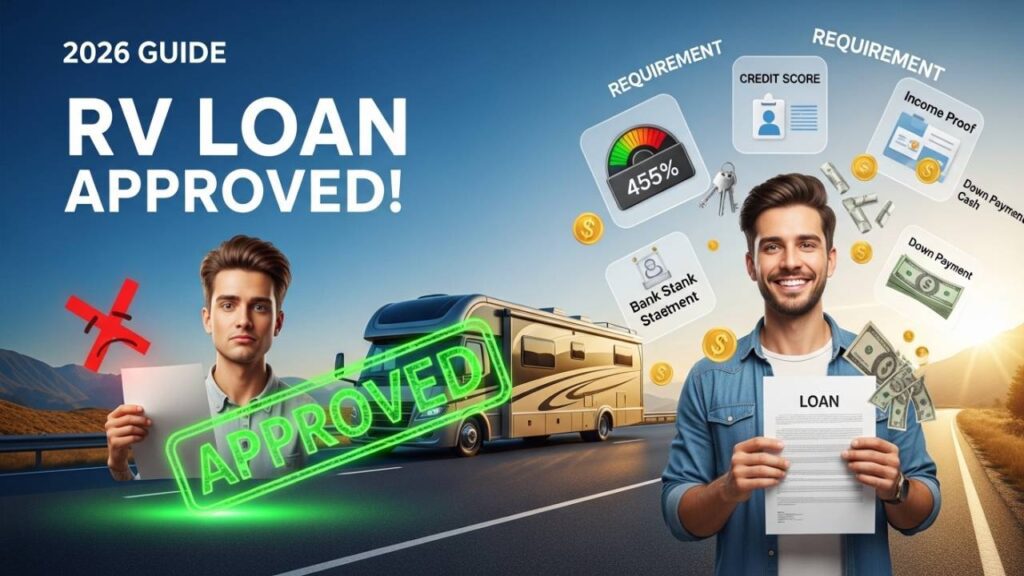
Owning a recreational vehicle (RV) is a dream for many adventure enthusiasts and retirees. However, the high cost of purchasing an RV makes financing necessary for most buyers. Understanding RV loan requirements and the approval process is crucial to securing favorable terms and getting approved quickly.
This comprehensive guide explains everything you need to know about RV financing, from initial requirements to final approval. Whether you’re a first-time RV buyer or upgrading to a luxury motorhome, this article will help you navigate the RV loan application process successfully.
What is an RV loan?
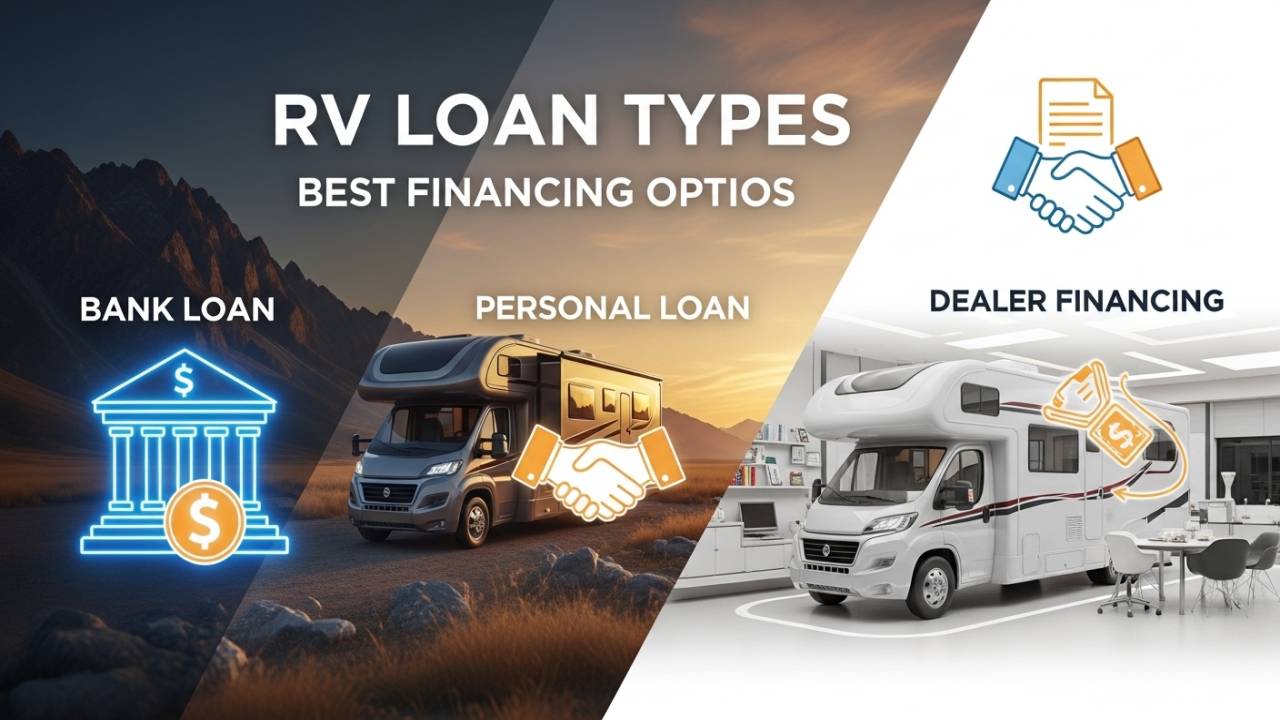
An RV loan is a specialized type of vehicle financing used specifically to purchase recreational vehicles. Unlike traditional auto loans, RV financing accounts for the unique characteristics of motorhomes, travel trailers, and fifth wheels.
Types of RV Loans
1. Secured RV Loans
Secured RV loans use the recreational vehicle itself as collateral. The lender holds a lien on the RV until the loan is fully paid.
Advantages:
- Lower RV loan interest rates
- Higher approval odds
- Larger loan amounts available
- Longer repayment terms (up to 25 years)
Disadvantages:
- The lender can repossess the RV if payments are missed
- Comprehensive insurance required
2. Unsecured Personal Loans for RV Purchase
Unsecured personal loans don’t require collateral but are used for RV financing.
Advantages:
- No risk of repossession
- Faster approval process
- Flexible use of funds
Disadvantages:
- Higher RV loan interest rates
- Lower borrowing limits
- Stricter credit requirements
3. Dealer Financing
Dealer financing is offered directly by RV dealerships through partnerships with lenders.
Advantages:
- Convenient one-stop shopping
- Quick approval process
- Dealer incentives available
Disadvantages:
- Often higher interest rates
- Less flexibility
- May include add-on services
4. Bank Loans vs. Credit Union Loans
Bank RV loans:
- Competitive RV loan interest rates
- Standardized requirements
- Multiple loan products
Credit Union RV loans:
- Lower interest rates for members
- More flexible requirements
- Better customer service
- Loyalty discounts available
RV Loan Requirements
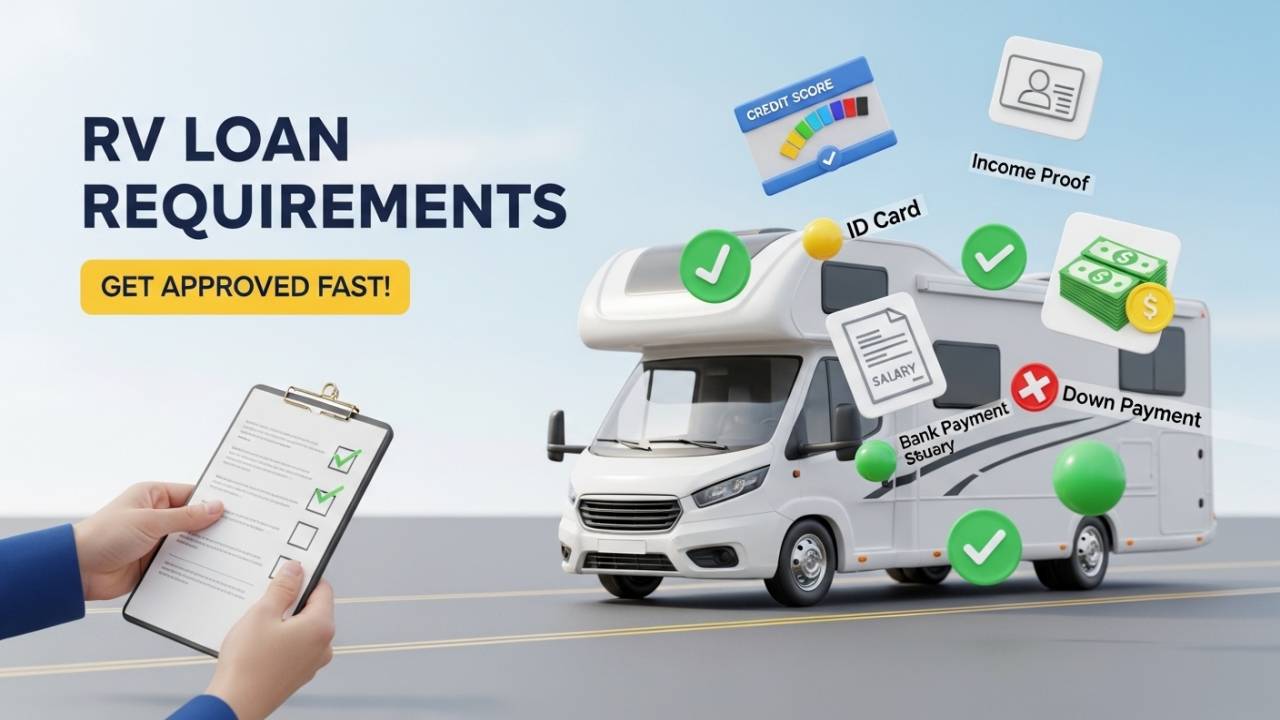
Essential RV Loan Requirements
To qualify for an RV loan, lenders typically require the following:
1. Minimum Age
- Must be at least 18 years old
- Some lenders require 21+ years
2. Valid Driver’s License
- Active, valid license required
- No suspended or revoked status
- Used for identity verification
3. Social Security Number
- Required for credit check
- Must match with credit bureau records
- Used for background verification
4. U.S. Citizenship or Permanent Residency
- Most lenders require this
- Proof of legal status needed
- Some accept valid visas
5. Stable Employment
- Currently employed or self-employed
- Minimum employment length varies by lender (typically 2+ months)
- Income verification required
6. Acceptable Credit History
- Minimum credit score typically 600+
- No recent bankruptcies or foreclosures
- Limited delinquencies acceptable
7. Bank Account
- Active checking account required
- Direct deposit preferred
- Used for loan payment setup
8. Contact Information
- Valid phone number
- Current email address
- Verifiable mailing address
Credit Score Requirements for RV Loans
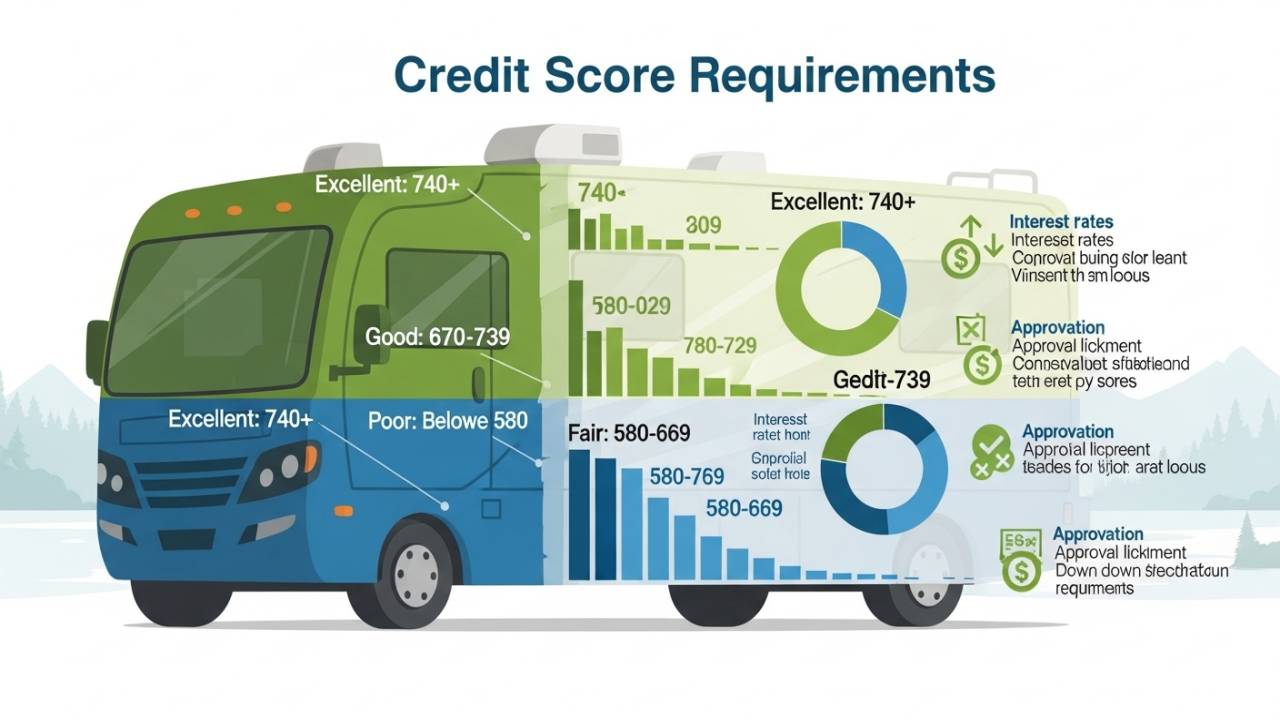
Understanding RV Loan Credit Scores
Your credit score is one of the most important factors in RV loan approval. Here’s what you need to know:
Credit Score Ranges and Approval
| Credit Score Range | Approval Likelihood | Interest Rate Impact |
|---|---|---|
| Excellent (760+) | Very High | Lowest rates (4-6%) |
| Good (700-759) | High | Competitive rates (6-8%) |
| Fair (650-699) | Moderate | Higher rates (8-10%) |
| Poor (600-649) | Low | Much higher rates (10-15%) |
| Very Poor (<600) | Very Low | Highest rates (15%+) |
How to Check Your Credit Score
- Free Credit Reports: Visit annualcreditreport.com
- Credit Monitoring Services: Experian, Equifax, TransUnion
- Bank Services: Many banks provide free credit score monitoring
- Credit Card Issuers: Provide FICO score for cardholders
Tips to Improve Your Credit Score Before RV Loan Application
1. Pay Bills On Time
- Set up automatic payments
- Avoid late payment damage
- Improves payment history (35% of score)
2. Reduce Credit Card Balances
- Lower utilization ratio
- Aim for <30% of available credit
- Immediately improves credit score
3. Don’t Close Old Credit Accounts
- Maintains credit history length
- Keeps available credit higher
- Preserves average account age
4. Dispute Credit Report Errors
- Get free annual report
- Challenge inaccuracies
- Can increase score significantly
5. Limit New Credit Applications
- Multiple inquiries hurt score
- Space applications 6+ months apart
- Shows financial responsibility
Income and Employment Verification

Employment Requirements for RV Loans
Employment History
- Minimum 2 months at current job
- Some lenders require 2+ years
- Self-employed need 2 years documentation
Income Stability
- Consistent income pattern required
- Increasing income is preferred
- No recent job changes ideal
Types of Acceptable Income
W-2 Employment Income
- Traditional employee wages
- Most reliable income type
- Verified through pay stubs and tax returns
Self-Employment Income
- Requires 2 years tax returns
- Business bank statements needed
- Average annual income calculated
Retirement Income
- Social Security statements
- Pension documents
- Investment account statements
Disability Income
- Award letters from SSA
- Bank statements showing deposits
- Continuing eligibility verification
Rental/Investment Income
- Tax returns required
- Lease agreements needed
- Bank statements showing deposits
Income-to-Debt Ratio
Most lenders use the debt-to-income (DTI) ratio to assess approval:
Standard DTI Requirements:
- Maximum 43-50% DTI
- RV loan payment included in calculation
- Lower DTI = Better approval odds
Example DTI Calculation:
- Monthly gross income: $5,000
- Existing monthly debts: $1,500
- Proposed RV loan payment: $800
- Total debt: $2,300
- DTI: 46% ($2,300 ÷ $5,000)
Down Payment Requirements
RV Loan Down Payment Guidelines
Typical Down Payment Requirements:
| RV Price | Recommended Down Payment | Percentage |
|---|---|---|
| $30,000 | $3,000 – $6,000 | 10-20% |
| $50,000 | $5,000 – $10,000 | 10-20% |
| $75,000 | $7,500 – $15,000 | 10-20% |
| $100,000 | $10,000 – $20,000 | 10-20% |
Impact of Down Payment on Loan Approval
Larger Down Payment Benefits:
- Lower loan amount needed
- Reduced lender risk
- Better RV loan interest rates
- Improved approval odds
- Lower monthly payments
No Money Down RV Loans
- Available from some lenders
- Higher interest rates (2-5% more)
- Stricter credit requirements
- Need excellent credit (740+)
Down Payment Sources
Acceptable Down Payment Sources:
- Personal savings
- Gift from family member (with documentation)
- Trade-in value of old vehicle
- Co-signer contribution
- Inheritance funds
Documentation Needed
Complete Document Checklist for RV Loan Application
Personal Identification Documents
- ✅ Valid driver’s license or state ID
- ✅ Social Security card or number
- ✅ Birth certificate (optional)
- ✅ Passport (if applying as non-citizen)
Proof of Income
- ✅ Recent pay stubs (last 2-3 months)
- ✅ W-2 forms (last 2 years)
- ✅ Tax returns (last 2 years)
- ✅ Bank statements (last 2-3 months)
- ✅ Profit and loss statement (if self-employed)
Employment Verification
- ✅ Employment letter from employer
- ✅ Offer letter (if recently hired)
- ✅ Job contract
Financial Information
- ✅ Bank statements (checking and savings)
- ✅ Investment account statements
- ✅ Retirement account statements
- ✅ Proof of other assets
Debt Information
- ✅ List of all current debts
- ✅ Mortgage statements
- ✅ Credit card statements
- ✅ Auto loan documents
- ✅ Student loan statements
RV-Specific Documents
- ✅ RV purchase agreement or invoice
- ✅ VIN (Vehicle Identification Number)
- ✅ RV specifications and pricing
- ✅ RV inspection report (if applicable)
Residency Documents
- ✅ Proof of current address
- ✅ Utility bills (electric, water, gas)
- ✅ Lease agreement or mortgage statement
- ✅ Government-issued ID
RV Loan Approval Process Step-by-Step
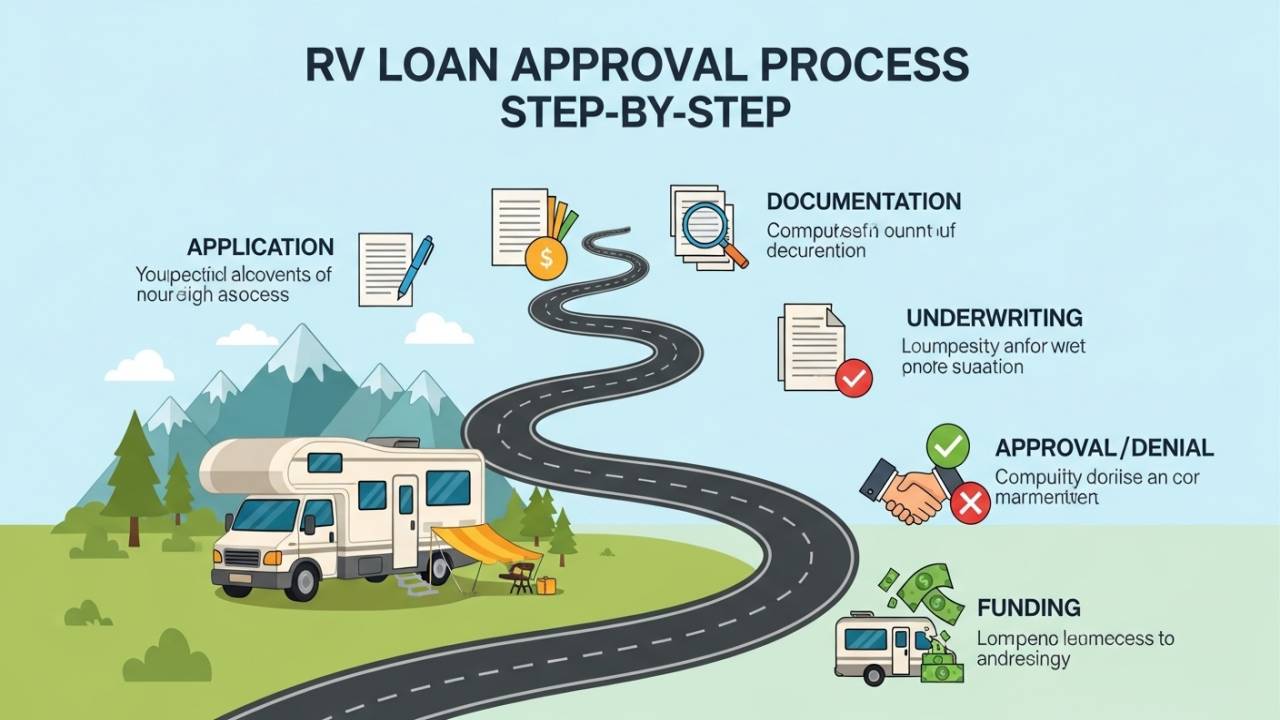
Complete RV Loan Approval Timeline
Step 1: Pre-Qualification (24-48 Hours)
What Happens:
- Initial eligibility assessment
- Soft credit inquiry (doesn’t hurt credit)
- Basic information collection
- Preliminary interest rate estimate
What You Provide:
- Name, contact information
- Employment status
- Approximate income
- Desired loan amount
Output: Pre-qualification letter (non-binding)
Step 2: Formal Application (1-2 Hours)
What Happens:
- Complete detailed application
- Hard credit inquiry performed
- Employment verification begins
- Document submission
What You Provide:
- All personal information
- Employment and income details
- Asset and debt information
- References
Output: Application confirmation number
Step 3: Credit and Background Check (24-48 Hours)
Credit Report Analysis:
- FICO score calculation
- Payment history review
- Outstanding debts assessment
- Delinquency and bankruptcy check
- Hard inquiries review
Background Check:
- Identity verification
- Employment verification
- Fraud screening
- Address history check
Output: Credit report summary
Step 4: Income Verification (2-3 Days)
Verification Methods:
- Direct Verification: Employer contact
- Documentation Review: Pay stubs and tax returns
- Bank Deposit Verification: Income deposits visible in statements
- Employer Statement: Employment verification letter
Acceptable Documentation:
- Recent pay stubs
- Tax returns (2 years)
- Bank statements showing income
- Employer letter
- Self-employment records
Output: Income verification approval
Also Read:- RV Fuel Efficiency: 10 Secrets That Cut Gas Costs 50% (2026 Guide)
Step 5: Debt-to-Income Analysis (1-2 Days)
Calculation Process:
- Total monthly gross income calculated
- All monthly debt obligations listed
- Proposed RV loan payment added
- DTI ratio computed
- Ratio compared to lender standards
Standard Requirements:
- Maximum 43-50% DTI
- Varies by lender and credit profile
- Lower DTI increases approval odds
Output: DTI approval or denial
Step 6: RV Appraisal and Inspection (3-5 Days)
What Gets Appraised:
- Actual RV condition assessment
- Market value determination
- Equipment and features evaluation
- Mechanical condition check
- Insurance requirements verification
Appraisal Options:
- Professional in-person appraisal
- Dealership valuation (trusted source)
- NADA RV guide valuation
- KBB recreational vehicle pricing
Output: Appraisal report with estimated value
Step 7: Insurance Verification (1-2 Days)
Required Documentation:
- RV insurance quote from insurer
- Comprehensive and collision coverage
- Liability coverage minimums
- Policy effective date within 30 days of funding
Insurance Requirements:
- Minimum liability: $100,000/$300,000
- Comprehensive coverage required
- Collision coverage required
- Named insured: lender as lienholder
Output: Insurance approval letter
Step 8: Underwriting Decision (2-3 Days)
Final Review Process:
- All information compiled
- Comprehensive file review
- Risk assessment completion
- Final approval decision
Possible Outcomes:
Approved:
- Conditional approval
- Full approval
- Clear to close
Conditional Approval:
- Additional information needed
- Secondary verification required
- Additional conditions to meet
Denied:
- Insufficient credit score
- High debt-to-income ratio
- Employment verification failed
- Fraud indicators
Output: Underwriting decision letter
Step 9: Loan Documentation (1-2 Days)
Documents to Sign:
- Promissory note
- Security agreement
- Disclosure statements
- Truth in Lending Act (TILA) disclosure
- RV financing contract
Review Requirements:
- Read all terms carefully
- Ask questions before signing
- Verify loan amount and rate
- Confirm payment terms
Output: Fully executed loan documents
Step 10: Funding and Delivery (1-5 Days)
Final Steps:
- Lender funds account
- Funds transferred to RV dealership
- RV title transferred to you
- Registration documents prepared
- Keys and documents delivered
Timeline: Usually 1-3 business days after final approval
Interest Rates and Loan Terms
RV Loan Interest Rate Factors
Rates are determined by:
1. Credit Score
- 760+: 4-6% rates
- 700-759: 6-8% rates
- 650-699: 8-10% rates
- <650: 10%+ rates
2. Down Payment Amount
- 20%+ down: Lower rate
- 10-20% down: Standard rate
- <10% down: Higher rate
3. Loan Term Length
- Shorter terms (5-7 years): Lower rates
- Longer terms (15-25 years): Higher rates
4. RV Age
- New RVs: Better rates
- Used (1-5 years): Standard rates
- Used (5+ years): Higher rates
5. Type of RV
- Motorhome: Standard rates
- Travel trailer: May be higher
- Class A/B: Generally better rates
6. Lender Type
- Banks: Competitive rates
- Credit unions: Lower rates
- Dealers: Often higher rates
- Online lenders: Varies widely
Current RV Loan Interest Rates (2026)
| Credit Profile | Loan Term | Current Rate Range |
|---|---|---|
| Excellent | 5 years | 4.5-6.0% |
| Excellent | 10 years | 5.0-6.5% |
| Good | 5 years | 6.5-8.0% |
| Good | 10 years | 7.0-9.0% |
| Fair | 5 years | 8.5-11.0% |
| Fair | 10 years | 9.5-12.0% |
Loan Term Options
Common RV Loan Terms:
5-Year Loan (60 months)
- Higher monthly payment
- Lower total interest paid
- Faster loan payoff
- Best for shorter adventures
10-Year Loan (120 months)
- Moderate monthly payment
- Balanced interest costs
- Most popular option
- Good flexibility
15-Year Loan (180 months)
- Lower monthly payment
- Higher total interest
- Longer commitment
- Useful for older buyers
20-Year Loan (240 months)
- Very low monthly payment
- Substantially more interest
- Maximum affordability
- Best for fixed-income retirees
25-Year Loan (300 months)
- Lowest monthly payment
- Highest total interest cost
- For premium RVs only
- Rare option
Also Read:- RV AC Not Working? Fix It in 30 Minutes (2026 Troubleshooting Guide)
Best RV Lenders and Options
Top RV Financing Lenders
1. Bank of America RV Financing
Requirements:
- Minimum credit score: 620
- Employment: 2+ years preferred
- Down payment: 10-20%
Features:
- Competitive rates: 6.5-9.5%
- Loan terms: Up to 15 years
- Pre-approval available
- Fast approval process
2. Credit Union RV Loans
Advantages:
- Lower rates for members
- More flexible requirements
- Better customer service
- Member benefits and discounts
Typical Rates: 5.5-8.5%
3. RV-Specific Lenders
Company Examples:
- Marine Bank
- RecRev (online)
- The RV Warehouse
- CoastHills Federal Credit Union
Advantages:
- RV expertise
- Streamlined process
- Specialized products
- Dealer relationships
4. Online RV Lenders
Popular Options:
- LendingTree
- Upstart
- Elevate Credit
- GreenSky
Advantages:
- Fast approval
- Easy comparison
- No dealership pressure
- Flexible terms
Common Reasons for RV Loan Rejection
Why RV Loans Get Denied
1. Low Credit Score
- Below 600: Very difficult approval
- Recent delinquencies: Major red flag
- Bankruptcy within 2 years: Automatic denial
- Multiple hard inquiries: Indicates risky behavior
2. High Debt-to-Income Ratio
- DTI above 50%: Usually denied
- Too many existing debts
- Insufficient income verification
- Unstable employment
3. Insufficient Income
- Income too low for loan amount
- Recent job change: May be issue
- Income difficult to verify
- Retirement concerns
4. Employment Issues
- Less than 2 months employment
- Multiple recent job changes
- Unemployment or furlough
- Questionable income source
5. Credit History Problems
- Recent bankruptcy (within 2 years)
- Foreclosure on home
- Repossession history
- Multiple collections accounts
6. Fraud Indicators
- Inconsistent information
- Discrepancies in documents
- False identity verification
- Suspicious activity patterns
7. RV-Related Issues
- RV value too low for loan amount
- RV age (usually 30+ years)
- RV not eligible for financing
- Insurance unavailable
8. Documentation Problems
- Incomplete application
- Missing required documents
- False information provided
- Unverifiable claims
Tips to Improve Approval Odds
How to Increase Your RV Loan Approval Chances
Before You Apply
1. Improve Your Credit Score
- Pay down credit cards to <30% utilization
- Make all payments on time
- Remove credit report errors
- Avoid new credit applications
2. Reduce Your Debt
- Pay off small debts completely
- Lower overall monthly obligations
- Improve debt-to-income ratio
- Show financial responsibility
3. Save for Down Payment
- Aim for 20% down payment
- Reduce loan amount needed
- Show financial discipline
- Lower lender risk
4. Gather Documentation Early
- Collect 2 years of tax returns
- Get recent pay stubs
- Prepare bank statements
- Organize employment letters
5. Build Employment Stability
- Stay in current job
- Avoid job changes before loan
- Get employment verification letter
- Maintain consistent income
During Application
1. Be Honest and Complete
- Provide all requested information
- Double-check accuracy
- Don’t omit relevant details
- Consistency across documents
2. Use a Co-Signer
- Spouse or family member
- Improves approval odds significantly
- Reduces interest rate
- Increases loan amount possible
3. Shop with Multiple Lenders
- Compare offers
- Negotiate better rates
- Find best terms
- Use for 14-day comparison window
4. Choose the Right RV
- Select appropriate price range
- Consider newer models
- Popular brands easier to finance
- Matching loan value
5. Increase Down Payment
- Show more financial commitment
- Reduces lender risk
- Better approval odds
- Lower interest rates
After Application
1. Respond Quickly to Requests
- Submit documents promptly
- Answer verification questions
- Don’t delay communication
- Keep contact information current
2. Don’t Make Big Financial Changes
- Avoid new job changes
- Don’t apply for new credit
- Don’t make large purchases
- Maintain income stability
3. Follow Up Appropriately
- Check on application status
- Ask for timeline updates
- Don’t apply elsewhere simultaneously
- Be patient and professional
Frequently Asked Questions
Q1: What is the minimum credit score needed for an RV loan?
A: Most RV lenders require a minimum credit score of 620. However, better rates are available with scores above 700. Some credit unions may work with scores as low as 580, but you’ll face higher RV loan interest rates.
Q2: How long does the RV loan approval process take?
A: The complete RV loan approval process typically takes 5-10 business days. Pre-qualification can happen in 24-48 hours, but underwriting and verification add time. Some online RV lenders offer approval in as little as 1-2 days.
Q3: Can I get an RV loan with bad credit?
A: Yes, bad credit RV loans are possible, but you’ll face:
- Higher RV loan interest rates (10-15%+)
- Larger down payment requirements (20%+)
- Higher fees
- Stricter terms
- Consider credit repair first
Q4: What documents are required for an RV loan application?
A: Essential documents include:
- Driver’s license and SSN
- Last 2-3 months pay stubs
- Last 2 years tax returns
- Bank statements
- RV purchase agreement
- Employment verification letter
- Proof of residence
Q5: Can I trade in my old RV toward a new one?
A: Yes! Trade-in value can be:
- Applied to new RV purchase price
- Used as down payment
- Reduces RV loan amount needed
- Improves approval odds
Q6: What happens if my RV loan application is denied?
A: If denied:
- Request specific denial reasons
- Review credit report for errors
- Address identified issues
- Apply again with improvements
- Consider a co-signer
- Try different lender
Q7: Are RV loan interest rates fixed or variable?
A: Most RV loans have fixed interest rates, meaning your rate stays the same throughout the loan term. Some lenders offer variable rates, which can change annually. Fixed rate RV loans are preferred for payment stability.
Q8: What is the maximum loan amount for an RV?
A: Maximum RV loan amounts vary by lender but typically:
- $50,000-$75,000: Easy to obtain
- $75,000-$150,000: Standard for many lenders
- $150,000+: Requires excellent credit (760+)
- Some credit unions: Up to $250,000 for exceptional borrowers
Q9: Do I need full insurance before RV loan approval?
A: No, but insurance must be in place before loan funding. You typically have 30 days after approval to secure a policy. Most lenders require:
- Comprehensive coverage
- Collision coverage
- Minimum liability ($100K/$300K)
Q10: Can I refinance my RV loan later?
A: Yes! RV loan refinancing is possible if:
- Your credit score improved
- Interest rates dropped
- You have equity in the RV
- You have better employment stability
- Refinancing could save significant money