So you’ve found the perfect little travel trailer online, you’re already picturing yourself parked at some lake somewhere… and then your buddy asks, “wait, can your car even pull that thing?” Good question. Honestly, it’s the question that trips up more first-time RV buyers than almost anything else.
People fall in love with a floor plan, put down a deposit, and only later find out their SUV is rated for half of what the trailer actually weighs once it’s loaded with water and gear. That’s an expensive mistake to make after the fact. So let’s sort it out before you’re standing in a dealership lot.
What “Towing Capacity” Actually Means
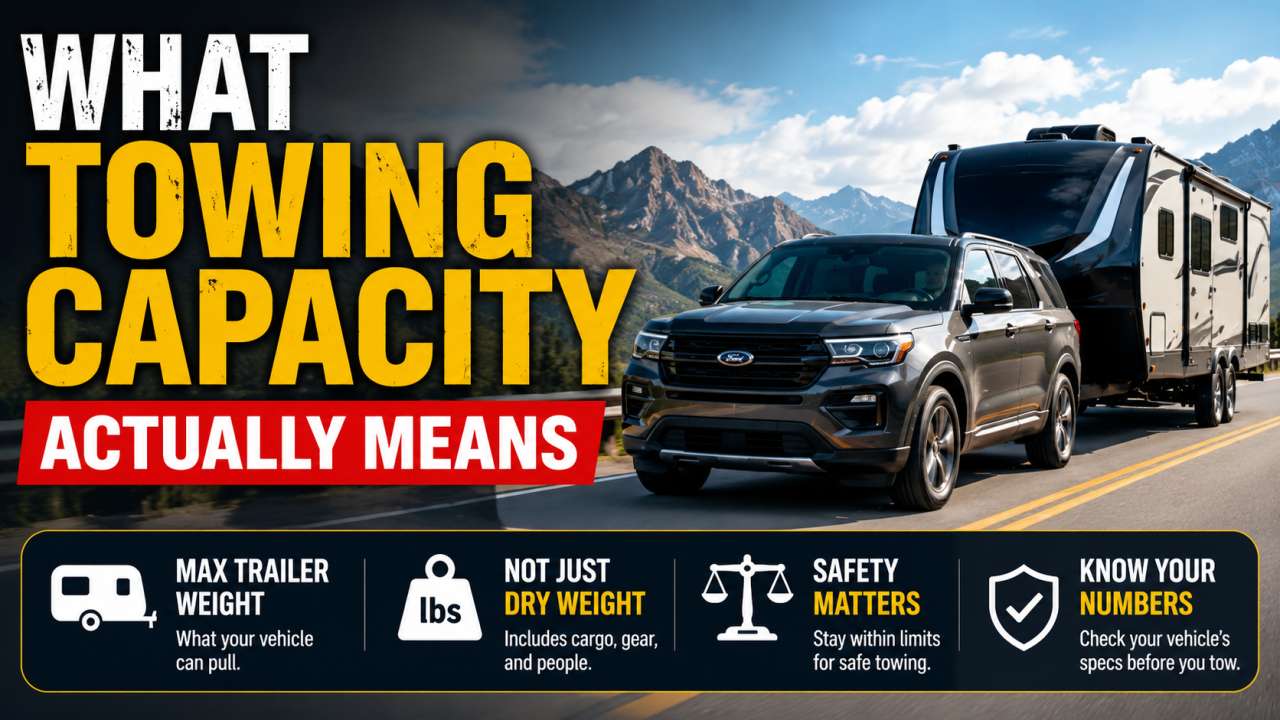
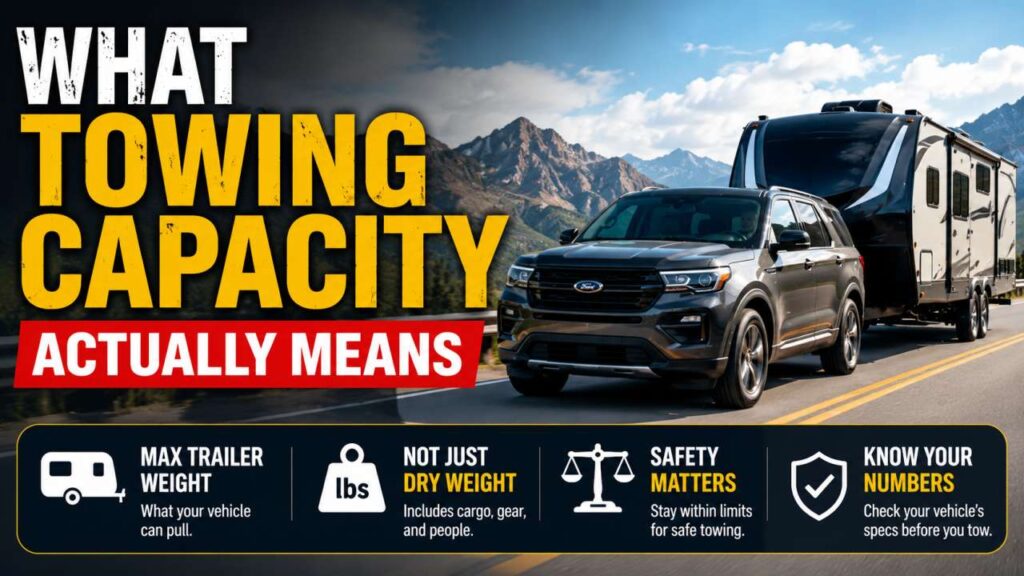
In plain terms, towing capacity is how much weight your vehicle is built to safely drag behind it. Not “probably fine” weight — the actual engineered limit, based on things like engine torque, transmission cooling, frame strength, and how good the brakes are at stopping all that extra mass.
Here’s the part that catches people off guard: it’s not just one number. Engineers and RV folks throw around a handful of acronyms, and if you don’t know what they mean, you can do the math wrong without realizing it.
| Term | What It Means | Why You Should Care |
|---|---|---|
| GVWR (Gross Vehicle Weight Rating) | Max weight of your tow vehicle alone, fully loaded with people, gear, fuel | Tells you if your own car is overloaded before you even hitch up |
| GCWR (Gross Combined Weight Rating) | Max combined weight of your vehicle + trailer, both fully loaded | Usually the real limiting factor — often lower than people expect |
| GTW (Gross Trailer Weight) | The RV’s actual weight when loaded with water, propane, and your stuff | Almost always higher than the “dry weight” advertised online |
| Tongue Weight | Downward pressure the trailer hitch puts on your car | Should be roughly 10–15% of trailer weight — too little causes sway, too much overloads the rear axle |
If you only remember one thing from this list, make it this: GCWR is usually what actually limits you, not the flashy “towing capacity” number in the ad.
Where to Actually Find Your Vehicle’s Real Number
A lot of people just Google “Toyota 4Runner towing capacity” and call it done. Problem is, towing capacity can swing by a couple thousand pounds depending on your trim, engine, and even what axle ratio your specific vehicle came with. Two 4Runners off the same lot can tow very different loads.
So skip the generic search results and go straight to the source:
- Your owner’s manual — boring, I know, but it has the actual chart for your engine and trim combo.
- The manufacturer’s annual towing guide — most brands publish one every year, and it breaks things down configuration by configuration.
- The door jamb sticker — driver’s side door, usually has GVWR and payload info.
- A VIN lookup at the dealer — this pulls the exact spec sheet tied to your specific vehicle, not just “the model in general.”
Don’t trust a friend who says “oh yeah, my truck pulls 9,000 lbs no problem” unless you’ve confirmed your trim matches theirs exactly. It often doesn’t.
Doing the Math Without Getting It Wrong
Okay, here’s where most of the mistakes happen. People look at the towing capacity number, compare it to the RV’s dry weight, see it fits, and move on. That’s the wrong way to do it, and here’s why.
Start with your vehicle’s actual available capacity, not the sticker number. Take your GCWR, subtract your vehicle’s curb weight, then subtract the weight of passengers and cargo you’ll actually be carrying. What’s left is your real towing room — and it’s almost always less than the headline number.
Then look at the RV’s GVWR, not its dry weight. This one trips up so many people. RV listings love to advertise “dry weight” or “UVW” because it’s the lightest, most flattering number. But that doesn’t include a full water tank, propane, batteries, or the stuff you’re going to pack in there. Once it’s loaded for an actual trip, it’s heavier — sometimes a lot heavier. Plan around the GVWR instead.
Check your hitch and rear axle against the tongue weight, not just the total weight. A trailer can technically fit your towing capacity and still overload your hitch receiver if it’s the wrong class.
Leave yourself a cushion. Most experienced RVers won’t load anywhere near the max — they stay 10 to 20% under, especially if mountains, wind, or summer heat are part of the trip. Towing capacity numbers are usually tested under pretty ideal conditions, not a 95-degree climb through the Rockies.
Also Read:- Paragon LXV 6.4: The Luxury Off-Road Caravan Built for Australia’s Toughest Adventures
What Can Your Vehicle Realistically Pull?
This is the part everyone actually wants to know. Here’s a rough breakdown of what different vehicle classes can typically handle — though again, always check your specific number rather than assuming.
| Vehicle Type | Typical Towing Capacity | Realistic RV Options |
|---|---|---|
| Sedans & small crossovers | Under 2,000–3,500 lbs | Usually not RVs — maybe a small utility trailer or teardrop camper |
| Midsize SUVs & smaller trucks | 3,500–7,500 lbs | Lightweight travel trailers, hybrid campers, 15–21 ft trailers |
| Full-size SUVs & half-ton trucks | 7,500–13,000 lbs | Mid-size travel trailers, some lighter fifth-wheels |
| Heavy-duty (3/4-ton, 1-ton) trucks | 13,000+ lbs | Large fifth-wheels, big bunkhouse trailers |
If you’re somewhere in the middle and unsure which row fits your car, that’s exactly what your owner’s manual or a quick dealer VIN check will settle.
The Gear That Actually Makes Towing Safe
Even with the math sorted, the wrong equipment can still turn a fine setup into a sketchy one.
A hitch receiver rated for less than your trailer’s weight is genuinely one of the more common — and more dangerous — mistakes people make. Match the hitch class to the load, not the other way around. If your trailer’s pushing past roughly 5,000 lbs, a weight-distribution hitch is worth the investment; it spreads the load across both axles instead of just sagging your rear end and lifting your front wheels (which messes with steering and braking more than people realize).
Most trailers above a certain weight legally require electric trailer brakes, which means your tow vehicle needs a brake controller — either built in or added aftermarket. Towing mirrors matter more than people expect too; once that trailer’s wider than your car, your stock mirrors just aren’t going to show you what’s coming up behind in the next lane. And if you’re doing serious mileage with a loaded trailer, especially somewhere hot or hilly, keep an eye on your transmission temps — overheating transmissions are one of the most common ways tow vehicles get damaged on long trips.
Also Read:- Radical Toyota Bush Camper Expands to Sleep 4 on a Land Cruiser
The Mistakes That Keep Happening
A few things show up again and again when people get into trouble towing:
Trusting the RV’s dry weight instead of its GVWR. Forgetting their own vehicle’s passengers and cargo count against the GVWR too. Looking only at “towing capacity” and ignoring GCWR entirely. And — probably the easiest fix on this whole list — never actually weighing the rig before a long trip.
That last one’s worth doing even if you’re confident in your math. Most truck stops have a CAT scale, and it costs about as much as a fast food meal to drive across and get real numbers. Cheap insurance, basically.
Bottom Line
Towing capacity isn’t really about the impressive number a dealer rattles off — it’s about what your specific vehicle, in its specific configuration, can pull safely once everything’s actually loaded. Work backward from your real GCWR, plan around the RV’s GVWR instead of its dry weight, and leave yourself some breathing room.
Get that part right, and the rest of it — the lake, the campfire, the whole reason you wanted an RV in the first place — actually gets to happen the way you pictured it.