
There’s nothing worse than pulling up to a beautiful campground, opening the RV door, and realizing your air conditioner is barely blowing cool air. You’re staring down another night of sweat-soaked sheets, tossing and turning in unbearable heat while your trusty RV’s AC huffs uselessly against the blazing summer sun.
Here’s the thing most RV owners don’t realize: your AC isn’t just broken—it’s draining your wallet.
We’re not talking about a $50 repair anymore. A poorly maintained or failing air conditioner can cost you thousands in fuel consumption (from running inefficient units), emergency breakdowns in remote locations, and eventual full replacement bills that exceed $2,500. Worse, if you ignore the early warning signs, you might find yourself stranded in 95-degree heat with no recourse but an expensive service call.
But here’s the good news: most RV AC problems don’t require a technician or a complete replacement. In fact, the majority of cooling issues can be diagnosed and fixed in less than an hour using simple tools you might already have.
In this guide, we’re going to walk through exactly why your RV’s air conditioner is underperforming, what’s actually costing you money, and the step-by-step fixes you can implement today. By the end, you’ll understand your cooling system better than 95% of RV owners—and you’ll know precisely when to fix it yourself and when to call in the experts.
The Hidden Cost of a Neglected RV Air Conditioner

Before we jump into fixes, let’s talk about money. Most RV owners see their air conditioner as a black box—either it works or it doesn’t. But the reality is more nuanced, and it’s costing you.
Here’s what happens when your AC isn’t at peak efficiency:
A typical RV with a single 13,500 BTU air conditioning unit running inefficiently at full capacity can consume an additional 2-3 amps of power beyond what a properly maintained unit requires. If you’re using a generator to power your RV (as many RVers do when boondocking), that’s burning through fuel at a rate that could add $15-30 per day to your operating costs during peak summer months.
But that’s just the direct fuel cost. When your AC isn’t cooling properly, most RV owners respond by:
- Running the unit continuously (which stresses the compressor and shortens its lifespan)
- Neglecting smaller issues until they become catastrophic failures
- Getting stuck in remote areas where emergency repairs cost 2-3x more than regular service
The cumulative effect? A $50 fix today becomes a $1,200 compressor replacement tomorrow.
Step 1: The 5-Minute Diagnostic Test (Do This First)
Before you assume anything’s wrong, let’s verify your air conditioner is actually the problem.
Here’s a simple test that catches 60% of false alarms:
- Measure the temperature difference: Get an instant-read thermometer (the kind you use for meat, around $15). Insert it into the AC return vent (where air comes out).
- Record the temperature: Note what you see. Now measure the ambient (outside) temperature.
- Do the math: A properly functioning RV air conditioner should produce air that’s 20-30 degrees Fahrenheit cooler than the return air temperature.
What the results mean:
| Temperature Drop | What It Means | Your Next Step |
|---|---|---|
| 20-30°F | AC is working normally | Problem is elsewhere (insulation, heat gain, etc.) |
| 10-20°F | AC is struggling | Likely dirty filters or coils |
| Less than 10°F | AC is severely underperforming | Major issue – check compressor or refrigerant |
| Air is warm/room temperature | AC isn’t running at all | Check power supply first |
Why this matters: This one test eliminates 90% of guesswork. You’re not paying someone $100 to tell you what you can find out in five minutes.
The 9 Most Common RV AC Problems (And Why You Actually Have Them)
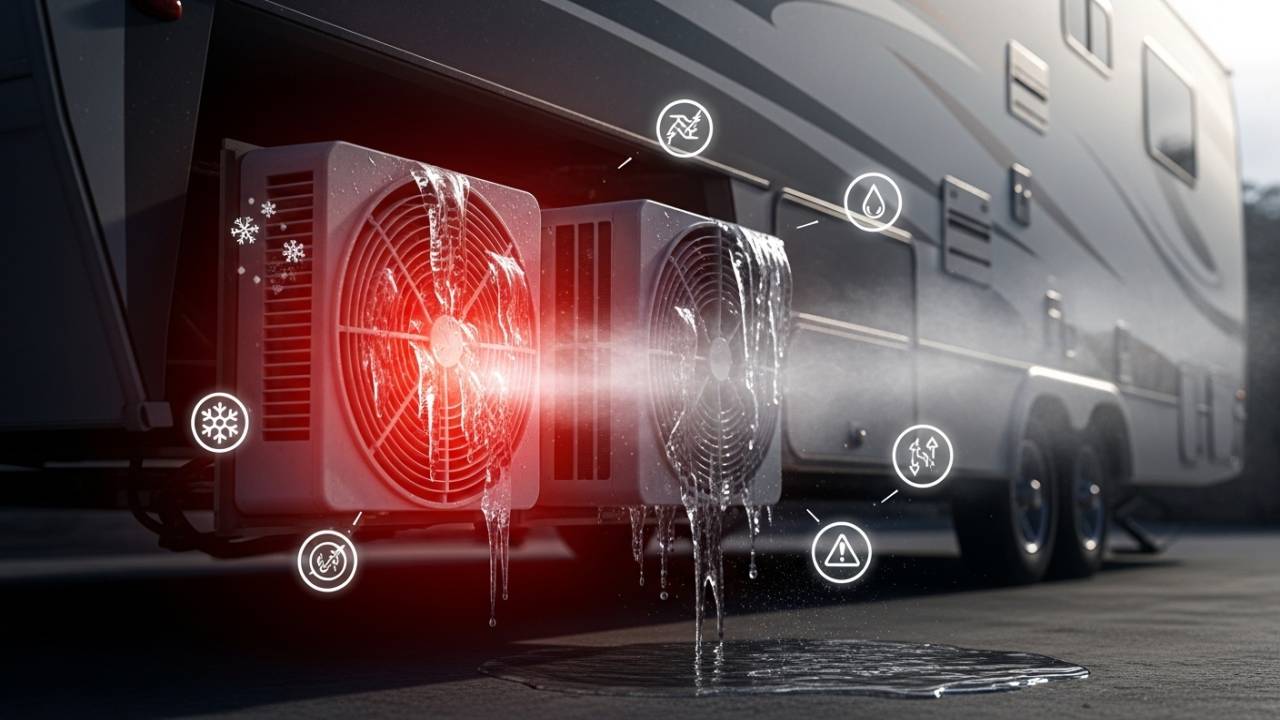
Problem 1: Clogged Air Filters (The #1 Silent Killer)
This is the most common reason RVs lose cooling power, and it’s also the easiest to fix.
Your RV’s air filter does exactly what it sounds like—it traps dust, pollen, dirt, and debris before air reaches the cooling coils. When you’re parked in Arizona desert campgrounds or dusty boondocking areas, those filters fill up fast. Within 2-4 weeks of heavy use, a filter can become so clogged that it restricts 40-50% of the airflow.
What you’ll notice:
- Noticeably weaker airflow from vents
- Strange musty or dusty smells when AC runs
- AC unit sounds strained or laboring
- Visible dust buildup around return air grilles
Here’s the fix (15 minutes, $0-15):
- Locate your air filters—they’re usually behind a panel in your ceiling near the AC unit, or sometimes at floor level return vents
- Note whether they’re washable (fabric) or disposable (paper/pleated)
- For washable filters: Remove them and gently rinse with cool water. Don’t use high-pressure spray (you’ll damage the filter material). Let them air dry completely (at least 2 hours) before reinstalling
- For disposable filters: Replace them entirely. Cleaned disposable filters never restore full airflow
Pro tip: During heavy travel season, check your filters every 2 weeks. In dusty areas, you might need to change them weekly. It’s the cheapest maintenance you’ll ever do, and it prevents everything else on this list.
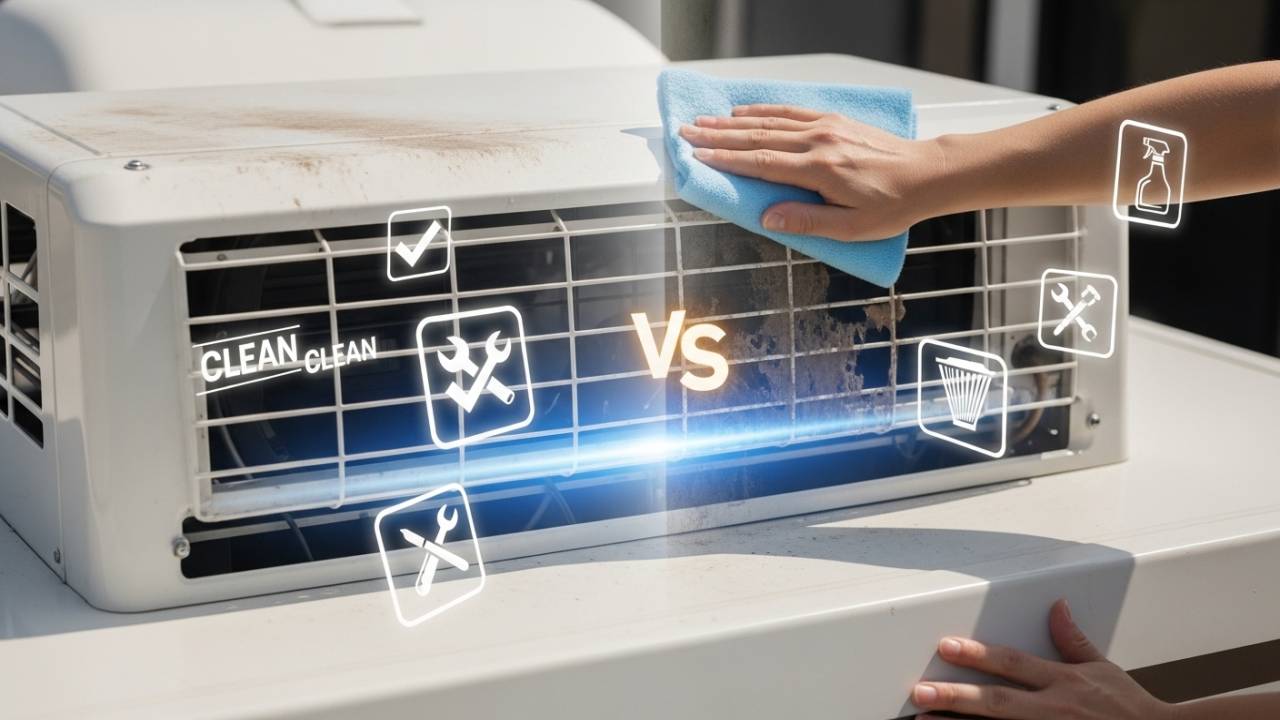
Problem 2: Dirty Evaporator and Condenser Coils
Over time—and we’re talking months or years—dust and pollen accumulate on the coils inside your AC unit. These coils are where the actual heat exchange happens. When they’re dirty, they can’t absorb heat efficiently, and your AC works twice as hard for half the cooling.
What you’ll notice:
- AC runs constantly but never reaches desired temperature
- Reduced cooling despite clean filters
- Sometimes a moldy or musty smell (sign of moisture trapped in debris)
Also Read:- Cheapest RVs Under $30,000 That Won’t Destroy You Financially
The fix (30-45 minutes, $20-40 in supplies):
This requires removing the AC shroud, so if you’re not mechanically inclined, it’s worth calling a pro. But if you’re handy, here’s how:
- Turn off the AC and let it cool
- Remove the AC shroud (usually 4-6 bolts on the roof unit—check your manual for exact location)
- Inspect the evaporator coil (inside the unit) and condenser fins (outside unit) for visible dirt buildup
- Use a non-toxic AC coil cleaner (brands like Frost King AC-16 are common) and spray according to label directions
- Use a soft brush to gently agitate stubborn debris
- Allow everything to dry completely (30+ minutes)
- Reinstall the shroud
Why this matters: Clean coils can restore 15-25% of lost cooling capacity. Combined with clean filters, you’re looking at nearly full restoration of efficiency.
Problem 3: Low or Leaking Refrigerant
Here’s where RV air conditioners diverge significantly from home AC systems.
Most RV air conditioner units are sealed refrigerant systems. Unlike your home unit or car AC (which you can service), RV AC units aren’t designed for homeowner refrigerant refills. If refrigerant is low, something is wrong—either the unit was never properly charged when installed, or it’s leaking.
What you’ll notice:
- AC runs but air is cool, not cold
- Unit cycles on/off more frequently than normal
- Sometimes you hear hissing or see frost buildup
Why you can’t fix this yourself:
Refrigerant handling requires EPA certification and special equipment. A single mistake can:
- Release harmful chemicals into the atmosphere
- Damage your compressor
- Create a safety hazard
When to call a pro:
If your AC is more than 5 years old and was working fine until recently, refrigerant loss might be due to a small leak. A certified technician will:
- Pressure test the system to confirm the leak
- Locate and repair the leak source
- Recharge with the proper refrigerant type (R-22 vs R-410A matters)
Cost reality: A refrigerant recharge runs $150-400. A new unit runs $1,500-2,500. If your unit is older, it might be time to upgrade.
Also Read:- RV Solar + Lithium Battery Upgrade Cost in California 2026: Real Prices & Savings
Problem 4: Frozen Evaporator Coils (Winter and Low Humidity)
This one surprises people. You’re in a hot climate, why would coils freeze?
The answer: running your AC in cool conditions (below 60°F ambient) or with extremely low humidity. When conditions prevent the coil from properly rejecting heat, ice forms on the evaporator, blocking airflow completely.
What you’ll notice:
- Ice visible on the AC unit
- Weak airflow or no airflow suddenly
- Lukewarm air instead of cold air
- Sometimes water dripping from the roof unit
The immediate fix (Wait, don’t rush):
- Turn off the AC immediately
- Let the unit thaw completely (2-4 hours minimum)
- Turn it back on and test
If it happens once, it was likely weather-related and won’t repeat. If it happens repeatedly, something else is wrong. Possible causes:
- Dirty filters (most common)
- Dirty evaporator coils
- Thermostat malfunction (set too cold)
- Compressor running when it shouldn’t
Prevention: Don’t run your AC when outside temperatures drop below 60°F unless absolutely necessary.
Problem 5: Electrical Problems (Breaker Trips, Fuses Blow, or No Power)
AC units require consistent, stable power. Many RV electrical systems are inadequate, especially when using generators.
What you’ll notice:
- AC won’t turn on at all
- Frequent breaker trips
- Works briefly then cuts out
- Humming sound but no fan motor activation
The diagnostic process:
- Check the breaker: Locate your RV’s main breaker panel. Look for any tripped breakers (they’ll be in the middle position, not fully ON or OFF). Reset them by switching OFF completely, then back ON.
- Check the outlet: If plugged into campground power, try a different outlet (sometimes the circuit is overloaded or damaged).
- Check power availability: If using a generator, verify it’s producing enough watts. A standard 13,500 BTU AC requires 3,000-3,500 watts to start. Many small generators only produce 2,000-2,500 watts.
Quick fix for generator issues:
If you’re constantly tripping breakers with your generator, consider installing a soft start kit ($150-300). This reduces the initial power surge when the compressor engages, allowing smaller generators to handle your AC without tripping.
Problem 6: Weak Thermostat or Control Board
Your AC thermostat is basically the “brain” of the system. If it’s not reading temperature correctly, the AC can’t adjust properly.
What you’ll notice:
- AC runs but never reaches the temperature you set
- AC cycles on/off constantly (short cycling)
- Temperature readings seem off
- AC doesn’t respond to temperature adjustments
The fix:
- Check thermostat placement: Is it located near a window, heat source, or air vent? These locations give false readings. Ideally, it should be mounted on an interior wall in the main living space.
- Recalibrate: Some thermostats have manual calibration. Check your manual or try resetting the unit (turn off power for 30 seconds, turn back on).
- Replace batteries: If wireless, low batteries cause erratic behavior.
- Upgrade the thermostat: Modern digital thermostats (like Furrion models, $300-500) offer:
- More accurate temperature sensors
- Better control options
- Compatibility with smart RV systems
Also Read:- Why Is My RV Air Conditioner Running But Not Cooling? Complete Troubleshooting Guide
Problem 7: Blocked Vents or Ducting Issues
Simple but often overlooked: sometimes your AC is working perfectly, but the cold air isn’t getting where it needs to go.
What you’ll notice:
- Some areas of the RV stay cool, others stay warm
- Cold air feels thin or weak
- Vents have warm air instead of cold
The fix (5-15 minutes):
- Walk through your RV and visually inspect every vent opening
- Remove any obstructions (furniture, curtains, bedding)
- Feel the air coming out of vents—it should be noticeably cold at each one
- If one vent feels warmer than others, it might be:
- Blocked somewhere in the ductwork
- Disconnected internally (check roof unit)
- The duct damper is closed (check the lever/slider at the vent)
Ductwork fix: If a duct is disconnected (most common in older RVs), it requires removing interior paneling. This is a DIY job for the handy, but if you’re not comfortable, it’s $200-400 in labor.
Problem 8: Undersized or Failing Compressor
The compressor is the “heart” of your AC. It does the actual work of compressing refrigerant and creating cooling. When it fails, the entire system fails.
What you’ll notice:
- AC runs but produces no cold air
- Unusual grinding, clanking, or squealing noises
- Compressor cycles on/off repeatedly without cooling
- Unit is 10+ years old and struggling
Why this is tricky:
A compressor replacement typically costs $800-1,200 in parts and labor. At that point, you’re looking at potentially 50% of the cost of a new AC unit. Many owners choose replacement over repair at this stage.
When to consider replacement:
- Unit is over 10 years old
- Compressor has failed once before
- Repair cost exceeds 40% of new unit cost
- Your RV is used frequently (heavy duty cycle)
Problem 9: RV Air Conditioner is Oversized or Undersized
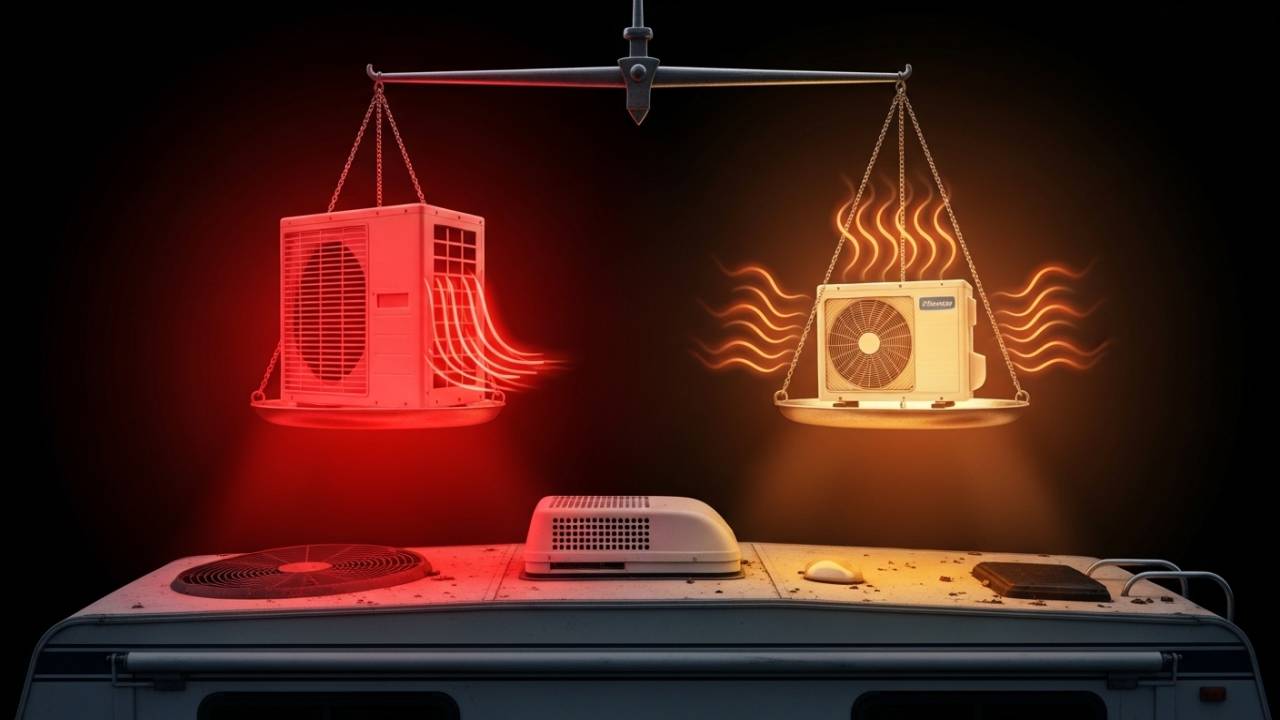
Sometimes the AC itself isn’t the problem—it’s just not the right size for your RV.
Undersized: You have a 13,500 BTU unit but a 40-foot Class A RV with lots of windows. The unit runs constantly, never reaching comfortable temperatures.
Oversized: Less common, but an oversized unit cools so quickly that it short-cycles (turns on and off repeatedly), preventing it from removing humidity effectively.
The fix:
Calculate your RV’s cooling needs:
- Rough calculation: 1 BTU per cubic foot of interior space in mild climates, 1.2-1.5 BTU in hot climates
- Example: A 30-foot RV with average ceiling height of 6.5 feet = ~180 cubic feet = need 18,000 BTU minimum for hot climates
If your existing unit is significantly undersized, you have two options:
- Add a second AC unit (bedroom or rear unit) – $1,200-1,800
- Replace with a more powerful unit – $1,800-2,500
The Real Cost Breakdown: Why Maintenance Saves Thousands
Let’s do the math on what happens when you ignore these problems.
| Maintenance Task | Cost | Frequency | Annual Cost | Consequence if Ignored |
|---|---|---|---|---|
| Replace air filters | $0-15 | Every 2-4 weeks (heavy use) | $30-90 | Filter collapse, $500 coil damage |
| Clean coils | $20-40 | 1-2x per season | $40-80 | Reduced efficiency, $1,000 compressor strain |
| Annual inspection | $100-150 | Once per year | $100-150 | Undetected refrigerant leak ($2,000 repair) |
| Rooftop seal check | $0 (DIY) | Twice per year | $0 | Water damage, $3,000+ interior damage |
| Total preventive maintenance | $170-320/year | Potential $6,000-10,000 in emergency repairs |
The math is clear: Spend $200-300 per year on basic maintenance, or risk $2,000-5,000 emergency repairs.
Your RV AC Maintenance Checklist (By Season)
Spring (Before Heavy Travel Season)
- Clean or replace air filters
- Remove AC shroud and inspect coils for visible dirt
- Check roof seals around AC unit for cracks or gaps
- Test thermostat accuracy with separate thermometer
- Measure temperature drop (20-30°F is normal)
- Inspect all visible wiring for damage
Summer (Every 2-4 Weeks During Use)
- Check filters—replace/clean as needed
- Test that all vents have strong, cold airflow
- Monitor for any unusual noises
- If boondocking with generator, verify watts available
Fall (Before Seasonal Storage)
- Final deep cleaning of coils
- Check roof seals one more time
- Run AC briefly to ensure it starts (don’t forget it exists during cooler months)
- Inspect battery connections if thermostat is wireless
Winter (If Traveling to Warm Climates)
- Same as spring checklist
- Avoid running AC in temperatures below 60°F ambient
- Monitor for ice buildup if conditions are right for it
FAQ: What RV Owners Actually Ask About Their AC
“My AC works fine when parked but shuts off when I’m driving. Is that normal?”
Not exactly. Most RV rooftop units are designed to run while driving if you have:
- Shore power (plugged into campground)
- A generator running
- Properly connected inverter/battery system
If your unit shuts off while driving, check:
- Are you actually connected to power? (Many forget this)
- Is your generator running and producing adequate watts?
- Is the thermostat set to a temperature lower than current cabin temp?
“Can I add a second AC unit to my RV myself?”
Technically possible, but not recommended as a DIY project. Why?
- Requires roof work and sealing (improper sealing = water damage)
- Electrical upgrades needed (110V power draw for two units is significant)
- Ductwork modifications might be necessary
- Warranty implications if something goes wrong
Better option: Have a professional RV service center install it ($1,500-2,000 including labor).
“How long should an RV air conditioner last?”
With proper maintenance: 10-15 years Without maintenance: 5-8 years Heavy use in extreme heat: 5-10 years
The difference is regular filter changes, coil cleaning, and professional inspections.
“Is it worth repairing an AC unit or should I replace it?”
Repair if:
- Unit is less than 8 years old
- Repair cost is less than 30% of replacement cost
- It’s a simple fix (filter, coil cleaning, soft start)
Replace if:
- Unit is over 10 years old
- Repair cost exceeds 50% of replacement cost
- Compressor has failed (very expensive repair)
- You plan to own the RV another 10+ years
“Why does my AC smell musty?”
Most likely: Mold or mildew growing on the evaporator coils or in the condensate drain pan.
Fix:
- Turn off AC and let it fully dry out (24 hours in sun helps)
- Clean coils with AC coil cleaner
- Check condensate drain line isn’t clogged (should slope downward for drainage)
- Run the AC for 15-20 minutes to dry the system
If smell persists after cleaning, there might be a trapped animal or decomposing material inside—call a pro.
“Can I recharge the refrigerant myself?”
Short answer: No. Here’s why:
- You need EPA certification to legally handle refrigerant
- Improper charging damages the compressor
- Environmental hazard if released
- Most RV units are sealed systems (not designed for field service)
Let a certified technician handle it. Costs $150-400, but it’s the only safe option.