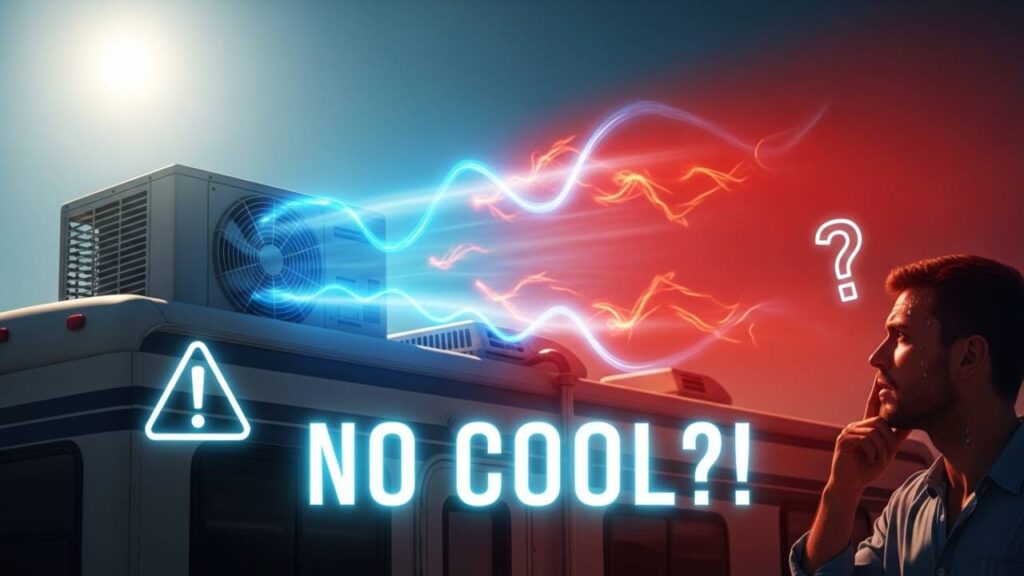
Imagine this scenario: You’re sitting in your RV on a scorching summer day when the outside temperature is hovering around 95 degrees Fahrenheit. Your air conditioning system is running—you can hear the fan spinning, the unit is clearly operational—but something feels desperately wrong. The air trickling from the vents isn’t cold; it’s barely cool, perhaps even lukewarm. Your heart sinks because you’re miles away from any repair shop, and the interior temperature inside your RV is climbing steadily.
Does this situation sound familiar? If it does, you’re definitely not alone. Thousands of RV owners face this frustrating problem every single year, and here’s the most important thing you need to know: In approximately 80% of cases, this problem is completely fixable. You don’t need to spend thousands of dollars at a mechanic shop, and you don’t need to suffer through an uncomfortably hot RV.
The question that haunts every RV owner in this situation is straightforward: “Why is my air conditioner running but not cooling?” The answer, fortunately, lies in a handful of common culprits—many of which you can diagnose and even fix yourself without professional help or breaking your budget.
Understanding How Your RV Air Conditioning System Works
Before we dive into solutions, it’s absolutely critical to understand how your RV air conditioning system actually works. You cannot troubleshoot effectively if you don’t understand what you’re troubleshooting.
Here’s the essential concept: Your RV’s air conditioning system operates very differently from a standard home air conditioning unit. This difference is crucial to understanding why your AC might be running without cooling effectively.
Your RV AC System Requires Two Different Power Sources
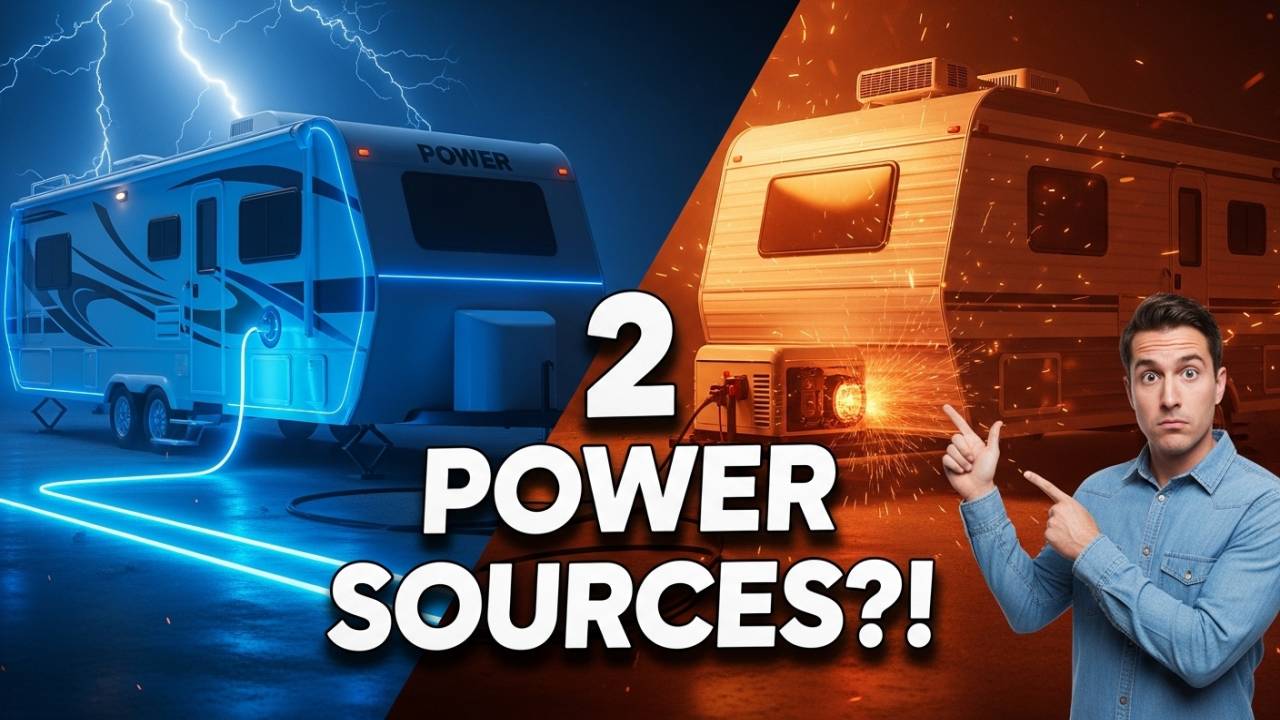
First Power Source – 12-Volt Direct Current (DC) Battery: Your RV air conditioner’s thermostat and all its control mechanisms operate on your 12-volt DC battery system. This is essentially the “brain” of your air conditioning system—it’s the component that determines when the AC should turn on and when it should shut off.
Second Power Source – 120-Volt Alternating Current (AC): Your AC unit’s compressor and fan motor (the components that actually produce cooling) require 120-volt AC power. This power comes either from shore power when you’re plugged into a campground or from a generator when you’re camping off-grid.
This dual-power setup is critically important because it explains why your AC might appear to be running (the fan is on, you hear noise, controls are responding) while the actual cooling mechanism (the compressor) isn’t functioning properly. This is precisely the scenario that results in warm air blowing from your vents despite the system being clearly active.
The Seven Main Reasons Your RV AC Runs But Doesn’t Cool
1. Low Refrigerant Levels – The Most Common Culprit
What This Problem Is: Over time, refrigerant can slowly leak out of your air conditioning system through tiny holes, faulty connections, or worn seals. You might not notice any visible puddles or obvious damage, but the refrigerant is gradually escaping from your system.
What Symptoms You’ll Experience:
- Air initially feels cool when you first turn on the AC, but gradually becomes warmer as the system runs
- When you touch the high-pressure line (the hot side), it feels extremely hot, while the low-pressure line remains warm instead of cold
- Your air conditioner cycles on and off repeatedly in what’s called short cycling
What You Should Do: Unfortunately, this is not a DIY repair. Low refrigerant requires specialized professional tools and expertise. You’ll need to contact a certified RV technician or mobile HVAC service who will:
- Measure your current refrigerant levels using specialized gauges
- Locate and seal any leaks in your system using advanced detection methods
- Recharge your system with the correct type of refrigerant (older RVs typically use R-22, while newer models use R-410A)
Cost Estimate:
- Diagnostic and recharge: $150-$400 depending on the severity of the leak
Prevention Tip: Have your refrigerant levels checked annually before the hot season begins. This 15-20 minute service can save you significant headaches.
Also Read:- RV Solar + Lithium Battery Upgrade Cost in California 2026: Real Prices & Savings
2. Dirty Condenser and Evaporator Coils
What This Problem Is: Your air conditioning system contains two main heat-exchange components: a condenser coil on the exterior of your rooftop unit and an evaporator coil inside the unit itself. Both components accumulate dust, dirt, dead bugs, and debris as air flows across them. This buildup acts like an insulating layer, preventing heat from being effectively released or absorbed by the refrigerant.
Think of it this way: trying to breathe through a dust-covered filter means air can pass through, but it won’t flow as efficiently as it should.
What Symptoms You’ll Experience:
- Weak or reduced airflow coming from your vents
- Your air conditioner runs for extended periods without reaching your desired interior temperature
- Visible dust or debris accumulates around the AC unit shroud
What You Should Do (DIY Option Available): This is one of the easiest fixes you can perform yourself:
- Turn off your AC completely and allow the system to cool for at least 30 minutes
- Access the condenser fins on the exterior of your rooftop unit (typically located at the back, visible even with the shroud in place)
- Use a soft-bristled brush to gently clean the delicate fins (they bend easily and are very fragile)
- Apply a coil-specific cleaner (purchase HVAC-rated coil cleaner, not household cleaners)
- Rinse thoroughly with a garden hose using only gentle pressure
- Repeat the cleaning process for the evaporator coil if you can access it
Cost Estimate:
- DIY approach: $0-$50 (just the cost of coil cleaner)
- Professional service: $100-$250
Safety Reminder: The AC fins are extremely delicate. Work carefully and don’t apply excessive pressure while cleaning.
3. Frozen Evaporator Coils
What This Problem Is: This sounds counterintuitive on a hot day, but it’s very real. When humidity levels are high or when your AC runs continuously without sufficient airflow, the evaporator coil (the cold component inside your unit) can actually freeze solid. Once ice forms, airflow becomes completely blocked, and you’re essentially blowing air around a block of ice instead of achieving cooling.
What Symptoms You’ll Experience:
- Your air conditioner cycles on and off repeatedly (called short cycling)
- You can see ice formations inside the AC unit
- Your interior temperature remains high despite the AC running continuously
- You notice a musty or moldy smell coming from your vents
What You Should Do:
- Immediately turn off your AC – this is urgent
- Allow the system to defrost completely (this typically takes 1-2 hours)
- Increase your fan speed to the highest setting to help prevent refreezing
- Check your interior humidity levels – if humidity exceeds 50%, use a dehumidifier
- Ensure your air filter is clean so that air flows properly across the coils
- Switch your thermostat from continuous mode to cycle mode to prevent constant operation
If this problem keeps recurring, there’s likely a deeper issue such as persistently dirty filters or chronically low airflow that needs investigation.
Cost Estimate:
- DIY defrost: $0 (no parts required, just time)
Important Warning: Never attempt to manually remove ice from the coils. You can permanently damage the delicate fins and create expensive problems.
Also Read:- Cheapest RVs Under $30,000 That Won’t Destroy You Financially
4. Dirty or Clogged Air Filters
What This Problem Is: Your return air filter is designed to catch dust, dirt, and debris before air reaches your cooling coils. When this filter becomes clogged or heavily soiled, airflow becomes severely restricted. This reduced airflow decreases cooling efficiency and can even cause your evaporator coil to freeze.
What Symptoms You’ll Experience:
- Weak airflow from your vents
- Dust accumulation visible around your vents and return air areas
- Unusual odors from your AC (musty or stale-smelling air)
- Your AC runs for much longer periods than usual without cooling effectively
What You Should Do (The Easiest Fix): This is genuinely the simplest maintenance task you can perform:
- Locate your return air filter (usually found in the ceiling area near your AC controls)
- Remove the grille or cover carefully
- Inspect the filter for visible dust and debris
- If the filter is washable: Rinse it thoroughly with water and allow it to dry completely before reinstalling
- If the filter is disposable: Replace it with a new filter (keep spare filters on hand for emergencies)
Cleaning Frequency:
- During heavy use periods: Clean or replace monthly
- In dusty environments: Clean more frequently
Cost Estimate:
- Replacement filters: $0-$20
- Time investment: Less than 10 minutes
Most Important Point: This is literally the single easiest preventive maintenance task you can perform, and it prevents multiple other problems from developing.
5. Insufficient Power Supply – The Electrical Issue
What This Problem Is: Your RV’s AC compressor is extremely power-hungry. If your RV isn’t receiving adequate electrical power—whether from a weak generator, low shore power voltage, or insufficient battery voltage for your controls—your compressor simply won’t engage or will shut down repeatedly.
What Symptoms You’ll Experience:
- Your AC doesn’t turn on at all, or turns on briefly before shutting down immediately
- Your electrical breaker trips repeatedly whenever you run the AC
- Your AC struggles significantly when other high-power appliances are operating
- Your AC works fine at 50-amp shore power but fails completely at 30-amp connections
What You Should Do:
- Check your electrical panel for any tripped breakers and reset them
- Verify your incoming voltage – it should read between 115-125 volts AC (check via your RV’s display panel or with a multimeter)
- Test with a multimeter at the campground pedestal if you’re comfortable doing so
- Reduce your electrical load by turning off non-essential 120-volt appliances (water heater, refrigerator charger, battery charger)
- If using a generator: Confirm it’s operating properly and producing adequate power (a standard 13,500 BTU AC requires at least 3,000 watts)
Critical Note: Low voltage can permanently damage your AC compressor over time. This isn’t merely a comfort issue—it’s about protecting expensive equipment.
Cost Estimate:
- Troubleshooting: $0 (you can do this yourself)
- Generator service: $200+ (if generator maintenance is needed)
Also Read:- 7 Types of RV Awnings [2026 Guide] – Which One Saves You Thousands?
6. Failed Capacitor or Compressor
What This Problem Is: The capacitor is an electrical component that helps start both the compressor and fan motors. When a capacitor fails, your AC might run (the fan spins), but the compressor won’t engage, meaning no refrigerant circulates and no cooling occurs. A compressor failure is more serious—it’s the “heart” of your entire system, and failure typically requires replacement or major repair.
What Symptoms You’ll Experience:
- Your AC fan runs but you don’t hear the characteristic sound of the compressor engaging
- Your unit hums or makes clicking noises when you attempt to turn it on
- Your AC sounds like it’s operating but produces absolutely no cold air
- You smell a burning or electrical odor coming from the unit (a warning sign of electrical failure)
What You Should Do:
For Capacitor Issues: This is technically a DIY repair, but use extreme caution. Capacitors retain electrical charge even when the unit is powered off, and touching the wrong component can deliver a serious electric shock. Unless you’re experienced with electrical work, have a professional replace it.
For Compressor Issues: This is definitely not a DIY job. You absolutely must seek professional service.
Cost Estimate:
- Capacitor replacement: $50-$150
- Compressor replacement: $500-$1,500+ (sometimes it’s more cost-effective to replace the entire AC unit)
7. Thermostat or Control Board Malfunction
What This Problem Is: Your thermostat is the command center of your entire air conditioning system. If it’s not properly calibrated, has dead batteries (in wireless models), or is malfunctioning, it won’t send proper signals to the AC system to initiate cooling.
What Symptoms You’ll Experience:
- Your AC turns on but won’t cool to your desired temperature setting
- Your thermostat display is blank or showing error messages
- Your AC cycles on and off randomly without your input
- Your thermostat settings seem to have no effect on actual cooling performance
What You Should Do:
- Check the thermostat batteries if you have a wireless model – replace them immediately
- Recalibrate your thermostat according to your unit’s manual instructions
- Reset the entire system by turning off power for 30 seconds, then turning it back on
- If problems persist: The control board or thermostat likely requires replacement
Cost Estimate:
- Thermostat replacement: $50-$300
DIY vs. Professional Repair Comparison Table
| Problem | DIY (Difficulty + Cost) | Professional (Cost + Risk + Recommendation) |
|---|---|---|
| Dirty air filter | Very Easy • $0–20 | N/A • No Risk • Do it yourself |
| Dirty coils | Easy • $10–40 | $150–300 • Low Risk (ladder work) • You can do this |
| Frozen coils | Very Easy • $0 | $150–200 • No Risk • Always do this yourself |
| Low refrigerant | Impossible • N/A | $200–400 • High Risk • Professional only |
| Capacitor failure | Moderate • $20–50 | $100–150 • High Risk (electrical shock) • Professional recommended |
| Compressor failure | Impossible • N/A | $500–1,500 • N/A • Professional required |
| Electrical problems | Moderate • $0–50 | $150–250 • High Risk • Professional recommended |
Diagnostic Flowchart for Troubleshooting
Step 1: Is your AC running at all?
- NO → Check your breaker panel, verify power supply, check thermostat batteries
- YES → Proceed to Step 2
Step 2: Is your compressor actually engaged? (You should hear a distinct clicking or humming sound)
- NO → Check your capacitor, inspect electrical connections, verify adequate voltage
- YES → Proceed to Step 3
Step 3: Check your low-pressure line temperature (Feel the refrigerant line on the exit side)
- WARM → Likely low refrigerant, call a professional
- COLD → Proceed to Step 4
Step 4: How is your airflow quality?
- WEAK → Clean your filters and coils immediately
- STRONG BUT WARM AIR → Check for ice on your coil, verify thermostat settings
- NORMAL COLD AIR → Problem solved (monitor for recurrence)
Preventive Maintenance Schedule
The best solution is preventing problems before they occur. Follow this maintenance schedule:
Monthly Maintenance (During Warm Season)
- Clean or replace your air filters
- Visually inspect your return air vents for obstructions
- Verify your thermostat settings are appropriate
Annual Maintenance (Before Summer Season Begins)
- Have a professional inspect your refrigerant levels
- Clean your condenser and evaporator coils
- Test your capacitors for proper operation
- Inspect your thermostat batteries
- Run a complete system test to ensure all components engage properly
Every 2-3 Years
- Have your generator serviced (if you use one for AC power)
- Inspect all electrical connections on your AC unit
- Check for refrigerant leaks using UV dye detection methods
Comprehensive FAQ Section
Q: Can I run my RV air conditioner while driving?
A: Yes, but only if you have adequate power available. If you’re connected to shore power at a campground, you can run your AC without issue. If you’re using a generator, you need at least 3,000 watts for a standard 13,500 BTU unit. Many modern generators can handle this, but older or smaller units struggle. The engine running in your motorhome provides only minimal additional power and is insufficient for AC operation.
Q: How cold should my RV air conditioner actually get?
A: Under ideal conditions, most RV AC units will cool your interior to approximately 20 degrees Fahrenheit below the outside temperature. So on a 95°F day, you should expect to reach approximately 75°F inside. On a 100°F day, aim for about 80°F. If temperatures are higher than this, something is definitely wrong with your system.
Q: What’s the actual difference between weak cooling and no cooling?
A: Weak cooling usually points toward dirty filters or coils, low refrigerant levels, or insufficient airflow. These problems are almost always fixable with cleaning or a refrigerant recharge. Complete cooling failure usually indicates more serious issues like compressor problems, electrical failures, or thermostat malfunction. Complete failure requires professional diagnosis.
Q: Why does my AC work great at the campground but fail when I’m camping off-grid?
A: This almost always comes down to power availability. Shore power at campgrounds is consistent and abundant. Your generator produces less power and may not deliver the steady voltage your AC compressor requires. Solution: invest in a quality generator or a soft-start device like the Micro-Air EasyStart Breeze, which reduces the initial power draw needed to start your compressor.
Q: Is AC replacement really that expensive?
A: Replacement units typically cost $800-$1,500, plus installation fees of $200-$500. However, repairs are usually much cheaper. Before replacing your entire unit, always get a professional diagnosis—many problems are fixable for under $300.
Q: What should I do if my AC breaks down while I’m traveling?
A: First, diagnose what’s happening using the flowchart in this guide. If it’s a dirty filter, fix it immediately. If it’s a refrigerant issue or electrical problem, contact a mobile RV service. Many areas have mobile technicians who come directly to your campsite or RV park.