You woke up this morning, pulled back the curtain, and — yep, grey sky. Again. If you are living full-time in your RV or heading out for a long boondocking trip, that overcast sky probably made your stomach drop a little. “How much power am I actually going to get today?”
The honest answer is: more than you think, but less than you are hoping for. Let us go through the real numbers so you know exactly what to expect when rv solar panels cloudy weather becomes your daily reality — and what you can do to squeeze every possible watt out of a grey day.
First, Let’s Kill the Biggest Myth
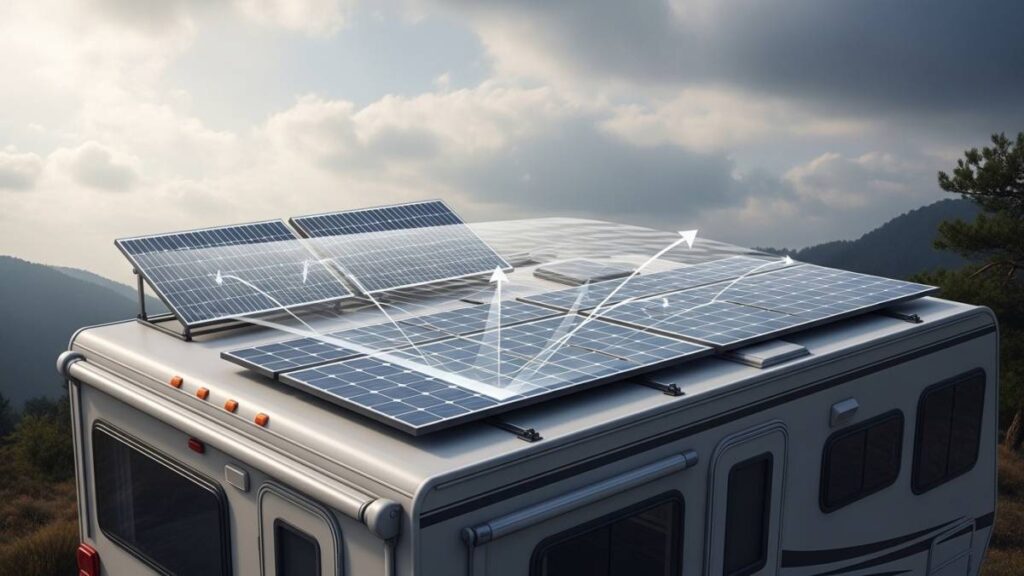
Many new RV solar owners assume that a cloudy day means zero power. Not even close. Solar panels do not run on direct sunshine alone — they run on light photons, which still penetrate cloud cover and hit your panels even on the dreariest days in Washington State or coastal Oregon.
What changes is the intensity of that light, and therefore the volume of electricity your panels generate. The drop is real and significant. But the power is absolutely still flowing.
The Real Output Numbers: Sunny vs. Cloudy vs. Overcast
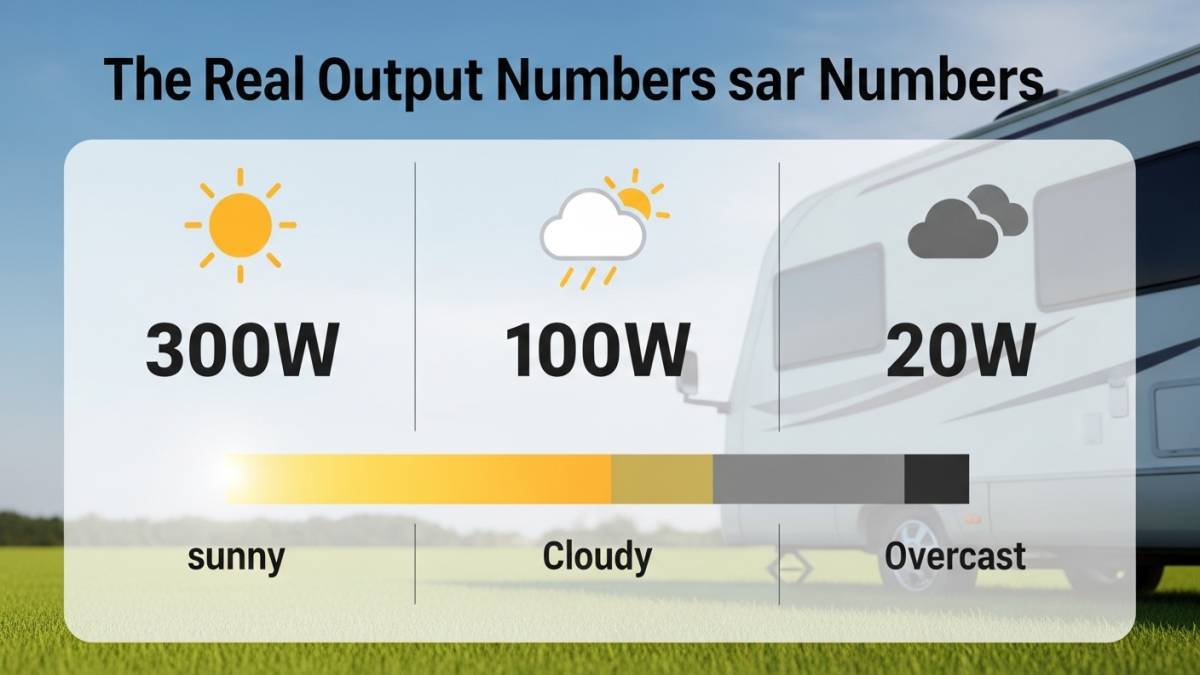
Here is what you actually get from a 200-watt monocrystalline panel under three different sky conditions, based on real-world data from RV owners and verified by solar research studies:
Also Read:- South Dakota RV Domicile: Solar Panel Tax Benefits & Setup
RV Solar Output Data Table — 200W Monocrystalline Panel
| Sky Condition | Estimated Output (Watts) | % of Rated Power | Daily Wh (6hr window) | What You Can Run |
|---|---|---|---|---|
| Full Sun (clear sky, peak hours) | 160 – 180W | 80 – 90% | 960 – 1,080 Wh | Fridge + lights + devices + fan |
| Partly Cloudy (scattered clouds) | 60 – 130W | 30 – 65% | 360 – 780 Wh | Fridge + lights + phone charging |
| Light Overcast (thin high clouds) | 40 – 70W | 20 – 35% | 240 – 420 Wh | Lights + device charging only |
| Heavy Overcast (thick low clouds) | 20 – 40W | 10 – 20% | 120 – 240 Wh | Basic LED lighting only |
| Heavy Storm / Rain | 5 – 20W | 2 – 10% | 30 – 120 Wh | Minimal — running on batteries |
Note: Real-world output under full sun is always less than a panel’s nameplate wattage because Standard Test Conditions (STC) used in labs rarely match field conditions. Expect 75–85% of your rated wattage on your best sunny days.
This table tells you something critical for trip planning: a partly cloudy day still gives you 30–65% of your normal power. That is often enough to keep a 12V compressor fridge running and charge your devices without touching your battery reserves meaningfully. Heavy overcast, on the other hand, genuinely is a draw-down day — you will be leaning on your battery bank heavily.
Why Output Varies So Much on Cloudy Days
Not all clouds are created equal, and this is something the generic “10–25% on cloudy days” advice misses completely.
Cloud altitude matters enormously. High, thin cirrus clouds scatter light diffusely but let a lot of it through. Panels actually perform relatively well under high clouds — sometimes even experiencing a brief “edge-of-cloud” boost where sunlight is concentrated through the gap between cloud layers and spikes panel output above its normal level for a few minutes. This is a real phenomenon that RV solar owners observe frequently.
Low, thick cumulonimbus clouds or a dense, dark storm front are an entirely different story. Those block the vast majority of usable light and can drive your output below 10% of rated capacity. Some RV solar forum members have reported seeing only 250–300 watts from an 8.7kW residential array during a heavy Pacific Northwest storm — roughly 3–4% of peak capacity.
Time of day compounds the cloud effect. Even on a partly cloudy day, output at 8am and 4pm is already reduced from the midday peak because of the sun’s lower angle. Add cloud cover on top of that, and morning and evening power generation on overcast days can be nearly negligible.
Also Read:- How to Size an RV Solar System the Right Way
Monocrystalline vs. Polycrystalline in Low Light — Which One Wins?
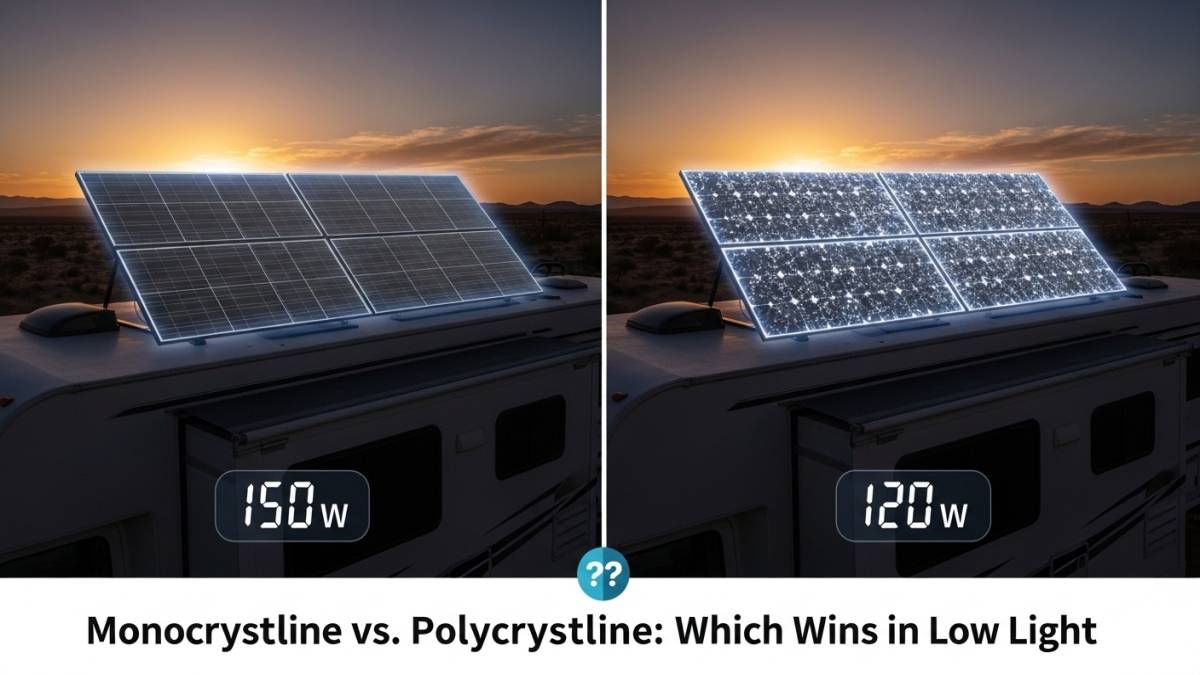
This is a genuinely important question for RVers choosing panels in 2026, and the answer is clear: monocrystalline panels outperform polycrystalline panels in low-light and diffuse light conditions, and the gap is more significant than the wattage ratings suggest.
Here is why it matters practically.
Monocrystalline Panels in Cloudy Weather
Monocrystalline panels are made from a single, pure silicon crystal structure. This purity means electrons flow more freely through the material, which makes them more responsive to diffuse light — the scattered, indirect light that makes up most of what reaches your panels on a grey day.
On a clear sunny day, a 200W monocrystalline panel and a 200W polycrystalline panel will perform fairly similarly. But on a cloudy day, the monocrystalline panel consistently outputs 10–20% more watts than its polycrystalline counterpart at the same rated wattage. Over the course of a full overcast day, that gap translates into a meaningful difference in how much battery capacity you preserve.
Modern PERC (Passivated Emitter and Rear Cell) monocrystalline panels take this even further. PERC technology adds a reflective layer at the back of the cell that captures light that would otherwise pass through unused, boosting low-light performance by an additional 5–10% compared to standard mono panels. If you are buying new panels in 2026, PERC monocrystalline is the clear choice.
Polycrystalline Panels in Cloudy Weather
Polycrystalline panels are made from multiple silicon crystals, which creates grain boundaries within the cell that slightly impede electron flow. In perfect light, this matters less. In diffuse or low-intensity light — exactly the kind of light you get from an overcast sky — the efficiency penalty compounds. A 200W polycrystalline panel might only output 45–55% of its rated capacity under partial cloud cover versus 55–65% for a comparable monocrystalline unit.
Verdict: If you live or travel frequently in the Pacific Northwest, the upper Midwest, the Great Lakes region, or anywhere that sees prolonged cloudy stretches, investing in monocrystalline — or better yet, PERC monocrystalline — panels pays back the price difference quickly in the form of better cloudy-day performance.
6 Practical Tips to Maximise RV Solar Output on Cloudy Days
1. Tilt Your Panels Toward the Light Source
On a heavily overcast day, the sky itself becomes your light source — it is the brightest direction to point your panels, not a direct solar angle. This means flatter panel angles — closer to horizontal — can actually capture more diffuse skylight than steeply angled panels optimised for direct sun. If you have a tilting roof mount or portable ground-deploy panels, experiment with laying them flatter on grey days.
2. Keep Panels Spotlessly Clean
On a sunny day, a thin layer of dust and grime on your panels might cost you 3–5% of output. On a cloudy day, when every photon counts, that same layer can cost you 10–15% of your already reduced generation. Wipe panels down regularly with a soft cloth and water, especially before a cloudy stretch.
3. Use an MPPT Charge Controller — Not PWM
Your charge controller’s job is to extract maximum power from your panels at any given moment. On a sunny day, both MPPT and PWM controllers work reasonably well. On a cloudy day, when panel voltage and amperage are fluctuating constantly, an MPPT controller continuously adjusts its load to find the optimal operating point — squeezing 20–30% more power out of your panels compared to a PWM controller. If you are still running PWM and frequently camp in cloudy conditions, upgrading to MPPT is one of the single highest-return improvements you can make.
4. Minimise Parasitic Loads on Low-Output Days
When cloud cover is heavy, ruthlessly trim your power consumption. Switch off anything unnecessary. Put devices on airplane mode. Run your fridge at a slightly higher temperature setting to reduce its duty cycle. Every watt-hour you save on a low-generation day is a watt-hour you do not have to pull from your battery bank.
5. Consider Adding a Portable Panel for Positioning Flexibility
Fixed rooftop panels are convenient but they go where your rig goes — including under the shadow of every tree and awning you park near. A portable ground-deploy panel gives you the ability to position it wherever the sky is brightest, which on a partly cloudy day can mean meaningful additional output. Many full-timers run a combination of fixed rooftop panels and one or two portable panels for this exact reason.
6. Park Strategically
Sounds obvious but is often overlooked: on a partly cloudy day, your parking position matters more than on a clear day. Face your rooftop array toward the south (in the Northern Hemisphere) with the least possible shade from trees, awnings, or nearby structures. Even a small patch of shade on one panel in a series-wired array drags down the output of the entire string.
Also Read:- Best RV Solar Panels for South Dakota 2026
FAQ: RV Solar in Bad Weather — 5 Honest Answers
Q1: Can I run my RV fridge entirely on solar during a cloudy day?
Maybe — it depends on how much panel capacity you have. A 12V compressor fridge typically consumes 30–50 amp-hours per day. On a partly cloudy day, a 400-watt rooftop array might still generate 600–900 Wh, which covers that fridge load with some left over. On a heavy overcast day with only 200–300 Wh of solar input, the fridge will be drawing from your batteries for a significant portion of the day. A larger panel array and a quality lithium battery bank are your best insurance here.
Q2: Do solar panels work in rain?
Yes, but output drops to the very low end of the overcast range — often 5–15% of rated capacity during active rainfall with dark cloud cover. The good news: rain is also cleaning your panels, which helps the next sunny day’s output. Light rain with thin clouds can actually produce surprisingly decent output — real-world RV solar owners report seeing 30–40% of rated output during light drizzle with bright skies above.
Q3: What is the “cloud edge effect” and is it real?
Very real. When the sun passes near the edge of a cloud, the cloud acts like a lens and concentrates sunlight rather than scattering it. This can briefly spike your solar output above its rated peak — sometimes 10–20% higher than the panel’s STC wattage for a few seconds or minutes. RV solar monitors show these spikes clearly. They are short-lived but they do contribute to your daily totals, especially on days with scattered cumulus clouds rather than uniform overcast.
Q4: How many cloudy days can my system handle before my batteries are depleted?
This entirely depends on your battery capacity, your daily consumption, and how much your panels still produce under cloud cover. As a rough rule: a 200 amp-hour lithium bank powering a modest full-timer lifestyle (fridge + lights + charging) might sustain you through two to three full heavy-overcast days before you need either a sunny break, a generator, or a shore power hookup. Sizing your battery bank for three to four days of autonomy at your actual daily consumption is wise if you plan to spend extended time in cloudy regions.
Q5: Should I get more panels or more batteries for cloudy-day resilience?
Both matter, but for cloudy-weather resilience, more panels address the root problem: not enough energy being captured during the day. More batteries only extend how long you can survive on the reserves you already have. The ideal cloudy-day setup is a larger panel array — 600W or more — combined with sufficient battery capacity (200+ amp-hours lithium) to bridge the overnight and low-generation hours. More panels plus MPPT control is almost always the better investment if cloudy weather is a regular part of your RV life.
Bottom Line: Grey Days Are Manageable With the Right Setup
Cloudy weather is never going to be your solar system’s favourite condition — but with the right panels (monocrystalline PERC), the right charge controller (MPPT), a properly sized battery bank, and a few smart habits on low-production days, rv solar panels cloudy weather performance becomes something you can plan around confidently rather than stress about.
Real RV solar life is not about having perfect sunny days every day. It is about building a system smart enough to handle the grey ones.
All output figures in this article are based on real-world community data from RV solar forums, verified against manufacturer specifications and academic research on photovoltaic performance under diffuse light conditions. Individual results will vary based on panel brand, age, angle, shading, and local cloud characteristics. Always size your system with a conservative estimate of cloudy-day performance in your target travel regions.