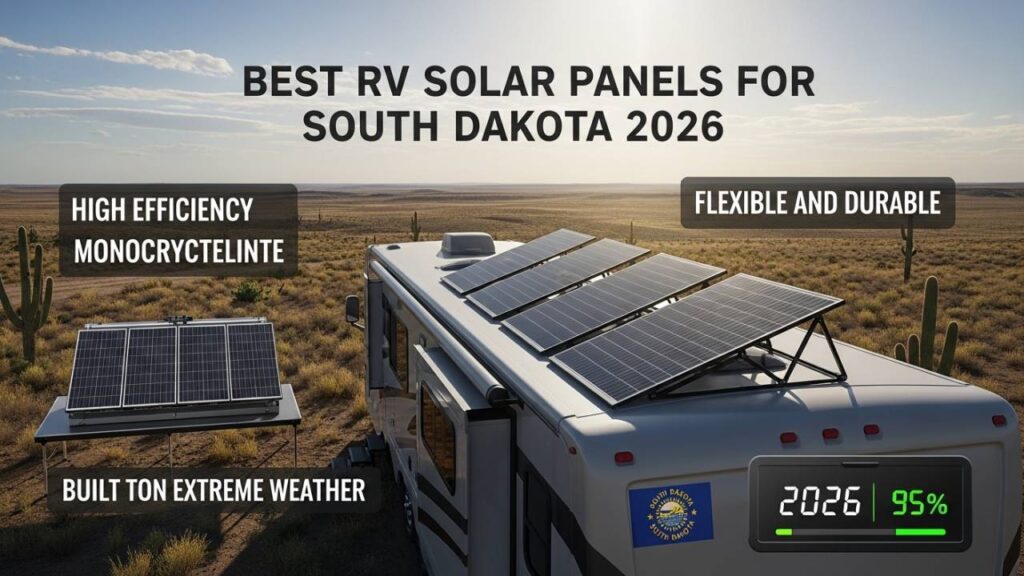
Picture this. You wake up inside your RV to absolute silence. No generator rumbling outside. No campground noise. Just the sound of wind brushing through the tall grass of the Badlands, the first pink light of sunrise touching the horizon, and your phone showing a full battery because your solar panels did all the work overnight. That is the South Dakota RV solar dream. And in 2026, it is more achievable, more affordable, and more practical than it has ever been.
South Dakota is honestly one of the most underrated states in America for RV solar living. Vast open skies, incredible BLM land around the Black Hills, epic camping near Badlands National Park, Custer State Park, and the Missouri River corridor — most of it free, most of it off grid, and nearly all of it bathed in consistent sunshine that solar panels love. But if you have ever tried to research RV solar panels for South Dakota specifically, you have probably run into guides that are either too technical, too vague, or aimed at homeowners rather than RVers.
This guide fixes that. By the end, you will know exactly which panels work best for South Dakota conditions, how to size your system correctly, what the installation process looks like, how much to budget in 2026, and which questions actually matter when you are standing in a shop trying to decide. Let us get into it.
Why South Dakota Is Actually Perfect for RV Solar
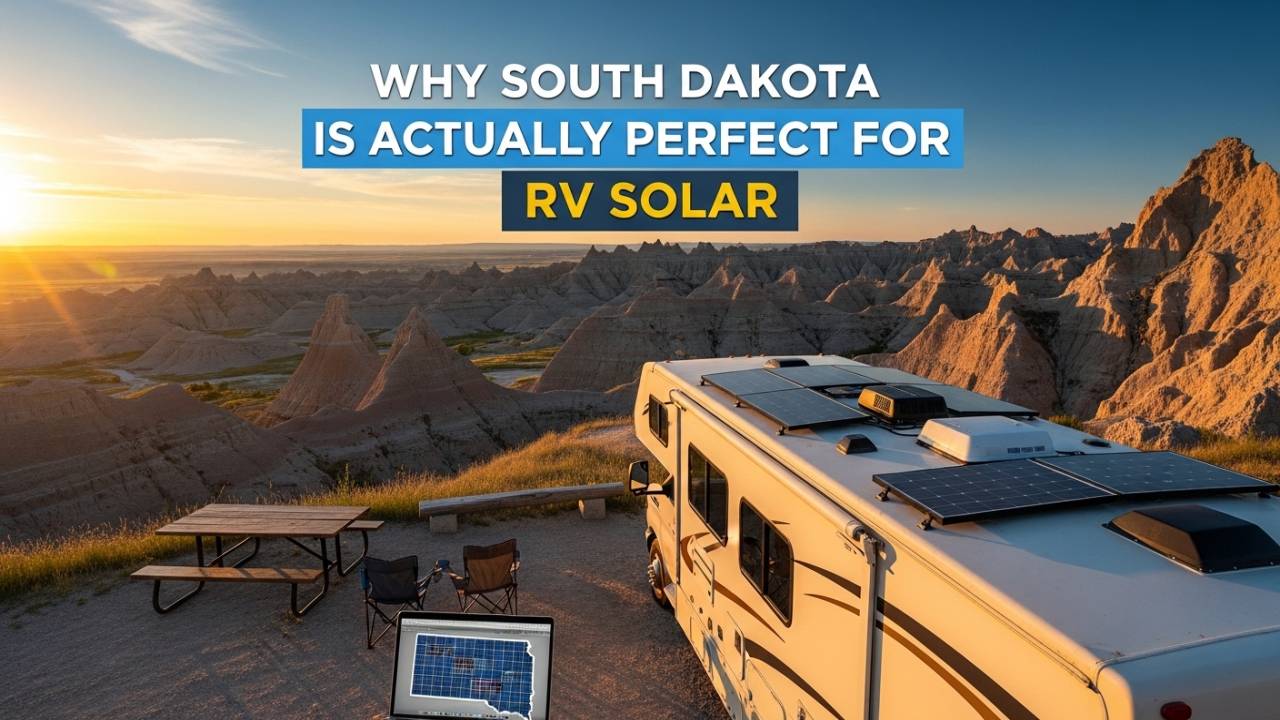
Most people assume South Dakota is a cold, grey, overcast state where solar panels would barely function. The reality is the complete opposite, and it is one of the best kept secrets in the RV solar world.
South Dakota averages between 4.5 and 6 peak sun hours per day depending on location. That is a genuinely strong solar resource. Rapid City in the western Black Hills region consistently gets closer to 5.5 to 6 hours of quality sun daily, making it one of the better solar locations in the entire Midwest. Even the eastern side of the state around Sioux Falls delivers solid production through spring, summer, and fall.
The state sits at relatively high elevation in many areas, which actually improves solar panel efficiency. Cooler air temperatures at elevation mean your panels do not overheat during peak production hours, which is a real issue in hotter states like Arizona and Texas where panels run hot and lose efficiency. South Dakota gives you the sunshine without the heat penalty.
Wide open terrain means minimal shading at most boondocking spots. This is a big deal for solar performance. When you camp at a wooded site in Tennessee or the Pacific Northwest, shade from trees can cut your production by 40 percent or more. Out in the open plains and buttes of western South Dakota, your panels see sky from sunrise to sunset without interference.
And the camping itself? South Dakota BLM land, national grasslands, and dispersed camping areas in the Black Hills National Forest give you hundreds of free or low-cost sites where you can park for days at a stretch without hookups. Solar-powered RVing in South Dakota is not just possible — it is genuinely the ideal way to experience the state.
Also Read:- Cheyenne RV Solar Installers: Top 5 Shops Reviewed (2026)
Understanding South Dakota’s Seasonal Solar Reality
South Dakota does have real seasons, and your solar setup needs to account for all four of them if you are a year-round traveler.
Summer from June through August is the golden season for solar in South Dakota. Long days, strong sun, minimal cloud cover in the western part of the state, and warm temperatures combine to deliver peak panel performance. A well-sized system will charge your battery bank comfortably before noon and have surplus power available for afternoon use.
Spring and fall bring shorter days and more variable cloud cover, but still deliver solid production. The key adjustment in these seasons is panel tilt. In summer, South Dakota’s sun angle is high enough that flat-mounted roof panels work efficiently. In spring and fall, the sun angle drops lower in the sky, and tilting your panels at a steeper angle toward the south can meaningfully increase your daily harvest. Many RVers use adjustable tilt bracket mounts specifically for this reason.
Winter is the honest challenge. South Dakota winters can be brutal with heavy snowfall, extended cloudy periods, and very short days. If you plan to full-time or winter camp in South Dakota, you will want a more robust system than a seasonal RVer needs — more panel capacity, more battery storage, and a backup strategy like a propane generator for extended storm periods. Most winter campers in South Dakota recommend a minimum of 600 watts of panels with at least 200 amp hours of lithium battery capacity just to maintain basic comfort during December and January.
Types of RV Solar Panels: Which One Is Right for You
Before we talk about specific products and setups, you need to understand the three main types of solar panels available for RVs in 2026. Each has a real use case, and the right choice depends on how you camp.
Monocrystalline Rigid Panels
These are the benchmark for RV rooftop solar. Made from a single silicon crystal structure, monocrystalline panels are the most efficient panels available today, consistently delivering 21 to 23 percent efficiency in real world conditions. They are physically compact for their wattage, meaning you can fit more power onto a limited roof space. They handle partial shade reasonably well and degrade slowly over a 25 year lifespan. The trade off is that they are heavier and require mechanical mounting into your roof structure. For South Dakota boondocking, monocrystalline rigid panels on a proper roof mount are the go-to recommendation for anyone doing extended off-grid stays.
Flexible Solar Panels
Flexible panels have improved dramatically since 2022 and are no longer the underperforming option they once were. Modern flexible panels from quality brands now hit 20 percent efficiency, only marginally behind rigid panels, while weighing significantly less and requiring no drilling for installation. They bond directly to the roof surface using industrial-grade adhesives. The limitation is longevity — flexible panels tend to degrade faster than rigid ones over years of temperature cycling and UV exposure. They also cannot be tilted for seasonal angle optimization since they are bonded flat. For South Dakota seasonal camping or for RVers who prioritize a no-drill install, flexible panels are a solid option. For full-timers who plan a decade of South Dakota desert camping, stick with rigid.
Portable Foldable Solar Panels
Portable solar panels are the unsung hero of RV solar, especially for shade-heavy camping situations. You park your RV under a beautiful ponderosa pine in the Black Hills for some shade, and instead of losing half your production, you simply run a cable from your foldable panel set up in the sunny clearing nearby. Portable panels are also ideal as a supplement to a roof system, giving you extra charging capacity when you need it without permanently expanding your roof array. Quality foldable panels in 2026 range from 100 watts to 200 watts per unit, with options that pair directly with portable power stations for a completely cable-free setup.
How to Size Your RV Solar System for South Dakota
This is the part of the guide that most people skip, and it is also the reason so many RVers end up with systems that either drain out by evening or cost twice as much as they needed to spend. Sizing is everything. Here is a simple method that actually works.
Step 1 — Calculate your daily power use
Write down every electrical device you run in your RV and estimate how many hours per day you use each one. Then multiply the device’s wattage by its daily hours of use. Add everything together. That total is your daily watt-hour consumption.
A typical South Dakota boondocking RV setup might include LED lighting at around 50 watt-hours per day, a 12 volt compressor fridge running at around 350 to 500 watt-hours depending on ambient temperature, phone and laptop charging at around 100 watt-hours, a water pump adding perhaps 30 watt-hours, and a small fan during warm nights at 50 to 100 watt-hours. That adds up to roughly 580 to 780 watt-hours per day for a comfortable but not extravagant off-grid setup.
Step 2 — Size your panels
Divide your daily watt-hour consumption by the number of peak sun hours at your South Dakota location, which we estimated at 5 hours for the western part of the state. So 700 watt-hours divided by 5 hours gives you 140 watts of minimum panel capacity. But that is the absolute minimum with zero buffer. Add a 25 percent safety margin for cloudy days, shade, and system inefficiencies, and you are looking at 175 watts as a realistic floor. Most RVers doing regular South Dakota boondocking are well served by 400 to 600 watts of total panel capacity to give themselves real flexibility.
Step 3 — Size your battery bank
Your battery bank needs to store enough power to carry you through the night and into the morning before your panels start producing again. A common guideline is to have battery capacity equal to two days of consumption to account for overcast days. At 700 watt-hours per day, that means 1,400 watt-hours of usable storage. If you are using lithium iron phosphate batteries, which discharge safely to 100 percent of rated capacity, you need 1,400 watt-hours of rated capacity. If you are using AGM lead-acid batteries, which should only be discharged to 50 percent to protect their lifespan, you need 2,800 watt-hours of rated capacity to get the same usable storage.
This is exactly why lithium batteries have become the default choice for serious South Dakota boondockers in 2026. LiFePO4 battery prices have dropped around 60 percent since 2022, making them cost competitive with AGM on a long-term basis while delivering dramatically better performance, lighter weight, and faster charging.
Also Read:- RV Solar System Setup Complete Beginner’s Guide (2026)
The Best RV Solar Panel Brands for South Dakota in 2026
There are dozens of brands on the market today and the quality range is enormous. Here are the brands that consistently earn strong real-world reviews from RVers who have actually used them in field conditions similar to South Dakota.
Renogy remains the most popular brand among DIY RV solar installers in America for good reason. Their panels are reliable, their kits include everything you need, their customer support is accessible, and their pricing is among the best value in the market. The Renogy 200 watt monocrystalline panel delivers consistent performance in South Dakota conditions and their Eclipse series flexible panels are among the best in the flexible category. For a first-time solar installer in South Dakota, Renogy is the safest starting point.
Zamp Solar is particularly popular among RVers because many RV manufacturers use Zamp as their factory-installed solar brand. If your RV came with a Zamp port or a Zamp system already installed, expanding with additional Zamp panels is plug-and-play. Their panels are built specifically to RV roof dimensions and mounting standards, which makes installation significantly cleaner than adapting panels designed for residential use. Slightly more expensive than Renogy but with a design that integrates beautifully with most RV roofs.
Go Power is another RV-focused brand with a strong reputation particularly in the Midwest and Great Plains market. Their panels pair extremely well with their own charge controller line, and the integrated ecosystem approach means fewer compatibility headaches during installation. A good choice for South Dakota RVers who prefer a matched system from a single manufacturer.
Jackery and EcoFlow dominate the portable foldable panel space and are the brands most frequently recommended for the portable supplement approach. Their foldable panels pair seamlessly with their power station products and the whole-system approach makes them incredibly user friendly even for people with zero solar installation experience. For a casual South Dakota weekend warrior who wants to dip a toe into solar without committing to a roof installation, a Jackery or EcoFlow portable kit is a brilliant entry point.
Charge Controllers: The Part Everyone Underestimates
Your charge controller is the brain of your solar system. It sits between your panels and your battery bank and manages how power flows from one to the other. The difference between a cheap controller and a good one is enormous, and in 2026 the advice is clear and consistent: always use an MPPT charge controller.
MPPT stands for Maximum Power Point Tracking. It sounds technical but the practical meaning is simple. An MPPT controller actively optimizes the electrical conversion between your panels and your battery to extract the maximum possible power at any given moment, including during partial cloud cover, early morning, and late afternoon when sun angle is low. Compared to the older PWM controller technology, an MPPT controller delivers 25 to 30 percent more energy harvest from the same panels in the same conditions.
In South Dakota’s variable spring and fall weather when you get half days of sun mixed with passing clouds, that 25 to 30 percent difference is genuinely significant. It can mean the difference between your batteries being fully charged by early afternoon versus still charging at sunset when you need to start running lights and cooking.
Victron Energy makes controllers that are consistently rated best in class by experienced off-grid RVers. Renogy and Rover make solid MPPT options at more accessible price points. Avoid cheap no-name controllers from unverified sellers as they frequently misreport charging status and can actually damage lithium batteries through improper voltage management.
Installing RV Solar in South Dakota: What to Know
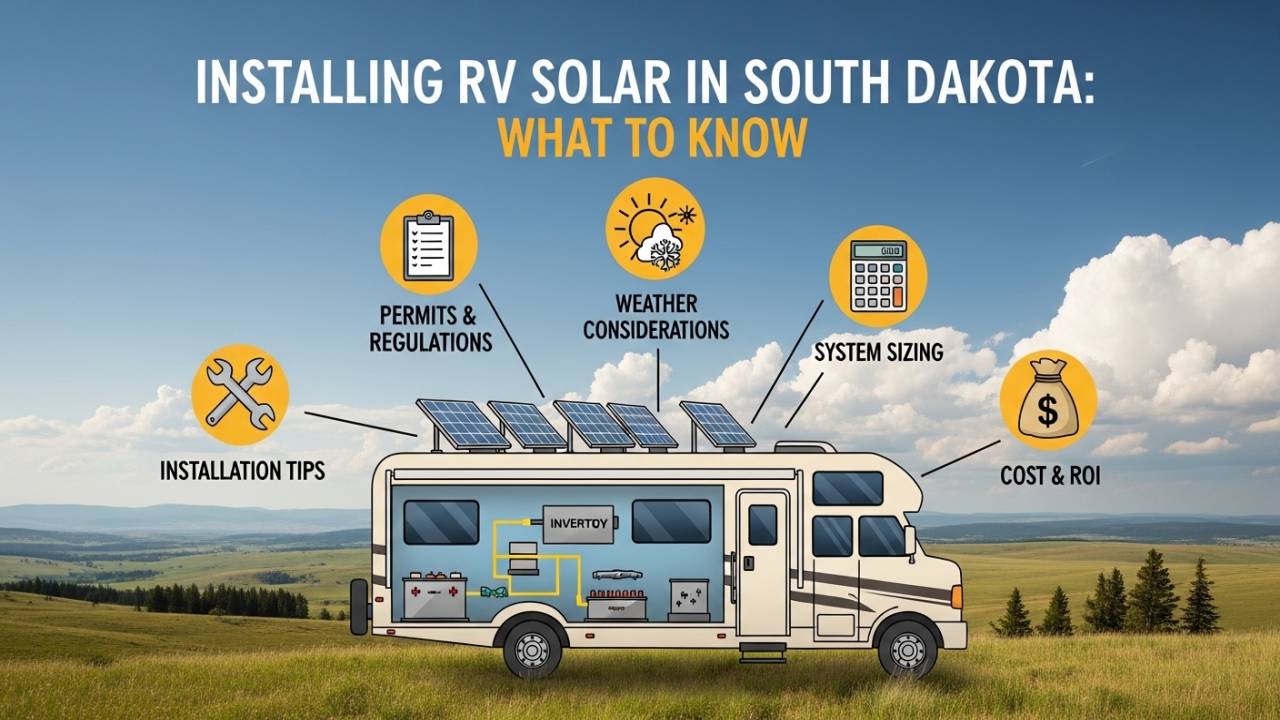
If you are doing a DIY installation, South Dakota is one of the simpler states to work in from a regulatory standpoint. There are no special permits required for RV solar installations. You are working on your own vehicle and the electrical work is self-contained within a 12 volt DC system that does not connect to any utility grid. No inspector is coming to check your roof mount.
That said, do the installation properly. The biggest mistake first-time installers make is skipping the roof truss search before drilling. Use a stud finder across your entire roof surface, mark every truss location with tape, and make sure your mounting brackets hit structural members rather than just thin roof decking. A screw in decking pulls free in a Wyoming-style wind. A screw in a truss does not.
Seal every roof penetration with Dicor lap sealant, which is the standard sealant for RV rubber roofing. Apply it generously and plan to re-inspect the sealant every spring. South Dakota winter freeze-thaw cycles can stress sealant joints, and a small sealant failure caught in April is a 15-minute fix. The same failure discovered after a summer rainstorm has soaked your ceiling insulation is a major repair job.
If you want a professional installation in South Dakota, Sota Solar specifically serves the South Dakota RV market and designs off-grid systems rather than grid-tied residential ones. Black Hills Solar in Rapid City serves the western South Dakota area and is one of the few local companies with NABCEP-certified installers, which is the gold standard certification for solar installation quality.
Also Read:- Wyoming Wind & RV Solar Panels: Protection & Mounting Tips
How Much Does RV Solar Cost in South Dakota in 2026
Budget reality is something a lot of solar guides dance around. Here are honest numbers for 2026.
A starter portable solar setup, meaning one or two quality foldable panels paired with a mid-range portable power station, costs between 600 and 1,200 dollars. This is the right entry point for occasional South Dakota weekenders who are not ready to commit to a roof installation.
A basic roof-mounted RV system of 200 to 400 watts with a quality MPPT charge controller and 100 amp hours of lithium battery storage costs between 1,200 and 2,200 dollars in parts for a DIY installation. Add 400 to 700 dollars for professional labor if you hire an installer.
A full off-grid boondocking system of 600 to 800 watts with 200 amp hours of lithium storage, a proper inverter for AC appliances, and a quality MPPT charge controller runs between 2,500 and 5,000 dollars in parts for a DIY build. A professional installation of an equivalent system typically runs between 4,000 and 8,000 dollars all in.
A serious full-timer setup of 1,000 watts or more with 400 plus amp hours of lithium, a multi-stage inverter-charger, and all the monitoring hardware you want to live comfortably off grid in South Dakota year-round will cost from 6,000 to 15,000 dollars depending on components. This is the setup for people who have sold the house and are living full-time in the rig.
The best news about 2026 pricing is that lithium battery costs have fallen so dramatically over the past three years that the sweet spot system — around 400 watts of panels with 200 amp hours of LiFePO4 storage — now costs about what a comparable lead-acid system cost in 2020, but performs dramatically better.
South Dakota BLM Camping: The Solar RVer’s Paradise
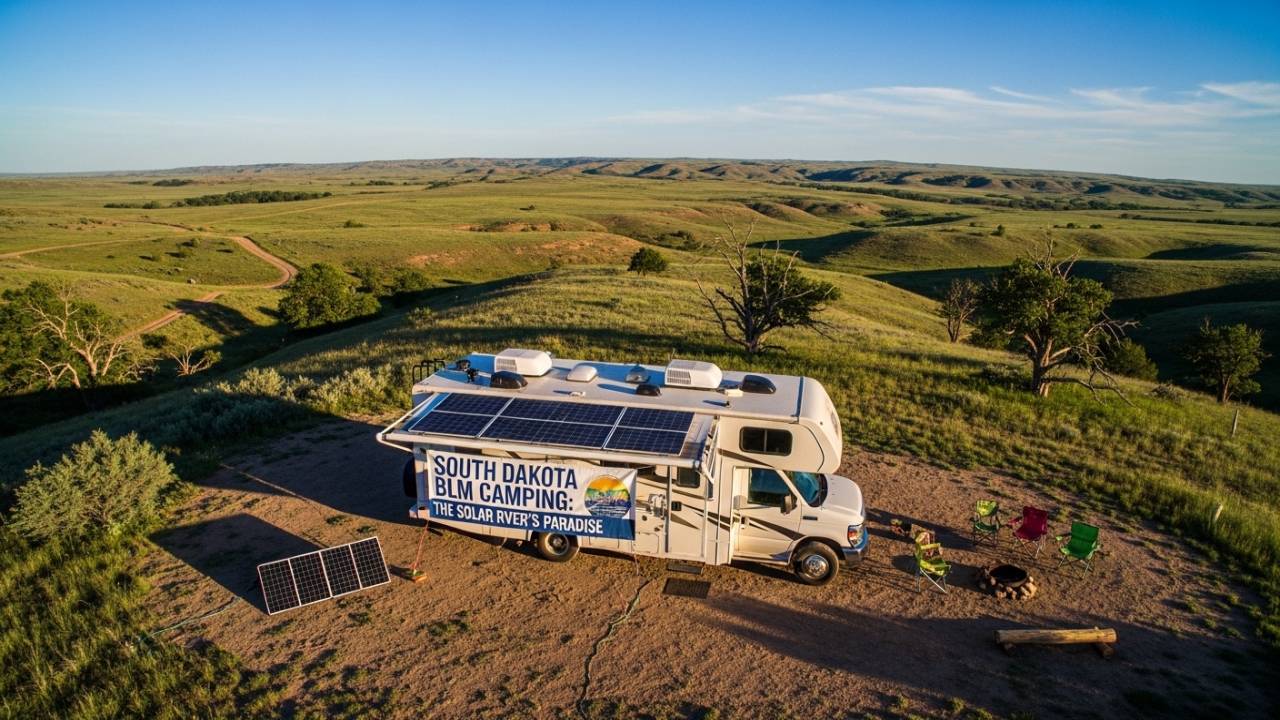
Let us take a moment to talk about where you are actually going to use this system, because South Dakota’s free camping options are genuinely exceptional and deserve recognition.
The Buffalo Gap National Grassland stretching across the Badlands region offers sweeping, treeless camping with unobstructed southern sky exposure that is essentially ideal for solar panels. You can park out there for up to 14 days on most BLM designated sites without paying a single dollar. The nearest hookup might be 60 miles away. Solar is not optional at these sites — it is the only sensible power strategy.
The Black Hills National Forest has extensive dispersed camping areas where you can park in clearings or along forest roads for 14-day stays. Many of these sites are partially shaded, which is where portable panels become valuable. Set the roof panels to collect what they can and deploy your foldable panels in the clearing while you enjoy the shade.
The Missouri River recreation area running through central South Dakota has dozens of Corps of Engineers camping spots that are either free or very low cost, with wide open river valley exposures perfect for solar collection. Combine morning photography of the river with afternoon solar charging and you have the perfect South Dakota day.
Custer State Park in the Black Hills is not free but is extraordinarily beautiful and offers primitive sites where a solar setup lets you stay disconnected from the world while still being comfortable. Bison wander through camp, the sunrises are extraordinary, and your panels keep the lights on while you experience one of the most underrated natural areas in America.
Frequently Asked Questions
Is South Dakota a good state for RV solar overall?
Yes, genuinely. The combination of strong sunshine hours, vast open camping terrain, minimal tree cover at most boondocking sites, and exceptional free camping opportunities makes South Dakota one of the best practical environments for solar RVing in the United States. The weather challenges are real in winter but manageable with the right size system.
How many solar panels do I need for a comfortable South Dakota boondocking setup?
For a couple living in a 24 to 30 foot trailer running a compressor fridge, LED lights, fans, and charging devices, 400 watts of panels paired with 200 amp hours of lithium battery capacity is a very comfortable daily driver in South Dakota from April through October. For winter use or air conditioning, scale up to 600 to 800 watts minimum.
Do I need a backup generator in South Dakota with solar?
For summer camping the answer is no in most situations. For shoulder season camping the answer is maybe, depending on how much cloud cover you get during your specific trip. For winter camping the answer is yes, keep a small propane or gas generator on board for extended multi-day storm periods where solar production drops to near zero.
What is the best battery type for South Dakota solar in 2026?
Lithium iron phosphate, also called LiFePO4, is the clear recommendation in 2026. The price gap between lithium and AGM lead-acid has closed dramatically and lithium performs better in cold weather down to about negative 4 degrees Fahrenheit for charging, weighs dramatically less, charges three to four times faster, and lasts three to five times longer in terms of charge cycles. In South Dakota’s cold winters, the faster recharge time from limited winter sun hours alone makes lithium worth the modest premium.
Can I leave my RV solar system unattended for months in South Dakota winter?
Yes, with proper preparation. Lithium batteries self-discharge very slowly and can sit for months without damage. Before leaving your rig for an extended winter period, bring your batteries to full charge, disconnect any parasitic loads, and if possible orient your panels to receive maximum low-angle winter sun for any maintenance charging that occurs. A quality MPPT controller with low-voltage disconnect will protect your batteries from over-discharge while you are away.
What if I have trees shading my campsite?
This is exactly the scenario where portable foldable panels earn their place. Park your rig where you want it, enjoy the shade, and run a cable from your portable panels set up in the sunny clearing nearby. It is more setup work but gives you complete flexibility over your camping spot without sacrificing power production.
Also Read:- Jackson Hole RV Solar Mountain Weather Performance Guide
The Bottom Line: South Dakota Deserves a Better Solar Reputation
South Dakota is quietly one of the finest solar destinations in America for RVers who know what they are doing. Strong sunshine, extraordinary free camping, vast open terrain, and a state that is genuinely still on the ground floor of its solar journey — meaning uncrowded BLM sites, empty grasslands, and the most spectacular quiet you will ever find outside of a truly remote wilderness.
Getting your RV solar setup right for South Dakota is not complicated. Buy quality panels — Renogy, Zamp, or Go Power are all solid starting points. Use an MPPT charge controller without exception. Invest in lithium iron phosphate batteries even if they cost a bit more upfront. Mount your panels into roof trusses, not just roof decking. Seal every penetration with Dicor. And size your system based on your actual consumption rather than guessing or copying what your neighbor installed.
Do those five things right and South Dakota will reward you with some of the finest off-grid RV experiences in the entire country. The Badlands at dawn, the Black Hills at golden hour, the Missouri River at sunset — all of them yours, all of them silent, all of them powered by the same sun that has been shining over this extraordinary state since long before any of us got here.