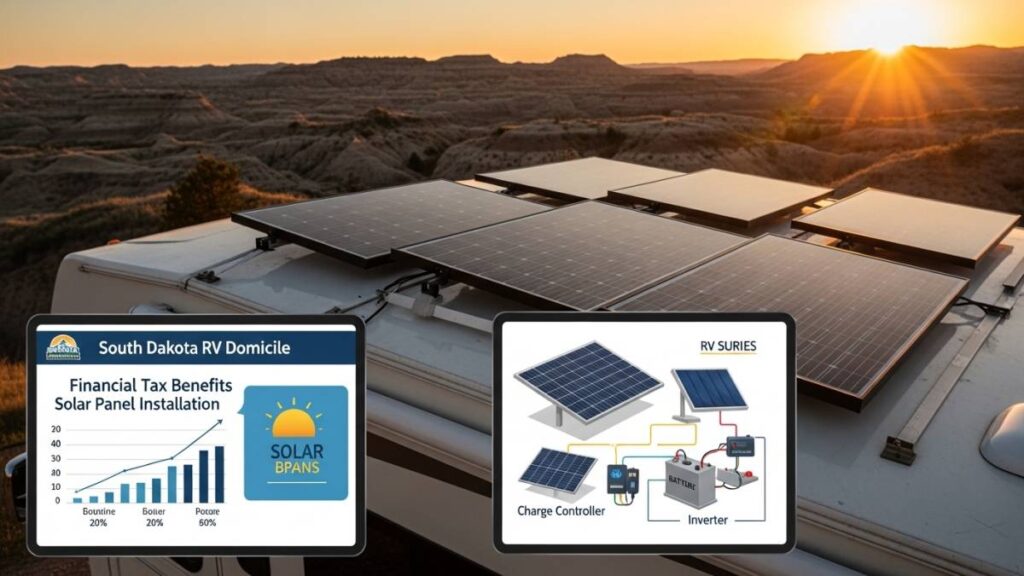
Here is something most full-time RVers on the road today do not fully realise: 2026 is the single most important year in recent memory to combine a South Dakota domicile with a solar panel setup on your RV. The reason? The 30% federal solar tax credit — one of the most generous financial incentives ever offered to American homeowners and RVers alike — is set to disappear completely for residential systems after December 31, 2026. This is not a rumour. In July 2025, Congress officially eliminated the residential clean energy credit for systems installed after this year’s deadline.
If you have been on the fence about going solar on your rig, the clock is now genuinely ticking. And if you have not yet set up South Dakota as your domicile state, this guide will show you exactly why doing both things in 2026 could be one of the smartest financial decisions you make all year.
Let us break it all down — clearly, completely, and with real numbers you can actually use.
What Is RV Domicile and Why Does It Matter So Much in 2026?
When you live full-time in an RV, you still need a legal home address for everything that matters: your driver’s licence, vehicle registration, tax filings, voter registration, health insurance, and more. The state you choose as your legal domicile — your official home state — has an enormous impact on how much money you keep, how much bureaucracy you deal with, and how freely you can move around the country without hassle.
The three states that full-time RVers most commonly choose are Florida, Texas, and South Dakota. All three have no state income tax. But in 2026, South Dakota continues to stand out as the easiest, most RVer-friendly of the three — and the one with the most flexibility built in for people whose lives are genuinely on the move.
Here is why South Dakota is still the top choice for so many nomadic Americans in 2026.
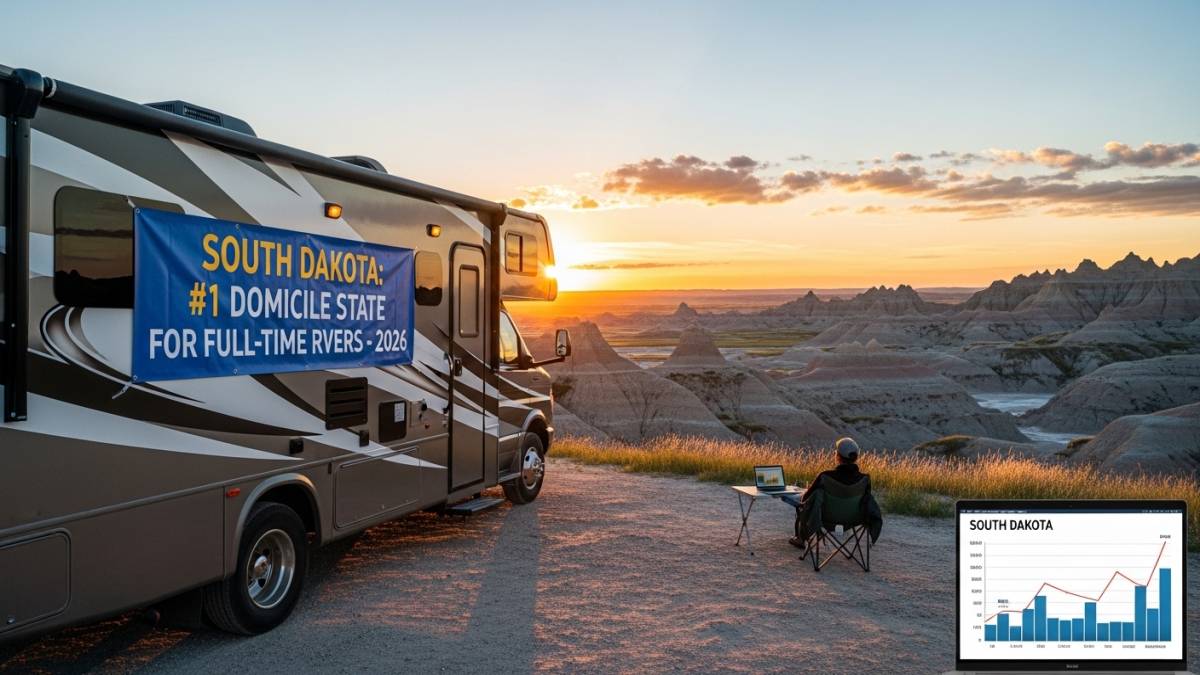
Why South Dakota Remains the #1 Domicile State for Full-Time RVers in 2026
Zero State Income Tax — Every Single Year
South Dakota charges no state personal income tax whatsoever. That is a flat 0%. Whether you are working remotely for a tech company, running an online business, freelancing on the road, or drawing retirement income, none of that gets taxed at the state level in South Dakota.
To understand how significant this is, consider that states like California tax income at up to 13.3%, Minnesota at over 9.8%, and Oregon at nearly 10%. A full-time RVer earning $80,000 a year who switches from California to South Dakota domicile could potentially save over $10,000 annually in state income taxes alone. Over five years, that is $50,000 kept in your pocket instead of handed to a state government you are barely spending time in.
South Dakota also has no inheritance tax, no personal property tax on vehicles, and no tax on pension income. For retirees living the RV lifestyle, this combination is particularly powerful.
Also Read:- How to Size an RV Solar System the Right Way
One of the Easiest Residency Requirements in the Country
To legally establish domicile in South Dakota in 2026, you need to do three things:
One: Spend at least one night in South Dakota. A single overnight stay at a campground, hotel, or even a friend’s driveway qualifies. Keep your receipt — you will need it as proof.
Two: Establish a South Dakota mailing address. This is done through a mail forwarding service. Companies like ChooseSD.com and DakotaPost have helped thousands of full-time RVers set up a legitimate South Dakota address that receives and forwards your mail wherever you are in the country.
Three: Visit the South Dakota DMV with your documents. You will surrender your previous state driver’s licence, get your new South Dakota licence, and register your vehicle. Most people complete this entire process in one single day.
That is genuinely it. No minimum income requirement. No property ownership requirement. No lengthy waiting period.
One important note for 2026: There was a legislative effort in the South Dakota legislature (House Bill 1232) that aimed to make residency harder to establish for those using mail forwarding services. As of this writing, that bill has not passed, and the current one-night residency standard remains in effect. However, RVers should stay informed about any changes to South Dakota legislation, as this is an evolving area. Consult a legal professional if you have specific concerns.
Maintaining Your South Dakota Residency Is Equally Simple
Once you are a South Dakota resident, you only need to return to the state and spend one night every five years to renew your licence and maintain your residency status. That is all. One overnight every five years.
For anyone constantly moving across America, this level of flexibility is almost unmatched by any other state’s requirements. Keep your campground receipts every time you pass through South Dakota — they serve as your proof of presence if your residency status is ever questioned.
Low Vehicle Registration Fees and Zero Emissions Inspections
South Dakota charges a vehicle excise tax of just 4%, which is typically far lower than the combined sales tax, excise tax, and personal property tax burden in most other states. For someone registering a large, expensive Class A or Class C motorhome, this alone can mean several thousand dollars in savings compared to states like Virginia or Massachusetts.
Even better, South Dakota requires no annual vehicle emissions inspections and no smog checks. This is a massive practical benefit for full-timers who may be driving older rigs that might struggle to pass emissions testing in stricter states. Drive your rig wherever you want, and never worry about whether your exhaust system will pass a test you did not know was coming.
Also Read:- Best RV Solar Panels for South Dakota 2026
Lower Insurance Costs
South Dakota consistently ranks as one of the states with lower auto and RV insurance costs. Insurance companies price premiums partly based on your domicile state’s traffic patterns, population density, and legal environment. South Dakota’s low population density and favourable legal landscape typically translate into noticeably lower insurance premiums than high-cost states. Many full-timers report saving hundreds of dollars per year on insurance after making the switch.
The 2026 Solar Urgency: Why This Year Is the Last Chance for the 30% Credit
Now here is the part of this guide that you genuinely cannot afford to skip.
In July 2025, Congress passed legislation that eliminated the Residential Clean Energy Credit — the federal solar Investment Tax Credit — for residential solar systems installed after December 31, 2026. This is the official end of the most valuable residential solar incentive in American history for individual homeowners and full-time RVers.
What this means in plain language: if your solar system is fully installed on your RV before the end of 2026, you can still claim 30% back on your federal taxes. If you miss this deadline, that credit is gone entirely for residential systems.
This is not a situation where the credit shrinks slightly or phases out slowly. It ends. And given how busy professional solar installers are as people rush to meet this deadline, acting now rather than in October or November is strongly advisable.
Understanding the Federal Solar Tax Credit for RV Owners in 2026
Does Your RV Qualify?
This is the question most RVers ask first, and the good news is that the answer is almost certainly yes — if the RV is your primary or secondary home.
According to IRS guidelines for the Residential Clean Energy Credit, a qualifying home includes a house, houseboat, mobile home, cooperative apartment, condominium, and manufactured home that meets federal construction standards. The IRS definition also extends to recreational vehicles when used as a qualifying residence.
If your RV is where you live full-time — as it is for the hundreds of thousands of Americans who have embraced this lifestyle — it qualifies as your primary home for IRS purposes. If you use it as a second home alongside a fixed residence, it qualifies as a second home.
Either way, you are in a strong position to claim this credit. You do not need a traditional house to benefit from the solar tax credit.
How Much Is the Credit Worth?
The Residential Clean Energy Credit is worth 30% of the total installed cost of your solar system. This is a dollar-for-dollar tax credit, not a deduction. Every dollar of credit reduces your federal income tax bill by one dollar.
Here is what that looks like in real numbers:
If your complete RV solar installation — panels, mounting hardware, charge controller, inverter, battery storage, wiring, and professional installation labour — costs $5,000, your credit equals $1,500.
If your system costs $8,000, your credit equals $2,400.
If you invest in a premium setup at $12,000, your credit equals $3,600.
The credit covers all of the following qualifying expenses:
- Solar panels
- Mounting and racking hardware
- MPPT or PWM charge controllers
- Pure sine wave inverters
- Battery storage systems (minimum 3 kWh capacity)
- All wiring and electrical components
- On-site preparation and installation labour
- Permitting and inspection fees
Also Read:- Wyoming Wind & RV Solar Panels: Protection & Mounting Tips
How to Claim It: IRS Form 5695
To claim the solar tax credit, you file IRS Form 5695 (Residential Energy Credits) along with your standard federal income tax return (Form 1040) for the year your system was installed and put into service.
Here is the step-by-step process in plain terms:
Step One: Keep every receipt, invoice, and contractor agreement related to your solar installation. You do not have to file these documents with your return, but the IRS strongly recommends retaining them in case of an audit.
Step Two: On Form 5695, enter the total gross cost of your solar system on the appropriate line (Line 1 for solar electric property costs). Include any battery storage costs on Line 5b.
Step Three: The form multiplies your total qualifying costs by 30% to calculate your credit amount.
Step Four: The resulting credit flows to Schedule 3 of Form 1040, where it directly reduces your tax liability.
Step Five: If your tax liability for the year is less than your total credit, you carry the unused portion forward to the following tax year. However, given that 2026 is the final year for this credit, plan your installation timeline and tax situation carefully with a qualified professional.
Important: The credit is non-refundable, meaning it can zero out your tax bill but cannot generate a cash refund on its own. Carryforward provisions still apply for the 2026 tax year credit being applied in subsequent years.
Always work with a qualified CPA or tax advisor when claiming energy credits, particularly regarding how your RV is classified for IRS purposes.
South Dakota’s Own Solar Property Tax Benefit
While South Dakota’s state-level solar incentives are less expansive than some other states, there is a meaningful property tax exemption worth knowing about.
Under South Dakota Codified Law (SDCL) 10-4-42 through 10-4-45, solar energy systems are partially exempt from real property tax assessment. Specifically, the first $50,000 or 70% of the assessed value of a qualifying solar energy system — whichever amount is greater — is exempt from property tax for systems under 5 megawatts.
For anyone who pairs their RV lifestyle with a small piece of South Dakota land (a popular strategy among some full-timers who want a genuine physical foothold in the state), this exemption means that adding solar to a fixed structure on that property will not significantly raise your property tax bill.
The 2026 RV Solar Setup Guide: From Zero to Off-Grid
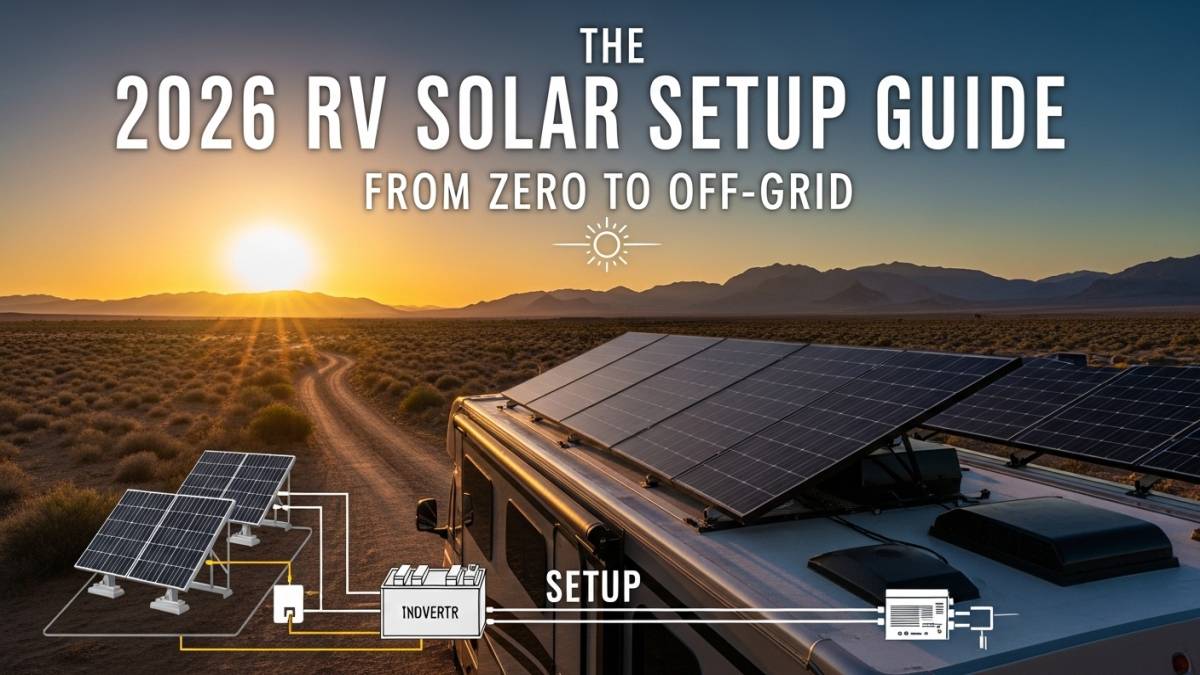
Setting up a solar system on your RV in 2026 does not require an engineering degree. But doing it right — sizing it properly, choosing quality components, and installing it safely — makes the difference between a system you love and one you are constantly fighting with. Here is exactly what you need to know.
Step One: Know Your Power Consumption Before You Buy Anything
The single most common mistake RVers make when going solar is buying panels before understanding their actual power usage. Spend one full week tracking every electrical device you use. Think through all of the following:
Your refrigerator is almost certainly your largest power draw — a 12V compressor fridge running continuously uses roughly 30 to 50 amp-hours per day. Lighting, if you have already switched to LED, uses very little. Charging phones and laptops adds up but is manageable. A television or streaming device, a fan or circulation system, a coffee maker, and a CPAP machine all need to be factored in.
Once you add everything up in watt-hours per day, you have your baseline energy demand. This number directly determines how much panel capacity and battery storage you need.
For most full-time RVers living a comfortable modern lifestyle in their rig, a system in the 400 to 800 watt panel range paired with 100 to 300 amp-hours of battery storage covers daily life very well through most of the year in most parts of the country.
Step Two: Choose Your Solar Panels
Monocrystalline panels are the clear first choice for RV rooftop installations in 2026. They deliver the most power output per square foot of surface area, they are durable, and their efficiency rating has continued to improve even as prices have remained competitive. For the limited roof space on most RVs, maximum efficiency per square foot matters enormously.
Polycrystalline panels cost a bit less and work acceptably, but their lower efficiency means you need more of them to generate the same output — and roof space is always at a premium.
Flexible or thin-film panels are lightweight and can be adhered to curved rooftops where rigid panels cannot mount. They are less efficient than monocrystalline, but they open up installation possibilities on rigs with unusual roof shapes or limited flat surface area. Some RVers use a combination of rigid monocrystalline panels on the flat sections and flexible panels on curved areas to maximise their total array.
Also Read:- Jackson Hole RV Solar Mountain Weather Performance Guide
Step Three: Choose Your Charge Controller
The charge controller sits between your solar panels and your battery bank. Its job is to regulate incoming power to protect your batteries from overcharging and maximise the energy your system captures.
MPPT (Maximum Power Point Tracking) controllers are the correct choice for any serious RV solar setup in 2026. They are more sophisticated than older PWM controllers and extract significantly more power from your panels — often 20 to 30% more energy across a day — by continuously optimising the electrical load. The additional cost pays back quickly in the form of better daily charging performance.
PWM (Pulse Width Modulation) controllers are simpler and less expensive. They work adequately for very small or basic systems but leave real energy on the table compared to MPPT. For any system over 200 watts, invest in MPPT.
Match your charge controller’s voltage and amperage rating to your panel array. A controller that is too small for your array will throttle your charging capacity. When in doubt, buy slightly above your current needs so your system has room to expand.
Step Four: Select Your Inverter
If you want to power any standard AC household appliances — a laptop with a three-prong charger, a blender, a hair dryer, a television, a CPAP machine — you need an inverter to convert the DC power from your batteries into the AC power those devices require.
Pure sine wave inverters are the right choice for modern RV setups. They produce clean, stable AC power that is safe for sensitive electronics, motors, and medical devices. Modified sine wave inverters cost less but produce dirtier power that can harm some electronics and cause others to run less efficiently.
For a full-time RV setup, a 1,500 to 3,000 watt pure sine wave inverter covers the needs of most road-dwellers comfortably. Size your inverter based on the maximum simultaneous wattage you expect to draw — add up your highest-draw appliances to find that number.
Step Five: The Battery Bank — The Most Important Decision You Will Make
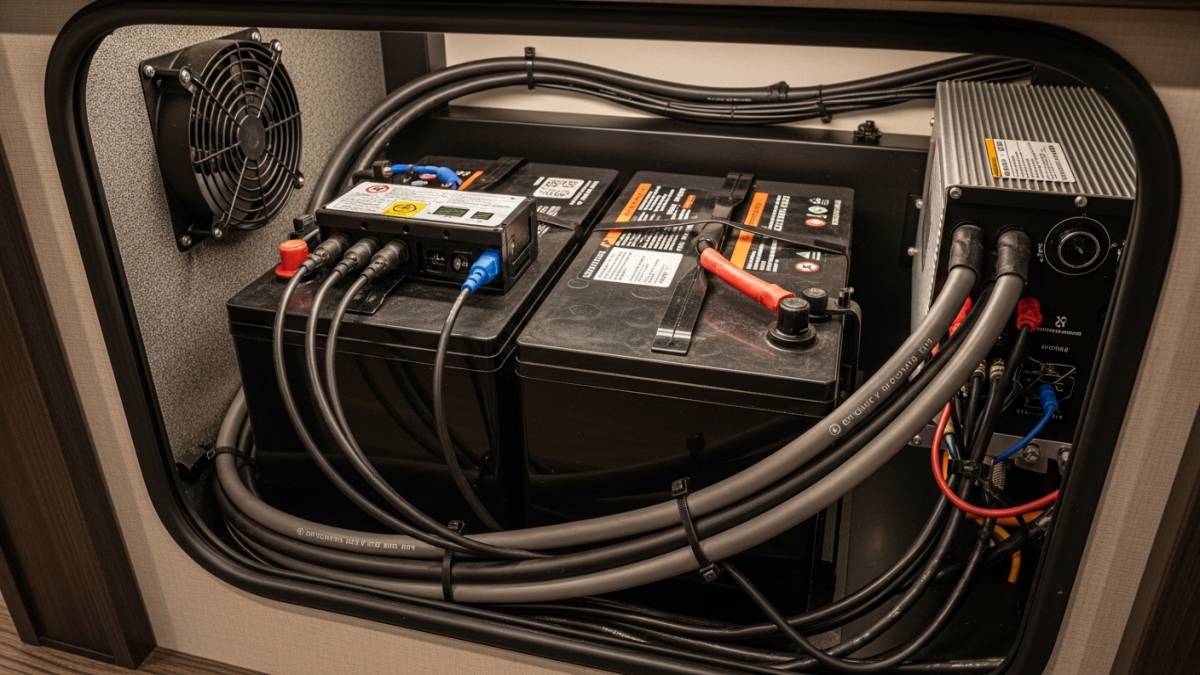
Your batteries are where your solar energy lives between the moment it is collected and the moment you use it. The quality and capacity of your battery bank determine how comfortable your off-grid experience actually is, especially at night and on overcast days.
Lithium Iron Phosphate (LiFePO4) batteries have completely transformed the RV solar landscape over the past several years, and in 2026 they are the overwhelming choice for full-time RVers. Here is why:
They weigh significantly less than lead-acid batteries. They can be discharged to a much lower state of charge — typically 80 to 90% depth of discharge without damage, compared to around 50% for lead-acid. They charge faster. They last dramatically longer — 3,000 to 5,000 charge cycles versus 300 to 500 for standard flooded lead-acid. And they require essentially zero maintenance.
Yes, lithium batteries cost more upfront. But when you calculate the cost per usable kilowatt-hour over the lifetime of the battery, lithium almost always wins, often by a significant margin.
For a full-time setup, 100 to 200 amp-hours of lithium storage gives you roughly one to two days of comfortable living between solar charging cycles, which is plenty when paired with a decent panel array.
AGM lead-acid batteries remain a valid budget option for part-time or weekend RVers who are not asking as much of their system. But for full-timers, the upgrade to lithium is worth every dollar.
Also Read:- RV Solar System Setup Complete Beginner’s Guide (2026)
Step Six: Professional Installation vs. DIY
This is a personal decision that depends on your comfort level with electrical work, your budget, and how complex your setup is.
Many experienced RVers successfully install their own solar systems using the wealth of tutorials, guides, and community knowledge available online. A straightforward rooftop installation with proper wiring, correct fusing, and a quality charge controller is something a motivated DIYer can tackle successfully.
That said, if you are not comfortable with 12-volt electrical systems, hiring a qualified RV technician or solar installer is absolutely worth the investment. An improper installation can damage your batteries, void warranties, create fire hazards, or leave your system significantly underperforming.
From a tax credit perspective, a professional installation with clear, itemised invoices makes your documentation cleaner and easier to substantiate with the IRS. Save every receipt regardless of which path you choose.
What the Combined Financial Picture Looks Like in 2026
Let us put real numbers to this so you can see the full picture.
Imagine a full-time RVer who establishes South Dakota domicile in early 2026 and installs a quality solar system on their rig before the December 31 deadline. Here is what their financial picture could look like:
State income tax savings: Switching from a state like Colorado (4.4% flat income tax) to South Dakota (0%) on an income of $65,000 saves roughly $2,860 per year.
Vehicle registration savings: Registering a Class C motorhome valued at $60,000 in South Dakota at 4% excise tax versus a state charging a combination of sales tax and personal property tax could save $1,500 to $3,000 at registration time.
Insurance savings: Many RVers report a reduction of $300 to $600 per year after switching their rig’s registration to South Dakota.
Federal solar tax credit: A $7,000 solar installation generates a $2,100 one-time federal tax credit directly reducing their federal income tax bill for the 2026 tax year.
Eliminated campground electrical hookup fees: A full-timer who boondocks even half the time instead of paying $15 to $25 per night for hookups saves roughly $2,700 to $4,500 per year in campground fees.
When you add these together, the first-year financial advantage of combining South Dakota domicile with a solar installation easily reaches $8,000 to $12,000 or more depending on your income, your previous state, and how often you camp off-grid. In subsequent years, the ongoing savings from no state income tax and eliminated hookup fees continue accumulating every single year.
The Legislative Warning Worth Knowing in 2026
It would not be a responsible guide if we did not mention one developing situation in South Dakota.
There have been legislative efforts within South Dakota to tighten residency requirements for full-time RVers, particularly around voter registration and the use of mail forwarding services as proof of address. As of the time this article is written, the one-night residency requirement for establishing domicile remains intact, and the ability to use mail forwarding services as part of your address documentation remains valid.
However, RVers should stay actively informed. The political landscape around nomadic residency is shifting gradually, and what is easy today could become more complicated in future legislative sessions. Organisations like Escapees RV Club and the Full-time Families community provide ongoing updates on these developments and are excellent resources for anyone navigating the nomadic legal landscape.
Keep all your documentation — your overnight receipts, your mail forwarding contracts, your DMV paperwork — and make a genuine, good-faith effort to return to South Dakota periodically. One of the cautionary tales in the full-timer community involves a couple who completed all the paperwork for South Dakota domicile but never returned to the state. Their original state’s tax authority challenged their domicile status, and because they could not demonstrate any ongoing intent to be South Dakotans, they lost and faced significant back taxes, penalties, and interest. Your intent to be a South Dakota resident matters as much as your paperwork.
Also Read:- Cheyenne RV Solar Installers: Top 5 Shops Reviewed (2026)
Your 2026 Action Plan: How to Do Both Things Before Year’s End
If you are convinced — and the numbers suggest you should be — here is a practical action plan to get both your South Dakota domicile and your solar installation done before the December 31, 2026 deadline.
For South Dakota domicile: Start by signing up with a mail forwarding service such as ChooseSD.com or DakotaPost. Then plan a trip to South Dakota — you can easily combine it with exploring the Black Hills, Badlands National Park, or the Spearfish Canyon area, which are genuinely worth visiting. Spend one night, visit the DMV, get your new South Dakota driver’s licence, register your vehicle, and you are officially a South Dakotan. The entire process typically takes one or two days at most.
For solar: Do not wait until autumn to start this process. Installers across the country are experiencing significant backlogs as people rush to meet the December 31, 2026 deadline. Get quotes now, make your component decisions, and either book a professional installer or order your DIY components as early in 2026 as possible.
For the tax credit: Line up a qualified CPA who understands the solar tax credit and, if possible, has experience working with RV owners. Make sure your installation is completed and your system is in service (meaning actually operational) before December 31, 2026. The IRS bases eligibility on the year the system is put into service, not the year it was purchased.
The Bottom Line: 2026 Is the Year to Act
South Dakota domicile has been one of the smartest financial moves available to full-time RVers for years. The combination of zero state income tax, easy residency requirements, low vehicle registration costs, no emissions inspections, and lower insurance rates creates a financial foundation that makes road life genuinely economical.
The federal solar tax credit is the final, time-sensitive piece of this puzzle. For 2026, the 30% credit remains available in full. After December 31, 2026, it is gone for residential systems — officially, by act of Congress. That makes this year the last, best window to add solar to your RV and recover nearly a third of your total system cost directly from your federal tax bill.
For the full-time RVer who wants to travel freely, live cheaply, and build a financially intelligent nomadic life — South Dakota domicile and solar power are not just two good ideas. In 2026, they are the two most urgent and financially rewarding steps you can take.
The road is waiting. Your rig deserves the sun. And your wallet deserves both.
Disclaimer: This article is intended for informational purposes only and does not constitute legal, tax, or financial advice. Tax laws, incentive programmes, and state residency requirements are subject to change. Please consult a qualified tax professional, CPA, or legal advisor for guidance specific to your personal situation before making any financial or legal decisions.