You turn on the hot water faucet. Cold. You wait a few seconds, hoping. Still cold. You check the switch again—it definitely says it’s on.
That sinking feeling is real, especially when you’re 40 miles from civilization, it’s 7 AM, and everyone in your group needs a shower before hitting the trail.
Here’s what I want you to know: most RV water heater problems are fixable. Seven out of ten times, it comes down to something simple—a switch that got flipped off, a propane tank running on fumes, a clogged igniter, or a worn-out anode rod. And the best part? You can fix most of these yourself in under 30 minutes with basic tools.
This guide walks you through every common issue, what to check first, and exactly how to fix it. Whether you’ve got a tank-style heater or tankless unit, we’ve covered it.
Quick Diagnosis: What’s Actually Wrong?
Before we dive deep, let’s figure out what you’re dealing with. Find your symptom below and jump straight to the fix that matters.
| What’s Happening | Likely Culprit | Jump To |
|---|---|---|
| No hot water at all | Heater’s off / propane empty | The Basics (below) |
| Propane mode won’t light | Dirty igniter / dead battery | Propane Issues |
| Electric mode isn’t heating | Tripped breaker / burned element | Electric Problems |
| Water’s lukewarm, not hot | Bypass valve open / cold water mixing | Lukewarm Water |
| Heater lights then dies | Thermostat or ECO switch tripped | Ignites Then Shuts Off |
| Tankless won’t activate | Low water flow / error code | Tankless Units |
| Water’s dripping out | Pressure relief valve / loose fittings | Leaks |
Start Here: Check the Basics (5 Minutes)
Before you pull anything apart, run through this quick checklist. Seriously—more than half of all service calls come down to one of these four things.
1. Is the Water Heater Actually Turned On?
This sounds obvious. But it catches everyone at least once. Propane and electric have separate switches on most units, and sometimes you’ve got one turned on and one turned off. Check both:
- Inside your RV on the control panel
- On the exterior access panel outside
Really. Check both.
2. Is Your Propane Tank Empty or Shut Off?
If you’ve been running the furnace all night or using the stove, your propane is lower than you think. Walk over to the tank and open the valve fully. Give the tank a gentle shake—you should hear liquid sloshing inside. If it’s silent, you’re running on vapors.
3. Is the Tank Actually Full of Water?
Never, never run an electric heater on an empty tank. You’ll burn out the heating element and potentially damage the whole unit. Before you switch to electric mode:
- Fill your freshwater tank completely
- Open a hot water faucet inside
- Wait until water flows steady (not sputtering with air)
- Now turn on the heater
4. Are the Bypass Valves in the Right Position?
After winterizing, bypass valves get left open so water skips the tank. This is intentional during storage. But before you use your RV, you need to flip them back to normal position.
Check these valves at:
- The back of the water heater unit
- Inside your water bay
If they’re still in bypass mode, water can’t fill the tank. Flip them to normal (closed bypass) and wait about 10 minutes for the tank to fill before testing.
Propane Mode Won’t Ignite (The Most Common Problem)
You flip the switch. You hear that familiar click-click-click. But the burner never actually lights. This is the #1 complaint with DSI (Direct Spark Ignition) heaters, which is what most modern RVs have.
Here’s what to check, in order:
First: Confirm you actually have propane Light a stove burner. If that won’t light, your propane is empty. Refill and come back. If the stove lights fine, you’ve got gas flowing. Move on.
Second: Check your battery voltage DSI igniters need at least 10.5 volts DC to fire properly. If your battery ran down overnight from heavy use, the igniter might click but can’t produce a spark strong enough to light gas.
Quick fix: Charge your batteries or plug into shore power for a couple hours. Come back and try again.
Third: Clean the igniter electrode Carbon builds up on the electrode tip over time. This gunk prevents a good spark.
What to do:
- Use fine-grit sandpaper or steel wool
- Gently clean just the tip
- Don’t use a drill bit or wire brush—you’ll enlarge the opening and mess up the gas/air mix
Fourth: Check the igniter gap The electrode tip should sit about 1/4 inch away from the burner. If it’s bent out of position, it can’t sense the flame properly and shuts everything off as a safety feature.
Gently straighten it if it’s bent. You’re aiming for that sweet 1/4-inch gap.
Fifth: Look for spider webs and wasp nests I’m not joking. This is way more common than you’d think, especially if your RV sat in storage for a while.
Open the exterior panel and grab a can of compressed air. Blow out:
- The burner tube
- The orifice opening
- Any visible debris
Spider webs and wasp nests are a top cause of “won’t ignite” failures.
Electric Mode Isn’t Heating (Three Things to Check)
If propane works fine but the electric element won’t heat, you’re dealing with one of three issues: a tripped breaker, a dead heating element, or a bad thermostat. Here’s how to find out which.
Step 1: Check the breaker
Walk to your 120V breaker panel inside the RV. Find the water heater breaker. Is it flipped to OFF? Flip it back on and wait 5 minutes.
Here’s why this happens: The electric heating element pulls 1,440 to 1,500 watts. If you’re running your AC unit, microwave, and water heater on a limited shore power hookup, the system shuts down to protect itself.
If it trips again right away, you’re overloaded. Turn off something else before running the heater.
Step 2: Verify you have shore power
No AC power = no electric heating, obviously. Check:
- That you’re plugged into the campground pedestal
- The breaker at the pedestal (sometimes they trip from the outside)
Step 3: Test the heating element with a multimeter
This tells you whether the element is actually dead or if it’s just not getting power.
What you need:
- A basic multimeter (any hardware store, $10-15)
How to test:
- Set your multimeter to ohms (resistance mode)
- Locate the heating element:
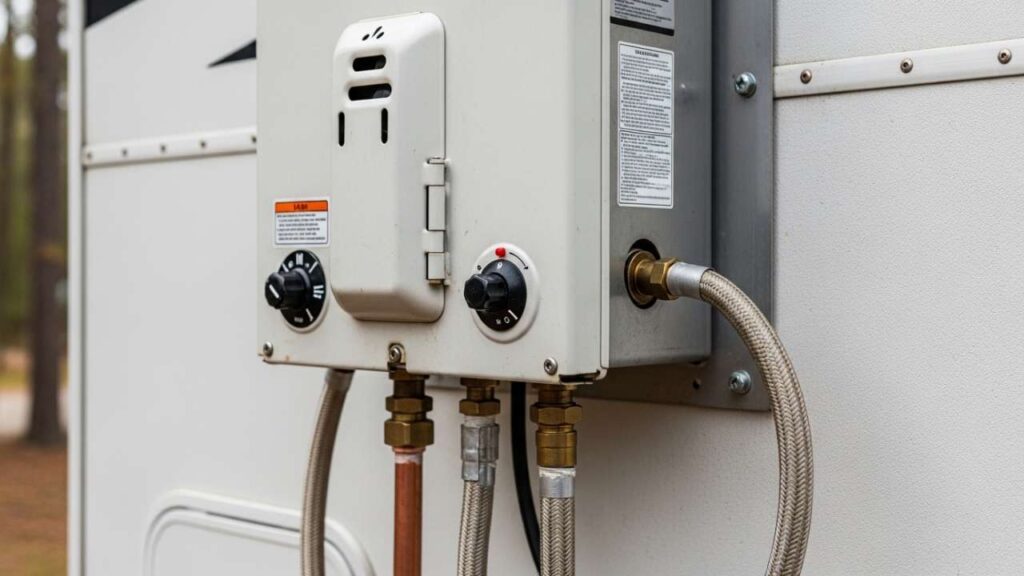
- Suburban units: front of the unit inside the exterior bay
- Dometic/Atwood units: back of the unit
- Place the multimeter leads on the two screw heads
- Read the number
What the numbers mean:
- 9.6 to 10 ohms = Element is good, power isn’t reaching it (check connections)
- Zero or infinity = Element is dead and needs replacement
Replacing a heating element (DIY-friendly)
Good news: this is totally doable yourself.
- Cost: $15-$35
- Time: About 20 minutes
- Tools needed: Basic wrench set, new element
Just make sure the power is completely off before you start.
Water Is Lukewarm, Not Hot (But Should Be Heating Fine)
You’ve got hot water coming out—just not as hot as it should be. The water heater itself is probably working great. The problem is cold water mixing in somewhere it shouldn’t.
Where to look:
Bypass valves (again) Seriously. If even one bypass valve is partially open, cold water bleeds into the hot line and drops your temperature way down. Check them again.
Your outdoor showerhead This one catches a lot of people. If the push-button on your outdoor showerhead isn’t fully off (just partially closed), cold water from the mixing valve trickles into the hot line.
Make sure it’s fully shut at the faucet handle, not just at the showerhead button.
Thermostat setting Some units come from the factory set lower than you’d expect. If you’ve got a Suburban unit, you can access the thermostat dial from the exterior bay. Turn it up a notch and test again.
The tank just needs more time A 6-gallon tank takes 30-35 minutes to fully heat on propane. A 10-gallon tank takes 45-55 minutes. If you turned it on and immediately ran hot water, you got whatever was already in the lines—which is cold.
Give it time. Then try again.
Heater Ignites, Then Shuts Off (5 Minutes Later)
The burner lights. Water gets hot. And then… it just dies. This usually means a safety switch is doing its job—which is good news, because it means nothing’s actually broken. Something just triggered it.
Most likely causes:
The ECO (Energy Cut-Off) switch got tripped This is a high-limit safety switch that cuts power if water temperature climbs too high. You’ll find a red button on the thermostat assembly (usually accessible from the exterior bay).
Important: Don’t just reset it and move on. A tripped ECO means something caused the water to overheat. Common reasons:
- Failed thermostat
- Dry-fire incident earlier
- Faulty temperature sensor
If it trips again after you reset, have a certified technician inspect it before using it again. The ECO is there to prevent damage—listen to it.
Weak flame or gas pressure issues A propane regulator that’s getting old can deliver uneven gas pressure. The burner lights but can’t maintain a steady flame, and the unit shuts off.
If your propane regulator is 5-7 years old and you’re having ignition problems across multiple appliances (stove and heater both acting up), it might need replacement.
Flame sensor out of position The flame sensor rod needs to sit centered in the flame path so it can confirm the burner is actually lit. If it’s been bumped or corroded, it won’t sense the flame and cuts the gas valve off as a safety measure.
Try centering or cleaning the sensor rod. That often fixes it.
Tankless RV Water Heaters (Different Beast Entirely)
Tankless heaters have their own set of issues. The most common problem? The unit just won’t activate.
Check these first:
The exterior on/off switch Most tankless units have an on/off switch on the exterior access panel in addition to the interior control panel. Both must be on.
If someone accidentally flipped the exterior switch off, nothing the interior controls do will matter. Easy to miss—but check it first.
Water flow is too low Tankless heaters need a minimum water flow to trigger the burner—usually around 0.5 to 0.7 gallons per minute (GPM).
If your water pressure is low, a filter is partially clogged, or you’re using a low-flow showerhead, the heater won’t fire.
Try this: Fully open a regular faucet (not a fancy low-flow one). Does the heater activate now? If yes, that’s your problem.
Error code on the display Write down the error code and look it up in your owner’s manual. Most codes are straightforward:
| Brand | Code | What It Means | Quick Fix |
|---|---|---|---|
| Furrion | E1 | No water flow detected | Check water pressure, open faucet fully |
| Furrion | E3 | Ignition failure | Check propane supply, clean igniter |
| Girard | 3 blinks | Overheat / thermal cutoff | Let cool, check flow rate |
| Girard | 5 blinks | Ignition lockout | Reset unit, check gas supply |
| Suburban (tankless) | No light | Exterior switch off | Check the exterior panel first |
Mineral buildup (hard water issue) Hard water leaves calcium deposits inside the heat exchanger over time. This reduces water flow and causes the unit to overheat and shut down.
If you’re in a hard water area: Descale annually using white vinegar or a commercial RV descaler. It’s cheap maintenance that prevents headaches.
Water Leaking from the Unit
A little dripping from the pressure relief valve during heating is totally normal—that valve opens when pressure builds inside the tank.
Constant dripping or leaking from the tank body itself? That’s different. Here’s what each leak location means:
Dripping constantly from the P/T relief valve
The valve itself might be faulty, or water temperature is running too high.
What to do:
- Buy a new P/T valve ($10-$20)
- Replace it (straightforward DIY job)
- If a new valve still drips constantly, the thermostat might be set too high or failing
Leak from water line fittings
PEX connections and brass fittings loosen over time from road vibration—it’s just part of RV life.
What to do:
- Tighten fittings carefully
- Hand-tight plus 1/4 turn with a wrench (for compression fittings)
- Don’t overtighten—you’ll just create a worse problem
Leak from the tank body itself
A crack in the tank, especially after a freeze event, means the unit needs to be replaced. There’s no reliable way to patch an RV water heater tank.
Rust-colored water from hot taps
This is a sign your anode rod has completely corroded, and the tank is now rusting from the inside.
What to do:
- Replace the anode rod immediately ($10-$15 part)
- It’s a simple DIY job
- If rust-colored water continues after replacing it, the tank might be past saving
Annual Maintenance: Prevent Problems Before They Start
Here’s the thing: most RV water heater failures are completely preventable. Spend 30 minutes once a year on maintenance, and you’ll extend your unit’s life by years.
| Task | When | Cost | Why It Matters |
|---|---|---|---|
| Replace anode rod | Annually | $12-$15 | Stops tank corrosion from the inside |
| Flush the tank | Annually (before storage) | Free | Removes sediment that kills efficiency |
| Clean igniter electrode | Annually | Free | Prevents ignition failures at the worst times |
| Clear burner tube | Annually / after storage | Free | Debris is a #1 no-ignite cause |
| Test P/T relief valve | Annually | Free (or $20-40 if replacement needed) | Safety check—prevents dangerous pressure buildup |
| Check anode rod thickness | Every 6 months (hard water areas) | $12-$15 if replacement needed | Hard water eats through rods faster |
| Inspect water line connections | Annually | Free | Road vibration loosens everything |
| Drain and bypass before winter | Before freezing temps | Free | A freeze crack = full replacement |
DIY vs. Calling a Technician
Know when to roll up your sleeves and when to call someone who knows what they’re doing:
| Problem | DIY OK? | Why |
|---|---|---|
| Cleaning igniter electrode | Yes | Simple, zero safety risk |
| Anode rod replacement | Yes | Straightforward, basic tools only |
| Heating element replacement | Yes (if comfortable with 120V) | Just verify power is off first |
| P/T relief valve replacement | Yes | Easy swap, cheap part |
| Resetting ECO switch | Reset only | You must find what caused it to trip |
| Propane gas line repair | No | Safety risk, needs certified work |
| Propane regulator replacement | No | Improper install affects all gas appliances |
| Full unit replacement | Experienced DIYers only | Complex wiring and plumbing |
Complete Troubleshooting Decision Tree
No Hot Water at All?
Is the water heater switched ON inside your RV?
- No? Turn it on, wait 15 minutes, test again. ✓ Problem solved.
- Yes? Continue.
Do you have water in the freshwater tank?
- No? Fill the tank, wait 5 minutes, test. ✓ Problem solved.
- Yes? Continue.
For propane models: Do you have propane?
- No? Refill the tank, test. ✓ Problem solved.
- Yes? Continue.
For electric models: Is the breaker ON?
- No? Flip it, wait 5 minutes, test. ✓ Problem solved.
- Yes? Continue.
Are bypass valves in normal position?
- No? Flip them to normal, wait 10 minutes, test. ✓ Problem solved.
- Yes? Continue.
For propane: Can you see the pilot light?
- No? Try relighting per your manual. If it won’t stay lit, thermocouple needs replacement.
- Yes? Continue.
For electric: Is there power to the element?
- No power? Check connections.
- Has power? Heating element has burned out.
Still not working? Move to the brand-specific section above or check the detailed chart below.
Lukewarm Water?
- Check bypass valves—are they partially in bypass? Flip to normal.
- Clean aerators (mineral buildup). Soak screens in white vinegar 30 minutes.
- Check valve failure (needs replacement, $40-80).
Strange Noises?
- Popping or knocking? Sediment at tank bottom. Drain and flush completely.
- Hissing or whistling? Temperature too high. Check thermostat (should be 110-120°F). Adjust or replace thermostat.
- High-pitched squealing? Line restriction or pump issue. Professional help recommended.
Water Leaking?
- Minor weeping from drain plug? Likely condensation. Tighten plug. If it keeps leaking, plug needs replacement ($10-20).
- Steady dripping from tank body? Corrosion inside. Try replacing anode rod ($40-60). If still leaking, tank needs replacement.
- Leaking from pressure relief valve? Valve is stuck or broken. Try lifting the lever manually. If nothing comes out, valve is stuck. Replace it ($40-60).
- Leaking from water connections? Tighten fittings with wrench. If that doesn’t work, replace O-rings or fittings.
Rotten Egg Smell?
- Bacteria reacting with anode rod
- Drain tank and refill with 1 part white vinegar to 3 parts water
- Let it sit several hours
- Drain and flush thoroughly
- If smell returns, replace anode rod ($40-60)
Advanced Maintenance Schedule: The Full Plan
Your water heater can last 10-15 years with proper care or fail in 5-6 years without it. Here’s your complete maintenance schedule:
Weekly (when actively using your RV):
- Check propane level on the gauge
- If below 25%, note for refilling soon
Monthly:
- Visual inspection for leaks, corrosion, or damage
- Check that all connections are tight
- Make sure drain valve isn’t weeping
Quarterly:
- Drain and flush tank
- Turn off power and propane
- Open drain valve completely
- Flush with clean water several times until water runs clear
Every 2-3 Years:
- Inspect anode rod (check your manual for location)
- If less than 1/4 inch thick, replace immediately
- This single task can add years of life
Every 6 Months:
- Check all connections
- Tighten any loose fittings with wrench
- Look for corrosion and clean if needed
Annually:
- Test pressure relief valve—lift the lever, water should dribble out
- If nothing happens, valve needs replacement
Before Storage:
- Drain tank completely
- Turn off all switches and propane
- Follow winterization procedures in your manual
After Storage / Before Use:
- Fill tank completely before turning on electric mode
- Let water run from a faucet until it comes steady (no air)
- This prevents dry-firing the heating element
Frequently Asked Questions
Why won’t my RV water heater ignite on propane?
The most common causes are a dirty igniter electrode, a blocked burner tube (spider webs or wasp nests), low propane, or low battery voltage.
Start by confirming propane flows at the stove. Then clean the igniter electrode with fine sandpaper. Finally, clear the burner tube with compressed air.
How do I reset my RV water heater?
For DSI models: Turn the switch off, wait 30 seconds, turn it back on.
If your unit has an ECO (Energy Cut-Off) switch, find the red reset button on the thermostat assembly (usually accessible from the exterior bay) and press it firmly. But always investigate why it tripped—resetting it without finding the cause is just a temporary fix.
How long does it take to heat water?
- 6-gallon tank on propane: 30-35 minutes
- 10-gallon tank on propane: 45-55 minutes
- Electric-only mode: 60-90 minutes depending on element wattage
- Dual-fuel (propane + electric together): Heats faster than either alone
Why is my heater getting hot but then shutting off?
Usually a tripped ECO (high-limit) switch or a flame sensor that’s not centered in the flame path. It can also be weak gas pressure from an old propane regulator.
Reset the ECO switch, but find the root cause. Repeated trips mean something is running hotter than it should.
Why won’t my tankless water heater turn on?
Check the exterior on/off switch first—this is the most commonly missed step. Then confirm water flow is above the minimum threshold (usually 0.5 GPM). Check for an error code and look it up in your manual.
How often should I replace the anode rod?
At least once a year. More often if you camp in hard water areas. The anode rod is sacrificial—it corrodes instead of your tank. When it’s gone, the tank starts corroding. A $12 part replaced annually can add years to your water heater’s life.
Can I run my RV water heater without an anode rod?
Never. Suburban water heaters require an anode rod to protect the steel tank from corrosion. Running without one will rust out your tank within a season or two.
Note: Dometic (Atwood) units use aluminum tanks and don’t require anode rods.
Final Thoughts: You’ve Got This
RV water heater problems feel like disasters when they happen. You’re stuck without hot water, worried about whether something expensive is broken, or stressed about being stranded.
But here’s the truth: most problems are preventable with basic maintenance, and most are fixable without professional help.
Use this troubleshooting chart. Follow the steps in order. If you’ve got Dometic, Atwood, or Forest River equipment, use the brand-specific sections.
And don’t hesitate to call a professional when something feels unsafe—especially anything involving gas.
Your hot shower is waiting. You’ve got everything you need to fix it yourself.
Related Articles
- How to Wire Solar Panels on an RV – Step-by-Step Beginner Guide
- RV Solar Panel Output on Cloudy Days — Real Numbers
- How to Size an RV Solar System the Right Way
- South Dakota RV Domicile: Solar Panel Tax Benefits & Setup
- Wyoming Wind & RV Solar Panels: Protection & Mounting Tips
- Best RV Solar Panels for South Dakota 2026